
Power Generation Market Size, Share, Trends, Growth and Forecast 2034

Power Generation Market By Energy Source (Thermal Power Generation, Hydroelectric Power Generation, Nuclear Power Generation, Solar Power Generation, Wind Power Generation, Biomass and Waste-to-Energy Generation), By Technology (Steam Turbines, Gas Turbines, Combined Cycle Plants, Photovoltaic Systems, Wind Turbines, Hydropower Turbines), By End User (Utilities and Grid Operators, Industrial Sector, Commercial Sector, Residential Sector, Off-Grid and Remote Communities), By Generation Scale (Utility-Scale Generation, Distributed Generation, Micro Generation), and By Region - Global and Regional Industry Overview, Market Intelligence, Comprehensive Analysis, Historical Data, and Forecasts 2025 - 2034
| Market Size in 2024 | Market Forecast in 2034 | CAGR (in %) | Base Year |
|---|---|---|---|
| USD 1,185.38 Billion | USD 2,222.82 Billion | 7.28% | 2024 |
Power Generation Industry Perspective:
What are the expected growth rate and market size of the power generation market during the forecast period?
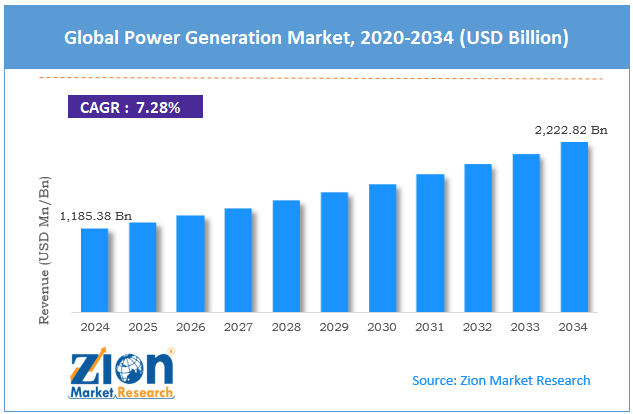
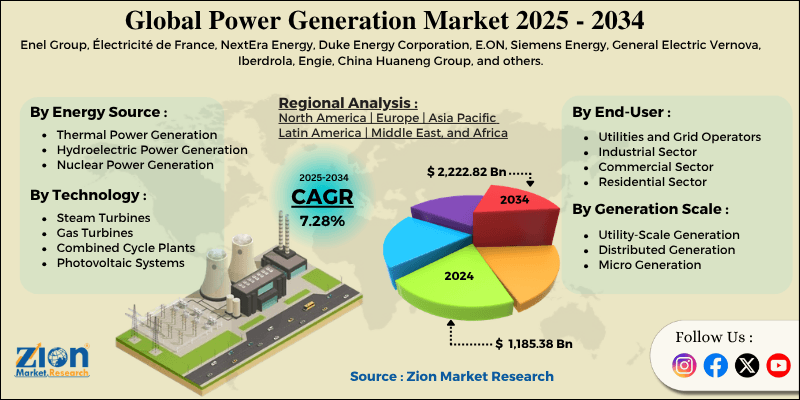
The global power generation market size was worth approximately USD 1,185.38 billion in 2024 and is projected to grow to around USD 2,222.82 billion by 2034, with a compound annual growth rate (CAGR) of roughly 7.28% between 2025 and 2034.
Power Generation Market: Overview
Power generation is the process of producing electricity from sources such as coal, natural gas, nuclear fuel, water, sunlight, wind, and biomass. This electricity is then distributed through power lines and grids to homes, offices, factories, hospitals, and schools. Almost everything we use today depends on a steady supply of electricity, making power generation one of the most important systems in modern life. Power can be generated in large plants that supply entire cities or in small systems, such as rooftop solar panels for individual homes. There are two main types: centralized generation, where electricity is made in big plants and sent over long distances, and distributed generation, where power is produced close to where it is used. Different methods are used to generate electricity, such as burning fuels to run turbines, using nuclear energy, harnessing flowing water, capturing sunlight through solar panels, and using wind turbines. Many countries are moving toward cleaner energy sources such as solar and wind to reduce pollution, lower costs, and improve future energy security.
The power generation market is growing due to rising electricity demand, rapid adoption of renewable energy, electrification of transport and industry, replacement of aging fossil-fuel plants, and strong government investment.
Key Insights
- As per the analysis shared by our research analyst, the global power generation market is estimated to grow annually at a CAGR of around 7.28% over the forecast period (2025 to 2034).
- In terms of revenue, the global power generation market size was valued at approximately USD 1,185.38 billion in 2024 and is projected to reach USD 2,222.82 billion by 2034.
- The power generation market is expected to grow due to rising global electricity demand, accelerating investment in renewable energy, government clean energy mandates, the electrification of transportation and industry, and the ongoing replacement of aging power infrastructure with modern, more efficient generation systems.
- Based on energy source, the solar power generation segment is expected to lead growth in the power generation market, while the wind power generation segment is anticipated to expand rapidly as offshore and onshore wind capacity continues to scale globally.
- Based on technology, the photovoltaic systems segment is expected to lead the power generation market in terms of new capacity additions, while combined-cycle gas turbines are anticipated to remain significant as a reliable and efficient transitional generation technology.
- Based on end user, the utilities and grid operators segment is the largest, while the industrial sector segment is growing rapidly as heavy industries invest in on-site renewable and cogeneration systems.
- Based on generation scale, the utility-scale generation segment is expected to lead the power generation market, while the distributed generation segment is anticipated to grow strongly as rooftop solar, microgrids, and community energy systems become increasingly mainstream.
- Based on region, Asia Pacific is projected to dominate the global power generation market during the estimated period, followed by North America.
Impact of the USA-Israel war on Iran on the Power Generation Market
The ongoing USA-Israel war on Iran is anticipated to influence both short-term and long-term dynamics of the power generation market. Fluctuations in oil and gas prices caused by regional instability are likely to raise electricity generation costs in the near term. In the long run, increased focus on alternative energy sources may help stabilize market growth.
Power Generation Market: Technology Roadmap 2025 to 2034
What key trends and future developments will drive the power generation market during the forecast period?
The clean energy transition is shaping the power generation market, advancing energy storage, grid digitalization, and declining renewable technology costs, and driving the urgent global need to expand electricity access while reducing carbon emissions. The market is expected to grow at a CAGR of around 7.28% over the forecast period, supported by strong, rising demand from utility companies, industrial energy users, national governments pursuing net-zero targets, and the rapidly expanding electric vehicle and data center sectors that require a massive, reliable electricity supply.
The following roadmap outlines the key development phases expected during the forecast period.
2025 to 2027: Renewable Growth Phase with Grid Integration
- Solar photovoltaic and onshore wind installations are expected to grow quickly as falling equipment costs make them the cheapest source of new electricity in many regions.
- Battery energy storage systems are likely to be deployed at scale with renewables to manage supply fluctuations and support grid stability.
- Smart inverters and grid management technologies are expected to become standard in new installations, improving grid flexibility.
2028 to 2031: Energy Storage Expansion Phase with Grid Modernization
- Long-duration energy storage technologies like flow batteries, compressed air, and green hydrogen are expected to see wider adoption to balance supply and demand without fossil fuels.
- Offshore wind development is expected to expand across major regions, with floating wind enabling projects in deeper waters with stronger winds.
- Advanced nuclear technologies such as small modular reactors are expected to see broader deployment, providing stable, low-carbon power.
2032 to 2034: Fully Decarbonized Digitally Managed Power System Phase
- Power systems are expected to use artificial intelligence to manage electricity supply and demand in real time and improve efficiency.
- Green hydrogen is expected to become a key energy storage and power source, supporting reliable low-carbon electricity generation.
- Virtual power plants are expected to become mainstream, connecting and managing many small energy systems as a single resource.
Power Generation Market: Dynamics
Growth Drivers
The rising global demand for electricity across all sectors is driving the power generation market.
The power generation market is growing strongly as global electricity demand is increasing faster than in recent decades. Population growth, rapid urbanization, and economic development in emerging countries are increasing electricity demand each year. More people are using electric devices, appliances, and digital services, which is adding to overall demand. The shift toward electric vehicles are a major growth driver, as millions of vehicles now require regular charging and a continuous power supply. At the same time, the fast expansion of data centers, artificial intelligence systems, and communication networks is creating a strong need for reliable, round-the-clock electricity.
Many developing regions across Africa, South Asia, Southeast Asia, and Latin America still lack stable access to electricity, and this unmet need is driving new investments in power generation. Industries such as steel, cement, chemicals, and aluminum are also moving toward electricity rather than fossil fuels, further increasing demand. All these factors are working together to drive steady, long-term growth in the power generation market, as countries invest in expanding capacity to meet rising energy needs.
What role does the global clean energy transition play in driving investment in the power generation market?
The power generation industry is growing rapidly due to the global shift toward clean energy, which is increasing investment in renewable power across all regions. Governments in more than 130 countries have set targets to reach net-zero emissions, making the power sector a top priority for change. These goals are supported by subsidies, tax benefits, incentives, and renewable energy contracts that encourage companies to invest in solar and wind projects. At the same time, the cost of solar panels and wind turbines has dropped significantly, making renewable energy cheaper than fossil fuel-based power in many areas. This cost advantage is attracting more investors and speeding up project development. Large companies are also demanding clean electricity to meet their sustainability goals, which is further boosting renewable adoption. All these factors are creating a strong cycle of investment, lower costs, and higher demand, driving steady, long-term growth in the power generation market.
Restraints
High capital investment requirements and limitations in grid infrastructure slow growth in the power generation market.
The power generation market, despite strong growth, faces several challenges that can slow down expansion and the shift to clean energy. Building large power plants, whether renewable or traditional, requires substantial upfront investment and lengthy construction periods. Projects such as solar farms, wind parks, hydro dams, and nuclear plants require complex approvals and can take years to complete. In many developing countries, limited access to affordable long-term funding makes it difficult to complete planned power projects on time. Another major challenge is outdated grid infrastructure, designed for older, centralized power systems and struggling to handle modern renewable energy sources. Renewable power is often spread across different locations and can be inconsistent, making grid management more difficult. Upgrading power grids requires large investments in transmission lines, substations, and advanced control systems. Approval delays for new grid infrastructure can also take many years. These financial and infrastructure limitations are slowing the growth of the power generation market in several regions.
Opportunities
What opportunities does the global push for energy security and electrification of industry create for the power generation market?
The power generation industry is creating strong growth opportunities due to rising focus on energy security and increasing electrification of industries and transport. Many countries have faced fluctuations in energy prices and supply issues, prompting governments to generate more electricity locally and reduce dependence on imported fuels. This has led to faster approvals and higher investment in solar, wind, hydropower, and nuclear energy projects. At the same time, industries like steel, cement, and chemicals are shifting from fossil fuels to electricity-based processes, which is increasing demand for power generation. Electric vehicles are also adding to electricity demand as more people switch to cleaner transport options. The rapid growth of data centers, driven by cloud computing and artificial intelligence, is creating a new group of large electricity users that require constant, reliable power. Many of these companies are signing long-term agreements with renewable energy providers, helping fund new projects. All these factors are creating major investment and expansion opportunities in the power generation market across different regions.
Challenges
How do permitting delays, supply chain constraints, and grid connection backlogs challenge the power generation market?
The power generation market faces several challenges that are slowing down the development of new projects despite strong demand. Approval processes for power plants, transmission lines, and substations are often slow and involve multiple steps, including environmental checks and land approvals. These delays increase costs and push project timelines further. Supply chain issues are another major problem, especially for renewable energy, as shortages of solar panels, wind components, transformers, and batteries cause delays and higher costs. Grid connection is also a key challenge, as many solar and wind projects are waiting for approval to connect to existing power systems. In some regions, this waiting list is very large and can take years to clear. There is also a shortage of skilled workers, like engineers and technicians, needed to build and manage these projects. These issues are making it harder for the power generation market to grow quickly and meet rising electricity demand.
Power Generation Market: Report Scope
| Report Attributes | Report Details |
|---|---|
| Report Name | Power Generation Market |
| Market Size in 2024 | USD 1,185.38 Billion |
| Market Forecast in 2034 | USD 2,222.82 Billion |
| Growth Rate | CAGR of 7.28% |
| Number of Pages | 228 |
| Key Companies Covered | Enel Group, Électricité de France, NextEra Energy, Duke Energy Corporation, E.ON, Siemens Energy, General Electric Vernova, Iberdrola, Engie, China Huaneng Group, and others. |
| Segments Covered | By Energy Source,By Technology, By End User, By Generation Scale, and By Region |
| Regions Covered | North America, Europe, Asia Pacific (APAC), Latin America, Middle East, and Africa (MEA) |
| Base Year | 2024 |
| Historical Year | 2019 - 2023 |
| Forecast Year | 2025 - 2034 |
| Customization Scope | Avail customized purchase options to meet your exact research needs. Request For Customization |
Power Generation Market: Segmentation
The global power generation market is segmented based on energy source, technology, end user, generation scale, and region.
What makes solar power generation the fastest-growing energy source segment in the power generation market?
Based on energy source, the global power generation market is divided into thermal, hydroelectric, nuclear, solar, wind, biomass, and waste-to-energy. The thermal power generation segment holds about 41% of the global market and remains dominant due to its large installed base and reliable electricity supply. The wind power generation segment holds around 18% share. It is growing rapidly, supported by increasing investments in renewable energy projects and expanding offshore wind capacity.
Why do photovoltaic systems lead the power generation market?
Based on technology, the market is segregated into steam turbines, gas turbines, combined-cycle plants, photovoltaic systems, wind turbines, and hydropower turbines. The photovoltaic systems segment accounts for around 34% of new capacity additions and leads due to falling installation costs, scalability, and strong government incentives. The combined cycle plants segment holds about 26% of the market share. It remains important for efficient, reliable power generation, offering lower emissions and better fuel efficiency than conventional thermal technologies.
What helps utilities and grid operators segment lead the power generation market?
Based on end user, the power generation market is classified into utilities and grid operators, industrial, commercial, residential, and off-grid communities. The utilities and grid operators segment holds around 54% of the global market and leads due to large-scale electricity production and ownership of transmission infrastructure. The industrial segment holds about 23% share. It is growing steadily as industries invest in captive power systems and on-site generation to ensure energy security, reduce costs, and maintain operational continuity.
Why does the utility-scale generation segment lead the generation scale segment in the power generation market?
Based on generation scale, the power generation industry is categorized into utility-scale generation, distributed generation, and micro generation. The utility-scale generation segment accounts for nearly 63% of the global market and remains dominant, driven by centralized plants that supply stable electricity through established grid systems. The distributed generation segment holds around 29% of the market share. It is growing due to increasing adoption of rooftop solar systems, localized energy production, and the need to improve efficiency while reducing transmission losses.
Power Generation Market: Regional Analysis
Why does Asia Pacific lead the global power generation market?
The power generation market is led by Asia Pacific, which accounts for about 42.7% of global demand and is expected to remain the top region in the coming years. This leadership is mainly due to the region’s large population and fast economic growth. Countries like China and India have large and growing electricity needs due to urbanization, industrial expansion, and improving living standards. China is the world's largest electricity consumer and invests heavily in all types of power generation, including coal, nuclear, solar, wind, and hydropower. India is the third-largest consumer and is rapidly expanding its renewable energy capacity to meet future demand.
Many Southeast Asian countries, such as Vietnam, Indonesia, the Philippines, Thailand, and Malaysia, are also increasing power generation to support manufacturing and development. Developed countries like Japan and South Korea are focusing on energy security and shifting toward cleaner energy sources. Australia is investing strongly in solar, wind, and battery storage projects. The region also has a strong manufacturing base for solar panels, wind turbines, and other power equipment, which supports faster growth. High infrastructure investment levels continue to boost capacity expansion. Strong government policies and incentives are encouraging rapid energy development. Rising electricity demand from industries and households is further strengthening market growth.
What supports North America's strong position in the global power generation market?
The power generation market ranks North America as the second-largest region, contributing about 22.4% of global demand and showing strong growth. This growth is driven by rising investment in clean energy, supportive government policies, and increasing electricity demand from modern sectors. The United States leads the region and is seeing rapid expansion in renewable energy, driven by strong policy support, including long-term tax benefits for solar, wind, battery storage, nuclear, and hydrogen projects. These policies have encouraged large private investments in new power generation projects. Canada is also focusing on clean electricity, using its strong hydropower base while adding more wind and solar capacity.
Mexico is expanding its power generation capacity to meet growing demand from industries and households, using a mix of natural gas and renewable energy sources. The region also benefits from advanced grid infrastructure, high electricity usage, and strong financial support for energy projects. The growing number of data centers, electric vehicles, and modern industries is further increasing electricity demand. High investment capacity allows faster project development and expansion. Strong technology adoption improves efficiency and reliability in power systems. Stable policies and clear regulations support long-term growth in the power generation market.
Recent Market Developments
- In March 2026, Xcel Energy, in partnership with Google, announced the development of a 1.6 gigawatt clean energy project in Minnesota, including a 300 MW / 30 GWh long-duration energy storage system to support growing data center power demand.
- In March 2026, Microsoft and NVIDIA launched an AI-based platform to accelerate nuclear power plant design, permitting, and construction, aiming to reduce project timelines and support rising electricity demand.
Power Generation Market: Competitive Analysis
The leading players in the global power generation market are:
- Enel Group
- Électricité de France
- NextEra Energy
- Duke Energy Corporation
- E.ON
- Siemens Energy
- General Electric Vernova
- Iberdrola
- Engie
- China Huaneng Group
The global power generation market is segmented as follows:
By Energy Source
- Thermal Power Generation
- Hydroelectric Power Generation
- Nuclear Power Generation
- Solar Power Generation
- Wind Power Generation
- Biomass and Waste-to-Energy Generation
By Technology
- Steam Turbines
- Gas Turbines
- Combined Cycle Plants
- Photovoltaic Systems
- Wind Turbines
- Hydropower Turbines
By End User
- Utilities and Grid Operators
- Industrial Sector
- Commercial Sector
- Residential Sector
- Off-Grid and Remote Communities
By Generation Scale
- Utility-Scale Generation
- Distributed Generation
- Micro Generation
By Region
- North America
- The U.S.
- Canada
- Mexico
- Europe
- France
- The UK
- Spain
- Germany
- Italy
- Rest of Europe
- Asia Pacific
- China
- Japan
- India
- Australia
- South Korea
- Rest of Asia Pacific
- The Middle East & Africa
- Saudi Arabia
- UAE
- Egypt
- Kuwait
- South Africa
- Rest of the Middle East & Africa
- Latin America
- Brazil
- Argentina
- Rest of Latin America
Table Of Content
Methodology
FrequentlyAsked Questions
Power generation is the process of producing electricity from sources such as coal, natural gas, nuclear fuel, water, sunlight, wind, and biomass. This electricity is then sent through power lines and grids to homes, offices, factories, hospitals, and schools.
The global power generation market is expected to grow due to rising electricity demand, renewable energy investment, clean energy policies, electrification, increasing data center use, and the replacement of aging fossil fuel infrastructure.
According to the study, the global power generation market size was worth around USD 1,185.38 billion in 2024 and is predicted to grow to around USD 2,222.82 billion by 2034.
The CAGR value of the power generation market is expected to be around 7.28% from 2025 to 2034.
Asia Pacific is expected to lead the global power generation market due to rising electricity demand, strong government investments, and large-scale manufacturing of energy equipment.
The major players profiled in the global power generation market include Enel Group, Électricité de France, NextEra Energy, Duke Energy Corporation, E.ON, Siemens Energy, General Electric Vernova, Iberdrola, Engie, and China Huaneng Group.
The report provides a comprehensive analysis of the power generation market, including a detailed evaluation of key growth drivers and market restraints, technology development trends, renewable energy transition dynamics, regional market performance, competitive landscape analysis, and a forward-looking outlook covering all major energy sources, technologies, end users, and generation scales across every key geography.
The power generation market is shaped by climate policies, carbon pricing, renewable targets, and fossil fuel phase-out plans. Environmental rules and green finance standards are also influencing project development and investment decisions.
The power generation market will be influenced by interest rates, fuel and material costs, global trade policies, and economic growth, all of which impact electricity demand and new capacity investments.
The power generation market includes large utilities, independent power producers, equipment manufacturers, and growing energy technology companies that support grid management, energy trading, and smart power systems.

HappyClients

