
Global Small Wind Power Market Size, Share, Trends Analysis Report 2034

Small Wind Power Market By Axis (Horizontal Axis and Vertical Axis), By Grid Type (Off-Grid and On-Grid), By Capacity (Up To 1 kW, 1 kW – 10 kW, 10 kW To 100 kW), By Application (Utility, Commercial, and Residential), and By Region - Global and Regional Industry Overview, Market Intelligence, Comprehensive Analysis, Historical Data, and Forecasts 2025 - 2034-
| Market Size in 2024 | Market Forecast in 2034 | CAGR (in %) | Base Year |
|---|---|---|---|
| USD 1.26 Billion | USD 3.87 Billion | 11.90% | 2024 |
What is Market Size of Small Wind Power Industry?
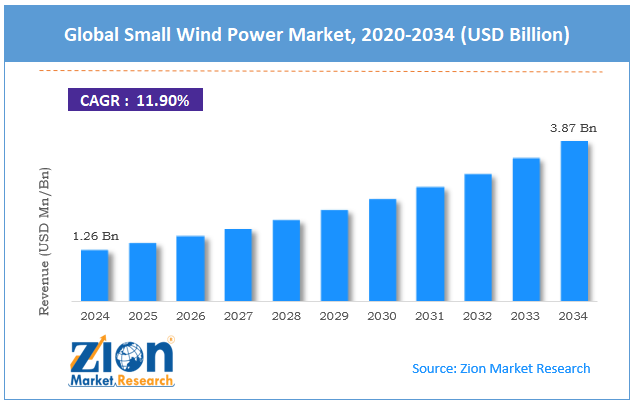
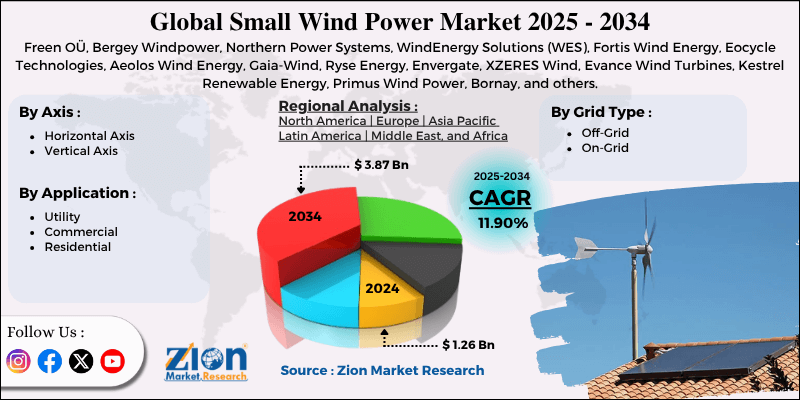
The global small wind power market size was worth around USD 1.26 billion in 2024 and is predicted to grow to around USD 3.87 billion by 2034, with a compound annual growth rate (CAGR) of roughly 11.90% between 2025 and 2034. The Small Wind Power Market is driven by rising demand for decentralized and off-grid renewable energy solutions, government incentives for small-scale clean energy, declining costs of small wind turbines, and growing awareness of energy independence in residential and commercial sectors.
Small Wind Power Market: Overview
Small wind power refers to energy generated using small-scale wind turbines. They are primarily used for generating energy sufficient for powering businesses, residential homes, and small farms. Wind power generated from small-scale turbines has also showcased off-grid applications. According to the Department of Energy (DOE), small wind electric systems are highly efficient solutions for generating home-based renewable energy. They do not emit harmful gases and act as an accelerating factor in achieving global pollution-related visions. The conventional capacity of small wind power ranges between 100 watts and 100 kilowatts (kW). As per industry research, compact turbines are considered ideal for installations in rural areas or regions with limited space availability.
Furthermore, the growing adoption of small wind power in residential homes and commercial centers worldwide will have a long-term impact on market revenue. The industry for small wind power faces competition from alternative sources of generating renewable energy, such as solar panel installations. These substitutes can impact the overall revenue generated by the market during the forecast period. Additionally, increasing innovation in terms of small wind power energy capacity may promote future growth opportunities for market players.
Key Insights:
- As per the analysis shared by our research analyst, the global small wind power market is estimated to grow annually at a CAGR of around 11.90% over the forecast period (2025-2034)
- In terms of revenue, the global small wind power market size was valued at around USD 1.26 billion in 2024 and is projected to reach USD 3.87 billion by 2034.
- The small wind power market is projected to grow at a significant rate due to the increasing support from the government, promoting the adoption of renewable energy sources.
- Based on the axis, the horizontal segment is growing at a high rate and will continue to dominate the global market as per industry projections.
- Based on the capacity segment, the 1 kW – 10 kW subsegment dominates with a substantial share & it is dominated as it suits a wide range of residential and small commercial needs, balancing affordability, performance, and ease of installation.
- Based on the application, the residential segment is anticipated to command the largest market share.
- Based on region, the Asia Pacific region dominates with the highest share & it is dominated due to rapid rural electrification needs, supportive government policies in countries like China and India, and growing investments in distributed renewable energy for remote and off-grid communities.
Small Wind Power Market: Growth Drivers
Increasing support from the government, promoting the adoption of renewable energy sources to fuel market revenue
The global small wind power market is expected to be led by the rising support from regional governments, which is promoting the adoption of renewable energy sources. Small wind power generators are highly effective in producing and distributing clean energy. Small wind turbines do not emit hazardous gases into the environment, unlike the traditionally used fuels for powering residential, commercial, or industrial spaces.
Regional governments across the globe are offering lucrative incentives to businesses and ordinary populations willing to invest in renewable energy solutions such as small wind power. One of the most common measures adopted by officials worldwide has emerged in the form of incentives directly proportional to the amount of renewable energy produced.
For instance, according to the Renewable Energy Production Incentive (REPI) program under Section 1212 of the Energy Policy Act of 1992 (EPACT) in the US, non-profit organizations owning wind facilities are eligible for an incentive of 1.5 cents per kilowatt hour. Similarly, other economies, including India, China, and European nations, have launched novel programs promoting the use of renewable energy sources for power generation.
Will rising focus on decentralizing energy production and distribution fuel higher revenue in the small wind power market?
One of the major factors propelling demand for small-scale wind power solutions is the increasing need to decentralize energy generation and distribution. Such facilities are mostly constructed close to the intended areas of use. Hence, they reduce the risk of disruptions in electricity generation and distribution.
Moreover, transmission losses that generally occur over long distances are greatly reduced in the case of decentralizing energy production sites. In addition to this, the lack of large-scale grid infrastructure in remote areas further proliferates the investments in the global small wind power market. The recent event of a blackout in Spain and Portugal, which occurred on 28th April, has further highlighted the importance of decentralized energy-generating solutions.
Small Wind Power Market: Restraints
High competition from alternative renewable energy sources impacts market revenue in the long run
The global small wind power industry is expected to be restricted due to the high competition the market faces from other sources of renewable energy. For instance, solar panels installed across residential and commercial units are more popular due to the easy availability of the technology and superior performance. The installation and maintenance of small wind power generators can be challenging and costly, further limiting the industry’s overall revenue.
Small Wind Power Market: Opportunities
How will introducing new solutions help boost the small wind power market?
The global small wind power market is expected to generate growth opportunities due to the increasing launch of new and sophisticated solutions in the market. In April 2025, Freen OÜ, a leading company specializing in the production of advanced small wind turbines, announced the launch of its horizontal-axis small wind turbine, Freen-H15.
With this move, the company has significantly expanded its product portfolio, diversifying from vertical axis models called Freen-6 and Freen-20. The company expects to fulfill the requirements of commercial businesses seeking solutions offering higher efficiency. The companies must have the capacity to install taller wind power generating units.
Increasing energy demand among commercial units to facilitate higher market revenue
Energy consumption across commercial scales is growing rapidly due to increasing investments in the construction of new facilities. However, traditional means of energy production and supply are unable to keep up with the exponentially rising end demand. In such cases, small wind power solutions are considered ideal for generating sufficient energy for business operations. Additionally, companies can ensure zero impact on the environment by leveraging the benefits of renewable energy generation.
Small Wind Power Market: Challenges
Will regulatory hurdles pose challenges to the long-term revenue growth of the small wind power market?
Regulatory and permitting hurdles, including zoning laws, noise regulations, and environmental impact assessments, vary widely by location and can delay or prevent small wind project approvals. Maintenance and service challenges in remote installations, combined with limited awareness among end-users about long-term benefits, hinder faster market penetration in certain regions.
Small Wind Power Market: Report Scope
| Report Attributes | Report Details |
|---|---|
| Report Name | Small Wind Power Market |
| Market Size in 2024 | USD 1.26 Billion |
| Market Forecast in 2034 | USD 3.87 Billion |
| Growth Rate | CAGR of 11.90% |
| Number of Pages | 216 |
| Key Companies Covered | Freen OÜ, Bergey Windpower, Northern Power Systems, WindEnergy Solutions (WES), Fortis Wind Energy, Eocycle Technologies, Aeolos Wind Energy, Gaia-Wind, Ryse Energy, Envergate, XZERES Wind, Evance Wind Turbines, Kestrel Renewable Energy, Primus Wind Power, Bornay, and others. |
| Segments Covered | By Axis, By Grid Type, By Capacity, By Application, and By Region |
| Regions Covered | North America, Europe, Asia Pacific (APAC), Latin America, the Middle East and Africa (MEA) |
| Base Year | 2024 |
| Historical Year | 2019 - 2023 |
| Forecast Year | 2025 - 2034 |
| Customization Scope | Avail customized purchase options to meet your exact research needs. Request For Customization |
Small Wind Power Market: Segmentation
The global small wind power market is segmented based on axis, grid type, capacity, application, and region.
Based on the axis, the global market segments are the horizontal axis and the vertical axis. In 2024, the highest growth was listed in the horizontal segment due to its superior cost-effectiveness and efficiency. Furthermore, horizontal small wind turbines are less expensive to maintain. In 2024, the conventional three-bladed structure of horizontal-axis solutions accounted for over 99.01% of the total revenue. The vertical axis segment is growing at a steady pace and will continue the same trend in the future.
Based on grid type, the global small wind power industry is divided into off-grid and on-grid. The on-grid segment is the most dominant with a leading share as it allows seamless integration with utility networks, net metering benefits, and easier financing, directly driving market growth through widespread adoption in grid-connected areas; the off-grid segment ranks as the second most dominant with strong potential in remote locations where it provides essential power independence without reliance on central grids.
Based on capacity, the small wind power market is divided into Up To 1 kW, 1 kW – 10 kW, and 10 kW To 100 kW. The 1 kW – 10 kW segment is the most dominant with a substantial share because it perfectly balances power output, cost, and space requirements for typical residential and small commercial users, supporting market expansion through versatile applications; the up to 1 kW segment ranks as the second most dominant for very small-scale or portable needs such as remote sensors or cabins.
Based on the application, the global market divisions are utility, commercial, and residential. In 2024, the highest revenue was generated by the residential segment. The increasing number of homeowners seeking new ways to produce and apply energy will propel segmental expansion. The commercial segment is anticipated to register a higher CAGR during the forecast period, as energy demands in major commercial centers are growing rapidly. For instance, a medium to large office building consumes an average of 15 – 25 kWh/sq ft every year.
Small Wind Power Market: Regional Analysis
What helps the Asia-Pacific region generate the highest revenue in the small wind power market?
The global small wind power market is expected to be led by Asia-Pacific during the forecast period. It is expected to deliver a CAGR of more than 14.31% during the projection duration. Market research suggests increasing expansion possibilities for developers of small wind power solutions across off-grid applications.
Rising demand for reliable power-generating technology, especially in remote parts of emerging economies such as China and India, will facilitate regional market expansion. The increasing government initiatives promoting the deployment of small wind farms may encourage more consumers to opt for the technology in the coming years.
North America is another growing region and is expected to deliver an exceptional CAGR in the coming years. According to industry analysis, during the forecast period, North America is anticipated to deliver a CAGR of over 14.79%, driven by a growing focus on generating clean energy across the US and Canada. In addition, the presence of a robust infrastructure supporting renewable energy solutions will facilitate smooth business operations in the North American market. Factors such as favorable legislation, higher consumer awareness, increasing disposable income, and easy access to technology may further promote the expansion of the North American market.
Europe demonstrates steady growth supported by environmental regulations and community-based renewable projects. Countries emphasize small-scale wind in rural and coastal areas.
Latin America shows promising development driven by off-grid needs in remote regions and improving policy frameworks.
The Middle East and Africa region exhibits emerging potential linked to rural electrification and hybrid renewable projects in areas with good wind resources.
Recent Developments
- In 2025, several manufacturers introduced advanced small wind turbines with improved low-wind-speed performance and hybrid solar integration capabilities.
- In 2025, governments in key Asian markets expanded subsidy programs for residential and community small wind installations to support rural energy access.
- In 2025, new partnerships between technology providers and local installers accelerated the deployment of smart, IoT-enabled small wind systems for remote monitoring.
Small Wind Power Market: Competitive Analysis
The global small wind power market is led by players like -
- Freen OÜ
- Bergey Windpower
- Northern Power Systems
- WindEnergy Solutions (WES)
- Fortis Wind Energy
- Eocycle Technologies
- Aeolos Wind Energy
- Gaia-Wind
- Ryse Energy
- Envergate
- XZERES Wind
- Evance Wind Turbines
- Kestrel Renewable Energy
- Primus Wind Power
- Bornay
What are the key trends in the Small Wind Power Market?
Hybrid Systems with Solar and Storage
Hybrid systems combining small wind turbines with solar panels and battery storage are gaining popularity as they provide more reliable power output and address intermittency issues for off-grid and backup applications.
Smart and IoT-Enabled Turbines
Smart and IoT-enabled turbines with remote monitoring, predictive maintenance, and performance optimization features are emerging to improve reliability, reduce downtime, and enhance user experience in distributed installations.
The global small wind power market is segmented as follows:
By Axis
- Horizontal Axis
- Vertical Axis
By Grid Type
- Off-Grid
- On-Grid
By Capacity
- Up To 1 kW
- 1 kW – 10 kW
- 10 kW To 100 kW
By Application
- Utility
- Commercial
- Residential
By Region
- North America
- The U.S.
- Canada
- Mexico
- Europe
- France
- The UK
- Spain
- Germany
- Italy
- Rest of Europe
- Asia Pacific
- China
- Japan
- India
- Australia
- South Korea
- Rest of Asia Pacific
- The Middle East & Africa
- Saudi Arabia
- UAE
- Egypt
- Kuwait
- South Africa
- Rest of the Middle East & Africa
- Latin America
- Brazil
- Argentina
- Rest of Latin America
Table Of Content
Methodology
FrequentlyAsked Questions
Small wind power involves distributed electricity generation using wind turbines rated typically below 100 kW, installed at or near the point of use for residential, commercial, or remote applications to provide clean, on-site or off-grid renewable energy.
The global small wind power market is expected to be led by the rising support from regional governments promoting the adoption of renewable energy sources.
According to study, the global small wind power market size was worth around USD 1.26 billion in 2024 and is predicted to grow to around USD 3.87 billion by 2034.
The CAGR value of the small wind power market is expected to be around 11.90% during 2025-2034.
Asia Pacific will contribute notably towards the Small Wind Power market value due to large rural populations, supportive policies, and strong demand for distributed energy solutions.
The global small wind power market is led by players like Freen OÜ, Bergey Windpower, Northern Power Systems, WindEnergy Solutions (WES), Fortis Wind Energy, Eocycle Technologies, Aeolos Wind Energy, Gaia-Wind, Ryse Energy, Envergate, XZERES Wind, Evance Wind Turbines, Kestrel Renewable Energy, Primus Wind Power, and Bornay.
Major challenges include high upfront installation costs, site-specific wind resource variability, complex permitting and regulatory processes, and limited awareness in some markets.
Emerging trends include hybrid wind-solar-storage systems, smart IoT-enabled turbines with remote monitoring, improved designs for low-wind-speed performance, and community-scale projects for rural electrification.
The value chain includes component and turbine manufacturers, system integrators and installers, project developers, distributors, and end-users in residential, commercial, and utility segments who operate and maintain the systems.
The global Small Wind Power market report provides comprehensive analysis, including market size, share, growth forecasts, detailed segmentation, regional insights, competitive landscape, key trends, drivers, restraints, opportunities, and strategic recommendations.

HappyClients

