
Polypropylene Glycol Market Size, Growth, Trends, Forecast 2034

Polypropylene Glycol Market By Application (Construction, Cosmetics, Automotive, Food Additives, Chemicals Manufacturing, Paints & Coatings, Adhesives & Sealants, Plastics, and Others), By Type (Industrial Grade and Chemical Grade), By Molecular Weight (High Molecular Weight, Medium Molecular Weight, and Low Molecular Weight), and By Region - Global and Regional Industry Overview, Market Intelligence, Comprehensive Analysis, Historical Data, and Forecasts 2026 - 2034
| Market Size in 2025 | Market Forecast in 2034 | CAGR (in %) | Base Year |
|---|---|---|---|
| USD 4.05 Billion | USD 6.29 Billion | 5.05% | 2025 |
Polypropylene Glycol Industry Perspective:
What is the anticipated size of the polypropylene glycol market during the projection period?
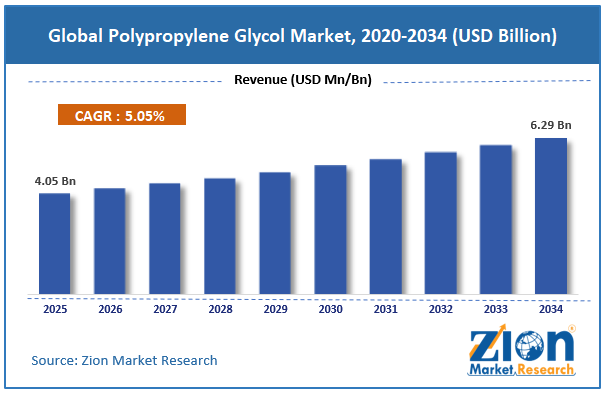
The global polypropylene glycol market size was worth around USD 4.05 billion in 2025 and is predicted to grow to around USD 6.29 billion by 2034, with a compound annual growth rate (CAGR) of roughly 5.05% between 2026 and 2034.
Key Insights:
- As per the analysis shared by our research analyst, the global polypropylene glycol market is estimated to grow annually at a CAGR of around 5.05% over the forecast period (2026-2034)
- In terms of revenue, the global polypropylene glycol market size was valued at around USD 4.05 billion in 2025 and is projected to reach USD 6.29 billion, by 2034.
- The polypropylene glycol market is projected to grow at a significant rate due to the rising applications in personal & cosmetic care solutions, plastic production, and use in paints & coatings.
- Based on the application, the construction segment is growing at a high rate and will continue to dominate the global market as per industry projections.
- Based on the type, the industrial grade segment is anticipated to command the largest market share.
- Based on the molecular weight, the low molecular weight segment is expected to lead the market growth trends.
- Based on region, Asia-Pacific is projected to dominate the global market during the forecast period.
Polypropylene Glycol Market: Overview
Polypropylene glycol is a synthetic compound with water absorption properties. It is used for producing polyester compounds. Additionally, propylene glycol is an essential ingredient in the manufacturing base for deicing solutions. According to the US Centers for Disease Control and Prevention, propylene glycol is used across food, chemical, and pharmaceutical industries as an antifreeze agent. Its water-absorbing properties allow the compound to retain moisture in certain medicines, food items, and cosmetic products. During the forecast period, demand for polypropylene glycol is expected to be driven by rising applications in personal & cosmetic care solutions, plastic production, and use in paints & coatings. However, high dependence on petrochemical feedstock, raw material price volatility, and environmental pressure may affect market revenue in the long run.
Impact of the USA-Israel and Iran war on the Polypropylene Glycol Market:
The USA-Israel and Iran war has affected prices and the supply chain of raw materials required for producing polypropylene glycol. Disruptions in crude oil and petrochemical supply chains are expected to negatively affect the polypropylene glycol market in the coming years. In the long run, the war may influence diversification, new strategic partnerships, and more robust supply chains.
Polypropylene Glycol Market: Dynamics
Growth Drivers
How will the personal care & cosmetic sector drive growth in the polypropylene glycol market during the forecast period?
The global polypropylene glycol market is expected to grow due to increasing use of the chemical compound in the personal care & cosmetic sector. Propylene glycol is considered a safe additive used as a formulation ingredient, emulsifier, and emollient in personal care & cosmetic products. Growing world population, increasing emphasis on personal grooming, a surge in disposable income, and the emergence of e-commerce & quick commerce have intensified sales in the personal care industry. According to official reports, the global personal care sector is expected to reach over USD 780 billion in revenue by the end of 2026. Additionally, a growing shift toward safer personal care solutions may further influence the use of polypropylene glycol in the coming years.
Accelerating sales of automotive to work in favor of the propylene glycol market in the coming years
Automobile vehicles use propylene glycol-based components such as coatings, adhesives, and foams. Rising demand for lightweight vehicles will propel automotive applications, subsequently fueling revenue in the global polypropylene glycol market in the coming years. Additionally, polypropylene glycol-oriented automotive coolants are promoted as solutions with low toxicity, improved handling safety, and biodegradability. The rapid proliferation of electric and hybrid vehicles and self-driving cars across passenger and commercial applications will favor market players.
Restraints
What are the leading restraints in the polypropylene glycol industry during the projection period?
The global polypropylene glycol industry is expected to be constrained by heavy dependence on petrochemical feedstock and raw material price volatility. The petrochemical supply chain has been significantly disrupted over the past decade by geopolitical tensions, trade wars, production outages, and evolving trade policies. Moreover, this has subsequently increased price sensitivity across the petrochemical sector.
Opportunities
How will bio-based solutions shape the polypropylene glycol market over the projection period?
The global polypropylene glycol market is expected to grow as companies invest in environmentally friendly, bio-based solutions. Partially renewable polypropylene glycol is gaining significant attention among chemicals & materials producers worldwide. In March 2024, Dow, a global leader in next-generation chemicals production, launched circular and bio-based propylene glycol solutions through its Ecolibrium and Renuva technologies, with applications across industries. These products use circular and bio-circular feedstocks.
Rising applications in emerging economies to promote market expansion in the coming years
Emerging economies such as Latin America, Asia-Pacific, and African countries are propelling the use of polypropylene glycol in the coming years. Emerging economies are registering rapid urbanization, industrialization, and foreign investment fueling the application of propylene glycol-based solutions. According to official reports, India is expected to scale its propylene production capacity by adding 7.28 million tonnes/year as domestic demand continues to rise.
Challenges
Competition from alternate solutions and environmental pressure to challenge the propylene glycol industry
The global propylene glycol industry is anticipated to be challenged by competition from alternative solutions such as polyester polyols and Polyethylene Glycol (PEG). Additionally, the industry faces tough regulatory and environmental pressure due to concerns over propylene glycol-related emissions, resource use, and waste production.
Polypropylene Glycol Market: Report Scope
| Report Attributes | Report Details |
|---|---|
| Report Name | Polypropylene Glycol Market |
| Market Size in 2025 | USD 4.05 Billion |
| Market Forecast in 2034 | USD 6.29 Billion |
| Growth Rate | CAGR of 5.05% |
| Number of Pages | 229 |
| Key Companies Covered | BASF SE, LyondellBasell Industries, Kumho Petrochemical, Dow Inc., DIC Corporation, Covestro AG, Jiangsu Haian Petrochemical, SKC Co. Ltd., Huntsman Corporation, Mitsui Chemicals, Sanyo Chemical Industries, PCC Rokita, INEOS Group, Zhejiang Huangma Chemical, Shell Chemicals, and others. |
| Segments Covered | By Application, By Type, By Molecular Weight, and By Region |
| Regions Covered | North America, Europe, Asia Pacific (APAC), Latin America, Middle East, and Africa (MEA) |
| Base Year | 2025 |
| Historical Year | 2020 - 2024 |
| Forecast Year | 2026 - 2034 |
| Customization Scope | Avail customized purchase options to meet your exact research needs. Request For Customization |
Polypropylene Glycol Market: Segmentation
The global polypropylene glycol market is segmented based on application, type, molecular weight, and region.
Why will the construction segment lead the polypropylene glycol industry revenue during the forecast period?
Based on application, the global market is divided into construction, cosmetics, automotive, food additives, chemical manufacturing, paints & coatings, adhesives & sealants, plastics, and others. In 2025, the construction industry accounted for around 31% of total revenue. It will continue growing at a significant CAGR during the forecast period. Rising use of polyurethane-based elastomers and sealants in the construction sector will aid segmental growth in the future.
Which will be the fastest-growing type during the forecast period in the polypropylene glycol market?
Based on type, the global polypropylene glycol industry is divided into industrial grade and chemical grade. According to official reports, the industrial grade segment led with 65.01% of total market share in 2025. It is projected to dominate the market in the coming years, driven by a surge in use in industrial coatings and sealants.
Which factors drive demand in the low molecular weight segment in the polypropylene glycol industry?
Based on molecular weight, the global market is fragmented into high molecular weight, medium molecular weight, and low molecular weight. The low molecular weight segment reported the highest growth in 2025. It accounted for 40.02% of the total revenue. Extensive applications of low molecular weight propylene glycol across major end-user industries, such as pharmaceutical and personal care, will promote segmental revenue.
Polypropylene Glycol Market: Regional Analysis
Why will Asia-Pacific lead the polypropylene glycol market in the coming years?
The global polypropylene glycol market is currently led by Asia-Pacific. In 2025, it accounted for 42% of the global revenue and will grow at a strong CAGR during the forecast period. Asia-Pacific is a leading producer of propylene glycol, with China and India leading the regional market. Moreover, rising end-user applications and scaling polyurethane production will support growth across Asia-Pacific.
How is Europe expected to perform in the polypropylene glycol market during the forecast period?
Europe is expected to emerge as a strong player in the polypropylene glycol market with a significant CAGR of 5.61% during the forecast period. In 2025, it accounted for 27% of the market revenue. Growth in Europe will be driven by leading specialty chemical producers and higher demand for bio-based polypropylene glycol. However, strict environmental pressure may affect regional market revenue in the coming years.
Polypropylene Glycol Market: Competitive Analysis
The global polypropylene glycol market is led by players like:
- BASF SE
- LyondellBasell Industries
- Kumho Petrochemical
- Dow Inc.
- DIC Corporation
- Covestro AG
- Jiangsu Haian Petrochemical
- SKC Co. Ltd.
- Huntsman Corporation
- Mitsui Chemicals
- Sanyo Chemical Industries
- PCC Rokita
- INEOS Group
- Zhejiang Huangma Chemical
- Shell Chemicals
What are the latest key trends in the polypropylene glycol market?
Demand for specialty polypropylene glycol
Evolving end-user applications will drive demand for high-performance, high-purity, specialty polypropylene glycol. Specific performance requirements will accelerate use across food, cosmetic, and pharmaceutical applications.
Building resilient supply chains
Polypropylene glycol producers and end-users are working to develop more resilient supply chains, driven by recent geopolitical tensions and disruptions. Feedstock sourcing and integration will remain prominent investment areas in the coming years.
The global polypropylene glycol market is segmented as follows:
By Application
- Construction
- Cosmetics
- Automotive
- Food Additives
- Chemicals Manufacturing
- Paints & Coatings
- Adhesive & Sealants
- Plastics
- Others
By Type
- Industrial Grade
- Chemical Grade
By Molecular Weight
- High Molecular Weight
- Medium Molecular Weight
- Low Molecular Weight
By Region
- North America
- The U.S.
- Canada
- Mexico
- Europe
- France
- The UK
- Spain
- Germany
- Italy
- Rest of Europe
- Asia Pacific
- China
- Japan
- India
- Australia
- South Korea
- Rest of Asia Pacific
- The Middle East & Africa
- Saudi Arabia
- UAE
- Egypt
- Kuwait
- South Africa
- Rest of the Middle East & Africa
- Latin America
- Brazil
- Argentina
- Rest of Latin America
Table Of Content
Methodology
FrequentlyAsked Questions
Polypropylene glycol is a synthetic compound with water absorption properties. It is used for producing polyester compounds.
The global polypropylene glycol market is expected to grow due to increasing use of the chemical compound in the personal care & cosmetic sector.
According to study, the global polypropylene glycol market size was worth around USD 4.05 billion in 2025 and is predicted to grow to around USD 6.29 billion by 2034.
The CAGR value of the polypropylene glycol market is expected to be around 5.05% during 2026-2034.
The global propylene glycol industry is anticipated to be challenged by competition from alternative solutions such as polyester polyols and Polyethylene Glycol (PEG).
Demand for specialty polypropylene glycol and building resilient supply chains are the emerging trends and innovations impacting the polypropylene glycol market.
The global polypropylene glycol market has performed well so far and will offer similar trends in the coming years.
Asia-Pacific will contribute notably towards the polypropylene glycol market value.
The global polypropylene glycol market is led by players like BASF SE, LyondellBasell Industries, Kumho Petrochemical, Dow Inc., DIC Corporation, Covestro AG, Jiangsu Haian Petrochemical, SKC Co., Ltd., Huntsman Corporation, Mitsui Chemicals, Sanyo Chemical Industries, PCC Rokita, INEOS Group, Zhejiang Huangma Chemical, and Shell Chemicals.
The report explores crucial aspects of the polypropylene glycol market, including a detailed discussion of existing growth factors and restraints while also browsing future growth opportunities and challenges that impact the market.

HappyClients

