
Packaged Juice Market Size, Share, Growth, Opportunities 2034

Packaged Juice Market By Type (Fruit-Based Packaged Juice, Vegetable-Based Packaged Juice, Mixed Fruit and Vegetable Juice, Nectar-Based Packaged Juice), By Packaging (Tetra Pack Cartons, Plastic Bottles, Glass Bottles, Aseptic Pouches), By Distribution Channel (Supermarkets and Hypermarkets, Convenience Stores, Online Grocery Platforms, Specialty Health Stores), By End User (Household Consumers, Food Service Providers, Educational Institutions, Corporate Offices), and By Region - Global and Regional Industry Overview, Market Intelligence, Comprehensive Analysis, Historical Data, and Forecasts 2026 - 2034
| Market Size in 2025 | Market Forecast in 2034 | CAGR (in %) | Base Year |
|---|---|---|---|
| USD 197.08 Billion | USD 409.2 Billion | 8.49% | 2025 |
Packaged Juice Industry Perspective:
What will be the size of the packaged juice market during the forecast period?
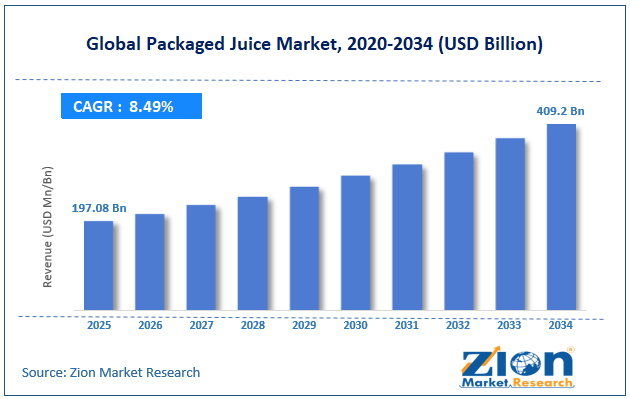
The global packaged juice market size was valued at approximately USD 197.08 billion in 2025 and is projected to reach around USD 409.2 billion by 2034, growing at a compound annual growth rate of approximately 8.49% between 2026 and 2034.
Key Insights
- As per the analysis shared by our research team, the global packaged juice market is estimated to grow at a compound annual growth rate of approximately 8.49% during the forecast period from 2026 to 2034.
- In terms of revenue, the global packaged juice market was valued at approximately USD 197.08 billion in 2025 and is projected to reach USD 409.2 billion by 2034.
- The packaged juice market is expected to grow strongly due to rising health consciousness, increasing demand for convenient nutrition, growing preference for natural ingredients, and expanding retail distribution networks.
- Based on type, fruit-based packaged juice leads the market because of its familiar taste and broad consumer appeal, while vegetable-based packaged juice is gaining strong momentum as one of the fastest-growing types among health-focused buyers.
- Based on packaging, tetra pack cartons lead the market due to their lightweight design and long shelf life. At the same time, aseptic pouches are the fastest-growing segment as brands target younger consumers seeking portable, on-the-go options.
- Based on distribution channel, supermarkets and hypermarkets lead the market due to wide product variety and frequent promotions, while online grocery platforms are steadily growing as more shoppers prefer doorstep delivery of everyday beverages.
- Based on end user, household consumers lead the market due to daily consumption habits and family purchasing patterns, while food service providers are growing rapidly as restaurants and cafés expand their cold beverage menus.
- Based on region, Asia Pacific leads the global packaged juice market. At the same time, the Middle East is the fastest-growing region due to rising disposable incomes and a growing preference for packaged over homemade beverages.
Packaged Juice Market: Overview
Packaged juice is fruit or vegetable juice that is processed, packed, and sold in bottles, cartons, cans, or pouches for convenient consumption. Processing methods such as pasteurization help packaged juice stay fresh for longer while preserving much of its taste and nutritional value. The packaged juice market includes fruit juices, vegetable juices, juice blends, nectars, and healthier beverage options. Growing urban populations, busy lifestyles, and rising interest in healthier drinks are increasing demand worldwide. Consumers choose packaged juice because it is easy to store, carry, and consume without preparation, making it useful at home, school, work, and while traveling. Growing demand for ready-to-drink beverages is also encouraging manufacturers to create smaller portions and convenient formats for busy consumers. Retailers are expanding their beverage sections to offer more juice varieties and healthier choices. Manufacturers are responding by offering low-sugar products, natural ingredients, organic options, and cleaner labels. Packaging improvements, including lightweight cartons, bottles, and resealable pouches, are also making products easier to transport and use. New flavors made from tropical and exotic fruits are helping brands attract younger consumers and expand product choices. Online grocery platforms are making packaged juice more accessible by allowing consumers to order a wider range of products from home.
The packaged juice industry continues to grow as beverage manufacturers, retailers, and health-focused brands work together to create tastier, more nutritious, and more convenient drink options worldwide.
Packaged Juice Market: Strategic Perspective
Where is the packaged juice market heading?
The packaged juice market is expected to shift toward healthier, more differentiated beverages as consumers become more selective about sugar, ingredients, and nutritional value. Organic juices, vegetable blends, functional drinks, exotic fruit combinations, and convenient single-serve formats are likely to gain attention alongside traditional fruit juices.
Where should businesses invest in the packaged juice market?
The packaged juice market presents opportunities in functional beverages, premium fruit varieties, recyclable packaging, local fruit sourcing, and direct-to-consumer distribution. Investment in efficient processing and supply chains can also help brands maintain quality while controlling costs, particularly as demand grows in emerging cities and modern retail channels.
What will reshape competition in the packaged juice market?
Success in the packaged juice market will increasingly depend on how effectively brands respond to changing health and convenience preferences. Companies that combine attractive formulations with reliable product availability, competitive pricing, sustainable packaging, and strong brand positioning are likely to stand out in an increasingly crowded beverage market.
Packaged Juice Market: Technology Roadmap 2026–2034
What is the projected development roadmap of the packaged juice market over the forecast period?
The packaged juice market is advancing through improved cold-pressing methods, more precise pasteurization control, expanded use of sustainable packaging, and growing incorporation of functional ingredients, making beverages healthier and more appealing for everyday consumers. The market is expected to grow at a compound annual growth rate of approximately 8.49% over the forecast period, driven by rising health awareness, evolving food safety standards, and ongoing refinement of juice processing technology.
The following roadmap outlines key development phases expected through 2034.
2026–2028: Healthier Formulation and Consumer Preference Shift Phase
- Lower-sugar product development: Juice brands are expected to reformulate products with less added sugar while retaining appealing taste through fruit blends and natural ingredients.
- Premium ingredient sourcing: Brands are likely to focus more on organic fruits, locally sourced produce, cold-pressed options, and recognizable ingredients to attract health-conscious buyers.
- Personalized product positioning: Manufacturers are expected to create juice ranges targeting specific consumer needs, including children's nutrition, active lifestyles, hydration, and everyday wellness.
2029–2031: Product Diversification and Distribution Expansion Phase
- Functional juice growth: Products containing vitamins, minerals, probiotics, botanical ingredients, and other functional components are expected to gain greater shelf space.
- New flavor experimentation: Brands are likely to introduce combinations using tropical fruits, vegetables, herbs, and regional ingredients to differentiate products and attract younger consumers.
- Digital retail expansion: Online grocery platforms, direct-to-consumer sales, and subscription-based beverage delivery are expected to give juice brands additional ways to reach households.
2032–2034: Sustainable and Intelligent Beverage Phase
- Next-generation packaging: Manufacturers are expected to move toward lighter, recyclable, and lower-waste packaging as sustainability becomes a stronger purchasing factor.
- Freshness-monitoring technology: Smart packaging may increasingly provide information about product freshness, storage conditions, or remaining shelf life.
- Personalized nutrition products: Packaged juice could increasingly be developed around individual dietary preferences, with products tailored to specific nutritional goals, lifestyles, and consumption patterns.
Packaged Juice Market: Dynamics
Growth Drivers
What is driving changing consumer preferences in the packaged juice market?
The packaged juice market is evolving as consumers become more selective about ingredients, sugar levels, and nutritional value. Many buyers are moving away from heavily sweetened drinks and looking for juices made with recognizable ingredients and real fruit content. This shift is encouraging brands to introduce no-added-sugar, organic, cold-pressed, and vegetable-based products. Functional juices containing ingredients linked to hydration, immunity, energy, or digestive health are also creating new product categories. Smaller pack sizes are becoming useful for school lunches, workplaces, and individual consumption, while larger formats continue to serve families. Growing interest in clean-label products is also encouraging brands to simplify ingredient lists and provide clearer nutrition information on packaging. Retailers are expanding chilled juice sections and online grocery platforms are making a wider range of products easier to compare and purchase. Manufacturers are also experimenting with tropical fruits, regional flavors, and blended formulations to attract different consumer groups. Improved packaging designs are helping maintain freshness while making products easier to carry, store, and consume throughout the day.
Premium and functional products are creating opportunities in the packaged juice market.
The packaged juice market is finding new growth areas through premium products that offer added value beyond basic refreshment. Brands are using exotic fruits, organic ingredients, vegetable blends, and functional formulations to appeal to consumers willing to pay more for perceived health benefits and higher-quality ingredients. Cold-pressed and minimally processed options are gaining attention because they are positioned as closer to fresh juice. Sustainable packaging is another area of innovation, with manufacturers exploring recyclable cartons, lighter bottles, and convenient resealable formats. Hotels, restaurants, cafés, schools, and workplaces are also increasing their use of packaged juice because it offers consistent portions and easier storage than freshly prepared alternatives.
Online grocery platforms are helping smaller and premium brands reach consumers outside traditional supermarket networks. Local fruit sourcing can also give manufacturers access to distinctive flavors while reducing dependence on imported ingredients. Single-serve juice packs are creating opportunities in travel, outdoor activities, and workplace consumption where portability matters. Subscription-based beverage delivery is also giving brands a new way to build regular purchasing habits and maintain direct relationships with consumers. Together, premium positioning, functional nutrition, packaging innovation, and wider distribution are creating fresh opportunities across the packaged juice market.
Restraints
High production costs are a key challenge limiting growth in the packaged juice market.
The packaged juice industry faces pressure from changing consumer preferences, rising input costs, and competition from fresh and alternative beverages. Fruit prices can fluctuate because of weather conditions, crop yields, transportation costs, and seasonal availability, making production costs difficult to predict. Consumers are also increasingly checking sugar levels and ingredient labels, which can challenge brands that rely heavily on sweetened formulations. Packaged juice competes with fresh juice, smoothies, flavored water, sports drinks, and other ready-to-drink products, giving consumers many alternatives. Maintaining taste and nutritional quality throughout storage can be difficult when products contain natural ingredients with limited shelf life. Packaging waste is another concern as consumers and regulators place greater emphasis on recyclable and environmentally responsible materials. In emerging markets, weak cold-chain networks can also affect chilled-product distribution. Companies can respond by improving sourcing, developing longer-lasting formulations, using sustainable packaging, controlling sugar levels, and expanding efficient distribution networks to strengthen their market position.
Opportunities
Will health-focused product innovation open new opportunities in the packaged juice market?
The packaged juice market is expanding beyond traditional orange and apple juice as consumers seek beverages that offer convenience, nutrition, and additional health benefits. Functional juices focused on hydration, energy, digestion, or immune support are creating new product categories and attracting health-conscious buyers. Premium juices made from exotic fruits, organic ingredients, cold-pressed formulations, and natural sweeteners are also helping brands target consumers willing to pay more for specialized products. Vegetable juices and fruit-vegetable blends provide another opportunity by helping consumers add more nutrients to their diets. Single-serve packs are becoming useful for schools, offices, travel, and on-the-go consumption, while larger packs continue to serve households. Hotels, restaurants, cafés, and institutional buyers are also creating demand through foodservice channels.
Online grocery platforms are helping smaller and premium brands reach customers beyond traditional supermarkets. Sustainable cartons, recyclable bottles, and improved packaging can further strengthen product appeal. Brands are also experimenting with regional fruit varieties and seasonal flavors to create products that match local tastes and stand out on retail shelves. Ready-to-drink juice shots and smaller, wellness-focused formats are creating new opportunities for consumers seeking quick, convenient nutrition.
Challenges
How are rising costs and supply challenges affecting the packaged juice market?
The packaged juice market faces challenges from changing fruit prices, seasonal supply, and growing consumer concerns about sugar content. Weather conditions, crop yields, and transportation costs can affect the availability and price of fruits and vegetables, making production costs difficult to manage. Consumers are also paying closer attention to nutrition labels and may avoid products with high sugar levels, encouraging manufacturers to reformulate traditional juices. Packaged juice competes with fresh juice, smoothies, flavored water, sports drinks, and other ready-to-drink beverages, giving consumers many alternatives. Packaging waste is another concern as shoppers and regulators increasingly expect recyclable and environmentally responsible materials. Chilled juice products may also face distribution difficulties in regions with limited cold-chain infrastructure. Imported ingredients can expose manufacturers to supply disruptions, currency changes, and higher transportation expenses. Companies can manage these pressures by sourcing local fruits, developing lower-sugar products, improving packaging sustainability, and strengthening supply networks.
Packaged Juice Market: Report Scope
| Report Attributes | Report Details |
|---|---|
| Report Name | Packaged Juice Market |
| Market Size in 2025 | USD 197.08 Billion |
| Market Forecast in 2034 | USD 409.2 Billion |
| Growth Rate | CAGR of 8.49% |
| Number of Pages | 227 |
| Key Companies Covered | PepsiCo, Coca-Cola Company, Dole Food Company, Del Monte Foods, Ocean Spray Cranberries, Parle Agro, Britvic PLC, Refresco Group, Rauch Fruchtsäfte, Suntory Beverage and Food, and others. |
| Segments Covered | By Type, By Packaging, By Distribution Channel, By End User, and By Region |
| Regions Covered | North America, Europe, Asia Pacific (APAC), Latin America, Middle East, and Africa (MEA) |
| Base Year | 2025 |
| Historical Year | 2020 - 2024 |
| Forecast Year | 2026 - 2034 |
| Customization Scope | Avail customized purchase options to meet your exact research needs. Request For Customization |
Packaged Juice Market: Segmentation
The global packaged juice market is segmented by type, packaging, distribution channel, end user, and region.
Why does fruit-based packaged juice lead the packaged juice market by type?
Based on type, the global packaged juice market is divided into fruit-based, vegetable-based, mixed fruit and vegetable, and nectar-based packaged juice. Fruit-based packaged juice holds about 45% of the market share, leading due to its familiar taste, broad consumer acceptance, and long-standing popularity across all age groups. Vegetable-based packaged juice holds around 22% market share. It is the fastest-growing segment because health-focused consumers are increasingly seeking low-sugar, nutrient-dense beverage alternatives.
How is tetra pack carton packaging maintaining its lead in the packaged juice market?
Based on packaging, the packaged juice industry is classified into tetra pack cartons, plastic bottles, glass bottles, and aseptic pouches. Tetra pack cartons account for approximately 41% of the global market share, driven by their lightweight design, long shelf life without refrigeration, and cost-effective transportation. Aseptic pouches hold around 18% market share. It is the fastest-growing due to expanding popularity among younger consumers who value portability and convenient, mess-free consumption.
Where do supermarkets and hypermarkets stand in the packaged juice market distribution landscape?
Based on distribution channel, the market is segregated into supermarkets and hypermarkets, convenience stores, online grocery platforms, and specialty health stores. Supermarkets and hypermarkets lead with about a 47% share because of their wide product selection, frequent promotional pricing, and established position as the primary shopping destination for household groceries. Online grocery platforms hold around 17% market share. They are growing steadily as more consumers embrace the convenience of scheduled beverage delivery alongside other household essentials.
Who accounts for the largest end-user share in the packaged juice market?
Based on end user, the packaged juice market is categorized into household consumers, food service providers, educational institutions, and corporate offices. Household consumers account for about 52% of the market, leading because of consistent daily consumption habits and because juice is a staple in most family grocery purchases. Food service providers hold around 21% market share. This segment is expanding quickly as restaurants, cafés, and quick-service outlets add more cold beverage options to their menus.
Packaged Juice Market: Regional Analysis
What factors are strengthening Asia Pacific’s position in the packaged juice market?
Asia Pacific leads the global packaged juice market and is expected to grow at a CAGR of around 5.6% during the forecast period. This strong position is supported by its large consumer base and rapidly changing food habits, which are creating strong demand for convenient beverages. China and India offer major opportunities because of their growing urban populations and expanding retail sectors. Consumers in cities are increasingly choosing ready-to-drink juice for breakfast, work, school, and travel instead of preparing beverages at home. Rising disposable incomes are allowing more households to purchase branded beverages regularly, while modern supermarkets and convenience stores are reaching smaller cities and towns. Increasing demand for healthier refreshments is also encouraging consumers to explore fruit blends, vegetable juices, and products with lower sugar and natural ingredients. The region also has strong fruit production, allowing manufacturers to develop products using locally available mango, pineapple, orange, apple, and other regional fruits.
Supermarkets, convenience stores, cafés, and online grocery platforms are increasing product availability beyond major cities. Younger consumers are showing greater interest in low-sugar, organic, natural, and functional juice products, encouraging brands to diversify their portfolios. Growing tourism and foodservice activity are also creating demand for packaged juice in hotels, restaurants, cafés, and travel locations. Local beverage companies are introducing flavors designed around regional preferences rather than relying only on traditional juice varieties. Growing household spending, wider retail access, strong agricultural supply, and changing consumer lifestyles are expected to help Asia Pacific retain its leading position in the global packaged juice market.
How are changing lifestyles driving growth in the Middle East packaged juice market?
The Middle East packaged juice market is expected to grow at a volume CAGR of around 5% during the forecast period. This growth is supported by rising consumer spending, expanding urban populations, and increasing demand for convenient beverages suited to busy lifestyles and the region’s hot climate. Saudi Arabia, the UAE, Qatar, and Kuwait are important markets where modern retail, hospitality, and foodservice industries are expanding. Rising disposable incomes are encouraging consumers to explore premium beverages, while growing urban populations are increasing demand for ready-to-drink products that require no preparation. Packaged juice suits hotels, restaurants, airports, cafés, offices, and family gatherings, creating demand beyond household consumption. Health-conscious consumers are also showing greater interest in natural ingredients, reduced-sugar recipes, and fruit-based alternatives to carbonated soft drinks.
Local fruit flavors and smaller single-serve packs are becoming more relevant as brands adapt products to regional tastes and on-the-go consumption. Tourism and international events are increasing demand for convenient single-serve beverages across hospitality and travel locations. Retailers are giving more shelf space to premium, imported, organic, and functional juice products, while local manufacturers are introducing flavors suited to regional preferences. Rising purchasing power and strong investment in food and beverage infrastructure are further supporting the category. These lifestyle, retail, and hospitality trends are expected to create sustained opportunities in the Middle East packaged juice market during the forecast period.
Recent Market Developments
- In June 2026, Tropicana launched its “Give Life Some Juice” campaign, expanding its focus beyond traditional orange juice to highlight its broader range of juice flavors and attract younger consumers.
Packaged Juice Market: Competitive Analysis
The leading players in the global packaged juice market are:
- PepsiCo
- Coca-Cola Company
- Dole Food Company
- Del Monte Foods
- Ocean Spray Cranberries
- Parle Agro
- Britvic PLC
- Refresco Group
- Rauch Fruchtsäfte
- Suntory Beverage and Food
The global packaged juice market is segmented as follows:
By Type
- Fruit Based Packaged Juice
- Vegetable Based Packaged Juice
- Mixed Fruit and Vegetable Juice
- Nectar Based Packaged Juice
By Packaging
- Tetra Pack Cartons
- Plastic Bottles
- Glass Bottles
- Aseptic Pouches
By Distribution Channel
- Supermarkets and Hypermarkets
- Convenience Stores
- Online Grocery Platforms
- Specialty Health Stores
By End User
- Household Consumers
- Food Service Providers
- Educational Institutions
- Corporate Offices
By Region
- North America
- The U.S.
- Canada
- Mexico
- Europe
- France
- The UK
- Spain
- Germany
- Italy
- Rest of Europe
- Asia Pacific
- China
- Japan
- India
- Australia
- South Korea
- Rest of Asia Pacific
- The Middle East & Africa
- Saudi Arabia
- UAE
- Egypt
- Kuwait
- South Africa
- Rest of the Middle East & Africa
- Latin America
- Brazil
- Argentina
- Rest of Latin America
Table Of Content
Methodology
FrequentlyAsked Questions
Packaged juice is fruit or vegetable juice that is processed, packed, and sold in bottles, cartons, cans, or pouches for convenient consumption. Processing methods such as pasteurization help packaged juice stay fresh for longer while preserving much of its taste and nutritional value.
The global packaged juice market is expected to grow due to rising health consciousness, increasing demand for convenient nutrition, growing preference for natural ingredients, and expanding retail distribution networks worldwide.
According to research, the global packaged juice market was valued at approximately USD 197.08 billion in 2025 and is projected to reach approximately USD 409.2 billion by 2034.
The compound annual growth rate of the packaged juice market is expected to be approximately 8.49% from 2026 to 2034.
Asia Pacific is expected to lead the global packaged juice market throughout the forecast period, driven by its large population, expanding middle class, and growing retail infrastructure.
The major players in the global packaged juice market include PepsiCo, Coca-Cola Company, Dole Food Company, Del Monte Foods, Ocean Spray Cranberries, Parle Agro, Britvic PLC, Refresco Group, Rauch Fruchtsäfte, and Suntory Beverage and Food.
The report examines key aspects of the packaged juice market, including research and development drivers, adoption barriers, application opportunities, competitive landscape dynamics, detailed regional market performance analysis, and a comprehensive forward-looking outlook across all major types, packaging formats, distribution channels, end-user segments, and geographic regions through 2034.
Rising incomes and higher consumer spending are supporting demand in the packaged juice market, especially for convenient and premium products. However, inflation and rising fruit, packaging, transportation, and production costs may increase prices and encourage consumers to choose more affordable options.
The packaged juice market offers opportunities in healthy beverages, local fruit sourcing, sustainable packaging, cold-chain distribution, and online retail. Partnerships between juice brands, farmers, retailers, and foodservice companies can support expansion.
Prices in the packaged juice market are rising as fruit, packaging, energy, labor, and transportation costs increase. Premium products, including organic, low-sugar, cold-pressed, and functional juices, also cost more because they use better ingredients and require specialized processing. In contrast, standard juice products remain more affordable for price-sensitive consumers.

HappyClients

