
Nonprofit CRM Software Market Size, Share, Trends, Growth and Forecast 2034

Nonprofit CRM Software Market By Deployment (Cloud-Based, On-Premises, and Hybrid), By Organization Size (Small & Medium Nonprofits and Large Nonprofits), By Application (Fundraising, Donor Management, Volunteer Management, Event Management and Others), By End-User (Charities, Foundations, Educational Institutions, Healthcare Organizations, and Others), and By Region - Global and Regional Industry Overview, Market Intelligence, Comprehensive Analysis, Historical Data, and Forecasts 2026 - 2034
| Market Size in 2025 | Market Forecast in 2034 | CAGR (in %) | Base Year |
|---|---|---|---|
| USD 1.79 Billion | USD 4.05 Billion | 9.5% | 2025 |
Nonprofit CRM Software Industry Perspective:
What will be the size of the global Nonprofit CRM Software market during the forecast period?
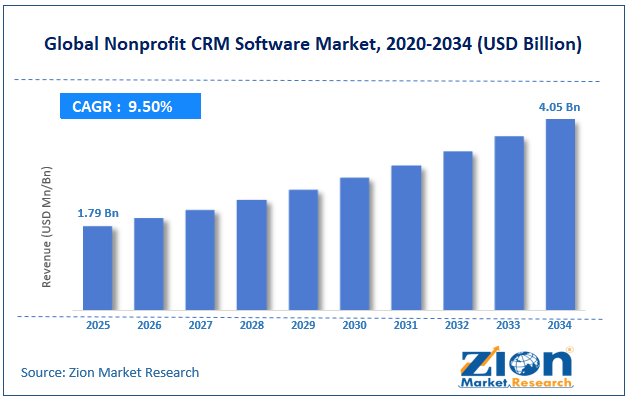
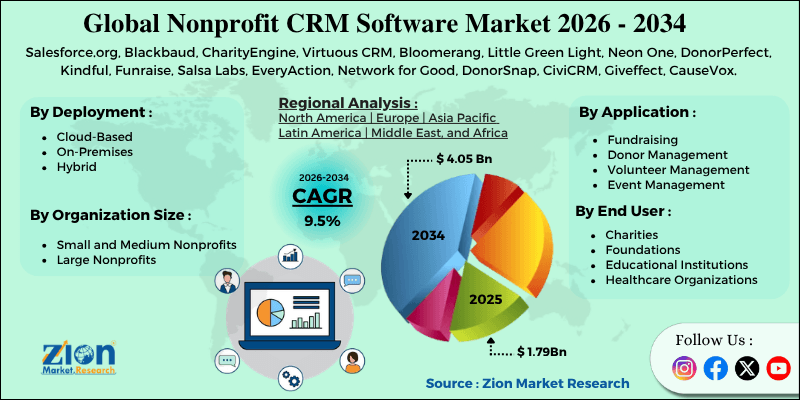
The global nonprofit CRM software market size was worth around USD 1.79 billion in 2025 and is predicted to grow to around USD 4.05 billion by 2034, with a compound annual growth rate (CAGR) of roughly 9.5% between 2026 and 2034.
Key Insights
- As per the analysis shared by our research analyst, the global nonprofit CRM software market is estimated to grow annually at a CAGR of around 9.5% over the forecast period (2026-2034).
- In terms of revenue, the global nonprofit CRM software market size was valued at around USD 1.79 billion in 2025 and is projected to reach USD 4.05 billion by 2034.
- Growing emphasis on volunteer and membership management is expected to propel the nonprofit CRM software market over the projected period.
- Based on the deployment, the cloud-based segment dominates the nonprofit CRM software market with a revenue share of 72% in 2025.
- Based on the organization size, the small and medium nonprofits segment held the largest revenue share in 2025 of 68%.
- Based on the application, the fundraising segment held a prominent share of 35% in 2025.
- Based on the end-user, the charities segment holds a prominent revenue share of 42% in 2025.
- Based on region, North America dominates the nonprofit CRM software market with a revenue share of 48% in 2025.
Nonprofit CRM Software Market: Overview
Nonprofit CRM Software is a specific type of customer relationship management (CRM) intended to help nonprofit organizations maintain relationships with donors, members, volunteers, recipients, sponsors, and other stakeholders in one centralized application. This particular solution allows nonprofit organizations to organize their donor database, track donations and grants, conduct fundraising activities, facilitate communications, organize volunteer work, measure results, and create necessary reports. By combining fundraising, donor engagement, event organization, and financial tracking into a single solution, nonprofit CRM software helps organizations improve processes, increase donor retention, improve transparency, and make informed decisions. With nonprofit organizations increasingly adopting cloud solutions, AI donor analytics, and an omnichannel approach, nonprofit CRM software becomes an integral part of effective fundraising, successful stakeholder management, and social impact maximization.
Impact of the USA-Israel War on Iran on the Nonprofit CRM Software Market
The USA-Israel rivalry with Iran has not had much direct influence on the nonprofit CRM software industry. On one hand, rising tensions have raised cybersecurity and risk assessment concerns for cloud infrastructure, increasing demand for CRM software that is reliable, secure, and cloud-based. On the other hand, humanitarian aid organizations facing crises in certain regions are increasingly adopting CRM software to organize better their donors, volunteers, beneficiaries, and fundraising activities. Therefore, although regional disturbances can impact spending on IT equipment in those regions, global demand for nonprofit CRM software is still robust due to nonprofit digitization and donor/program management needs.
Nonprofit CRM Software Market: Dynamics
Growth Drivers
How does the growing digital transformation across nonprofit organizations drive the nonprofit CRM software market?
Digital transformation is gaining traction in nonprofit organizations as they work to streamline fundraising activities, engage donors and volunteers more effectively, and deliver programs. As many charities have adopted digital strategies such as online donations, virtual fundraising, mobile apps, and social media marketing, the need for unified CRM software has become even greater. Contemporary nonprofit CRM software combines functionalities like donor databases, communication, grant management, events, and financial reporting in a single system that enables the automation of administrative processes, personalization of communication with donors, and informed decision-making based on data analysis. Cloud computing, artificial intelligence-based donor analysis, workflow automation, and omnichannel engagement further facilitate operations and minimize administrative burden. The need for increased transparency and stronger stakeholder relations in efforts to make the most of available resources contributes to the rapid growth of the nonprofit CRM software market.
Restraints
High implementation and subscription costs hamper the growth of the nonprofit CRM software industry
Implementation and subscription costs are among the biggest barriers to adopting CRM software for nonprofits. The total costs incurred during the implementation process include subscription costs, customization costs, integration costs, data migration costs, training costs, and technical support costs.
Nonprofits use funding from grants and donations, which makes it difficult for the organizations to justify high costs even though they offer a long-term advantage. In most cases, limited budgets force many organizations to opt for spreadsheets and old technology rather than advanced CRM. While the emergence of cloud-based CRM and SaaS models has decreased the initial infrastructure costs required to deploy CRM solutions, the total implementation and subscription costs continue to limit market growth.
Opportunities
Why does the increasing adoption of cloud-based CRM solutions offer a lucrative opportunity for the nonprofit CRM software market?
The rising popularity of cloud-based CRM software is creating ample potential for the Nonprofit CRM Software market to grow by increasing the accessibility and affordability of donor and operations management solutions among nonprofits of all scales. In cloud-based CRM solutions, there is no requirement for on-site infrastructure, allowing quick and affordable deployment without heavy capital outlay, with subscription-based pricing instead. The cloud-based platform allows instant access to donors, volunteers, and program information from anywhere, facilitating collaborative work from home and multiple locations.
Furthermore, such cloud-based platforms automatically update software and ensure enhanced data security while offering integrated payments and fundraising, email marketing, accounting, and grants management. The cloud-based solution also offers artificial intelligence-based analytics for donor segmentation and campaign optimization. With digital fundraising, remote working, and reliance on data becoming key priorities for nonprofits today, the shift toward cloud-based solutions will create numerous possibilities for expanding software vendors' clientele and generating revenue through subscription-based models.
Challenges
How does the limited technical expertise and IT resources pose a significant challenge to the growth of the nonprofit CRM software industry?
Limited technical expertise and insufficient IT capacity continue to impede the use of nonprofit CRM software, especially among small and mid-sized nonprofit organizations. These organizations generally have lean staff and minimal budgets for technological investment, which makes it challenging to hire and retain competent IT staff who can install, customize, integrate, and maintain CRM software systems. Government data provides evidence of skills gap challenges in the wider digital sphere; the 2025 Digital Government Index conducted by the OECD showed that 72% of OECD countries have conducted skills gap analysis, but many are still facing difficulties in recruiting and retaining digital skills. Moreover, only 17% of OECD countries have a public-sector digital skills strategy, which indicates a continued issue of skills shortage in the workforce. Furthermore, it is estimated that 10% of the U.S. workforce is employed in the nonprofit sector, indicating that the digital skills gap in this vast workforce is a challenge to technology modernization.
Nonprofit CRM Software Market: Report Scope
| Report Attributes | Report Details |
|---|---|
| Report Name | Nonprofit CRM Software Market |
| Market Size in 2025 | USD 1.79 Billion |
| Market Forecast in 2034 | USD 4.05 Billion |
| Growth Rate | CAGR of 9.5% |
| Number of Pages | 227 |
| Key Companies Covered | Salesforce.org, Blackbaud, CharityEngine, Virtuous CRM, Bloomerang, Little Green Light, Neon One, DonorPerfect, Kindful, Funraise, Salsa Labs, EveryAction, Network for Good, DonorSnap, CiviCRM, Giveffect, CauseVox, Wild Apricot, Keela, Sumac, and others. |
| Segments Covered | By Deployment, By Organization Size, By Application, By End User, and By Region |
| Regions Covered | North America, Europe, Asia Pacific (APAC), Latin America, Middle East, and Africa (MEA) |
| Base Year | 2025 |
| Historical Year | 2020 - 2024 |
| Forecast Year | 2026 - 2034 |
| Customization Scope | Avail customized purchase options to meet your exact research needs. Request For Customization |
Nonprofit CRM Software Market: Segmentation
Deployment Insights
Why does the cloud-based segment hold a prominent position in the nonprofit CRM software market?
The cloud-based segment dominates the nonprofit CRM software market with a revenue share of 72% in 2025. The reasons for such growth include growing demand for efficient, affordable, and remotely accessible solutions for non-profit organizations. Cloud-based CRM systems do not require costly local infrastructure and initial investments, as the cost of such services is based on subscription fees. This is especially important for small and medium-sized non-profits with tight budgets. Using cloud-based CRM systems allows for remote access to information related to donors, volunteers, fundraising campaigns, and program management.
Organization Size Insights
Does the small and medium nonprofits segment capture the largest share in the nonprofit CRM software market?
The small and medium nonprofits segment held the largest revenue share of the nonprofit CRM software industry in 2025, at 68%. Growth is driven by the increasing digitalization of operations at nonprofit organizations and low-cost cloud-based CRM options. The growing need for small organizations to manage donors and fundraisers more efficiently, with tighter budgets and fewer staff, is driving increased adoption of subscription-based CRM systems. Modern CRMs allow for automatic donor communication, online donation management, event planning, and reporting features that help SMNs reduce administrative costs and improve stakeholder relations.
Application Insights
How does the fundraising segment capture the largest share in the nonprofit CRM software market?
The fundraising segment held a prominent share of the nonprofit CRM software market of 35% in 2025. Growth trends are driven by the surge in digital fundraising approaches and the rising need to manage donor interactions. In this regard, nonprofit organizations are turning to customer relation management (CRM) software to optimize constituent acquisition, automate fundraising operations, personalize communication with donors, and retain relationships by analyzing valuable information. Moreover, the trend toward online fundraising, peer-to-peer fundraising, crowdfunding, recurring donations, and social media-enabled campaigns contributes to the growing need for CRMs that offer an end-to-end solution to manage diverse fundraising platforms.
End-User Insights
Why does the charities segment capture the largest share in the nonprofit CRM software market?
The charities segment holds a prominent revenue share of the nonprofit CRM software industry of 42% in 2025. The market for CRM software in charitable organizations is growing due to the need to strengthen relationships with donors, optimize fundraising, and increase organizational productivity. Charitable organizations use CRM software to manage donor databases, receive recurring donations, organize fundraising, track grants, communicate with donors and volunteers, and build relationships with stakeholders. Moreover, the tendency to donate online, make mobile donations, develop peer-to-peer fundraising, and run social media campaigns has also grown.
Regional Insights
What factors drive the North America region in the nonprofit CRM software market?
North America dominates the nonprofit CRM software market with a revenue share of 48% in 2025. The presence of a large non-profit sector, a high degree of digitization, and the increasing use of cloud-based technologies are the key factors driving regional demand. Non-profit corporations in the United States and Canada are upgrading their customer relations platforms and turning to CRM more frequently than before. In addition, the regions offer deep market knowledge of SaaS-based solutions, a wide range of products utilizing artificial intelligence, and a growing trend towards online donations and omnichannel engagement.
Governmental statistics help illustrate the scope of the market growth opportunities. According to the Bureau of Labor Statistics of the USA, Non-Profit Organizations registered under the 501(c)(3) tax status employed approximately 12.8 million people, or 9.9% of the total number of people working in the country’s private sector in 2022 (BLS, 2023). At the same time, non-profit entities comprise about 10% of the workforce in the United States, according to the US Census Bureau. Thus, North America can be considered a region with a significant presence of social organizations that now seek to optimize their fundraising processes through digital means. As the companies evolve to embrace emerging technologies and approaches to donor management, North America will contribute strongly to the growth of the Nonprofit CRM Software market revenue.
Nonprofit CRM Software Market: Competitive Analysis
The global Nonprofit CRM Software market is dominated by players like:
- Salesforce.org
- Blackbaud
- CharityEngine
- Virtuous CRM
- Bloomerang
- Little Green Light
- Neon One
- DonorPerfect
- Kindful
- Funraise
- Salsa Labs
- EveryAction
- Network for Good
- DonorSnap
- CiviCRM
- Giveffect
- CauseVox
- Wild Apricot
- Keela
- Sumac
The global Nonprofit CRM Software market is segmented as follows:
By Deployment
- Cloud-Based
- On-Premises
- Hybrid
By Organization Size
- Small and Medium Nonprofits
- Large Nonprofits
By Application
- Fundraising
- Donor Management
- Volunteer Management
- Event Management
- Others
By End User
- Charities
- Foundations
- Educational Institutions
- Healthcare Organizations
- Others
By Region
- North America
- The U.S.
- Canada
- Mexico
- Europe
- France
- The UK
- Spain
- Germany
- Italy
- Rest of Europe
- Asia Pacific
- China
- Japan
- India
- Australia
- South Korea
- Rest of Asia Pacific
- The Middle East & Africa
- Saudi Arabia
- UAE
- Egypt
- Kuwait
- South Africa
- Rest of the Middle East & Africa
- Latin America
- Brazil
- Argentina
- Rest of Latin America
Table Of Content
Methodology
FrequentlyAsked Questions
Nonprofit CRM Software is a specific type of customer relationship management (CRM) intended to help nonprofit organizations maintain relationships with donors, members, volunteers, recipients, sponsors, and other stakeholders in one centralized application.
The nonprofit CRM software market is primarily driven by the increasing digital transformation of nonprofit organizations, growing demand for data-driven donor engagement, and the rapid adoption of cloud-based CRM solutions. Rising online fundraising activities, recurring donation programs, and omnichannel communication strategies are encouraging nonprofits to invest in centralized platforms that streamline donor management, volunteer coordination, grant tracking, and campaign automation.
The nonprofit CRM software market faces several challenges, including high implementation and subscription costs, which can be difficult for small and medium-sized nonprofit organizations with limited budgets. Limited technical expertise and IT resources often hinder successful deployment, customization, and ongoing system management.
Based on the application, the fundraising segment is expected to dominate the nonprofit CRM software market growth during the projected period.
Emerging trends in the nonprofit CRM software market include the integration of artificial intelligence (AI) and machine learning for predictive donor analytics, automated donor segmentation, personalized fundraising campaigns, and intelligent engagement recommendations. The growing adoption of cloud-based and SaaS CRM platforms is improving scalability, remote accessibility, and cost efficiency for nonprofit organizations. Vendors are also incorporating low-code/no-code customization, workflow automation, and omnichannel communication capabilities to streamline operations.
According to the report, the global nonprofit CRM software market size was worth around USD 1.79 billion in 2025 and is predicted to grow to around USD 4.05 billion by 2034.
The global nonprofit CRM software market is expected to grow at a CAGR of 9.5% during the forecast period.
The global nonprofit CRM software industry growth is expected to be led by North America over the forecast period.
The global nonprofit CRM software market is dominated by players like Salesforce.org, Blackbaud, CharityEngine, Virtuous CRM, Bloomerang, Little Green Light, Neon One, DonorPerfect, Kindful, Funraise, Salsa Labs, EveryAction, Network for Good, DonorSnap, CiviCRM, Giveffect, CauseVox, Wild Apricot, Keela, and Sumac, among others.
The nonprofit CRM software market report covers the geographical market along with a comprehensive competitive landscape analysis. It also includes cash flow analysis, profit ratio analysis, market basket analysis, market attractiveness analysis, sentiment analysis, PESTLE analysis, trend analysis, SWOT analysis, trade area analysis, demand & supply analysis, Porter’s five forces analysis, and value chain analysis.

HappyClients

