
Naphthenic Base Oil Market Size, Share, Trends, Growth and Forecast 2034

Naphthenic Base Oil Market By Product Type (Hydrotreated Naphthenic Oil, Solvent-Refined Naphthenic Oil, and Re-Refined Naphthenic Oil), By Application (Lubricants and Greases, Transformer and Electrical Oils, Rubber Processing Oils, Metalworking Fluids, and Process Oils), By End-User (Automotive Industry, Electrical Equipment Manufacturers, Rubber and Polymer Producers, and Industrial Machinery Sector), By Distribution Channel (Direct Industrial Sales, Specialty Chemical Distributors, Online Industrial Platforms, and Trading Companies), and By Region - Global and Regional Industry Overview, Market Intelligence, Comprehensive Analysis, Historical Data, and Forecasts 2025 - 2034
| Market Size in 2024 | Market Forecast in 2034 | CAGR (in %) | Base Year |
|---|---|---|---|
| USD 2.48 Billion | USD 3.52 Billion | 3.96% | 2024 |
Naphthenic Base Oil Industry Perspective:
What will be the size of the naphthenic base oil market during the forecast period?
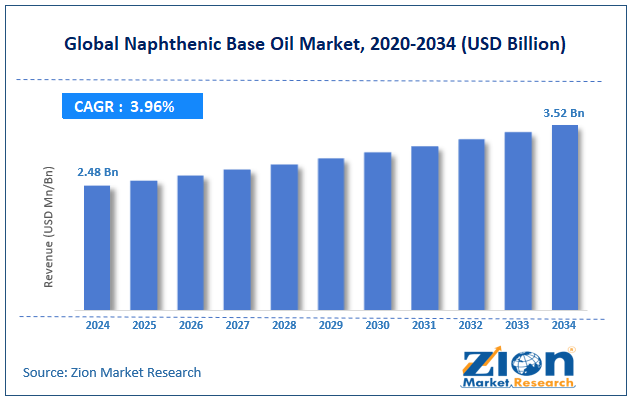
The global naphthenic base oil market size was worth approximately USD 2.48 billion in 2024 and is projected to grow to around USD 3.52 billion by 2034, with a compound annual growth rate of roughly 3.96% between 2025 and 2034.
Naphthenic Base Oil Market: Overview
Naphthenic base oil is a mineral oil derived from crude sources rich in naphthenic hydrocarbons, valued for flexibility, stability, and strong dissolving ability. It performs well at low temperatures and remains fluid in cold environments, making it suitable for demanding industrial applications. High solvency allows effective blending with additives, rubber, and chemicals without affecting performance. Industries such as automotive, electrical, and metalworking rely on it for consistent results. Production involves refining naphthenic crude using solvent processing or hydrotreating to reduce impurities and improve safety. Hydrotreated variants offer better stability, lower levels of harmful contaminants, and longer service life. Electrical equipment uses it for cooling and insulation due to its strong resistance to heat and electrical stress. Rubber manufacturing benefits from its ability to improve flexibility, durability, and uniform mixing in products like tires, seals, and hoses.
Growing demand for a reliable power supply and industrial expansion continue to support market growth. The increasing focus on high-performance, environmentally safer oils is further driving adoption across industries. The naphthenic base oil market is driven by rising focus on performance, safety, and stricter environmental standards, as well as increasing demand for hydrotreated grades. Meanwhile, expanding industrial activity and complex lubricant needs continue to strengthen its role in the global lubricant and specialty chemical supply chain.
Key Insights
- As per the analysis shared by our research analysts, the global naphthenic base oil market is estimated to grow annually at a compound annual growth rate of around 3.96% over the forecast period from 2025 to 2034.
- In terms of revenue, the global naphthenic base oil market size was valued at approximately USD 2.48 billion in 2024 and is projected to reach USD 3.52 billion by 2034.
- The naphthenic base oil market is expected to grow steadily, supported by expanding global electrical infrastructure, rising demand for high-performance rubber and lubricant products, increasing industrial activity in developing economies, and the growing preference for hydrotreated naphthenic grades that meet environmental and safety standards.
- Based on product type, the hydrotreated naphthenic oil segment is expected to lead the overall market, while the re-refined naphthenic oil segment is anticipated to grow at a notably fast pace.
- Based on application, the transformer and electrical oils segment is expected to lead the naphthenic base oil market, while the rubber processing oils segment is anticipated to grow steadily.
- Based on end-user, the electrical equipment manufacturers segment is the largest current end-user group, while the rubber and polymer producers segment is anticipated to grow most rapidly during the forecast period as demand for specialty rubber products increases.
- Based on distribution channel, the specialty chemical distributors segment is expected to lead the naphthenic base oil market, while online industrial platforms are anticipated to grow significantly.
- Based on region, Asia Pacific is projected to dominate the global naphthenic base oil market during the estimated period, followed by Europe and North America.
Impact of the USA-Israel War on Iran on the Naphthenic Base Oil Market
The ongoing tensions involving the United States, Israel, and Iran are expected to influence the naphthenic base oil market while encouraging stronger supply chain resilience and strategic planning across regions. Iran’s role as a key supplier of naphthenic crude may create short-term supply constraints and pricing pressure, but it also opens opportunities for alternative sourcing regions to expand and stabilize global supply. Potential disruptions in the Strait of Hormuz may affect logistics and costs, though industry participants are likely to respond with diversified sourcing, improved inventory management, and long-term strategies that support steady market growth and reliability.
Naphthenic Base Oil Market: Technology Roadmap 2025–2034
What is the projected development roadmap of the naphthenic base oil market over the forecast period?
The naphthenic base oil market is improving with better refining methods that make oils cleaner and safer, smart monitoring systems that maintain consistent quality, new eco-friendly and recycled oil options, and more energy-efficient production processes. The market is expected to grow at a compound annual growth rate of around 3.96% over the forecast period, driven by consistent demand from electrical, rubber, and industrial lubricant sectors.
The following roadmap outlines key development phases expected through 2034.
2025–2027: Advanced Refining and Quality Improvement
- Naphthenic base oil producers are likely to adopt improved refining methods that produce cleaner oils with lower levels of harmful impurities while maintaining strong performance.
- Digital monitoring tools and smart sensors are expected to help track oil quality in real time, ensuring consistent viscosity, color, and purity standards.
- Manufacturers are likely to introduce customized oil grades designed for specific uses such as transformers, rubber products, and metalworking fluids.
2028–2031: Sustainable Sourcing and Alternative Feedstock
- Companies are expected to explore new crude oil sources in regions like Latin America and North Africa to reduce supply risks.
- Recycling of used naphthenic oils is likely to grow as waste collection systems improve and the focus on environmentally friendly practices rises.
- New systems to track carbon emissions and certify low-impact production are expected to help industries choose more sustainable oil options.
2032–2034: Next-Generation Performance and Bio-Based Integration
- New additive technologies are expected to improve oil strength, heat resistance, and lifespan in demanding electrical and industrial applications.
- Bio-based naphthenic oil blends made from plant sources and mineral oils are likely to support sustainability without reducing performance.
- Artificial intelligence tools are projected to help companies design better oil formulas faster while improving accuracy for specialized industrial needs.
Naphthenic Base Oil Market: Dynamics
Growth Drivers
What is driving growth in the naphthenic base oil market amid rising industrial and energy infrastructure development?
The naphthenic base oil market is growing steadily due to rising demand from power and industrial sectors worldwide. The expansion of electricity networks, renewable energy projects, and rural electrification is increasing demand for transformers, which rely on naphthenic oil for effective cooling and insulation. Strong dielectric performance and reliable operation in low temperatures make it a preferred choice for electrical applications. Replacement of aging transformer fleets and continuous upgrades in grid infrastructure are further supporting long-term demand. Growth in the automotive and rubber industries is also driving market expansion.
Naphthenic oils play a key role in rubber processing by improving flexibility, durability, and manufacturing efficiency. Increasing vehicle production, especially in emerging economies, is boosting demand for tires and industrial rubber components. Rapid industrialization, infrastructure development, and rising consumption of lubricants and specialty oils are strengthening market growth, ensuring steady demand for naphthenic base oil across multiple end-use industries.
Industrial lubricants and metalworking are driving growth in the naphthenic base oil market.
The naphthenic base oil industry is expanding due to strong demand from lubricants, greases, and industrial fluid applications across multiple sectors. Naphthenic oils are widely used in specialty lubricants because they stay fluid in low temperatures, mix well with additives, and work smoothly with seals and machine parts. Industries operating in cold environments, such as mining, forestry, construction, and cold storage, depend on these oils for reliable machine performance and reduced wear. Metalworking industries also play a key role in market growth, as naphthenic oils are essential components of cutting fluids and cooling oils used in machining processes. These fluids help reduce heat, lower friction, and extend equipment life during precision operations.
Growing manufacturing activities, especially in automotive and aerospace production, are increasing the need for efficient metalworking solutions. Expanding industrial use across sectors continues to support steady demand and long-term growth for the naphthenic base oil market. Rising demand for high-performance, durable industrial oils is further strengthening market adoption across both developed and developing economies. The increased focus on equipment efficiency and longer service life is encouraging the wider use of naphthenic base oils in advanced industrial applications.
Restraints
How do limited crude availability and rising synthetic alternatives challenge the naphthenic base oil market?
The naphthenic base oil market faces growth challenges due to the limited availability of suitable crude oil sources, which are concentrated in only a few regions worldwide. Such supply concentration can create shortages, increase raw material costs, and disrupt consistent production for refiners operating outside these regions. Competition from synthetic lubricants is another key restraint, as synthetic oils often offer better stability and longer service life in high-performance applications. Many industries are gradually shifting toward these alternatives to reduce maintenance and improve efficiency, limiting demand in certain segments.
Strict environmental regulations, especially in Europe, are also affecting the market by restricting the use of oils with higher aromatic content. Manufacturers are required to invest in cleaner refining processes and reformulated products, which can increase operational costs and create challenges for smaller companies in the naphthenic base oil market.
Opportunities
Electrical grid expansion, circular economy trends, and emerging markets are creating new opportunities in the naphthenic base oil market.
The naphthenic base oil market is set to gain from several strong long-term opportunities driven by global development and sustainability trends. The expansion of power grid infrastructure across Asia, Africa, and Latin America is increasing demand for transformers, for which naphthenic oil is widely used for cooling and insulation. Large-scale electrification projects are creating steady demand for high-quality transformer oils. The growth of the circular economy is also opening new avenues, as re-refining used oils is becoming more practical and cost-effective, helping companies reduce waste, lower costs, and meet environmental goals.
Rising industrialization and increasing vehicle ownership in emerging regions such as India and Southeast Asia are boosting demand for rubber products, lubricants, and industrial oils. Improvements in local refining capacity are making these oils more accessible and affordable, encouraging wider adoption across industries. Expanding applications and a stronger focus on sustainability are expected to support the continuous growth of the naphthenic base oil industry.
Challenges
What challenges does the naphthenic base oil market face from feedstock risks and environmental regulations?
The naphthenic base oil market faces several ongoing challenges, including supply, regulatory, and pricing stability. Limited availability of naphthenic crude in a few regions creates supply risks and can quickly raise production costs in the event of disruptions. Companies must manage sourcing carefully through long-term contracts and better inventory planning. Strict environmental and health regulations are also becoming more demanding, requiring producers to invest in cleaner refining methods and continuous product testing to meet global standards. Smaller manufacturers often struggle with these added costs and compliance requirements.
Price fluctuations remain another concern, as costs are influenced by crude supply, demand changes, and currency shifts, making budgeting difficult for buyers. Managing these uncertainties while maintaining consistent supply and quality remains a key challenge for participants in the naphthenic base oil market.
Naphthenic Base Oil Market: Report Scope
| Report Attributes | Report Details |
|---|---|
| Report Name | Naphthenic Base Oil Market |
| Market Size in 2024 | USD 2.48 Billion |
| Market Forecast in 2034 | USD 3.52 Billion |
| Growth Rate | CAGR of 3.96% |
| Number of Pages | 226 |
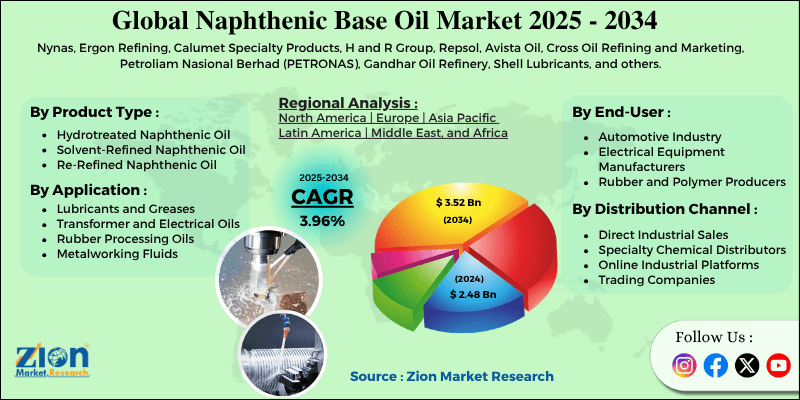
| Key Companies Covered | Nynas, Ergon Refining, Calumet Specialty Products, H and R Group, Repsol, Avista Oil, Cross Oil Refining and Marketing, Petroliam Nasional Berhad (PETRONAS), Gandhar Oil Refinery, Shell Lubricants, and others. |
| Segments Covered | By Product Type, By Application, By End-User, By Distribution Channel, and By Region |
| Regions Covered | North America, Europe, Asia Pacific (APAC), Latin America, Middle East, and Africa (MEA) |
| Base Year | 2024 |
| Historical Year | 2019 - 2023 |
| Forecast Year | 2025 - 2034 |
| Customization Scope | Avail customized purchase options to meet your exact research needs. Request For Customization |
Naphthenic Base Oil Market: Segmentation
The global naphthenic base oil market is segmented by product type, application, end-user, distribution channel, and region.
What makes the hydrotreated naphthenic oil segment the expected leader in the broader naphthenic base oil market?
Based on product type, the global market is divided into hydrotreated naphthenic oil, solvent-refined naphthenic oil, and re-refined naphthenic oil. The hydrotreated naphthenic oil segment accounts for approximately 58% of the global naphthenic base oil market and remains dominant because hydrotreating significantly reduces levels of harmful compounds while preserving the natural performance properties that make naphthenic oil valuable. The re-refined naphthenic oil segment holds around 9% market share. It is the fastest-growing category, driven by rising sustainability requirements and improved collection infrastructure for used industrial oils.
How does the transformer and electrical oils application segment maintain its leading position in the naphthenic base oil market?
Based on application, the naphthenic base oil industry is categorized into lubricants and greases, transformer and electrical oils, rubber processing oils, metalworking fluids, and process oils. The transformer and electrical oils segment accounts for approximately 35% of the global naphthenic base oil market share, driven by investments in electrical infrastructure, grid modernization, and the deployment of high-voltage transmission and distribution equipment. The rubber processing oils segment holds around 28% of the market share. It is growing steadily as global tire manufacturing output expands and automotive production increases across Asian and emerging markets.
What makes the electrical equipment manufacturers segment lead the naphthenic base oil end-user market?
Based on end-user, the market is classified into the automotive industry, electrical equipment manufacturers, rubber and polymer producers, and the industrial machinery sector. The electrical equipment manufacturers segment leads the market with around 38% share, driven by strong reliance on naphthenic base oil for transformers and switchgear applications. The rubber and polymer producers segment holds around 27% share. It is growing steadily as rising tire and rubber production increases oil demand across Asia and other regions.
How do specialty chemical distributors dominate the distribution landscape of the naphthenic base oil market?
Based on distribution channel, the naphthenic base oil market is segregated into direct industrial sales, specialty chemical distributors, online industrial platforms, and trading companies. The specialty chemical distributors segment holds about 42% share and remains dominant, as industrial buyers depend on distributors for reliable supply, support, and product variety. The online industrial platforms segment holds around 7% of the market share. It is growing steadily as digital procurement expands, helping smaller buyers and lubricant blenders access better pricing and faster sourcing.
Naphthenic Base Oil Market: Regional Analysis
What makes Asia Pacific the fastest-growing region in the naphthenic base oil market?
The naphthenic base oil market is led by Asia Pacific and is expected to grow significantly at a CAGR of around 5.1% during the forecast period, driven by strong industrial and infrastructure development across the region. High investments in electricity networks, including grid expansion and renewable energy integration, are increasing demand for transformer oils, where naphthenic base oil plays a key role in cooling and insulation. Asia Pacific also dominates global rubber and tire manufacturing, creating large-scale demand for process oils used in production. Rapid industrial growth across sectors such as automotive, construction, and heavy machinery is further supporting market expansion.
China remains the largest market in the region due to its strong electrical sector, large-scale rubber and tire production, and extensive industrial base. Continuous government investments in power infrastructure and clean energy projects are supporting steady demand for transformer oils. India is another important market, with growing electricity access, rising vehicle production, and increasing industrial output driving consumption. Efforts to build local refining capacity are also improving supply availability. Southeast Asian countries such as Indonesia, Vietnam, Thailand, and Malaysia are experiencing rapid growth driven by expanding manufacturing, infrastructure development, and rising automotive production, making the region a key growth hub.
Rising urbanization, increasing energy consumption, and supportive government policies across emerging economies are further accelerating demand for reliable industrial oils. Growing foreign investments and expanding local manufacturing capabilities are also strengthening regional supply chains and boosting overall market growth potential.
How do regulations and innovation shape Europe’s naphthenic base oil market?
Europe is the second-largest region in the naphthenic base oil market, growing steadily at a CAGR of around 2.8%, driven by strong industrial demand and the adoption of advanced technologies. Europe has a well-established market for naphthenic oils, especially in transformer oils and specialty lubricants used in industrial and electrical applications. Strict environmental regulations across the region have encouraged the use of cleaner, more refined oil grades, making European buyers more focused on quality, safety, and performance. Countries such as Sweden, the United Kingdom, and Germany play a key role in production, with strong refining and blending capabilities supporting regional supply. Ongoing upgrades of aging power infrastructure and rising investment in renewable energy projects, including offshore wind, are increasing the need for transformer oils. Industrial economies such as Germany and France are major consumers due to their large machinery, automotive, and manufacturing sectors.
Europe is also leading in sustainable practices, with growing interest in recycled and bio-based naphthenic oils. Focusing on reducing environmental impact and improving efficiency encourages innovation, making the region an important center for advanced, eco-friendly naphthenic base oil solutions. Across Europe, the growing focus on circular-economy practices and stricter emission targets is driving the adoption of sustainable oil solutions. The region’s strong research and development ecosystem and advanced refining technologies are further improving product quality and supporting long-term market growth.
Recent Market Developments
- In April 2026, Ergon announced a price increase for its naphthenic base oils across North America, reflecting rising feedstock costs and strong demand in transformer oil and process oil applications.
Naphthenic Base Oil Market: Competitive Analysis
The leading players in the global naphthenic base oil market are;
- Nynas
- Ergon Refining
- Calumet Specialty Products
- H and R Group
- Repsol
- Avista Oil
- Cross Oil Refining and Marketing
- Petroliam Nasional Berhad (PETRONAS)
- Gandhar Oil Refinery
- Shell Lubricants
The global naphthenic base oil market is segmented as follows:
By Product Type
- Hydrotreated Naphthenic Oil
- Solvent-Refined Naphthenic Oil
- Re-Refined Naphthenic Oil
By Application
- Lubricants and Greases
- Transformer and Electrical Oils
- Rubber Processing Oils
- Metalworking Fluids
- Process Oils
By End-User
- Automotive Industry
- Electrical Equipment Manufacturers
- Rubber and Polymer Producers
- Industrial Machinery Sector
By Distribution Channel
- Direct Industrial Sales
- Specialty Chemical Distributors
- Online Industrial Platforms
- Trading Companies
By Region
- North America
- The U.S.
- Canada
- Mexico
- Europe
- France
- The UK
- Spain
- Germany
- Italy
- Rest of Europe
- Asia Pacific
- China
- Japan
- India
- Australia
- South Korea
- Rest of Asia Pacific
- The Middle East & Africa
- Saudi Arabia
- UAE
- Egypt
- Kuwait
- South Africa
- Rest of the Middle East & Africa
- Latin America
- Brazil
- Argentina
- Rest of Latin America
Table Of Content
Methodology
FrequentlyAsked Questions
Naphthenic base oil is a mineral oil derived from crude sources rich in naphthenic hydrocarbons, valued for flexibility, stability, and strong dissolving ability. It performs well at low temperatures and remains fluid in cold environments, making it suitable for demanding industrial applications.
The global naphthenic base oil market is expected to grow steadily, supported by expanding electrical grid infrastructure, rising demand for rubber and tire products, and increasing use of industrial lubricants across developing economies. Strong environmental regulations are also encouraging the shift toward cleaner hydrotreated oils, while the growing adoption of re-refined oils is supporting sustainable, cost-efficient market expansion.
According to a study, the global naphthenic base oil market size was worth around USD 2.48 billion in 2024 and is predicted to grow to around USD 3.52 billion by 2034.
The compound annual growth rate value of the naphthenic base oil market is expected to be around 3.96% during 2025–2034.
Asia Pacific is expected to lead the global naphthenic base oil market during the forecast period, driven by the region's dominant position in transformer manufacturing and deployment, its massive rubber and tire production capacity, and its rapidly growing industrial sector across China, India, and Southeast Asia.
The major players in the global naphthenic base oil market include Nynas, Ergon Refining, Calumet Specialty Products, H and R Group, Repsol, Avista Oil, Cross Oil Refining and Marketing, Petroliam Nasional Berhad (PETRONAS), Gandhar Oil Refinery, and Shell Lubricants.
The report examines key aspects of the naphthenic base oil market, including growth drivers, restraints, emerging opportunities, challenges, a competitive landscape analysis, regional breakdowns, and a detailed future outlook across all major product types, applications, end-users, and geographies.
Which distribution channel segment holds the largest market share in the naphthenic base oil market?
The specialty chemical distributors segment dominates the naphthenic base oil distribution landscape, as industrial buyers across the transformer manufacturing, rubber processing, and lubricant blending sectors rely on specialized distributors for consistent product supply, technical expertise.
What regulatory or environmental factors are affecting the growth of the naphthenic base oil market?
The naphthenic base oil market is influenced by regulations governing polycyclic aromatic hydrocarbon content in rubber process oils, environmental standards for transformer fluid biodegradability and disposal, chemical safety requirements under frameworks such as REACH in Europe, and sustainability mandates that encourage the use of re-refined or bio-based oil alternatives in industrial applications.
The naphthenic base oil market is influenced by crude oil prices, energy costs, industrial activity, infrastructure investments, and currency fluctuations, while rising industrial growth in developing economies continues to support demand.

HappyClients

