
Motorcycle Chains Market Size, Share, Trends, Growth and Forecast 2034

Motorcycle Chains Market By Chain Type (X-ring Chain, O-ring Chain, and Standard Ring Chain), By Motorcycle Type (Cruiser, Standard, Sports, Off-Road, Touring, and Others), By Engine Capacity (Up to 150 CC, 150-300 CC, 300-500 CC, and Above 500 CC), By Sales Channel (Aftermarket and Original Equipment Manufacturer (OEM)), and By Region - Global and Regional Industry Overview, Market Intelligence, Comprehensive Analysis, Historical Data, and Forecasts 2026 - 2034
| Market Size in 2025 | Market Forecast in 2034 | CAGR (in %) | Base Year |
|---|---|---|---|
| USD 12.73 Billion | USD 4.77 Billion | 6.40% | 2025 |
Motorcycle Chains Industry Perspective:
What is the anticipated size of the motorcycle chains market during the projection period?
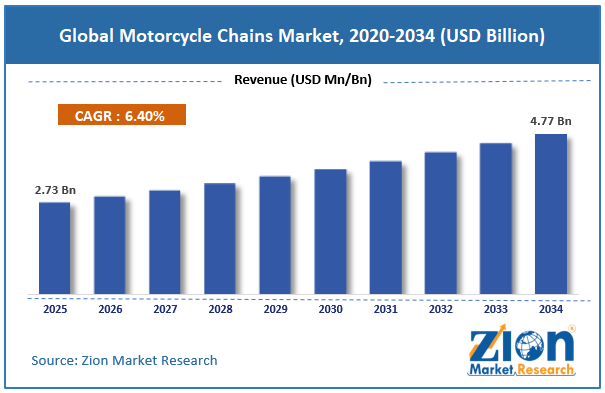
The global motorcycle chains market size was worth around USD 2.73 billion in 2025 and is predicted to grow to around USD 4.77 billion by 2034, with a compound annual growth rate (CAGR) of roughly 6.40% between 2026 and 2034.
Key Insights:
- As per the analysis shared by our research analyst, the global motorcycle chains market is estimated to grow annually at a CAGR of around 6.40% over the forecast period (2026-2034)
- In terms of revenue, the global motorcycle chains market size was valued at around USD 2.73 billion in 2025 and is projected to reach USD 4.77 billion, by 2034.
- The motorcycle chains market is projected to grow at a significant rate due to rising vehicle ownership, growing tourism, increasing use of motorcycles in ride-sharing services, and strict regulatory guidelines.
- Based on the chain type, the X-ring chain segment dominated the market growth rate, but the O-ring chain segment will grow at a faster CAGR.
- Based on the motorcycle type, sports bikes are expected to generate significant revenue during the forecast period.
- Based on the engine capacity, the above 500 CC segment is expected to lead the market growth trends.
- Based on the sales channel, original equipment manufacturers are projected to experience significant growth in the coming years.
- Based on region, Asia-Pacific is projected to dominate the global market during the forecast period.
Motorcycle Chains Market: Overview
Motorcycle chains are a part of automotive drive systems. Motorcycle chains are one of the different ways of transferring mechanical energy from the gearbox to the rear wheel. In chain drive systems, energy is transmitted using a roller chain, also known as a transmission chain or drive chain. It is made of short cylindrical rollers of specific diameters. The rollers are held together using chainplates on both sides. Motorcycle chains are available in different types and across a price range. During the forecast period, demand for motorcycle chains is expected to be driven by rising vehicle ownership, growing tourism, increasing use of motorcycles in ride-sharing services, and strict regulatory guidelines. However, the risk of supply chain disruptions, a shift toward shaft and belt drive systems, and low-quality aftermarket products may discourage smooth motorcycle chain market expansion during the forecast period.
Impact of the USA-Israel and Iran war on the Motorcycle Chains Market:
The USA-Israel and Iran war will affect prices and availability of essential raw materials such as metals, steel, and alloy. It may also affect logistics costs. Market players may have to seek new transportation routes to reach intended markets. However, the long-term outlook for motorcycle chains remains positive as the number of vehicle owners reaches new heights.
Motorcycle Chains Market: Dynamics
Growth Drivers
Which factors are driving vehicle ownership in the motorcycle chains market?
The global motorcycle chains market is expected to be led by a growing number of vehicle owners worldwide. Urbanization, demand for novel methods of transportation, rising disposable income, and affordability of motorcycles as compared to cars are some of the leading factors driving the vehicle ownership rate. Motorcycles are widely preferred among urban populations as these vehicles are excellent ways to navigate city traffic. In remote locations, motorcycles are preferred due to their affordability and their ability to handle rough terrains. The growing number of motorcycle buyers will ultimately drive demand for chains as this drive system is widely preferred among various vehicle producers.
Growing tourism and demand for ride-sharing services to work in favor of the industry leaders
A large number of international and domestic travelers prefer renting motorcycles during their stay. Growing popularity of motorcycle touring has intensified demand for high-performance, comfortable bikes. According to official reports, more than 129 million travelers participate in road trips every year. In addition, several ride-sharing companies have introduced bikes as a mode of safe and effective transportation. This trend has further influenced revenue in the global motorcycle chains market. For instance, in May 2025, Lyft, a major ride-sharing brand, launched bike-sharing services in Los Angeles, USA.
Restraints
How will raw material volatility limit motorcycle chains market growth?
The global motorcycle chains industry is projected to be restricted due to instability in prices and availability of essential raw materials. Motorcycle chains are made of steel, alloys, and metals. Geopolitical instability significantly influences the availability and pricing of these materials. Increased cost results in higher production expenses and limited profit margins.
Opportunities
Rising demand for high-end motorcycles to generate growth opportunities
The global motorcycle chains industry will generate growth opportunities due to rising demand for luxury and expensive bikes. Motorcycles designed for sports, off-roading, or a premium riding experience have witnessed steady growth in the last few years. In April 2026, Ducati, one of the world’s leading providers of high-end motorbikes, launched its most expensive street-legal range in the form of Superleggera V4 Centenario. The bike is lightweight and equipped with a racing-grade DID ERV7 chain.
How will the e-commerce industry shape the motorcycle chains market during the forecast period?
E-commerce brands use motorbikes for last-mile delivery services. The emergence of quick commerce has further intensified the use of motorbikes in delivering products to the consumer’s doorsteps. The rapid expansion of e-commerce giants and regional players will fuel demand for efficient motorcycles, simultaneously pulling applications of bike chains.
Challenges
Low-quality aftermarket products and competition from other drive systems challenge market growth
The global motorcycle chains industry will be challenged by concerns over low-quality aftermarket products and a steady shift toward shaft and belt drive systems. Counterfeit or low-grade products pose safety risks and also affect profit margins of authorized brands. Moreover, a growing number of motorcycle producers are shifting toward shaft or belt drive systems since they require limited maintenance and offer longer service life.
Motorcycle Chains Market: Report Scope
| Report Attributes | Report Details |
|---|---|
| Report Name | Motorcycle Chains Market |
| Market Size in 2025 | USD 2.73 Billion |
| Market Forecast in 2034 | USD 4.77 Billion |
| Growth Rate | CAGR of 6.40% |
| Number of Pages | 229 |
| Key Companies Covered | Tsubakimoto Chain Co., Thai Motor Chain Co., D.I.D. (Daido Kogyo), IRIS Chains, Renthal Ltd., Regina Catene, JT Sprockets, RK Japan (RK Takasago Chain), Hengjiu Group, Enuma Chain Manufacturing (EK Chain), Hangzhou Qianjiang Chain Industries, Rockman Industries, L.G. Balakrishnan & Bros. (Rolon), Sunstar Suisse SA, Qingdao Choho Industrial (QT Chain), and others. |
| Segments Covered | By Chain Type, By Motorcycle Type, By Engine Capacity, By Sales Channel, and By Region |
| Regions Covered | North America, Europe, Asia Pacific (APAC), Latin America, Middle East, and Africa (MEA) |
| Base Year | 2025 |
| Historical Year | 2020 - 2024 |
| Forecast Year | 2026 - 2034 |
| Customization Scope | Avail customized purchase options to meet your exact research needs. Request For Customization |
Motorcycle Chains Market: Segmentation
The global motorcycle chains market is segmented based on chain type, motorcycle type, engine capacity, sales channel, and region.
Why will the X-ring chain segment lead the motorcycle chains industry revenue during the forecast period?
Based on chain type, the global market segments are X-ring chain, O-ring chain, and standard ring chain. In 2025, the highest growth was listed in the X-ring chain segment. It accounted for 51% of the global revenue. During the forecast period, the O-ring chain segment is anticipated to generate the fastest CAGR of 8.57% due to higher use in high-end and adventure motorcycles.
Which will be the fastest-growing motorcycle type during the forecast period in the motorcycle chains market?
Based on motorcycle type, the global market is fragmented into cruiser, standard, sports, off-road, touring, and others. Standard motorcycles lead the market growth trends in 2025. They accounted for 43% of the global revenue. In the coming years, the sports segment is projected to deliver a CAGR of 8.57%. Growing investments in regional and international sports events and higher demand among general buyers will encourage segmental growth.
Which factors drive demand in the up to 150 CC segment in the motorcycle chains industry?
Based on engine capacity, the global motorcycle chains industry is divided into up to 150 CC, 150-300 CC, 300-500 CC, and above 500 CC. In 2025, up to 150 CC was the leading revenue generator. It held control over 56% of the total market share. Above 500 CC is projected to emerge as the fastest-growing segment during the forecast period. It will register a CAGR of 9.2% as interest in adventure sports and motorcycle touring is on the rise.
What will be the influence of the original equipment manufacturer (OEM) segment on the motorcycle chains market?
Based on sales channel, the global market segments are aftermarket and original equipment manufacturer (OEM). In 2025, the market was led by the original equipment manufacturer (OEM) segment, contributing up to 63.7% of the total revenue. It will continue leading the market with a CAGR of 7% during the forecast period as OEMs offer authentic motorcycle parts, eliminating the risk of low-quality vehicle components.
Motorcycle Chains Market: Regional Analysis
Why will Asia-Pacific lead the motorcycle chains market during the forecast period?
The global motorcycle chains market is expected to be led by Asia-Pacific. In 2025, the region accounted for 61% of global revenue and is expected to grow at a CAGR of 8.51% during the forecast period. Asia-Pacific has high demand for motorbikes among commercial and residential buyers. According to official reports, China has more than 84 million motorcycle owners around the country. In addition, robust motorcycle manufacturing systems, thriving aftermarket sales, and increasing use by e-commerce companies will aid regional dominance in the coming years.
What will be the contribution of Europe in the motorcycle chains market in the coming years?
Europe is anticipated to emerge as the second-highest revenue generator in the global motorcycle chains market. In 2025, it accounted for 19% of the global revenue. It is projected to deliver a CAGR of 6.56% during the forecast period. Growing motorcycle tourism, increased demand for premium motorbikes, and greater applications in ride-sharing services will promote regional market growth trends.
Motorcycle Chains Market: Competitive Analysis
The global motorcycle chains market is led by players like:
- Tsubakimoto Chain Co.
- Thai Motor Chain Co.
- D.I.D. (Daido Kogyo)
- IRIS Chains
- Renthal Ltd.
- Regina Catene
- JT Sprockets
- RK Japan (RK Takasago Chain)
- Hengjiu Group
- Enuma Chain Manufacturing (EK Chain)
- Hangzhou Qianjiang Chain Industries
- Rockman Industries
- L.G. Balakrishnan & Bros. (Rolon)
- Sunstar Suisse SA
- Qingdao Choho Industrial (QT Chain)
What are the latest key trends in the motorcycle chains market?
Advanced chain technologies
Market players are focusing on delivering advanced chain technologies such as Z-ring and X-ring systems. The primary focus will be on reducing friction, improving lubrication retention, and extending service life.
Aftermarket sales
The aftermarket motorcycle chains sector is growing rapidly, with several authentic dealers and distributors entering the market. This will ensure good quality aftersale products are available in the market at affordable prices.
The global motorcycle chains market is segmented as follows:
By Chain Type
- X-ring Chain
- O-ring Chain
- Standard Ring Chain
By Motorcycle Type
- Cruiser
- Standard
- Sports
- Off-Road
- Touring
- Others
By Engine Capacity
- Up to 150 CC
- 150-300 CC
- 300-500 CC
- Above 500 CC
By Sales Channel
- Aftermarket
- Original Equipment Manufacturer (OEM)
By Region
- North America
- The U.S.
- Canada
- Mexico
- Europe
- France
- The UK
- Spain
- Germany
- Italy
- Rest of Europe
- Asia Pacific
- China
- Japan
- India
- Australia
- South Korea
- Rest of Asia Pacific
- The Middle East & Africa
- Saudi Arabia
- UAE
- Egypt
- Kuwait
- South Africa
- Rest of the Middle East & Africa
- Latin America
- Brazil
- Argentina
- Rest of Latin America
Table Of Content
Methodology
FrequentlyAsked Questions
Motorcycle chains are a part of automotive drive systems. Motorcycle chains are one of the different ways of transferring mechanical energy from the gearbox to the rear wheel.
The global motorcycle chains market is expected to be led by a growing number of vehicle owners worldwide.
According to study, the global motorcycle chains market size was worth around USD 2.73 billion in 2025 and is predicted to grow to around USD 4.77 billion by 2034.
The CAGR value of the motorcycle chains market is expected to be around 6.40% during 2026-2034.
The global motorcycle chains industry will be challenged by concerns over low-quality aftermarket products and a steady shift toward shaft and belt drive systems.
Advanced chain technologies and aftermarket sales are the emerging trends and innovations impacting the motorcycle chains market.
The global motorcycle chains market has performed well so far and will offer similar trends in the coming years.
Asia-Pacific will contribute notably towards the motorcycle chains market value.
The global motorcycle chains market is led by players like Tsubakimoto Chain Co., Thai Motor Chain Co., D.I.D. (Daido Kogyo), IRIS Chains, Renthal Ltd., Regina Catene, JT Sprockets, RK Japan (RK Takasago Chain), Hengjiu Group, Enuma Chain Manufacturing (EK Chain), Hangzhou Qianjiang Chain Industries, Rockman Industries, L.G. Balakrishnan & Bros. (Rolon), Sunstar Suisse SA, and Qingdao Choho Industrial (QT Chain), and others.
The report explores crucial aspects of the motorcycle chains market, including a detailed discussion of existing growth factors and restraints, while also browsing future growth opportunities and challenges that impact the market.

HappyClients

