
Global Main Automation Contractor (MAC) Market Size, Share, Growth, Opportunities 2034

Main Automation Contractor (MAC) Market By Automation Type (Industrial Automation, IT Process Automation, Home Automation, Process Automation, and Building Automation), By Application (Manufacturing, Food and Beverage, Pharmaceuticals, Oil and Gas, Utilities, and Automotive), By Scale of Operation (Small Scale Projects, Large Scale Projects, and Medium Scale Projects), By Service Type (Consultation Services, Maintenance and Support Services, Implementation Services, Engineering Services, and Training Services), and By Region - Global and Regional Industry Overview, Market Intelligence, Comprehensive Analysis, Historical Data, and Forecasts 2026 - 2034
| Market Size in 2025 | Market Forecast in 2034 | CAGR (in %) | Base Year |
|---|---|---|---|
| USD 5.6 Billion | USD 10.7 Billion | 7.5% | 2025 |
Main Automation Contractor (MAC) Industry Perspective:
What will be the size of the global Main Automation Contractor (MAC) market during the forecast period?
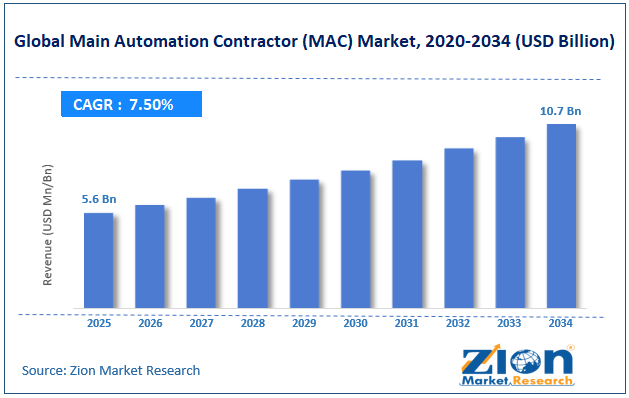
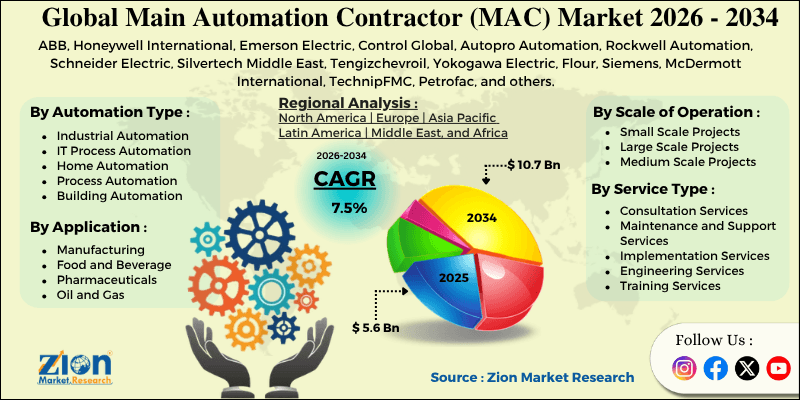
The global Main Automation Contractor (MAC) market size was worth around USD 5.6 billion in 2025 and is predicted to grow to around USD 10.7 billion by 2034, with a compound annual growth rate (CAGR) of roughly 7.5% between 2026 and 2034.
Key Insights
- As per the analysis shared by our research analyst, the global Main Automation Contractor (MAC) market is estimated to grow annually at a CAGR of around 7.5% over the forecast period (2026-2034).
- In terms of revenue, the global Main Automation Contractor (MAC) market size was valued at around USD 5.6 billion in 2025 and is projected to reach USD 10.7 billion by 2034.
- Expansion of digital transformation and Industry 4.0 is expected to propel the Main Automation Contractor (MAC) market over the projected period.
- Based on the automation type, the industrial automation segment held the largest revenue share in 2025.
- Based on the application, the manufacturing segment held the largest revenue share in 2025.
- Based on the scale of operation, the large-scale projects segment captures a prominent revenue share in 2025.
- Based on the service type, the maintenance and support services segment is set to grow in the Main Automation Contractor (MAC) market.
- Based on region, North America dominates the Main Automation Contractor (MAC) market.
Main Automation Contractor (MAC) Market: Overview
A Main Automation Contractor (or MAC) refers to a company that designs, engineers, integrates, installs, and maintains all automation systems in a particular industrial facility or project. In other words, a Main Automation Contractor is an entity that handles all automation-related aspects, from front-end engineering design (FEED) to system integration and testing, cybersecurity, and commissioning. It plays a leading role in coordinating multiple automation vendors and ensuring the delivery of integrated control solutions for distributed control systems (DCS), programmable logic controllers (PLCs), supervisory control and data acquisition (SCADA) systems, instrumentation, networks, and software. Main Automation Contractors are involved in projects in various industries, including oil and gas, chemical processing, power generation, mining, pharmaceuticals, water treatment, and manufacturing. These companies help design and implement integrated automation systems that enhance operational efficiency, safety, reliability, scalability, and overall performance of a facility or process plant.
Impact of the USA-Israel War on Iran on the Main Automation Contractor (MAC) Market
The conflict between the United States and Israel, and Iran has both negative and positive effects on the Main Automation Contractor (MAC) market. MACs are firms that design industrial automation systems for the oil & gas, power, chemical, mining, and critical infrastructure industries. Due to the nature of the work, geopolitical issues affect the automation sector. It has hampered shipping and fuel prices in the Strait of Hormuz, increasing the risk that multinational corporations would delay large-scale investments in the Middle East. Additionally, automation system suppliers’ supply chains for the Middle East have been disrupted, causing project costs to rise and timelines to be extended.
Main Automation Contractor (MAC) Market: Dynamics
Growth Drivers
How does the rising demand for integrated industrial automation drive the Main Automation Contractor (MAC) market?
The growing need for integrated industrial automation is the main reason why the Main Automation Contractor market is increasing. Organizations are looking to maximize production efficiency while minimizing risk and improving productivity, safety, and reliability. In addition, system integration is becoming more essential for large-scale processes that consist of several standardized control components, such as distributed control systems (DCS), programmable logic controllers (PLCs), supervisory control and data acquisition (SCADA) systems, instrumentation, networks, and manufacturing execution systems (MES). Main Automation Contractors play an essential role in such cases, as they design, integrate, test, and commission a complete automation system that effectively controls its various components.
On the other hand, industrial facilities are adopting more automated solutions to keep up with the demands of modern society, which is why organizations are turning to Main Automation Contractors to support their own Industry 4.0, Industrial Internet of Things (IIoT), and advanced analytics initiatives. These include remote operations, as well as the digitalization, integration, and automation of production facilities, which is why the MAC market is projected to see demand from both new industrial installations and the modernization of existing ones.
Restraints
High Initial Capital Investment posing a restraint to the Main Automation Contractor (MAC) industry growth
High capital expenditure is a significant restraint in the growth of the Main Automation Contractor (MAC) market. The application of automation requires significant investment in distributed control systems (DCS), programmable logic controllers (PLCs), supervisory control and data acquisition (SCADA), industrial software, instrumentation, communication, engineering, integration, testing, and commissioning.
Similarly, expenses on cybersecurity, training, maintenance, and support are also high. The exorbitant costs associated with automation hinder the growth of small and medium-sized enterprises and discourage industrial organizations from adopting end-to-end automation solutions and services. In addition, the time required to execute projects and the long payback period also make companies wait to invest in automation, particularly during economic downturns. Thus, the high capital expenditure is a major challenge in the development of the market.
Opportunities
Why does the increasing partnership in the sector offer a lucrative opportunity for the Main Automation Contractor (MAC) market?
Increasing partnership is expected to offer a lucrative opportunity to the Main Automation Contractor (MAC) market. For instance, in June 2025, Jinggong Holding Group Co Ltd and Yokogawa Electric Corp announced that they have established a strategic partnership to explore new business development and growth opportunities by integrating their business in manufacturing optimization, energy management, and other areas.
Under the partnership, the companies will identify and realize synergies in optimizing Jinggong Group’s chemical recycling, high-performance fiber, and other plants by introducing AI autonomous control and other Yokogawa automation solutions. In addition, both parties will develop energy management systems for electric power and other energy networks. The companies intend to introduce the solutions and technologies in manufacturing that they plan to co-develop and apply in other regions outside of China in the future.
Challenges
How does the shortage of skilled automation professionals pose a significant challenge to the growth of the Main Automation Contractor (MAC) industry?
The shortage of specialized automation professionals is a major restraint to market growth. This is because effective automation solutions require highly skilled control engineers, system integrators, instrumentation experts, software developers, cybersecurity experts, and commissioning personnel, among others. The rising need for IIoT, artificial intelligence, digital twins, cloud-based infrastructures for industrial applications, and advanced control systems across industries has outpaced the current availability of professionals with relevant skills.
Thus, the talent shortage can impede the rate at which industries adopt automation solutions. It may also increase workforce costs, lengthen commissioning times, and raise risks in project implementations, especially when multiple large-scale projects are handled at a time. Similarly, the lack of skilled workers may hinder the delivery of high-quality automation systems, processes, and services, which are crucial in meeting customer demands. Overall, the scarcity of automation experts will constrain the rate at which the Main Automation Contractor (MAC) market will grow.
Main Automation Contractor (MAC) Market: Report Scope
| Report Attributes | Report Details |
|---|---|
| Report Name | Main Automation Contractor (MAC) Market |
| Market Size in 2025 | USD 5.6 Billion |
| Market Forecast in 2034 | USD 10.7 Billion |
| Growth Rate | CAGR of 7.5% |
| Number of Pages | 228 |
| Key Companies Covered | ABB, Honeywell International, Emerson Electric, Control Global, Autopro Automation, Rockwell Automation, Schneider Electric, Silvertech Middle East, Tengizchevroil, Yokogawa Electric, Flour, Siemens, McDermott International, TechnipFMC, Petrofac, and others. |
| Segments Covered | By Automation Type, By Application, By Scale of Operation, By Service Type, and By Region |
| Regions Covered | North America, Europe, Asia Pacific (APAC), Latin America, Middle East, and Africa (MEA) |
| Base Year | 2025 |
| Historical Year | 2020 - 2024 |
| Forecast Year | 2026 - 2034 |
| Customization Scope | Avail customized purchase options to meet your exact research needs. Request For Customization |
Main Automation Contractor (MAC) Market: Segmentation
Automation Type Insights
Why does the industrial automation segment hold a prominent position in the Main Automation Contractor (MAC) market?
The industrial automation segment held the largest revenue share in 2025. Markets are being driven by an increased emphasis on integrated automation solutions to optimize productivity, operational efficiency, safety, and reliability. Main Automation Contractors play an important role in designing, integrating, and commissioning distributed control systems (DCS), programmable logic controllers (PLCs), supervisory control and data acquisition (SCADA) systems, industrial instrumentation, manufacturing execution systems (MES), and Industrial Internet of Things (IIoT) into unified systems. Rising investments in smart factories, Industry 4.0, digitalization, predictive maintenance, and remote operations in the downstream, upstream, and midstream sectors, as well as the chemical, power, pharma, mining, food & beverage, water, and other industries, are rising.
Application Insights
Does the manufacturing segment capture the largest share in the Main Automation Contractor (MAC) market?
The manufacturing segment held the largest revenue share in 2025. Growth is mainly attributed to the rising adoption of smart manufacturing technologies and integrated automation solutions to improve product productivity and quality while reducing overall production costs. Further, manufacturers are focusing on complete connected production systems that utilize distributed control systems (DCS), programmable logic controllers (PLCs), supervisory control and data acquisition (SCADA), robotics, manufacturing execution systems (MES), and industrial Internet of Things (IIoT) to optimize the production process. Main Automation Contractors (MACs) offer turnkey automation engineering, system integration, multi-vendor coordination, commissioning, and lifecycle support to help manufacturers achieve connected production systems and better integration across the factory floor.
Scale of Operation Insights
How does the large-scale projects segment capture the largest share in the Main Automation Contractor (MAC) market?
The large scale projects segment captures a prominent revenue share in 2025. Mega projects in various industries such as oil & gas, petrochemical, power, mining, water and wastewater, LNG, or large manufacturing require a Main Automation Contractor (MAC) that manages the whole life cycle of automation equipment, from design and engineering to installation, commissioning, start-up, and operational support. Such projects involve thousands of automation devices, many different control systems, and hundreds of suppliers. Main automation contractors manage all aspects of projects involving distributed control systems (DCS), PLC SCADA, instrumentation, control, industrial networks, and digital systems.
Service Type Insights
Why does the maintenance and support services segment capture the largest share in the Main Automation Contractor (MAC) market?
The maintenance and support services segment is set to grow in the Main Automation Contractor (MAC) market as operators seek to maximize the lifecycle of their automation systems and infrastructure. Industrial facilities are typically controlled by sophisticated automation systems such as distributed control systems (DCS), programmable logic controllers (PLCs), and supervisory control and data acquisition (SCADA). These systems require regular maintenance, updates, and support to ensure they function reliably and securely. Main Automation Contractors (MACs) offer maintenance and support services for such systems.
Regional Insights
What factors drive the North America region in the Main Automation Contractor (MAC) market?
North America dominates the Main Automation Contractor (MAC) market. The surge in industrial automation, advanced manufacturing, energy, and digitalization primarily drives the growth. United States and Canada are currently undergoing extensive modernization of their industrial facilities, power plants, oil and gas, petrochemical, and water facilities, among others. As a result, the demand for Main Automation Contractors in the region is forecasted to rise substantially. This trend is attributed to the adoption of the latest technologies, including Industrial Internet of Things, artificial intelligence, digital twin, robotics, cloud, and industrial analytics and predictive maintenance, in the manufacturing sector. These technologies require end-to-end automation engineering, system integration, commissioning, and lifecycle support services.
Industrialization policies promoted by governments have resulted in increased automation investment. According to the U.S. Department of the Treasury, manufacturing construction spending is up more than two times compared to the end of 2021. This is due to the passage of the Infrastructure Investment and Jobs Act (IIJA), the CHIPS and Science Act, and the Inflation Reduction Act, which have allocated substantial funds for semiconductor, electronics, battery, and advanced manufacturing industries. This, in turn, has created demand for industrial automation systems and integration contractors.
Main Automation Contractor (MAC) Market: Competitive Analysis
The global Main Automation Contractor (MAC) market is dominated by players like:
- ABB
- Honeywell International
- Emerson Electric
- Control Global
- Autopro Automation
- Rockwell Automation
- Schneider Electric
- Silvertech Middle East
- Tengizchevroil
- Yokogawa Electric
- Flour
- Siemens
- McDermott International
- TechnipFMC
- Petrofac
The global Main Automation Contractor (MAC) market is segmented as follows:
By Automation Type
- Industrial Automation
- IT Process Automation
- Home Automation
- Process Automation
- Building Automation
By Application
- Manufacturing
- Food and Beverage
- Pharmaceuticals
- Oil and Gas
- Utilities
- Automotive
By Scale of Operation
- Small Scale Projects
- Large Scale Projects
- Medium Scale Projects
By Service Type
- Consultation Services
- Maintenance and Support Services
- Implementation Services
- Engineering Services
- Training Services
By Region
- North America
- The U.S.
- Canada
- Mexico
- Europe
- France
- The UK
- Spain
- Germany
- Italy
- Rest of Europe
- Asia Pacific
- China
- Japan
- India
- Australia
- South Korea
- Rest of Asia Pacific
- The Middle East & Africa
- Saudi Arabia
- UAE
- Egypt
- Kuwait
- South Africa
- Rest of the Middle East & Africa
- Latin America
- Brazil
- Argentina
- Rest of Latin America
Table Of Content
Methodology
FrequentlyAsked Questions
A Main Automation Contractor (or MAC) refers to a company that designs, engineers, integrates, installs, and maintains all automation systems in a particular industrial facility or project. In other words, a Main Automation Contractor is an entity that handles all automation-related aspects, from front-end engineering design (FEED) to system integration and testing, cybersecurity, and commissioning. It plays a leading role in coordinating multiple automation vendors and ensuring the delivery of integrated control solutions for distributed control systems (DCS), programmable logic controllers (PLCs), supervisory control and data acquisition (SCADA) systems, instrumentation, networks, and software.
The Main Automation Contractor (MAC) market is primarily driven by the rising adoption of industrial automation, Industry 4.0, and Industrial Internet of Things (IIoT) technologies across manufacturing, oil & gas, power generation, chemicals, mining, and water treatment industries. Increasing investments in large-scale industrial infrastructure projects, modernization of aging facilities, and the growing need for integrated multi-vendor automation systems are fueling market growth.
What are the major challenges restraining the growth of the Main Automation Contractor (MAC) market?
The Main Automation Contractor (MAC) market faces several growth challenges, including the high initial capital investment required for integrated automation systems, engineering, and system integration services. A shortage of skilled automation professionals, complexities associated with integrating multi-vendor and legacy systems, and increasing cybersecurity risks in connected industrial environments further hinder market expansion.
Based on the service type, the maintenance and support services segment is expected to dominate the Main Automation Contractor (MAC) market growth during the projected period.
Emerging trends in the Main Automation Contractor (MAC) market include the increasing adoption of Industry 4.0, Industrial Internet of Things (IIoT), artificial intelligence (AI), digital twins, and cloud-based industrial automation platforms to enable smarter and more connected operations. Main Automation Contractors are also integrating advanced industrial cybersecurity solutions, edge computing, predictive maintenance, and remote monitoring capabilities into automation projects.
According to the report, the global Main Automation Contractor (MAC) market size was worth around USD 5.6 billion in 2025 and is predicted to grow to around USD 10.7 billion by 2034.
The global Main Automation Contractor (MAC) market is expected to grow at a CAGR of 7.5% during the forecast period.
The global Main Automation Contractor (MAC) industry growth is expected to be led by North America over the forecast period.
The global Main Automation Contractor (MAC) market is dominated by players like ABB, Honeywell International, Emerson Electric, Control Global, Autopro Automation, Rockwell Automation, Schneider Electric, Silvertech Middle East, Tengizchevroil, Yokogawa Electric, Flour, Siemens, McDermott International, TechnipFMC, and Petrofac, among others.
The Main Automation Contractor market report covers the geographical market along with a comprehensive competitive landscape analysis. It also includes cash flow analysis, profit ratio analysis, market basket analysis, market attractiveness analysis, sentiment analysis, PESTLE analysis, trend analysis, SWOT analysis, trade area analysis, demand & supply analysis, Porter’s five forces analysis, and value chain analysis.

HappyClients

