Global Live Cell Encapsulation Market Size, Share, Analysis, Trends, Growth 2032

Live Cell Encapsulation Market Analysis By Technique (Liquid Jet, Dripping, and Coaxial Airflow), By Polymer Type (Silica, Alginate, Cellulose Sulfate, and Chitosan), By Application (Drug Delivery, Probiotics, Research, and Transplant), and By Region - Global and Regional Industry Overview, Market Intelligence, Comprehensive Analysis, Historical Data, and Forecasts 2024 - 2032
| Market Size in 2023 | Market Forecast in 2032 | CAGR (in %) | Base Year |
|---|---|---|---|
| USD 297.84 million | USD 423.92 million | 4.0% | 2023 |
Live Cell Encapsulation Industry Perspective
What will be the global live cell encapsulation market size during the forecast period?
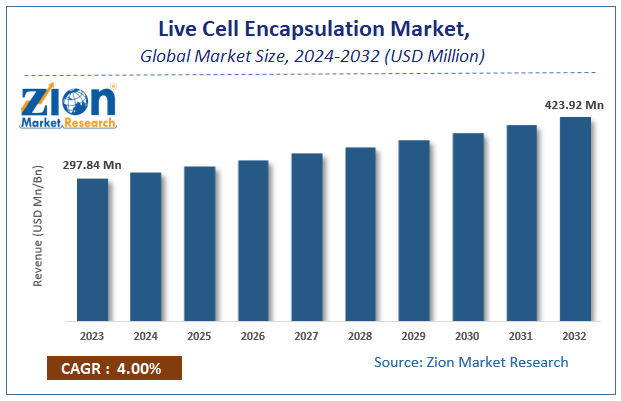
The global live cell encapsulation market size accrued earnings worth approximately USD 297.84 million in 2023 and is predicted to gain revenue of about USD 423.92 million by 2032, and is set to record a CAGR of nearly 4.0% over the period from 2024 to 2032.
This report provides a comprehensive analysis of the growth drivers, restraints, and challenges shaping demand across the global live cell encapsulation market throughout the forecast period, while highlighting high-potential emerging opportunities within the industry.
Key Insights
- As per the analysis shared by our research analyst, the global live cell encapsulation market is estimated to grow at a CAGR of approximately 4.0% during the forecast period from 2024 to 2032.
- In terms of revenue, the global live cell encapsulation market size was valued at around USD 297.84 million in 2023 and is projected to reach USD 423.92 million by 2032.
- The market is driven by public and private funding for product development and research, growing awareness of encapsulated cells in managing chronic ailments, rising occurrence of target disorders, use of new drug delivery systems, and large-scale application in probiotics, drug delivery, and cell transplantation.
- Based on the technique, dripping segments are widely used for producing consistent microcapsules that support cell viability and controlled exchange of nutrients and therapeutic molecules.
- Based on the polymer type, alginate holds a leading position due to its biocompatibility, mild gelation conditions that help preserve cell viability, and extensive research and clinical experience supporting its use in encapsulation systems.
- Based on the application, the drug delivery segment represents major demand areas as encapsulation enables protected, sustained delivery of therapeutic cells and proteins while limiting immune exposure.
- Regionally, North America is expected to lead the live cell encapsulation market during the forecast period, supported by public and private research funding, presence of key industry participants, and strong activity in cell therapy and regenerative medicine in the United States and Canada.
Live Cell Encapsulation Market: Overview
Cell encapsulation technique comprises restricting cells within a polymeric semipermeable membrane to help in two-way molecule diffusion, including oxygen influx and outward diffusion of waste items. Cell microencapsulation technology requires the immobilization of cells inside a semi-permeable polymeric membrane that enables molecules such as oxygen, nutrients, growth factors, etc., necessary for cell metabolism and the external diffusion of waste products and therapeutic proteins to be bidirectionally.
Live Cell Encapsulation Market: Growth Factors
Massive funding of public as well as private enterprises for promoting product development and encouraging research activities to increase the efficiency of clinical trials in cell technology will propel the market trends. Apart from this, the growing awareness among the population about the major role played by encapsulated cells in managing chronic ailments will further spur the growth graph of the live cell encapsulation business. Nonetheless, the restricted access to raw materials of high-quality and large-scale acceptance of alternate mode of treatments are projected to inhibit the upsurge of live cell encapsulation market in the years ahead. Moreover, an increase in the utilization of cell encapsulation methods by healthcare service providers and medical experts is one of the few factors supplementing the surge of the live cell encapsulation industry.
The industry growth is also influenced by the rising occurrence of target disorders, massive use of new drug delivery systems for treatment of chronic ailments, and technological breakthroughs. Large-scale application of the technology in probiotics, drug delivery, and cell transplantation will shape up the business scope.
Live Cell Encapsulation Market: Report Scope
| Report Attributes | Report Details |
|---|---|
| Report Name | Live Cell Encapsulation Market |
| Market Size in 2023 | USD 297.84 Million |
| Market Forecast in 2032 | USD 423.92 Million |
| Growth Rate | CAGR of 4.0% |
| Number of Pages | 285 |
| Key Companies Covered | BioTime, Inc., Neurotech Pharmaceuticals, Inc., Lycored, Sigilon Therapeutics, Inc., Evonik Industries, Blacktrace Holdings Ltd., Balchem Corporation, Reed Pacific Pty Ltd., Living Cell Technologies Ltd., Merck KGAA, Encapsys, LLC, BÜCHI Labortechnik AG, Sernova Corporation, and MiKroCaps. |
| Segments Covered | By Technique, By Polymer Type, By Application, and By Region |
| Regions Covered | North America, Europe, Asia Pacific (APAC), Latin America, Middle East, and Africa (MEA) |
| Base Year | 2023 |
| Historical Year | 2018 - 2022 |
| Forecast Year | 2024 - 2032 |
| Customization Scope | Avail customized purchase options to meet your exact research needs. Request For Customization |
Live Cell Encapsulation Market: Segmentation
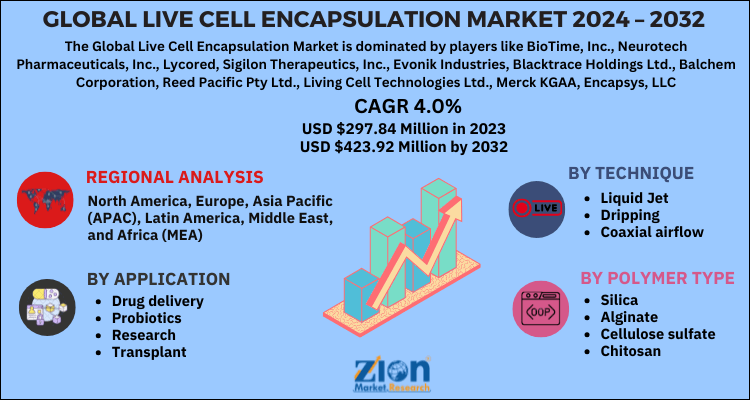
The live cell encapsulation market is segmented by technique, polymer type, application, and region. All the segments of the live cell encapsulation market have been analyzed based on present and future trends and the market is estimated from 2024 to 2032.
Based on Technique, the live cell encapsulation market is divided into liquid jet, dripping, and coaxial airflow. Dripping methods are widely used because they can produce relatively uniform microcapsules under mild conditions that help preserve cell viability. These approaches support controlled size and membrane properties important for nutrient diffusion and immune isolation. Liquid jet and coaxial airflow techniques offer alternative routes for capsule formation and are applied where specific size ranges, throughput, or membrane architectures are required, contributing to process flexibility across research and development settings.
Based on Polymer Type, the market is divided into silica, alginate, cellulose sulfate, and chitosan. Alginate holds a leading position due to its biocompatibility, ability to form hydrogels under mild conditions that support cell survival, and extensive research and clinical experience. It is frequently used as a primary matrix for microencapsulation. Cellulose sulfate, chitosan, and silica-based materials address specialized needs related to mechanical strength, permeability control, or particular biological interactions, expanding the range of encapsulation systems available for different therapeutic and research applications.
Based on Application, the live cell encapsulation market is divided into drug delivery, probiotics, research, and transplant. Drug delivery and transplant applications represent major demand areas because encapsulation can protect therapeutic cells or enable sustained local release of proteins while limiting direct exposure to the host immune system. Probiotics applications use encapsulation to improve survival of beneficial microorganisms through processing and delivery. Research applications support method development, biomaterial evaluation, and preclinical studies that underpin future clinical products across regenerative medicine and cell therapy.
Live Cell Encapsulation Market: Regional Analysis
Why will North America continue to dominate the global market during the projection period?
North America is expected to lead the live cell encapsulation market during the forecast period. The region benefits from strong public and private funding for research activities related to living cell encapsulation in the United States and Canada. The presence of key industry participants and a mature biotechnology and clinical research infrastructure supports translation of encapsulation technologies toward therapeutic use. These factors enable North America to drive innovation, clinical development, and commercial activity that influence global standards and investment priorities in the field.
Europe maintains significant activity supported by large-scale research in biotechnology in countries such as Germany and the United Kingdom. Asia Pacific is expected to grow as awareness of healthcare needs and interest in new methods for treating chronic diseases increase in markets including China, India, and other countries across the region. Latin America and the Middle East and Africa represent emerging opportunities where gradual expansion of biotechnology research and healthcare investment may support future adoption of cell encapsulation approaches.
Live Cell Encapsulation Market: Competitive Players
Some of the major players in the global live cell encapsulation market include;
- BioTime, Inc.
- Neurotech Pharmaceuticals, Inc.
- Lycored
- Sigilon Therapeutics, Inc.
- Evonik Industries
- Blacktrace Holdings Ltd.
- Balchem Corporation
- Reed Pacific Pty Ltd.
- Living Cell Technologies Ltd.
- Merck KGAA
- Encapsys, LLC
- BÜCHI Labortechnik AG
- Sernova Corporation
- MiKroCaps
Segments Covered
The global live cell encapsulation market is segmented as follows:
By Technique
- Liquid Jet
- Dripping
- Coaxial Airflow
By Polymer Type
- Silica
- Alginate
- Cellulose Sulfate
- Chitosan
By Application
- Drug Delivery
- Probiotics
- Research
- Transplant
By Region
- North America
- The U.S.
- Canada
- Mexico
- Europe
- France
- The UK
- Spain
- Germany
- Italy
- Rest of Europe
- Asia Pacific
- China
- Japan
- India
- Australia
- South Korea
- Rest of Asia Pacific
- The Middle East & Africa
- Saudi Arabia
- UAE
- Egypt
- Kuwait
- South Africa
- Rest of the Middle East & Africa
- Latin America
- Brazil
- Argentina
- Rest of Latin America
Table Of Content
Methodology
FrequentlyAsked Questions
Live cell encapsulation is a technique that encloses living cells within a polymeric semipermeable membrane. The membrane allows diffusion of oxygen, nutrients, and therapeutic molecules while protecting cells from direct immune attack, and is used in biotechnology and medical therapies such as drug delivery, probiotics, research, and transplantation.
The global live cell encapsulation market is driven by public and private funding for research and product development, growing awareness of encapsulated cells in managing chronic ailments, rising occurrence of target disorders, use of new drug delivery systems, and applications in probiotics, drug delivery, and cell transplantation.
According to study, the global live cell encapsulation market size was worth around USD 297.84 Million in 2023 and is predicted to grow to around USD 423.92 Million By 2032.
The global live cell encapsulation market is expected to grow at a compound annual growth rate (CAGR) of approximately 4.0% during the forecast period from 2024 to 2032.
Major challenges include restricted access to high-quality raw materials, competition from alternative treatments, maintaining cell viability, scalability and reproducibility of processes, regulatory requirements, and high development costs.
The value chain typically includes polymer and biomaterial suppliers, encapsulation technology and equipment providers, biotechnology and pharmaceutical developers, research institutions, clinical and regulatory partners, and end users in healthcare and research settings.
Emerging trends include advanced biomaterials for cell protection, expansion into regenerative medicine and controlled release applications, and continued progress in scalable manufacturing and clinical translation of encapsulated cell therapies.
North America is expected to lead and contribute notably to the global live cell encapsulation market, supported by research funding, presence of key players, and strong activity in cell therapy and regenerative medicine.
Some of the prominent players operating in the global live cell encapsulation market are; BioTime, Inc., Neurotech Pharmaceuticals, Inc., Lycored, Sigilon Therapeutics, Inc., Evonik Industries, Blacktrace Holdings Ltd., Balchem Corporation, Reed Pacific Pty Ltd., Living Cell Technologies Ltd., Merck KGAA, Encapsys, LLC, BÜCHI Labortechnik AG, Sernova Corporation, and MiKroCaps. and others.
The report explores crucial aspects of the live cell encapsulation market, including a detailed discussion of existing growth factors and restraints, while also browsing future growth opportunities and challenges that impact the market.

HappyClients