
Global Live Cell Encapsulation Market Size, Share, Analysis, Trends, Growth 2032

Live Cell Encapsulation Market Analysis by Technique (Liquid Jet, Dripping, Coaxial airflow), by Polymer Type (Silica, Alginate, Cellulose sulfate, Chitosan), by Application (Drug delivery, Probiotics, Research, Transplant), and by Region - Global Industry Perspective Comprehensive Analysis and Forecast, 2024-2032
| Market Size in 2023 | Market Forecast in 2032 | CAGR (in %) | Base Year |
|---|---|---|---|
| USD 297.84 million | USD 423.92 million | 4.0% | 2023 |
What is the live cell encapsulation market size?
The global Live Cell Encapsulation market size accrued earnings worth approximately USD 297.84 Million in 2023 and is predicted to gain revenue of about USD 423.92 Million by 2032, is set to record a CAGR of nearly 4.0% over the period from 2024 to 2032.
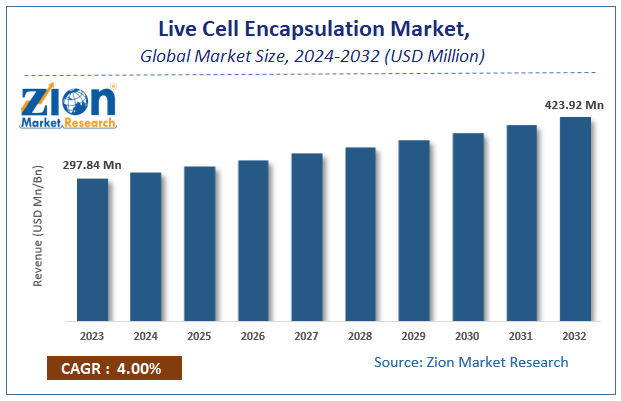
Global Live Cell Encapsulation Market: Overview
Cell encapsulation technique comprises of restricting cells within polymeric semipermeable membrane for helping in two-way molecule diffusion including oxygen influx and outward diffusing of waste items. Cell microencapsulation technology requires the immobilization of cells inside a semi-permeable polymeric membrane that enables molecules such as oxygen, nutrients, growth factors, etc., necessary for cell metabolism and the external diffusion of waste products and therapeutic proteins, to be bidirectionally diffused.
Global Live Cell Encapsulation Market: Growth Factors
Massive funding of public as well as private enterprises for promoting product development and encouraging research activities for increasing the efficiency of clinical trials in cell technology will propel the market trends. Apart from this, the growing awareness among the population about the major role played by encapsulated cells in managing the chronic ailments will further spur the growth graph of the live cell encapsulation business. Nonetheless, the restricted access to raw materials of high-quality and large-scale acceptance of alternate mode of treatments are projected to inhibit the upsurge of live cell encapsulation market in the years ahead. Moreover, an increase in the utilization of cell encapsulation methods by the healthcare service providers and medical experts are one of the few factors supplementing the surge of the live cell encapsulation industry.
The industry growth is also influenced by the rising occurrence of target disorders, massive use of new drug delivery systems for treatment of the chronic ailments, and technological breakthroughs. Large scale application of the technology in probiotics, drug delivery, and cell transplantation will shape up the business scope.
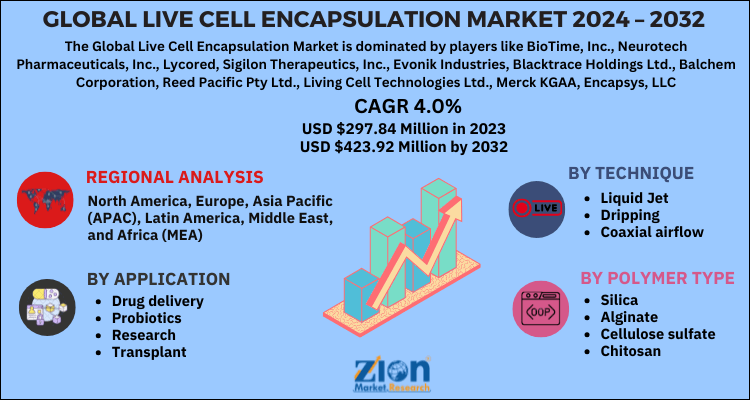
Live Cell Encapsulation Market: Report Scope
| Report Attributes | Report Details |
|---|---|
| Report Name | Live Cell Encapsulation Market |
| Market Size in 2023 | USD 297.84 Million |
| Market Forecast in 2032 | USD 423.92 Million |
| Growth Rate | CAGR of 4.0% |
| Number of Pages | 204 |
| Key Companies Covered | BioTime, Inc., Neurotech Pharmaceuticals, Inc., Lycored, Sigilon Therapeutics, Inc., Evonik Industries, Blacktrace Holdings Ltd., Balchem Corporation, Reed Pacific Pty Ltd., Living Cell Technologies Ltd., Merck KGAA, Encapsys, LLC, BÜCHI Labortechnik AG, Sernova Corporation, and MiKroCaps. |
| Segments Covered | By Technique, By Polymer Type, By Application, and By Region |
| Regions Covered | North America, Europe, Asia Pacific (APAC), Latin America, Middle East, and Africa (MEA) |
| Base Year | 2023 |
| Historical Year | 2018 - 2022 |
| Forecast Year | 2024 - 2032 |
| Customization Scope | Avail customized purchase options to meet your exact research needs. Request For Customization |
Global Live Cell Encapsulation Market: Segmentation
The live cell encapsulation market can be segmented into technique, application, and polymer type. Based on the technique, the market is classified into a liquid jet, dripping, and coaxial airflow. Application wise, the live cell encapsulation industry is divided drug delivery, probiotics, research, and transplant. On the basis of polymer type, the live cell encapsulation market is segregated into silica, alginate, cellulose sulfate, and chitosan.
Global Live Cell Encapsulation Market: Regional Analysis
Based on the region, the live cell encapsulation market can be divided into five main regions: Latin America, North America, Asia Pacific, Europe, and the Middle East and Africa. North America live cell encapsulation market is projected to experience profitable growth in the near future. The regional market expansion can be accredited to rise in the public sector as well as private sector funding of research activities related to living cell encapsulation sector in countries such as Canada and the U.S. Additionally, the presence of key players will steer the live cell encapsulation industry surge in North America.
Large-scale research activities in the biotechnology sector witnessed in countries such as Germany and the UK will ensure massive business growth in the European region. The growing awareness about healthcare and need for devising new methods of treating chronic diseases in countries such as India, Bangladesh, Thailand, Indonesia, Pakistan, Sri Lanka, and China will further embellish the growth of Asia Pacific market in the foreseeable future.
Global Live Cell Encapsulation Market: Competitive Players
Few of the main participants in live cell encapsulation market include
- BioTime, Inc.
- Neurotech Pharmaceuticals, Inc.
- Lycored
- Sigilon Therapeutics, Inc.
- Evonik Industries
- Blacktrace Holdings Ltd.
- Balchem Corporation
- Reed Pacific Pty Ltd.
- Living Cell Technologies Ltd.
- Merck KGAA
- Encapsys, LLC
- BÜCHI Labortechnik AG, Sernova Corporation, and MiKroCaps.
The report segments the Global Live Cell Encapsulation market as follows:
By Technique
- Liquid Jet
- Dripping
- Coaxial airflow
By Polymer Type
- Silica
- Alginate
- Cellulose sulfate
- Chitosan
By Application
- Drug delivery
- Probiotics
- Research
- Transplant
By Region
- North America
- The U.S.
- Canada
- Mexico
- Europe
- France
- The UK
- Spain
- Germany
- Italy
- Rest of Europe
- Asia Pacific
- China
- Japan
- India
- Australia
- South Korea
- Rest of Asia Pacific
- The Middle East & Africa
- Saudi Arabia
- UAE
- Egypt
- Kuwait
- South Africa
- Rest of the Middle East & Africa
- Latin America
- Brazil
- Argentina
- Rest of Latin America
Table Of Content
Methodology
FrequentlyAsked Questions
Live cell encapsulation is a technique to enclose living cells within protective materials. It is used in biotechnology and medical therapies.
The global live cell encapsulation market is expected to be driven by the advancements in cell therapy, regenerative medicine, and controlled drug delivery applications.
According to study, the global live cell encapsulation market size was worth around USD 297.84 Million in 2023 and is predicted to grow to around USD 423.92 Million By 2032.
The global live cell encapsulation market is expected to grow at a Compound Annual Growth Rate (CAGR) of around CAGR 4.0% during the forecast period from 2024-2032.
The global live cell encapsulation industry is projected to be challenged by Major challenges include maintaining cell viability, scalability of processes, and regulatory approvals. High costs and reproducibility issues slow commercialization.
The Opportunities include cell therapy delivery, regenerative medicine, and controlled release systems. Biomaterial innovation and scalable manufacturing unlock clinical adoption will offer significant growth opportunities in the live cell encapsulation market.
Advanced biomaterials for cell protection; regenerative medicine applications; controlled release technologies are the emerging trends and innovations impacting the live cell encapsulation market.
The global live cell encapsulation market is expected to be led by North America during the forecast period.
Some of the prominent players operating in the global live cell encapsulation market are; BioTime, Inc., Neurotech Pharmaceuticals, Inc., Lycored, Sigilon Therapeutics, Inc., Evonik Industries, Blacktrace Holdings Ltd., Balchem Corporation, Reed Pacific Pty Ltd., Living Cell Technologies Ltd., Merck KGAA, Encapsys, LLC, BÜCHI Labortechnik AG, Sernova Corporation, and MiKroCaps. and others.
The report explores crucial aspects of the live cell encapsulation market, including a detailed discussion of existing growth factors and restraints, while also browsing future growth opportunities and challenges that impact the market.

HappyClients

