
Leak Detection and Repair Market Size, Growth, Global Trends, Forecast 2034

Leak Detection and Repair Market By Technology (Acoustic and Ultrasonic Detection, Fiber Optic Sensing Systems, Infrared Thermal Imaging, Tracer Gas and Chemical Detection), By Application (Oil and Gas Pipeline Networks, Water and Wastewater Distribution Systems, Industrial Process and Chemical Plants, Building, HVAC and Utility Systems), By End-User (Municipal Water and Utility Authorities, Oil and Gas and Petrochemical Companies, Manufacturing and Industrial Facilities, Commercial and Residential Property Owners), By Solution Type (Detection Equipment and Sensors, Repair and Sealing Services, Monitoring Software and Analytics Platforms, Inspection and Consulting Services), and By Region - Global and Regional Industry Overview, Market Intelligence, Comprehensive Analysis, Historical Data, and Forecasts 2026 - 2034
| Market Size in 2025 | Market Forecast in 2034 | CAGR (in %) | Base Year |
|---|---|---|---|
| USD 22.16 Billion | USD 39.82 Billion | 6.62% | 2025 |
Leak Detection and Repair Industry Perspective:
What will be the size of the leak detection and repair market during the forecast period?
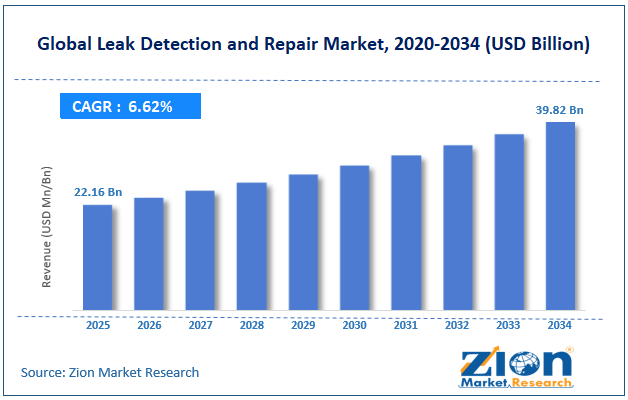
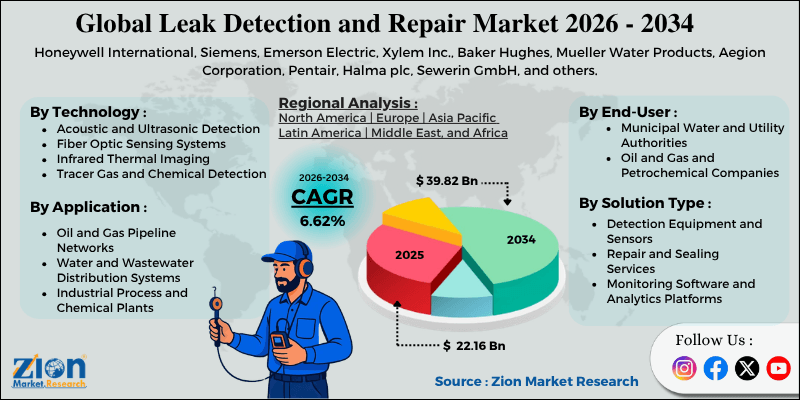
The global leak detection and repair market size was worth approximately USD 22.16 billion in 2025 and is projected to grow to around USD 39.82 billion by 2034, with a compound annual growth rate of roughly 6.62% between 2026 and 2034.
Key Insights
- As per the analysis shared by our research analyst, the global leak detection and repair market is estimated to grow annually at a compound annual growth rate of around 6.62% over the forecast period from 2026 to 2034.
- In terms of revenue, the global leak detection and repair market size was valued at approximately USD 22.16 billion in 2025 and is projected to reach USD 39.82 billion by 2034.
- The leak detection and repair market is expected to grow steadily, driven by aging water and gas pipeline networks in developed regions, rising government funding for non-revenue water reduction programs, growing awareness of methane emission control, expanding industrial safety compliance requirements, and increasing adoption of remote and automated monitoring tools.
- Based on technology, acoustic and ultrasonic detection is expected to lead the market. At the same time, fiber-optic sensing systems are anticipated to grow steadily as pipeline operators seek continuous, long-distance monitoring solutions.
- Based on application, the water and wastewater distribution segment is expected to lead the leak detection and repair market. In contrast, the oil and gas pipeline networks segment is anticipated to grow rapidly, driven by tighter methane leak regulations and stronger pipeline safety enforcement.
- Based on end-user, municipal water and utility authorities form the largest current end-user group. At the same time, oil and gas and petrochemical companies are expected to grow rapidly during the forecast period as emission monitoring rules become stricter.
- Based on solution type, detection equipment and sensors are expected to lead the market, while monitoring software and analytics platforms are anticipated to grow steadily as more utilities and plants move toward predictive, data-driven maintenance.
- Based on region, North America is projected to dominate the global leak detection and repair market during the estimated period, followed by the Asia Pacific.
Leak Detection and Repair Market: Overview
Leak detection and repair systems are technologies, equipment, and services used to find, monitor, and repair leaks in pipelines, storage tanks, buildings, and industrial equipment, helping prevent water, gas, oil, and chemical losses before they become serious problems. These systems use sensors, software, and inspection tools to detect even small leaks that are difficult to see with the naked eye. Modern solutions include acoustic sensors, fiber-optic cables, infrared cameras, pressure-monitoring devices, and tracer gases to locate leaks and expedite repairs accurately. After a leak is identified, technicians repair it using sealing compounds, pipe clamps, pipe relining, or other specialized methods without always replacing the entire pipeline. Leak detection and repair systems are widely used in water utilities, oil and gas facilities, manufacturing plants, commercial buildings, and chemical industries to improve safety and reduce losses. Rising water and energy costs, stricter environmental regulations, and growing concerns about aging infrastructure are increasing demand for these systems. Early leak detection helps prevent accidents, reduce maintenance costs, improve operational efficiency, protect the environment, and support sustainability goals, making these solutions an essential part of modern infrastructure management.
The leak detection and repair industry is growing due to aging infrastructure, tightening safety regulations, and the rising need to conserve water and energy resources.
Impact of the USA-Israel War on Iran on the Leak Detection and Repair Market
Geopolitical tensions involving the United States, Israel, and Iran may affect global oil and gas supply routes, creating short-term uncertainty about pipeline safety investments in the Middle East. Some disruptions in regional energy trade could delay planned infrastructure inspection projects and draw more attention to the importance of monitoring critical pipelines for damage or sabotage. However, steady demand from water utilities and industrial safety programs worldwide is expected to keep the leak detection and repair market on a stable growth path despite short-term regional challenges.
Leak Detection and Repair Market: Technology Roadmap 2025–2034
What is the projected development roadmap of the leak detection and repair market over the forecast period?
The leak detection and repair market is advancing through smarter sensors, artificial intelligence-based leak prediction, satellite and drone-based monitoring, and self-healing pipe materials that reduce the need for manual repair work. The market is expected to grow at a compound annual growth rate of around 6.62% over the forecast period, driven by steady demand from water conservation programs and industrial safety upgrades worldwide.
The following roadmap outlines key development phases expected through 2034.
2025–2027: Sensor Accuracy and Remote Monitoring Expansion Phase
- Equipment makers are expected to improve the accuracy and sensitivity of acoustic and fiber optic sensors, allowing operators to detect smaller leaks earlier and with fewer false alarms.
- Wireless and battery-powered sensor networks are expected to expand across water and gas distribution systems, reducing the need for constant manual inspection.
- Cloud-based dashboards are expected to help utilities and plant managers track leak data from multiple sites in a single location, speeding up response times.
2028–2031: Artificial Intelligence and Predictive Maintenance Phase
- Companies are expected to use artificial intelligence and machine learning to predict where leaks are likely to occur before they actually happen, based on pipe age, material, and pressure history.
- Drone- and satellite-based inspections are expected to grow for large pipeline networks that are difficult or costly to inspect on foot.
- Integration between leak detection systems and existing utility management software is expected to become more common, enabling faster, more coordinated repair work.
2032–2034: Self-Healing Materials and Autonomous Repair Phase
- Self-healing pipe coatings and materials are expected to gain wider use, automatically sealing small cracks before they turn into larger leaks.
- Autonomous robotic repair tools are expected to be used more often inside pipelines, reducing the need for excavation and manual labor.
- Fully integrated smart infrastructure networks are expected to combine detection, prediction, and repair into a single automated system for major cities and industrial sites.
Leak Detection and Repair Market: Dynamics
Growth Drivers
What is driving growth in the leak detection and repair market as infrastructure ages and regulations tighten?
The leak detection and repair market is growing steadily as aging pipeline infrastructure, rising water loss, and stricter environmental and safety regulations increase the need for advanced monitoring solutions. Many cities in North America and Europe still depend on water, gas, and oil pipelines that were installed decades ago. As these pipelines age, they are more likely to develop leaks that waste valuable resources, increase maintenance costs, and pose serious safety risks. To address these challenges, governments and regulatory authorities are introducing stricter rules for methane leak detection, water conservation, pipeline inspections, and emission control.
As a result, utilities and industrial companies are investing in modern leak detection systems to identify problems early and reduce the risk of costly repairs, service disruptions, and regulatory penalties. Growing concerns about water scarcity are also prompting water utilities to minimize water loss from hidden pipeline leaks. At the same time, oil and gas companies are adopting advanced leak monitoring technologies to reduce methane emissions, improve workplace safety, and protect the environment. Together, aging infrastructure, increasing environmental awareness, stricter government regulations, and the need to reduce operating costs are driving long-term global demand for leak detection and repair solutions across multiple industries.
Rising industrial safety standards and smart infrastructure investments are further strengthening the market growth.
The leak detection and repair industry is growing as companies across the manufacturing, oil and gas, chemical, and utility sectors focus on improving workplace safety, reducing product loss, and increasing operational efficiency. Even small leaks can lead to costly downtime, equipment damage, toxic chemical exposure, and fires or explosions if not detected early. To prevent these risks, many businesses are adopting advanced leak detection systems that continuously monitor pipelines, storage tanks, and industrial equipment. These systems help identify leaks quickly, allowing repairs to be completed before they become major problems. Many organizations are also investing in smart infrastructure by using connected sensors, IoT technology, and real-time monitoring software, rather than relying solely on manual inspections. This digital approach improves maintenance planning, lowers operating costs, and reduces unexpected equipment failures. As companies continue to invest in safer, smarter, and more efficient operations, global demand for leak detection and repair solutions is expected to grow steadily across industrial and municipal applications.
Restraints
High upfront costs and complex installation requirements are key challenges in the leak detection and repair market.
The leak detection and repair market faces several challenges, mainly due to the high cost of advanced leak detection systems and the difficulty of installing them across large, aging, or outdated infrastructure. Many small water utilities, factories, and industrial facilities, particularly in developing countries, struggle to afford technologies such as fiber optic sensors, acoustic leak detection systems, and continuous monitoring solutions, even though these investments can reduce long-term maintenance costs. Upgrading older pipelines, storage tanks, and buildings with modern monitoring equipment is also challenging because most existing infrastructure was not built to support these technologies.
In addition, harsh operating conditions, including extreme temperatures, underground environments, moisture, and exposure to corrosive chemicals, can affect sensor performance and increase maintenance requirements. Limited budgets and funding constraints often prevent public utilities from adopting advanced monitoring systems as quickly as they need to. Together, these factors continue to limit the faster adoption of leak detection and repair solutions, despite their proven safety, environmental, and cost-saving benefits.
Opportunities
How are smart cities, water scarcity, and infrastructure projects driving the leak detection and repair market?
The leak detection and repair market is creating significant growth opportunities as governments and industries invest in smart cities, water conservation, and modern infrastructure projects across developing regions. Many smart city initiatives now include advanced leak detection systems to improve water management, reduce energy losses, and strengthen public infrastructure. Growing concerns about water scarcity, especially in the Middle East, Africa, and South Asia, are encouraging governments to upgrade aging water distribution networks and reduce water leakage. Rapid urbanization in the Asia Pacific, Latin America, and parts of Africa is also increasing demand for new pipelines designed with built-in leak-monitoring technology from the outset.
At the same time, oil and gas companies are installing advanced leak detection solutions to meet stricter environmental regulations and improve operational safety. The falling cost of sensors, improvements in IoT-based monitoring systems, and rising awareness among small utilities and industrial businesses are making these technologies more accessible. Together, these trends are creating strong long-term opportunities for the global leak detection and repair market while supporting safer, smarter, and more sustainable infrastructure development.
Challenges
What challenges does the leak detection and repair market face in technical accuracy and workforce readiness amid rising competition?
The leak detection and repair market faces several challenges, including the need for highly accurate detection systems and a shortage of skilled professionals who can install, operate, and maintain advanced monitoring equipment. Even modern leak detection sensors can sometimes give false alarms or fail to detect very small leaks, especially in complex underground pipelines or noisy industrial environments. This can reduce user confidence and make leak detection more difficult. Installing, calibrating, and maintaining these systems also requires trained technicians, but many regions face a shortage of workers with the necessary technical skills.
As leak detection technology becomes more advanced and data-driven, the demand for experienced professionals continues to grow. The market is also highly competitive, with both large global companies and smaller local providers competing for projects, creating pricing pressure across the industry. Smaller companies often struggle to keep up with rapid technological advancements, while larger companies must continue investing in innovation, employee training, and customer support. These challenges can slow market growth and make it more difficult for many organizations to adopt advanced leak detection and repair solutions.
Leak Detection and Repair Market: Report Scope
| Report Attributes | Report Details |
|---|---|
| Report Name | Leak Detection and Repair Market |
| Market Size in 2025 | USD 22.16 Billion |
| Market Forecast in 2034 | USD 39.82 Billion |
| Growth Rate | CAGR of 6.62% |
| Number of Pages | 227 |
| Key Companies Covered | Honeywell International, Siemens, Emerson Electric, Xylem Inc., Baker Hughes, Mueller Water Products, Aegion Corporation, Pentair, Halma plc, Sewerin GmbH, and others. |
| Segments Covered | By Technology, By Application, By End-User, By Solution Type, and By Region |
| Regions Covered | North America, Europe, Asia Pacific (APAC), Latin America, Middle East, and Africa (MEA) |
| Base Year | 2025 |
| Historical Year | 2020 - 2024 |
| Forecast Year | 2026 - 2034 |
| Customization Scope | Avail customized purchase options to meet your exact research needs. Request For Customization |
Leak Detection and Repair Market: Segmentation
The global leak detection and repair market is segmented by technology, application, end-user, solution type, and region.
What makes acoustic and ultrasonic detection the expected leader in the leak detection and repair market?
Based on technology, the global leak detection and repair market is divided into acoustic and ultrasonic detection, fiber optic sensing systems, infrared thermal imaging, and tracer gas and chemical detection. Acoustic and ultrasonic detection holds about 40% of the market share, leading due to its reliability, cost-effectiveness, and compatibility with a wide range of pipe materials and sizes. Fiber-optic sensing systems hold around a 22% share. It is one of the fastest-growing segments, driven by increasing demand for continuous monitoring of long oil, gas, and water pipelines.
How does the water and wastewater distribution application segment maintain its leading position in the leak detection and repair market?
Based on application, the leak detection and repair market is categorized into oil and gas pipeline networks, water and wastewater distribution systems, industrial process and chemical plants, and building, HVAC, and utility systems. The water and wastewater distribution segment accounts for about 38% of the global leak detection and repair market, driven by the need to reduce water losses in urban distribution networks. The oil and gas pipeline networks segment holds around 27% share. It is one of the fastest-growing segments, driven by stricter methane emission regulations and stronger safety standards across the oil and gas industry.
What makes municipal water and utility authorities the leading end-users of leak detection and repair solutions?
Based on end-user, the market is classified into municipal water and utility authorities, oil and gas and petrochemical companies, manufacturing and industrial facilities, and commercial and residential property owners. Municipal water and utility authorities lead with about 36% share, driven by ongoing pressure to reduce water waste and improve service reliability for growing populations. Oil & gas and petrochemical companies hold around a 29% share of the market. They are growing rapidly due to stricter regulations on emissions monitoring and pipeline safety.
How do detection equipment and sensors dominate the solution type landscape in the leak detection and repair market?
Based on solution type, the leak detection and repair industry is segregated into detection equipment and sensors, repair and sealing services, monitoring software and analytics platforms, and inspection and consulting services. Detection equipment and sensors account for about 41% of the market, leading due to their accuracy and reliability in leak monitoring. Monitoring software and analytics platforms hold around 18% share. They are growing steadily as utilities and industries adopt predictive, data-driven leak management systems.
Leak Detection and Repair Market: Regional Analysis
How is North America shaping global demand for leak detection and repair solutions?
The North America leak detection and repair market holds the largest share and is expected to grow at a CAGR of around 5.8% during the forecast period. Market growth is driven by aging water and gas pipelines, stricter environmental regulations, and increasing government investments to reduce water loss and methane emissions. The United States is the leading market because it has a large network of old pipelines that require regular monitoring, maintenance, and repairs. Federal and state governments are also investing heavily in upgrading critical infrastructure. Canada is supporting regional growth through investments in oil and gas pipeline safety and improvements to municipal water distribution systems. Growing awareness of the financial losses and environmental damage caused by undetected leaks is encouraging both public utilities and private companies to adopt advanced leak detection systems.
At the same time, stricter reporting rules for methane emissions and water leakage are increasing the demand for modern monitoring technologies. The expansion of smart city projects and digital infrastructure is creating additional opportunities for connected leak detection solutions. These factors continue to make North America the leading regional market for leak detection and repair systems.
How does Asia Pacific maintain its strong position in the leak detection and repair market?
The Asia Pacific leak detection and repair market is the second-largest regional market and is expected to grow at a CAGR of around 7.1% during the forecast period. Growth is supported by rapid urbanization, expanding industries, and increasing government efforts to improve water conservation and infrastructure. China plays a major role due to its large-scale infrastructure projects and growing focus on reducing water and energy losses in rapidly developing cities. India is also witnessing strong growth through government-led water management programs and rising investments in oil and gas pipeline safety.
Countries such as Japan and South Korea contribute through their advanced manufacturing industries, where accurate leak detection is essential for safety and operational efficiency. Vietnam, Indonesia, and Thailand are also experiencing rising demand as urban populations grow and water distribution networks continue to expand. Governments across the region are investing in smart water management and digital infrastructure, including advanced leak detection systems. Increasing industrial development, stronger environmental awareness, and greater investment in modern monitoring technologies are helping the Asia-Pacific region become one of the fastest-growing markets for leak detection and repair solutions.
Recent Market Developments
- In April 2026, Atmos International launched Atmos Insight, a high-resolution water network monitoring platform designed to help utilities detect leaks earlier and improve water distribution efficiency.
- In June 2026, Xylem Inc. continued expanding its SmartBall pipeline inspection and leak detection platform, helping water utilities identify small leaks and assess pipeline condition with minimal service disruption.
Leak Detection and Repair Market: Competitive Analysis
The leading players in the global leak detection and repair market are:
- Honeywell International
- Siemens
- Emerson Electric
- Xylem Inc.
- Baker Hughes
- Mueller Water Products
- Aegion Corporation
- Pentair
- Halma plc
- Sewerin GmbH
The global leak detection and repair market is segmented as follows:
By Technology
- Acoustic and Ultrasonic Detection
- Fiber Optic Sensing Systems
- Infrared Thermal Imaging
- Tracer Gas and Chemical Detection
By Application
- Oil and Gas Pipeline Networks
- Water and Wastewater Distribution Systems
- Industrial Process and Chemical Plants
- Building, HVAC, and Utility Systems
By End-User
- Municipal Water and Utility Authorities
- Oil and Gas and Petrochemical Companies
- Manufacturing and Industrial Facilities
- Commercial and Residential Property Owners
By Solution Type
- Detection Equipment and Sensors
- Repair and Sealing Services
- Monitoring Software and Analytics Platforms
- Inspection and Consulting Services
By Region
- North America
- The U.S.
- Canada
- Mexico
- Europe
- France
- The UK
- Spain
- Germany
- Italy
- Rest of Europe
- Asia Pacific
- China
- Japan
- India
- Australia
- South Korea
- Rest of Asia Pacific
- The Middle East & Africa
- Saudi Arabia
- UAE
- Egypt
- Kuwait
- South Africa
- Rest of the Middle East & Africa
- Latin America
- Brazil
- Argentina
- Rest of Latin America
Table Of Content
Methodology
FrequentlyAsked Questions
Leak detection and repair systems are tools, equipment, and services designed to identify, locate, and fix leaks in pipelines, storage tanks, buildings, and industrial equipment. They use sensors, software, and inspection methods to spot leaks of water, oil, gas, or chemicals early, helping prevent damage, waste, and safety hazards.
The global leak detection and repair market is expected to grow, driven by aging pipeline infrastructure in developed regions, tightening methane-emission and water-loss regulations, rising government funding for smart water networks, growing industrial safety requirements, and the increasing adoption of artificial intelligence-based predictive monitoring tools.
According to research, the global leak detection and repair market size was worth around USD 22.16 billion in 2025 and is predicted to grow to around USD 39.82 billion by 2034.
The compound annual growth rate value of the leak detection and repair market is expected to be around 6.62% during 2026 to 2034.
North America is expected to lead the global leak detection and repair market during the forecast period, driven by aging water and gas infrastructure, strong regulatory pressure on methane emissions, and significant public funding for pipeline safety and water conservation programs.
The major players in the global leak detection and repair market include Honeywell International, Siemens, Emerson Electric, Xylem Inc., Baker Hughes, Mueller Water Products, Aegion Corporation, Pentair, Halma plc, and Sewerin GmbH.
The report examines key aspects of the leak detection and repair market, including growth drivers, restraints, emerging opportunities, challenges, a competitive landscape analysis, regional breakdowns, and a detailed future outlook across all major technologies, applications, end users, and geographies.
The leak detection and repair market is shifting toward smart, connected monitoring systems, with growing preference for predictive maintenance, real-time data tracking, and automated repair solutions across water, energy, and industrial sectors worldwide.
The leak detection and repair market will grow in water distribution monitoring, oil and gas pipeline safety, industrial process protection, and building utility management, driven by resource conservation goals, safety regulations, and rising global infrastructure investment.
The leak detection and repair market is advancing through artificial intelligence-based leak prediction, fiber-optic and satellite monitoring, self-healing pipe materials, and autonomous robotic repair tools, alongside digital platforms that improve accuracy, efficiency, and cost savings across water and industrial applications.

HappyClients

