
Gas Pipeline Infrastructure Market Size, Share, Trends, Growth and Forecast 2032

Gas Pipeline Infrastructure Market - By Operation (Distribution And Transmission), By Application (Offshore And Onshore), By Diameter (> 36 Inch, 25-36 Inch, 17-24 Inch, And = 16 Inch), By Equipment (Valves {Gate Valve, Ball Valve, & Plug Valve}, Pipeline, Metering Skids, And Compressor Station {Motors & Turbine}), And By Region - Global Industry Perspective, Comprehensive Analysis, and Forecast, 2024 - 2032
| Market Size in 2023 | Market Forecast in 2032 | CAGR (in %) | Base Year |
|---|---|---|---|
| USD 4.06 Billion | USD 5.16 Billion | 2.7% | 2023 |
Gas Pipeline Infrastructure Market Insights
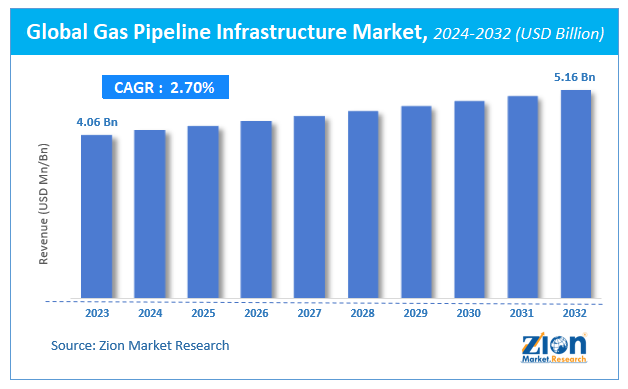
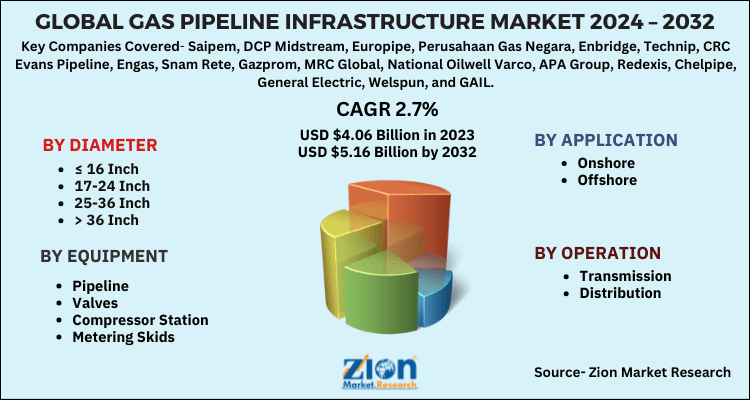
Zion Market Research has published a report on the global Gas Pipeline Infrastructure Market, estimating its value at USD 4.06 Billion in 2023, with projections indicating that it will reach USD 5.16 Billion by 2032. The market is expected to expand at a compound annual growth rate (CAGR) of 2.7% over the forecast period 2024-2032.
The report explores the factors fueling market growth, the hitches that could hamper this expansion, and the opportunities that may arise in the Gas Pipeline Infrastructure industry. Additionally, it offers a detailed analysis of how these elements will affect market demand dynamics and market performance throughout the forecast period.
Introduction
Gas pipeline infrastructure is a safe mode and cost-effective way of natural gas transportation and helps in connecting source to destination. Precisely, it assists in establishing the connection between producer and the consumer. Furthermore, it is the viable alternative of transporting gas through land route. However, it is utilized in both the offshore and onshore activities. Moreover, the gas pipeline infrastructure is defined as a pipeline that accumulates, transports, and distributes natural gas from gas wells or gas basins to the end-user.
Market Growth Drivers
Escalating demand for natural gas in commercial, power generation, residential, chemical, and manufacturing sectors will proliferate the expansion of gas pipeline infrastructure industry over the forecasting years. Surge in the government funding to increase the access of the gas pipeline to remote areas coupled with requirement of upgrading the current infrastructure of gas pipelines to avoid accidents or leakages will prompt the market growth in the years ahead. Apparently, rise in the exploration & production of shale gas and escalating need of deploying pipeline for transporting the gas across emerging economies and developed countries are few of the key aspects driving the expansion of gas pipeline infrastructure industry over the forecasting years. Ongoing projects like construction of Iran-Pakistan gas pipeline and Central Asia – China gas pipeline will further catapult the expansion of global gas pipeline infrastructure industry over the forthcoming years.
Furthermore, surging requirement of natural gas for power generation along with discoveries of gas reserves will offer new horizons of growth for the market in the years ahead. With energy preservation and renewable energy trends becoming the buzz words of energy & mining sector, governments across the globe are focusing on building strong gas pipeline infrastructure to reduce fuel emissions in atmosphere, thereby driving the business trends.
Gas Pipeline Infrastructure Market: Report Scope
| Report Attributes | Report Details |
|---|---|
| Report Name | Gas Pipeline Infrastructure Market |
| Market Size in 2023 | USD 4.06 Billion |
| Market Forecast in 2032 | USD 5.16 Billion |
| Growth Rate | CAGR of 2.7% |
| Number of Pages | 110 |
| Key Companies Covered | Saipem, DCP Midstream, Europipe, Perusahaan Gas Negara, Enbridge, Technip, CRC Evans Pipeline, Engas, Snam Rete, Gazprom, MRC Global, National Oilwell Varco, APA Group, Redexis, Chelpipe, General Electric, Welspun, and GAIL |
| Segments Covered | By Application, By Operation, By Equipment, By Diameter And By Region |
| Regions Covered | North America, Europe, Asia Pacific (APAC), Latin America, Middle East, and Africa (MEA) |
| Base Year | 2023 |
| Historical Year | 2018 - 2022 |
| Forecast Year | 2024 - 2032 |
| Customization Scope | Avail customized purchase options to meet your exact research needs. Request For Customization |
North American Market To Garner Humungous Gains Over 2020-2026
The growth of the market in North America over the estimated timespan is due to massive funding of natural gas pipeline infrastructure projects. Furthermore, increase in the gas exports through national pipeline in Mexico will widen the scope of business in the region over the forecast timespan. Apparently, launching of new projects and expansion of current pipeline network in the countries like the U.S. will amplify the growth of the gas pipeline infrastructure industry in North America over the forthcoming years.
Key players influencing the market expansion are -
- Saipem
- DCP Midstream
- Europipe
- Perusahaan Gas Negara
- Enbridge
- Technip
- CRC Evans Pipeline
- Engas
- Snam Rete
- Gazprom
- MRC Global
- National Oilwell Varco
- APA Group
- Redexis
- Chelpipe
- General Electric
- Welspun
- GAIL.
The global gas pipeline infrastructure market is segmented as follows:
By Application
- Onshore
- Offshore
By Operation
- Transmission
- Distribution
By Equipment
- Pipeline
- Valves
- Ball Valve
- Gate Valve
- Plug Valve
- Compressor Station
- Turbine
- Motors
- Metering Skids
By Diameter
- ≤ 16 Inch
- 17-24 Inch
- 25-36 Inch
- > 36 Inch
By Region
- North America
- The U.S.
- Canada
- Mexico
- Europe
- France
- The UK
- Spain
- Germany
- Italy
- Rest of Europe
- Asia Pacific
- China
- Japan
- India
- Australia
- South Korea
- Rest of Asia Pacific
- The Middle East & Africa
- Saudi Arabia
- UAE
- Egypt
- Kuwait
- South Africa
- Rest of the Middle East & Africa
- Latin America
- Brazil
- Argentina
- Rest of Latin America
Table Of Content
Methodology
FrequentlyAsked Questions
Gas pipeline infrastructure transports natural gas over long distances. It ensures safe and continuous energy supply
The global Gas Pipeline Infrastructure market is expected to be driven by the rising energy demand, gas distribution expansion, and pipeline modernization. Investments in safety and cross-border pipelines support market growth.
According to study, the global Gas Pipeline Infrastructure market size was worth around USD 4.06 Billion in 2023 and is predicted to grow to around USD 5.16 Billion By 2032.
The global Gas Pipeline Infrastructure market is expected to grow at a Compound Annual Growth Rate (CAGR) of around CAGR 2.7% during the forecast period from 2024-2032.
The global Gas Pipeline Infrastructure industry is projected to be challenged by Challenges include high capital costs, regulatory approvals, and safety and environmental concerns.
The Opportunities include natural gas demand growth, energy transition fuel role, pipeline modernization, and cross-border energy projects will offer significant growth opportunities in the Gas Pipeline Infrastructure market.
Smart pipeline monitoring with sensors; integrity management and leak detection; upgrades driven by energy security needs are the emerging trends and innovations impacting the Gas Pipeline Infrastructure market.
The global Gas Pipeline Infrastructure market is expected to be led by North America during the forecast period.
Some of the prominent players operating in the global Gas Pipeline Infrastructure market are; Saipem, DCP Midstream, Europipe, Perusahaan Gas Negara, Enbridge, Technip, CRC Evans Pipeline, Engas, Snam Rete, Gazprom, MRC Global, National Oilwell Varco, APA Group, Redexis, Chelpipe, General Electric, Welspun, and GAIL and others.
The report explores crucial aspects of the Gas Pipeline Infrastructure market, including a detailed discussion of existing growth factors and restraints, while also browsing future growth opportunities and challenges that impact the market.

HappyClients

