
Global Fiber Optic Sensors Market Size, Share, Report 2034

Fiber Optic Sensors Market By Type (Intrinsic and Extrinsic), By End-User Industry (Energy & Power, Defense, Transportation, Infrastructure, Medical, Industrial, and Others), By Component (Receivers, Transmitters, Fiber Optic Cables, and Optical Amplifiers), and By Region - Global and Regional Industry Overview, Market Intelligence, Comprehensive Analysis, Historical Data, and Forecasts 2025 - 2034
| Market Size in 2024 | Market Forecast in 2034 | CAGR (in %) | Base Year |
|---|---|---|---|
| USD 2480.6 Million | USD 4650.38 Million | 6.73% | 2024 |
Fiber Optic Sensors Industry Perspective:
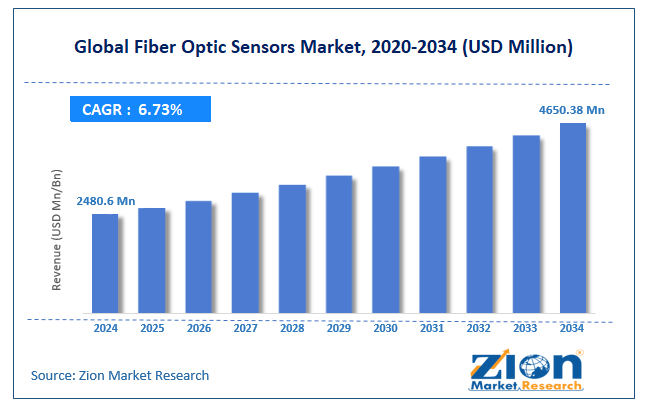
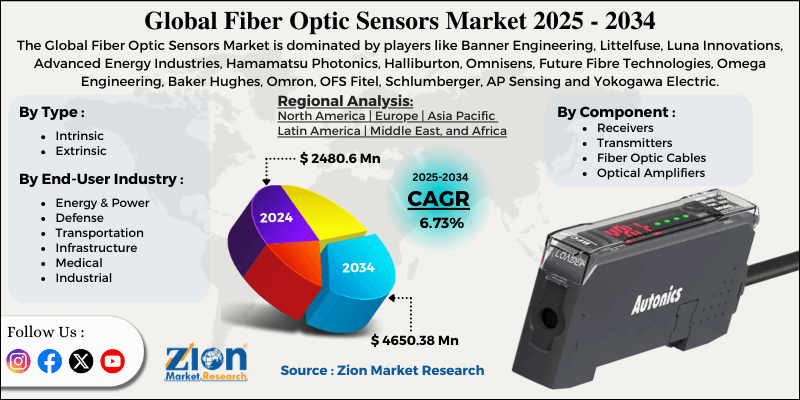
The global fiber optic sensors market size was worth around USD 2480.6 Million in 2024 and is predicted to grow to around USD 4650.38 Million by 2034 with a compound annual growth rate (CAGR) of roughly 6.73 % between 2025 and 2034.
Key Insights:
- As per the analysis shared by our research analyst, the global fiber optic sensors market is estimated to grow annually at a CAGR of around 6.73 % over the forecast period (2025-2034)
- In terms of revenue, the global fiber optic sensors market size was valued at around USD 2480.6 Million in 2024 and is projected to reach USD 4650.38 Million by 2034.
- The market is projected to grow at a significant rate due to the to be driven by the rising applications of the technology in the medical industry.
- Based on the type, the intrinsic segment is growing at a high rate and will continue to dominate the global market, as per industry projections.
- Based on the end-user industry, the energy & power segment is anticipated to command the largest market share.
- Based on region, North America is projected to dominate the global market during the forecast period.
Fiber Optic Sensors Market: Overview
Fiber optic sensors, also known as optical fiber sensors, are modern-age sensing elements. They are used for sensing essential quantities such as pressure, temperature, displacements, vibrations, concentrations, and rotations. Fiber optic sensors play a critical role in remote sensing. In addition to this, fiber optic sensors are compact and hence can fit into different environments. Furthermore, fiber optic sensors use light instead of electricity to transmit information. Some of the prominent advantages of fiber optic sensors include applications in harsh conditions, immunity against electrical interference, and higher accuracy. They are widely used for monitoring the structural integrity of large-scale facilities and infrastructure such as tunnels, bridges, buildings, and energy systems.
During the forecast period, demand for fiber optic sensors is expected to continue growing, driven by rising applications in offshore projects and the medical sector. Additionally, the increasing introduction of novel and advanced fiber optic sensors will propel market growth opportunities in the coming years. A major drawback for the industry players may emerge in the form of high capital investment and technical limitations in certain environments.
Fiber Optic Sensors Market Dynamics
Growth Drivers
How will increased applications in the medical sector fuel the fiber optic sensors market growth?
The global fiber optic sensors market is expected to be driven by the rising applications of the technology in the medical industry. These sensing devices are widely used in different types of medical devices, including surgical instruments and wearables for health monitoring. Fiber optic sensors are extremely small in size and hence can easily fit into surgical equipment to enter compact body parts such as blood vessels. In addition to this, extensive biocompatibility of fiber optic sensors encourages safe use of the technology during surgical procedures. According to industry research, fiber optic sensors are more preferred during minimally invasive surgeries or in high-voltage environments.
In September 2025, researchers at the Indian Institute of BITS Pilani, in partnership with IIT Bombay, developed a novel portal and low-cost fiber optic sensor for monitoring brain health. The nano-engineered sensing device accurately detects L-tyrosine. It is a critical molecule for determining brain health, neurological balance, and hormone regulation. The growing demand for next-generation medical devices worldwide will create higher investments in the fiber optic sensors sector.
Rising investments in infrastructure projects and demand for structural health monitoring will propel industry revenue
Over the last few years, investments in infrastructure projects worldwide have grown at an unprecedented scale. Developing economies such as China, India, and African nations have emerged as some of the prominent investors in infrastructure-related projects. In addition to this, aging infrastructure has further created growth scope for modern architecture. Tunnels, bridges, dams, and high-rise commercial & residential buildings are some of the most prominent forms of novel infrastructure.
Structural health monitoring (SHM) plays a crucial role in ensuring structural safety and preventing unwanted failures or accidents. The solutions available in the global fiber optic sensors market are some of the leading technologies helping companies obtain critical information related to SHM and take preventative measures. The growing awareness about the importance of infrastructure resilience will create higher demand for fiber optic sensors in the coming years.
Restraints
Why will cost constraints emerge as leading growth barriers against the fiber optic sensors market?
The global industry for fiber optic sensors is expected to be restricted due to the high capital cost associated with the technology. The expenses associated with fiber optic sensors are a result of the growing price of fiber cables, complex signal processing technology, and the use of next-generation sensors. The initial financial burden can become overwhelming for small and medium-sized firms, leading to a restricted number of players operating in the market.
Opportunities
Increasing technological advancements are reported in the industry to generate growth opportunities
The global fiber optic sensors market is expected to generate growth opportunities due to the rising technological advancements reported in the market. These advancements are directed toward improving fiber optic sensor performance and overall applications. In November 2025, Huawei announced the launch of a major breakthrough in substation digitalization using its Intelligent Perimeter Fiber Sensing technology. The novel solution replaces the older approach of manual substation inspection with a continuous 360-degree fiber-optic sensing. It can detect even subtle changes in the environment for more accurate results.
Will regulatory requirements positively influence the fiber optic sensors market growth trends in the future?
One of the major growth propellers for the fiber optic sensing industry is the growing regulatory requirements on contractors and builders to ensure the structural and environmental integrity of construction projects. Public safety has become a prime area of concern among governments, creating demand for applications of fiber optic sensors in large-scale and smaller projects. Companies are expected to invest in fiber optic sensors to comply with regional safety standards to avoid safety risks and regulatory penalties.
Challenges
Lack of standard policies to challenge market growth during the projection period
The global industry for fiber optic sensors is expected to be challenged by the lack of standardization across the global landscape. This form of non-uniformity exists in interfaces, data formats, and protocols among manufacturers. Additionally, challenges related to interoperability can further impact market decisions in the long run. Lack of flexibility and rising business uncertainty can impact business decisions in the long run.
Fiber Optic Sensors Market: Report Scope
| Report Attributes | Report Details |
|---|---|
| Report Name | Fiber Optic Sensors Market |
| Market Size in 2024 | USD 2480.6 Million |
| Market Forecast in 2034 | USD 4650.38 Million |
| Growth Rate | CAGR of 6.73% |
| Number of Pages | 240 |
| Key Companies Covered | Banner Engineering, Littelfuse, Luna Innovations, Advanced Energy Industries, Hamamatsu Photonics, Halliburton, Omnisens, Future Fibre Technologies, Omega Engineering, Baker Hughes, Omron, OFS Fitel, Schlumberger, AP Sensing and Yokogawa Electric. |
| Segments Covered | By Type, By End-User Industry, By Component and By Region |
| Regions Covered | North America, Europe, Asia Pacific (APAC), Latin America,The Middle East and Africa (MEA) |
| Base Year | 2024 |
| Historical Year | 2019 to 2023 |
| Forecast Year | 2025 - 2034 |
| Customization Scope | Avail customized purchase options to meet your exact research needs. Request For Customization |
Fiber Optic Sensors Market: Segmentation
The global fiber optic sensors market is segmented based on type, end-user industry, component, and region.
Based on type, the global market segments are intrinsic and extrinsic. In 2024, the highest growth was listed in the intrinsic segment. It accounted for nearly 98.01% of the total revenue. Intrinsic fiber optic sensors are designed to perform the role of core sensing elements. They offer excellent reliability and accuracy in detecting changes in external conditions, including temperature and heat. The industry players can expect similar trends in the future.
Based on the end-user industry, the global market divisions are energy & power, defense, transportation, infrastructure, medical, industrial, and others. In 2024, the energy & power segment emerged as the leading revenue generator. The digitalization of the energy sector and application of smart grid solutions are expected to fuel segmental revenue in the coming years. The oil & gas sector is anticipated to emerge as the second-highest revenue generator in the future.
Fiber Optic Sensors Market: Regional Analysis
Why will North America emerge as the leading region in the fiber optic sensors market?
The global fiber optic sensors market is expected to be led by North America during the projection period. The region will be dominated by the US, according to official research. Growth in North America will be driven by rising investments in upgrading existing infrastructure in the country, along with the construction of new state-of-the-art public and private buildings. The US is home to several high-rise buildings requiring the use of fiber optic sensor technology to monitor the structural health of these facilities. Moreover, strict safety regulations governing the regional market will further encourage higher revenue in North America.
Europe is expected to emerge as a prominent market. The growing number of offshore projects and rising investments in large-scale renewable energy plants will create growth opportunities in the region. Countries such as Germany, France, and the UK will lead regional revenue in the coming years. Asia-Pacific is expected to register the fastest CAGR during the forecast period. Growing infrastructure development projects across Asian countries and rising applications of the technology in the medical sector will fuel regional expansion. Additionally, growth in Asia-Pacific will be promoted by efforts toward the cost of technology production and end application, while encouraging the scalability of fiber optic sensors.
Fiber Optic Sensors Market: Competitive Analysis
The global fiber optic sensors market is led by players like;
- Banner Engineering
- Littelfuse
- Luna Innovations
- Advanced Energy Industries
- Hamamatsu Photonics
- Halliburton
- Omnisens
- Future Fibre Technologies
- Omega Engineering
- Baker Hughes
- Omron
- OFS Fitel
- Schlumberger
- AP Sensing
- Yokogawa Electric
Fiber Optic Sensors Market: Key Market Trends
Growing demand for real-time monitoring
A rising trend in the industry, fueling the fiber optic sensors market, has emerged in the form of rising demand for solutions that allow real-time monitoring and tracking of critical elements that impact the industrial landscape. Fiber optic sensors allow access to vibration, temperature, and strain-related information in real time and thus witness greater acceptance.
Environment monitoring
The growing concerns worldwide related to sustainability and environmental damage caused by industrialization have propelled the increased application of fiber optic sensors. These solutions detect changes in environmental conditions, including tracking of pollution levels.
The global fiber optic sensors market is segmented as follows:
By Type
- Intrinsic
- Extrinsic
By End-User Industry
- Energy & Power
- Defense
- Transportation
- Infrastructure
- Medical
- Industrial
- Others
By Component
- Receivers
- Transmitters
- Fiber Optic Cables
- Optical Amplifiers
By Region
- North America
- The U.S.
- Canada
- Europe
- France
- The UK
- Spain
- Germany
- Italy
- Rest of Europe
- Asia Pacific
- China
- Japan
- India
- South Korea
- Southeast Asia
- Rest of Asia Pacific
- Latin America
- Brazil
- Mexico
- Rest of Latin America
- Middle East & Africa
- GCC
- South Africa
- Rest of Middle East & Africa
Table Of Content
Methodology
FrequentlyAsked Questions

HappyClients

