
Medical Devices Retail Market Size, Share, Industry Analysis Report 2032

Medical Devices Retail Market By End-users (hospitals, home care, diagnostic centers, and others), By Types of expenditure (private and public), By Device types (anesthesia & respiratory devices, ENT devices, nephrology & urology devices, diabetic care devices, cardiovascular devices, orthopedic devices, ophthalmic devices, dental equipment & supplies, in-vitro diagnostic, and others) And By Region: - Global and Regional Industry Overview, Market Intelligence, Comprehensive Analysis, Historical Data, and Forecasts, 2024-2032
| Market Size in 2023 | Market Forecast in 2032 | Growth Rate (in %) | Base Year |
|---|---|---|---|
| USD 538.21 Billion | USD 865.49 Billion | CAGR at 5.42% | 2023 |
Description
How big is the Medical Devices Retail Market?
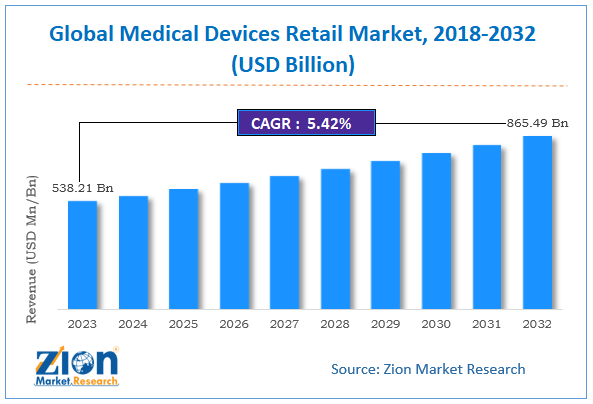
According to the report published by Zion Market Research, the global Medical Devices Retail Market size was valued at USD 538.21 Billion? in 2023 and is predicted to reach USD 865.49 Billion? by the end of 2032. The market is expected to grow with a CAGR of 5.42% during the forecast period. The report analyzes the global Medical Devices Retail Market’s growth drivers, restraints, and impact on demand during the forecast period. It will also help navigate and explore the arising opportunities in the Medical Devices Retail Market industry.
Global Medical Devices Retail Market: Overview
Medical devices are machines, apparatus, instruments, or articles that can be utilized for effective treatment, prevention, screening, and diagnosis of different types of disorders and diseases. It can also be utilized for restoring, correcting, detecting, measuring, or modifying the function and structure of the human body to improve the overall health of an individual. The medical devices retail market is associated with the sales of goods to consumers directly in smaller quantities and these are not for resale. Such devices are sold on retail stores including weighing scale, stethoscopes, thermometers, monitoring & diagnosing kits, and other wearable devices which can be utilized for monitoring different parameters of health.
Global Medical Devices Retail Market: Growth Factors
The growing inclination of people towards advanced technology is one of the major factors driving the growth of the global medical devices retail market. Moreover, the significant spike in the geriatric population all across the globe further propels the growth of the global medical devices retail market as they are more vulnerable to experience chronic disorders and diseases. Moreover, the hike in the accessibility to healthcare facilities offered by semi-government, government, private, and research institutes also boost the growth of the global medical devices retail market.
The increasing investment to boost the research and development activities in order to launch innovative and distinct medical devices to deal with the growing prevalence of chronic diseases effectively further escalates the growth of the market globally. However, the increasing research and development activities in the field of medical devices led to the launch of more advanced monitoring devices that are highly adopted by people nowadays to generate huge revenue in the global medical devices retail market.
Moreover, it has opened many lucrative growth opportunities in the market globally. Also, the ongoing technological development all across the globe is assisting manufacturers to develop highly advanced products to cater to the needs of patients. Moreover, the growing incidences and prevalence of chronic disorders in people all across the globe also poses a huge demand for monitoring, diagnosing, and screening devices in the market. The outback of the coronavirus pandemic has positively affected the growth of the global medical devices retail market during the forecast period. The pandemic has significantly propelled the demand for several diagnostic kids’ digital thermometers, oxygen meter, and many others.
Key Insights
- As per the analysis shared by our research analyst, the global Medical Devices Retail Market is estimated to grow annually at a CAGR of around 5.42% over the forecast period (2024-2032).
- In terms of revenue, the global Medical Devices Retail Market size was valued at around USD 538.21 Million in 2023 and is projected to reach USD 865.49 Million by 2032.
- Based on the end-users, the Hospitals represent the largest end-user segment in the global medical devices retail market. This dominance is attributed to the high volume of patient visits for various treatments and surgical procedures, necessitating a wide range of medical devices.
- Based on the types of expenditure, the Private expenditure accounts for the majority share in the medical devices retail market. This is driven by increased private investments in healthcare infrastructure and services, leading to higher procurement of medical devices through private channels.
- Based on the device types, the In-vitro diagnostic devices hold a significant share in the medical devices market. Their widespread use in diagnosing chronic diseases and conditions contributes to their dominance.
- Based on the region, the North America leads the global medical devices retail market. This leadership is due to advanced healthcare infrastructure, high healthcare expenditure, and rapid adoption of innovative medical technologies.
Medical Devices Retail Market: Report Scope
| Report Attributes | Report Details |
|---|---|
| Report Name | Medical Devices Retail Market Research Report |
| Market Size in 2023 | USD 538.21 Billion |
| Market Forecast in 2032 | USD 865.49 Billion |
| Growth Rate | CAGR of 5.42% |
| Number of Pages | 196 |
| Key Companies Covered | Baxter International Inc., Fresenius Medical Care, Cardinal Health, Siemens Healthineers, Ethicon LLC., GE Healthcare, Philips Healthcare, DePuy Synthes, Medtronic, and Stryker |
| Segments Covered | By End-users, By Types of expenditure, By Device types and By Region |
| Regions Covered | North America, Europe, Asia Pacific (APAC), Latin America, Middle East, and Africa (MEA) |
| Base Year | 2023 |
| Historical Year | 2018 - 2022 |
| Forecast Year | 2024 - 2032 |
| Customization Scope | Avail customized purchase options to meet your exact research needs. Request For Customization |
Global Medical Devices Retail Market: Segmentation
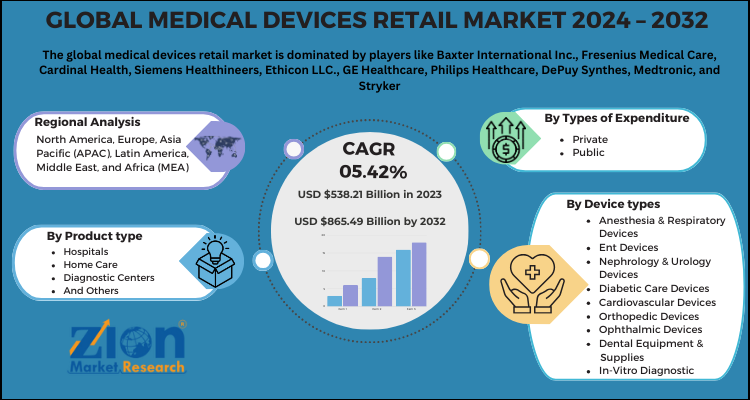
The global medical devices retail market can be segmented into end-users, types of expenditure, device types, and regions. All the segments have been analyzed based on present and future trends and the market is estimated from 2024 to 2032.
By end-user, the market can be segmented into hospitals, home care, diagnostic centers, and others. The hospital segment accounts for the largest share in the global medical devices retail market due to the large pool of patients visiting hospitals regularly for treatment. The home care segment is anticipated to witness huge growth during the forecast period due to the outbreak of coronavirus pandemic all across the globe.
By type of expenditure, the market can be segmented into private and public.
By device type, the market can be segmented into anesthesia & respiratory devices, ENT devices, nephrology & urology devices, diabetic care devices, cardiovascular devices, orthopedic devices, ophthalmic devices, dental equipment & supplies, in-vitro diagnostic, and others.
The regional segment includes the current and forecast demand for North America, Europe, Asia Pacific, Latin America, and the Middle East and Africa.
Global Medical Devices Retail Market: Regional analysis
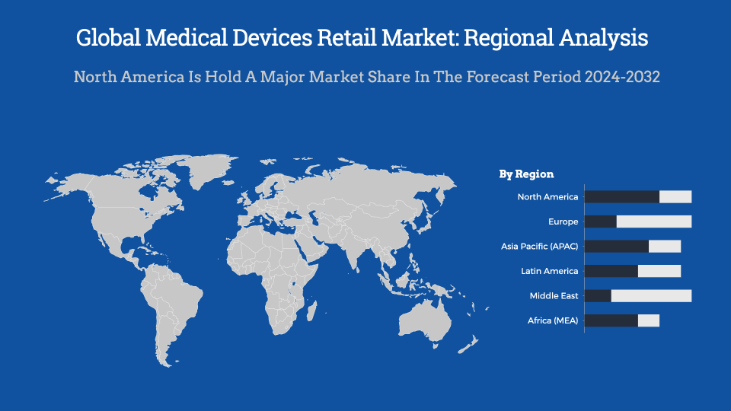
North America accounts for the largest share in the global medical devices retail market due to the presence of a strong consumer base in the region. Moreover, the rising incidences of chronic diseases in the region further boost the growth of the regional market during the forecast period.
Asia Pacific is expected to witness huge growth during the forecast period due to the presence of prominent market players in the region. Also, the growing disposable income of people fuels the growth of the regional market during the forecast period.
Global Medical Devices Retail Market: Competitive Players
Some of the significant players in the global medical devices retail market are:
- Baxter International Inc.
- Fresenius Medical Care
- Cardinal Health
- Siemens Healthineers
- Ethicon LLC.
- GE Healthcare
- Philips Healthcare
- DePuy Synthes
- Medtronic
- Stryker.
The Global Medical Devices Retail Market is segmented as follows:
By End-users
- Hospitals
- Home Care
- Diagnostic Centers
- And Others
By Types of expenditure
- Private
- Public
By Device types
- Anesthesia & Respiratory Devices
- Ent Devices
- Nephrology & Urology Devices
- Diabetic Care Devices
- Cardiovascular Devices
- Orthopedic Devices
- Ophthalmic Devices
- Dental Equipment & Supplies
- In-Vitro Diagnostic
- And Others
By Region
- North America
- The U.S.
- Canada
- Mexico
- Europe
- France
- The UK
- Spain
- Germany
- Italy
- Rest of Europe
- Asia Pacific
- China
- Japan
- India
- Australia
- South Korea
- Rest of Asia Pacific
- The Middle East & Africa
- Saudi Arabia
- UAE
- Egypt
- Kuwait
- South Africa
- Rest of the Middle East & Africa
- Latin America
- Brazil
- Argentina
- Rest of Latin America
What Reports Provides
- Full in-depth analysis of the parent market
- Important changes in market dynamics
- Segmentation details of the market
- Former, on-going, and projected market analysis in terms of volume and value
- Assessment of niche industry developments
- Market share analysis
- Key strategies of major players
- Emerging segments and regional markets
- Testimonials to companies in order to fortify their foothold in the market.
Table Of Content

FrequentlyAsked Questions
Medical devices retail involves selling medical equipment directly to consumers or healthcare providers. It includes pharmacies and specialty stores.
The global Medical Devices Retail market is expected to be driven by the Driven by aging populations, higher prevalence of chronic diseases, and growing demand for home-use and personal medical devices. Expanding retail pharmacy networks and online medical stores improve accessibility.
According to study, the global Medical Devices Retail market size was worth around USD 538.21 Billion in 2023 and is predicted to grow to around USD 865.49 Billion By 2032.
The global Medical Devices Retail market is expected to grow at a Compound Annual Growth Rate (CAGR) of around CAGR 5.42% during the forecast period from 2024-2032.
The global Medical Devices Retail industry is projected to be challenged by Challenges include regulatory compliance for device dispensing, inventory and cold-chain constraints for select products, and pricing pressure from online marketplaces.
The Opportunities arise from growth in home healthcare, increasing chronic disease prevalence, and expansion of omni-channel retail and subscription-based medical supplies will offer significant growth opportunities in the Medical Devices Retail market.
Omnichannel D2C with virtual fitting and guided buying; subscription models for consumables (CPAP, diabetes); stronger compliance, e-prescription linkage, and last-mile logistics are the emerging trends and innovations impacting the Medical Devices Retail market.
The global Medical Devices Retail market is expected to be led by North America during the forecast period.
Some of the prominent players operating in the global Medical Devices Retail market are; Baxter International Inc., Fresenius Medical Care, Cardinal Health, Siemens Healthineers, Ethicon LLC., GE Healthcare, Philips Healthcare, DePuy Synthes, Medtronic, and Stryker and others.
The report explores crucial aspects of the Medical Devices Retail market, including a detailed discussion of existing growth factors and restraints, while also browsing future growth opportunities and challenges that impact the market.
HappyClients

