
Industrial Absorbent Market Size, Growth, Global Trends, Forecast 2034

Industrial Absorbent Market By Material (Natural, Inorganic, and Synthetic), By Type (Universal, Oily-only, Hazmat, and Others), By Product (Pads, Sheets & Mats, Rolls, Pillows, and Others), By End-User (Oil & Gas, Healthcare, Food Processing, Manufacturing, Chemical, and Others), and By Region - Global and Regional Industry Overview, Market Intelligence, Comprehensive Analysis, Historical Data, and Forecasts 2025 - 2034
| Market Size in 2024 | Market Forecast in 2034 | CAGR (in %) | Base Year |
|---|---|---|---|
| USD 5.6 Billion | USD 8.4 Billion | 4.2% | 2024 |
Industrial Absorbent Industry Perspective:
What will be the size of the global industrial absorbent market during the forecast period?
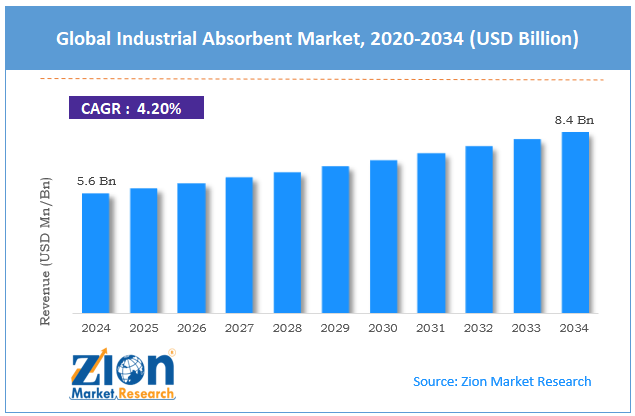
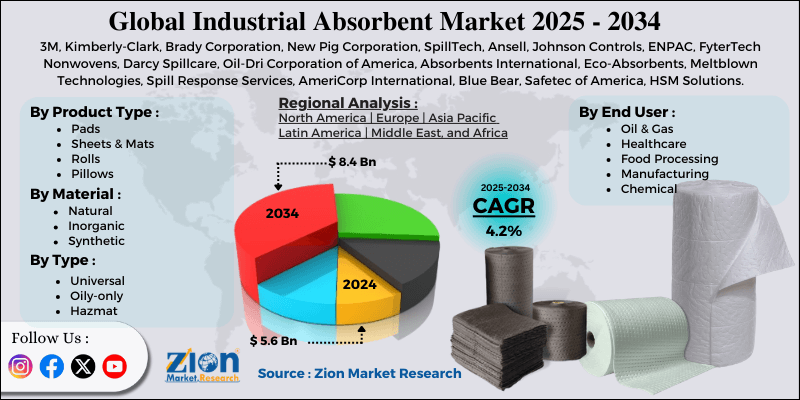
The global industrial absorbent market size was worth around USD 5.6 billion in 2024 and is predicted to grow to around USD 8.4 billion by 2034, with a compound annual growth rate (CAGR) of roughly 4.2% between 2025 and 2034.
Key Insights
- As per the analysis shared by our research analyst, the global industrial absorbent market is estimated to grow annually at a CAGR of around 4.2% over the forecast period (2025-2034).
- In terms of revenue, the global industrial absorbent market size was valued at around USD 5.6 billion in 2024 and is projected to reach USD 8.4 billion by 2034.
- Stringent environmental & waste regulations are expected to drive the industrial absorbent market.
- Based on the material, the natural material generates the highest market share in 2024.
- Based on the type, the universal type dominates the industry growth.
- Based on the product, the pads segment is growing at a significant rate over the projected period.
- Based on the end-user, the healthcare industry dominates the industry growth.
- Based on region, the Asia Pacific captures the largest revenue share in 2024.
Industrial Absorbent Market: Overview
Industrial absorbents are a tailor-made solution for the management of liquid spills in industrial and commercial settings. They are often used to absorb oil, petrol, chemicals, coolants, solvents, and water-based liquids, which can leak or spill during the manufacturing process, transit, storage, or maintenance procedures. Industrial absorbents are available in all shapes and sizes, including mats, pads, rolls, pillows, socks, booms, and loose granular applications, and are typically based on materials such as polypropylene, cellulose, clay, and other natural and synthetic fibers. The use of industrial absorbents is essential in providing a safe workplace by minimizing slip hazards and equipment damage, while limiting contamination and discharges into the environment. Oil and gas, chemical, automotive, food processing, marine, and heavy manufacturing are among the industries that most commonly use these absorbents.
Industrial Absorbent Market: Dynamics
Growth Drivers
Why does the expansion of industrial activities stimulate the expansion of the industrial absorbent market?
Industrial growth remains an important force shaping growth in the industrial absorbent industry. As more industries expand and open worldwide, the frequency of leaks, drips, and accidental spills is likely to increase as well. Plants that are routinely open 24 hours a day and have large production loads—such as refineries, warehouses, automotive plants, and chemical processing plants—deal with large quantities of oils, coolants, solvents, lubricants, and other potentially hazardous chemicals that must be kept under control.
Lastly, the ongoing increase in industrialization in growing economies throughout Latin America, the Asia Pacific, and the Middle East leads to more factories and industrial infrastructure, and thus heavier production loads. Business and industrial success means investing more heavily in safety management systems at the plant, the warehouse, the workshop, and the construction site; part of that system includes reducing spill-related risks with absorbent products. Industrial growth, therefore, leads to more demand for spill control/disposal products and the associated recurring revenue streams.
For instance, according to the data published by the International Energy Agency, the global oil & gas sector is experiencing steady growth, with the market projected to grow from USD 8,337.22 billion in 2025 to USD 8,751.35 billion in 2026 at a 5% CAGR. India is leading this demand, with consumption projected to rise from 5.6 to 6.7 million barrels per day by 2030, driven by industrialization and a 2.8% annual GDP growth.
Restraints
Fluctuating raw material price hindering the industry’s growth
Volatility in raw material prices is a key restraint on the growth of the industrial absorption industry. Industrial absorbents are manufactured from a wide range of petrochemical products, such as polypropylene, cellulose fibers, clay minerals, and other polymer-based raw materials. These depend on the price of crude oil and the availability of supply/demand balance, global politics, and trade agreements. The export of products from one economy can also influence the prices in the market. Throughout the supply chain, the direct relationship with crude oil prices has a profound impact.
For instance, polypropylene and other polymers are derived from crude oil; therefore, any wavering petroleum prices directly influence the production costs. Margin pressure experienced by absorbent producers due to sharp increases in the price of raw materials will be another factor. Although this indirect effect may influence the producer's decision by passing the cost increase onto the user, it will be difficult, as many industries operate on tight budgets to compete in a worldwide marketplace. It is most difficult for manufacturers to increase their prices without losing business. It discourages companies from investing in innovation and capacity increases and creates uncertainty in long-term supply agreements.
Opportunities
Does increasing acquisition offer a potential opportunity for the industrial absorbent market growth?
The increasing acquisition is expected to flourish the industrial absorbent market. For instance, in January 2026, Attindas Hygiene Partners’ expansion strategy took an important step forward with its acquisition of Societa Italiana Lavorazione Cellulosa (SILC S.p. A.). In the transaction, Attindas entered into a share purchase agreement for all of the 53-year-old family-owned company’s shares.
Based in Trescore Cremasco, Italy, near Milan, SILC S.p. A. has been producing high-quality, absorbent hygiene and skincare products for customers throughout Europe. Its customer base and range of products enhance Attindas’ position throughout northern and southern Europe and will begin to provide opportunities to better serve the whole of Europe and export markets.
Challenges
Does the availability of lower-cost substitutes pose a major challenge to the industrial absorbent market growth?
The existence of lower-cost alternatives poses a formidable challenge to the growth of the industrial absorbent market, especially in price-conscious segments. For the vast majority of end users and applications, the lowest-cost option is often the most attractive to end users, particularly for small manufacturing units, workshops, construction sites, and certain other emerging markets. Instead of purchasing engineered absorbent pads, rolls, or booms made of polypropylene or proprietary fibers, these end users may choose cheaper alternatives—sawdust, sand, crushed clay, rags, or even readily available granular materials. Such alternatives are widely accessible and require low initial capital investment. These alternatives may forgo the initial price premium that engineered product offerings are paying.
But, as is typical of industrial markets, this trend will only result in slower penetration of high-cost/high-margin engineered absorbent products. Different applications will not yield as readily to pump and absorb alternatives. Industries with strict rules, like oil & gas, chemicals, marine, and pharmaceuticals, probably won't find cheaper alternatives that work as well as engineered absorbents because those alternatives don't absorb as quickly, aren't as safe for the environment, don't use granular materials, or don't meet strict disposal needs.
Industrial Absorbent Market: Report Scope
| Report Attributes | Report Details |
|---|---|
| Report Name | Industrial Absorbent Market |
| Market Size in 2024 | USD 5.6 Billion |
| Market Forecast in 2034 | USD 8.4 Bllion |
| Growth Rate | CAGR of 4.2% |
| Number of Pages | 221 |
| Key Companies Covered | 3M, Kimberly-Clark, Brady Corporation, New Pig Corporation, SpillTech, Ansell, Johnson Controls, ENPAC, FyterTech Nonwovens, Darcy Spillcare, Oil-Dri Corporation of America, Absorbents International, Eco-Absorbents, Meltblown Technologies, Spill Response Services, AmeriCorp International, Blue Bear, Safetec of America, HSM Solutions, PIG Corporation, and others. |
| Segments Covered | By Material, By Type, By Product, By End User, and By Region |
| Regions Covered | North America, Europe, Asia Pacific (APAC), Latin America, Middle East, and Africa (MEA) |
| Base Year | 2024 |
| Historical Year | 2019 to 2023 |
| Forecast Year | 2025 - 2034 |
| Customization Scope | Avail customized purchase options to meet your exact research needs. Request For Customization |
Industrial Absorbent Market: Segmentation
Material Insights
Why does natural material hold the dominant position in the industrial absorbent market?
The natural material generates the highest market share in 2024. This growth is driven by the increased awareness about the environment, sustainability programs, and legislative pressure to minimize plastic waste. Natural absorbents, which are made from cellulose fiber, cotton, wool, coconut peat moss, corn cob, recycled paper, and so on, are getting a better response from all industries where spill control is more eco-friendly and biodegradable, like manufacturing, food processing, marine, chemical, and others.
Type Insights
Why does universal type hold the largest share in the industrial absorbent industry?
The universal type dominates the industry growth. Revenue increase is attributed to the product’s flexibility, low cost, and ability to be used in a wide variety of applications. A universal type is capable of taking in oils, water, coolants, solvents, and benign chemicals and can thus be used as an all-around maintenance and leak management tool within manufacturing plants, warehouses, service and maintenance facilities, car maintenance garages, and logistics storage areas. The economic value of universal absorbents is that users do not need to purchase different types of absorbents, which then require separate storage and ordering. The market believes that globally expanding industrial activity and higher occupational health and safety standards are encouraging companies to favor universal-type products for regular maintenance and spill management.
Product Insights
Is the pad segment of the industrial absorbent market growing significantly?
The pads segment is growing at a significant rate over the projected period. This growth is driven by the high level of convenience, efficiency, and frequent use of this product throughout day-to-day industrial maintenance operations. Absorbent pads are lightweight, easily placed, and easily absorb oils, coolants, solvents, and other industrial process fluids, making them more than suitable for the day-to-day management of usage spills across manufacturing plants, automotive workshops, and associated oil & gas industries. As they are disposable, they continually meet the recurring demand.
End-User Insights
What factors make healthcare a dominant segment of the industrial absorbent market?
The healthcare industry dominates the industry growth. Revenue growth has been attributed to the growing focus on standards for hygiene, infection control, and regulation compliance in hospitals, laboratories, pharmaceutical processing plants, and diagnostic centers. Hospitals and other healthcare facilities often come into contact with biofluids, disinfectants, chemicals, and pharmaceutical substances that require on-the-spot, safe cleanup and containment of spill residues during processing, storage, or first response. Industrial absorbents have many applications, including pads and sheets, as well as chemical-specific absorbent products. Industrial applications for absorbents include hospitals, laboratories, and storage areas. There is growing investment in health infrastructure, rising hospital admissions, and increased pharmaceutical production.
Regional Insights
Why does the Asia Pacific lead the industrial absorbent market?
The Asia Pacific captures the largest revenue share in 2024. This regional growth is driven by increased industrialization, manufacturing activity, and rising safety regulations for occupational and environmental protection standards in the region. Countries including China, India, Japan, South Korea, and other ASEAN nations are experiencing rapid growth in the oil & gas, automotive, chemicals, pharmaceuticals, food processing, and heavy manufacturing industries, all of which generate a need for spill control and containment products.
The growth of industrial infrastructure and the development of SEZ areas and logistics centers have increased the presence of oils, fuels, lubricants, and chemicals as routine trading items, which drives the consumption of absorbent products. This is coupled with regulatory pressures in these nations forcing the chemical, oil, and steel companies to develop best practices in spill management, and the continuous effort from the customers for reduced environmental impact of operations. Increased focus by regional governments on sustainability and a growing preference for environmentally benign, biodegradable absorbents already in use in various parts of the world will augment the market growth in the region. Asia Pacific has long been a manufacturing powerhouse and continues to grow as a major contributor to global revenue.
Industrial Absorbent Market: Competitive Analysis
The global industrial absorbent market is dominated by players like:
- 3M
- Kimberly-Clark
- Brady Corporation
- New Pig Corporation
- SpillTech
- Ansell
- Johnson Controls
- ENPAC
- FyterTech Nonwovens
- Darcy Spillcare
- Oil-Dri Corporation of America
- Absorbents International
- Eco-Absorbents
- Meltblown Technologies
- Spill Response Services
- AmeriCorp International
- Blue Bear
- Safetec of America
- HSM Solutions
- PIG Corporation
The global industrial absorbent market is segmented as follows:
By Material
- Natural
- Inorganic
- Synthetic
By Type
- Universal
- Oily-only
- Hazmat
- Others
By Product
- Pads
- Sheets & Mats
- Rolls
- Pillows
- Others
By End User
- Oil & Gas
- Healthcare
- Food Processing
- Manufacturing
- Chemical
- Others
By Region
- North America
- The U.S.
- Canada
- Europe
- France
- The UK
- Spain
- Germany
- Italy
- Rest of Europe
- Asia Pacific
- China
- Japan
- India
- South Korea
- Southeast Asia
- Rest of Asia Pacific
- Latin America
- Brazil
- Mexico
- Rest of Latin America
- Middle East & Africa
- GCC
- South Africa
- Rest of Middle East & Africa
Table Of Content
Methodology
FrequentlyAsked Questions

HappyClients

