
Football Shirts Market Size, Trend, Growth, Industry Analysis 2034

Football Shirts Market By Product Type (Home Shirts, Away Shirts, Third Shirts, Goalkeeper Shirts), By End-User (Men, Women, Kids), By Distribution Channel (Online, Offline, Sports Stores, Department Stores), and By Region - Global and Regional Industry Overview, Market Intelligence, Comprehensive Analysis, Historical Data, and Forecasts 2025 - 2034
| Market Size in 2024 | Market Forecast in 2034 | CAGR (in %) | Base Year |
|---|---|---|---|
| USD 13.46 Billion | USD 22.78 Billion | 6.80% | 2024 |
Football Shirts Industry Perspective:
What will be the size of the global football shirts market during the forecast period?
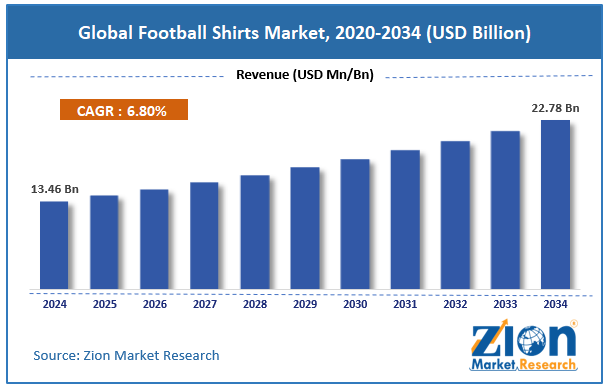
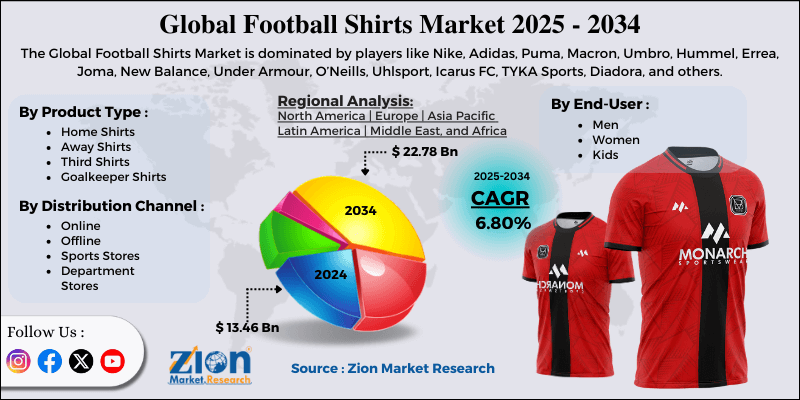
The global football shirts market size was around USD 13.46 billion in 2024 and is projected to reach USD 22.78 billion by 2034, with a compound annual growth rate (CAGR) of roughly 6.80% between 2025 and 2034.
Key Insights:
- As per the analysis shared by our research analyst, the global football shirts market is estimated to grow annually at a CAGR of around 6.80% over the forecast period (2025-2034)
- In terms of revenue, the global football shirts market size was valued at around USD 13.46 billion in 2024 and is projected to reach USD 22.78 billion by 2034.
- The football shirts market is projected to grow significantly owing to the expansion of major international leagues and tournaments, the growth of online retail and e‑commerce channels, and technological advancements in performance and fabric features.
- Based on product type, the home shirts segment is expected to lead the market, while the away shirts segment is expected to grow considerably.
- Based on end-user, the men segment is the dominating segment, while the women segment is projected to witness sizeable revenue over the forecast period.
- Based on the distribution channel, the offline segment is expected to lead the market, followed by the online segment.
- By region, Europe is projected to dominate the global market during the forecast period, followed by North America.
Football Shirts Market: Overview
A football shirt is the iconic upper-body garment of a soccer kit, worn by players and fans alike, usually in team colors with the country crest or club sponsor logos, and at times player numbers and names. Originally functional and simple cotton garments to differentiate teams on the pitch, they have advanced into moisture-wicking, high-tech, lightweight designs that also serve as strong symbols of culture, identity, and fashion for supporters across the globe. The global football shirts market is poised for notable growth, driven by the global fanbase and viewership, the growth of youth and women's football, and personalization and customization. Football has a billion fans worldwide, creating constant demand for official shirts. Fans purchase jerseys to show loyalty during tournaments and leagues. This makes shirts a key item of fan merchandise worldwide.
Moreover, youth programs and women’s leagues are growing rapidly. This introduces new demographics to the football shirt sector. Brands can target these domains with tailored sizes and designs. Furthermore, fans are now seeking jerseys with their favorite players’ numbers or their own names. Online platforms facilitate the creation of such personalized products. This trend augments engagement and elevated margin sales.
Nevertheless, the global market faces limitations due to factors such as the high cost of official jerseys and seasonal demand fluctuations. Official licensed shirts are high-priced. This restricts access for budget-sensitive customers and may push them to buy cheaper substitutes. Likewise, shirt sales are linked to tournaments or league seasons. Off-season periods witness low demand. This cyclical nature may impact revenue consistency. Still, the global football shirts industry benefits from several favorable factors, such as customized and on-demand products, eco-friendly and sustainable shirts, and lifestyle and streetwear crossovers.
Personalized shirts create unique value for fans. Brands may change the premium for custom designs. This boosts customer loyalty and engagement. Shirts made from organic or recycled materials attract conscious buyers. Sustainability may distinguish brands. It also supports worldwide environmental trends. Football shirts are increasingly worn in sports contexts. Collaborations with fashion drive more attraction. This trend creates crossover prospects in lifestyle markets.
Football Shirts Market: Dynamics
Growth Drivers
How are sponsorship and kit deals driving the worldwide football shirts market?
High-value sponsorships between global sportswear brands and clubs drive both promotion and production of football shirts. Lucrative kit contracts benefit from exclusive releases, marketing campaigns, and expanded international distribution. Sponsors usually collaborate on limited-edition or co-branded jerseys, improving consumer interest and exclusivity. Revenue from these deals allows clubs to invest in new designs and merchandising advancements. Exposure through media and advertising motivates fans to purchase official kits. Sponsorship contracts, hence, remain a major propeller of demand and supply in the global football shirts market.
How are technological improvements impacting the football shirts market?
Football shirts are changing with advanced fabrics and smart solutions to enhance performance, comfort, and authenticity. Modern jerseys use moisture-wicking, breathable materials and may include AR features or NFC chips for authentication and fan engagement. These advancements also help brands tackle counterfeiting, track sales, and improve the shopping experience through digital tools.
Restraints
Frequent design changes slow down the market progress
Biannual or annual kit releases may overwhelm consumers and reduce repeat purchases. Fans may not buy a new shirt every season if they already own one. Constant design updates may also increase production costs for brands and clubs. Retailers risk unsold inventory if designs are disliked or unpopular. Too-frequent changes may dilute brand loyalty and cause consumer fatigue.
Opportunities
How are licensing and club merchandise expansion advantageous for the growth of the football shirt market?
Clubs can expand licensed merchandise beyond jerseys to include training kits, fan apparel, and retro lines. Offering limited or exclusive editions drives demand. Associations with online platforms can increase worldwide accessibility. Fans are willing to pay for high-quality products. Licensing creates multiple revenue streams and boosts brands' loyalty. Strategic merchandise growth offers continual growth potential, thereby favoring the expansion of the football shirts industry.
Challenges
Counterfeit prevention and supply chain complexity restrict the market growth
Ensuring authenticity and quality in worldwide supply chains is increasingly challenging. Logistics, production, and distribution networks comprise numerous stakeholders, which increases costs. Grey-market and counterfeit products exploit supply chain gaps. Enforcing and monitoring standards worldwide required massive resources. Supply chain challenges add operational challenges and reduce profitability. Maintaining brand integrity remains a persistent challenge.
Football Shirts Market: Report Scope
| Report Attributes | Report Details |
|---|---|
| Report Name | Football Shirts Market |
| Market Size in 2024 | USD 13.46 Billion |
| Market Forecast in 2034 | USD 22.78 Billion |
| Growth Rate | CAGR of 6.80% |
| Number of Pages | 213 |
| Key Companies Covered | Nike, Adidas, Puma, Macron, Umbro, Hummel, Errea, Joma, New Balance, Under Armour, O’Neills, Uhlsport, Icarus FC, TYKA Sports, Diadora, and others. |
| Segments Covered | By Product Type, By End-User, By Distribution Channel, and By Region |
| Regions Covered | North America, Europe, Asia Pacific (APAC), Latin America, Middle East, and Africa (MEA) |
| Base Year | 2024 |
| Historical Year | 2019 - 2023 |
| Forecast Year | 2025 - 2034 |
| Customization Scope | Avail customized purchase options to meet your exact research needs. Request For Customization |
Football Shirts Market: Segmentation
The global football shirts market is segmented based on product type, end-user, distribution channel, and region.
Why is the Home Shirts segment projected to dominate the football shirts market?
Based on product type, the global football shirts industry is divided into home shirts, away shirts, third shirts, and goalkeeper shirts. The home shirts segment accounts for nearly 35% of the global market due to the strong fan appeal of the primary team identity and colors. They are released every season with updated designs, thereby fueling frequent purchases among supporters. Home shirts also present a club’s merchandising strategy, making them a core revenue driver for teams and brands alike.
On the other hand, the away shirts segment ranks second with 27% of the market share. They offer alternate colorways that attract fans who prefer variety beyond the traditional home kit. These shirts feature creative designs that attract both collectors and supporters. Their prominence is driven by visibility during away matches and limited-edition drops that supplement main home shirt sales.
What factors help the Men segment lead the football shirts market?
Based on end-user, the global football shirts market is segmented into men, women, and kids. The men's segment holds a leading 60% market share, fueled by historically high fan engagement and high participation among male consumers. This segment benefits from broad exposure to professional leagues, strong purchasing power, and heavy marketing for male supporters. Men’s shirts also account for the bulk of authentic and replica kit sales worldwide.
Conversely, the women’s segment has the fastest-growing share, accounting for 30% of the total market. This denotes the growth of women’s football and growing female fan participation. Growth is propelled by greater visibility for women’s leagues, expanded marketing efforts for female supporters, and targeted designs for female fits.
What are the key reasons for the leadership of the Offline segment in the football shirts market?
Based on distribution channel, the global market is segmented into online, offline, sports stores, and department stores. The offline channels segment accounts for 61% of the market. These channels comprise stadium shops, department stores, and sports stores. Most consumers prefer to see, try, and touch shirts before buying, mainly premium or official kits. This channel also benefits from in-store promotions, impulse purchases, and seasonal displays during tournaments and match days.
Nonetheless, the online channels segment holds second place with 24% market share, driven by official club stores, e-commerce platforms, and third-party sports retailers. Fans enjoy the convenience of shopping from home, easy access to global team merchandise, and customization options. Online sales channels also benefitted by social media marketing and digital adoption.
Football Shirts Market: Regional Analysis
What enables Europe strong foothold in the global Football Shirts Market?
Europe is projected to maintain its dominant position in the global football shirts market, with an 8% CAGR, owing to a deep-rooted football culture and fan loyalty, the presence of top leagues and global clubs, and established merchandise and retail infrastructure. Europe holds the leading share of the worldwide market, accounting for nearly 45% of total revenue. This is backed by a highly engaged fan base and long-established football traditions. Fans in countries such as Germany, Spain, France, and England routinely purchase national and club team shirts, often season after season. This cultural passion translates directly into consistently strong merchandise demand; moreover, the region hosts leading, commercially powerful leagues that attract millions of supporters worldwide.
Clubs like Barcelona, Bayern Munich, Manchester United, and Real Madrid sell millions of shirts every year. This augments regional leadership, attracting local and international purchases. Europe’s advanced licensing and retail infrastructure backs broader distribution of official jerseys through strong online channels and physical stores. Long-term associations between major appeal brands and clubs fuel seasonal releases, high-visibility merchandising campaigns, and limited editions. This developed ecosystem makes Europe the most lucrative market for official shirts.
Why does North America rank second in the global Football Shirts Market?
North America maintains its position as the second-largest region, with a 7% CAGR in the global football shirts industry, driven by a growing fanbase and league prominence, strong US market leadership, and the expansion of merchandise and e-commerce infrastructure. North America accounts for nearly 20% of the global market, ranking second after Europe. This growth is fueled by elevated interest in international football, viewership of top European leagues, and Major League Soccer (MLS). High-profile signings, such as Lionel Messi's in MLS, have significantly increased jersey sales and European fan engagement.
Moreover, within the region, the US accounts for nearly 65% of total demand for football shirts due to strong consumer spending and widespread media coverage of European club football. Fans steadily purchase both national and club team jerseys, backed by strong licensing and retail availability. Mexico and Canada contribute to the growth, with surging interest in international and soccer competitions augmenting shirt sales.
Additionally, digital retail channels and e-commerce platforms are expanding access to authentic football shirts in North America, enabling fans to purchase club kits worldwide. Online custom printing services and sports retailers further stimulate purchases by offering more selections and personalized products. This digital growth accelerates market growth and helps the region maintain a robust rank worldwide.
Football Shirts Market: Competitive Analysis
The leading players in the global football shirts market are:
- Nike
- Adidas
- Puma
- Macron
- Umbro
- Hummel
- Errea
- Joma
- New Balance
- Under Armour
- O’Neills
- Uhlsport
- Icarus FC
- TYKA Sports
- Diadora
What are the key trends in the global Football Shirts Market?
Sustainability & eco‑friendly production:
There is a strong inclination toward sustainable football shirts made from recycled polyester, biodegradable materials, and organic cotton. Consumers are prioritizing environmentally friendly products, driving brands to adopt green manufacturing practices and lower their carbon footprints. This trend not just supports global environmental concerns but also differentiates products in a crowded industry.
Tech integration & smart jerseys:
Football shirts are increasingly integrating technologies such as smart textiles, NFC chips, and performance sensors. Digital features and NFC enable fans to access exclusive content and verify authenticity directly on their shirts. High-tech and smart fabrics also enhance comfort, modern performance, and breathability, appealing to consumers and players.
The global football shirts market is segmented as follows:
By Product Type
- Home Shirts
- Away Shirts
- Third Shirts
- Goalkeeper Shirts
By End-User
- Men
- Women
- Kids
By Distribution Channel
- Online
- Offline
- Sports Stores
- Department Stores
By Region
- North America
- The U.S.
- Canada
- Mexico
- Europe
- France
- The UK
- Spain
- Germany
- Italy
- Rest of Europe
- Asia Pacific
- China
- Japan
- India
- Australia
- South Korea
- Rest of Asia Pacific
- The Middle East & Africa
- Saudi Arabia
- UAE
- Egypt
- Kuwait
- South Africa
- Rest of the Middle East & Africa
- Latin America
- Brazil
- Argentina
- Rest of Latin America
Table Of Content
Methodology
FrequentlyAsked Questions
Football shirts are storage depots specially designed to store and organize diverse packaging materials. They store materials such as bubble wrap, tape, boxes, and other supplies, neatly arranged and readily accessible, thereby increasing the efficiency of the packaging process.
The global football shirts market is projected to grow due to the increasing global popularity of football and fan engagement, rising disposable incomes in emerging markets, and the availability of personalization and customization options.
According to study, the global football shirt market was valued at around USD 13.46 billion in 2024 and is expected to grow to around USD 22.78 billion by 2034.
The CAGR value of the football shirts market is expected to be around 6.80% during 2025-2034.
Major opportunities driving the football shirts market include customization, women’s and youth segments, sustainable products, e commerce expansion, and growth in emerging markets.
Europe is expected to lead the global football shirts market during the forecast period.
The United Kingdom is a significant contributor to the global football shirts market in Europe, thanks to top leagues like the Premier League, a strong football culture, and high fan merchandise consumption.
The key players profiled in the global football shirts market include Nike, Adidas, Puma, Macron, Umbro, Hummel, Errea, Joma, New Balance, Under Armour, O’Neills, Uhlsport, Icarus FC, TYKA Sports, and Diadora.
Stakeholders should focus on personalization, digital transformation, strategic partnerships, sustainability, and localized engagement to stay competitive in the football shirts market.
The report examines key aspects of the football shirts market, including a detailed analysis of current growth factors and restraints, as well as future growth opportunities and challenges.

HappyClients