
Folding Boxboard Market Size, Share, Trends, Growth 2032

Folding Boxboard Market By Material (Pulp-Based, Bleached Chemical, Recovered Paper, and Others), By Application (Greeting Cards, Cosmetics, Healthcare, Higher End & General Packaging, and Others), and By Region - Global and Regional Industry Overview, Market Intelligence, Comprehensive Analysis, Historical Data, and Forecasts 2024 - 2032
| Market Size in 2023 | Market Forecast in 2032 | CAGR (in %) | Base Year |
|---|---|---|---|
| USD 12.92 Billion | USD 20.76 Billion | 5.41% | 2023 |
Folding Boxboard Market: Industry Perspective
What will be the global folding boxboard market size during the forecast period?
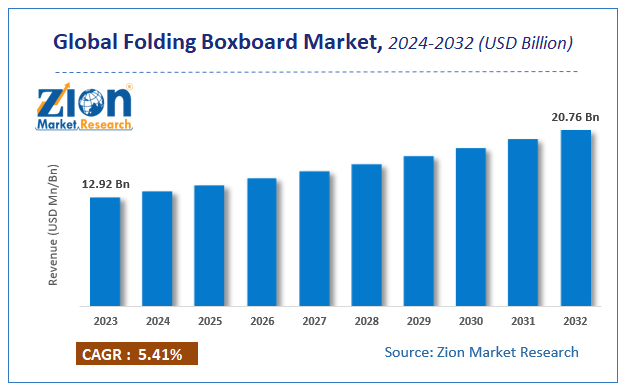
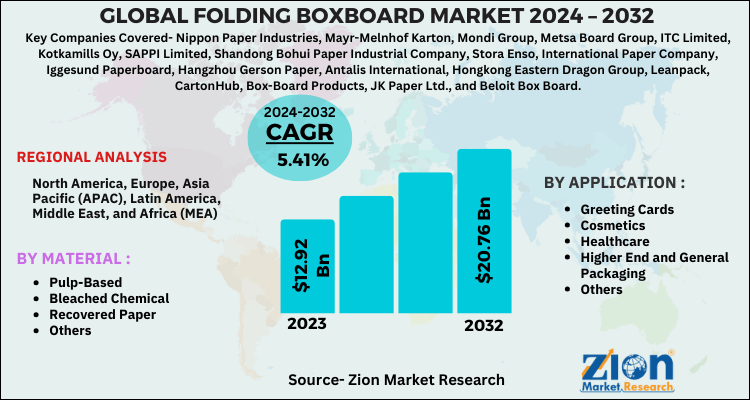
The global folding boxboard market size was worth around USD 12.92 billion in 2023 and is predicted to reach around USD 20.76 billion by 2032, with a compound annual growth rate (CAGR) of roughly 5.41% between 2024 and 2032.
This report provides a comprehensive analysis of the growth drivers, restraints, and challenges shaping demand across the global folding boxboard market throughout the forecast period, while highlighting high-potential emerging opportunities within the industry.
 Request Free Sample
Key Insights
- As per the analysis shared by our research analyst, the folding boxboard market is estimated to grow annually at a CAGR of roughly 5.41% over the forecast period from 2024 to 2032.
- In terms of revenue, the global folding boxboard market size was valued at around USD 12.92 billion in 2023 and is projected to reach USD 20.76 billion by 2032.
- The folding boxboard market is driven by rising demand from end-use packaging sectors such as pharmaceuticals, food and beverages, cosmetics, and luxury goods, thanks to its superior stiffness, lightweight profile, and premium printability.
- By material, the pulp-based category accounted for the leading share of 43.5% in the global folding boxboard market because multi-layered mechanical and chemical pulping provides unmatched structural strength, high rigidity, and optimal cost efficiency for protective carton packaging.
- By application, the healthcare category accounted for the leading share of 32.8% in the global folding boxboard market because stringent regulatory compliance, product safety, high-definition informational printing, and anti-counterfeiting requirements favor premium medical carton packaging.
- North America dominated the global folding boxboard market with a revenue share of 38.2% because of stringent environmental mandates phasing out single-use plastics and accelerated consumer preference for sustainable, circular fiber-based packaging solutions.
Folding Boxboard Market: Overview
Folding boxboard, also called FBB under DIN Standard 19303 codes of UCor GC, is a paperboard grade made from multiple layers of mechanical and chemical pulps. Folding boxboard has major applications in the packaging industry because of its low density and high firmness. These boxboards are used in various applications, including luxury goods, food packaging, cosmetics packaging, and pharmaceutical packaging. Folding boxboards have gained popularity over the past decades because of their cost-effectiveness, solid form, reliability, and lightweight nature. Folding boxboard products provide strong consistency in quality, performance, and effectiveness in packaging production and the packing process.
European standards permit the use of optical brightening agents, including fluorescent dyes, in paperboard coatings for food-grade paperboard packaging. These are extensively used in most of the retail products and are available in a various range of thicknesses, depending on product size. Folding boxboards are used in the cosmetics, food and beverages, medical, photographic, pharmaceutical, and frozen food industries.
Moreover, folding boxboards offer better print quality than corrugated printed boxes, and their lightweight design makes them ideal for packing small products. Folding boxboards can be treated as per a product’s specific requirements, such as foiling, laminating, and polishing to matte or gloss.
Folding Boxboard Market: Growth Drivers
What factors are primarily accelerating demand in the folding boxboard market?
Rising demand from industries such as food and beverages, pharmaceuticals, and cosmetics is a primary growth driver. Folding boxboard offers low density, high firmness, cost-effectiveness, reliability, and lightweight properties that suit a wide range of packaging needs.
Superior print quality compared with many alternative boards, combined with the ability to apply foiling, laminating, or polishing treatments, supports premium and general packaging applications. Growing consumer preference for environmentally beneficial and recyclable packaging further accelerates adoption.
Folding Boxboard Market: Restraints
What factors are limiting the expansion of the folding boxboard market?
Certain performance limitations, including brittleness or tear strength in specific grades, can constrain use in highly demanding applications.
Competition from alternative packaging materials and periodic fluctuations in raw material availability or pricing can also influence market growth rates in some regions.
Folding Boxboard Market: Opportunities
Where do significant growth opportunities lie for the folding boxboard market?
Expanding demand for sustainable, recyclable packaging solutions creates substantial opportunities as industries respond to regulations and consumer preferences for environmentally responsible materials.
Growth in emerging markets, particularly in Asia Pacific, driven by population expansion and rising disposable incomes in countries such as India and China, supports higher consumption of packaged goods and related folding boxboard applications.
Folding Boxboard Market: Challenges
What key challenges confront participants in the folding boxboard market?
Maintaining consistent quality and performance while meeting evolving sustainability and regulatory requirements remains an ongoing challenge. Producers must balance cost, recyclability, and functional properties.
Competition from other paperboard grades and packaging formats requires continuous product development and efficient production processes to sustain market position.
Folding Boxboard Market: Report Scope
| Report Attributes | Report Details |
|---|---|
| Report Name | Folding Boxboard Market |
| Market Size in 2023 | USD 12.92 Billion |
| Market Forecast in 2032 | USD 20.76 Billion |
| Growth Rate | CAGR of 5.41% |
| Number of Pages | 210 |
| Key Companies Covered | Nippon Paper Industries, Mayr-Melnhof Karton, Mondi Group, Metsa Board Group, ITC Limited, Kotkamills Oy, SAPPI Limited, Shandong Bohui Paper Industrial Company, Stora Enso, International Paper Company, Iggesund Paperboard, Hangzhou Gerson Paper, Antalis International, Hongkong Eastern Dragon Group, Leanpack, CartonHub, Box-Board Products, JK Paper Ltd., and Beloit Box Board |
| Segments Covered | By Material, By Application, and By Region |
| Regions Covered | North America, Europe, Asia Pacific (APAC), Latin America, Middle East, and Africa (MEA) |
| Base Year | 2023 |
| Historical Year | 2018 - 2022 |
| Forecast Year | 2024 - 2032 |
| Customization Scope | Avail customized purchase options to meet your exact research needs. Request For Customization |
Folding Boxboard Market: Segmentation
The global folding boxboard market is segmented by material, application, and region. All the segments of the folding boxboard market have been analyzed based on present and future trends and the market is estimated from 2024 to 2032.
Based on Material Segment, the folding boxboard market is divided into pulp-based, bleached chemical, recovered paper, and others. The pulp-based category is the dominant division in this sector, commanding a substantial market share because it combines mechanical wood pulp in the core with bleached chemical pulp on the outer layers. This layered architecture delivers exceptional structural bulk, high bending resistance, and superior stiffness at lower basis weights, making it the preferred grade for standard folding carton fabrication. By optimizing fiber consumption without sacrificing protective strength, pulp-based boards offer an unmatched cost-to-performance ratio that drives large-scale adoption across primary packaging lines worldwide. Meanwhile, the bleached chemical category is the second most dominant division, capturing high value due to the exceptional brightness, purity, and sensory neutrality required in high-end pharmaceutical and food applications.
Based on Application Segment, the folding boxboard market is divided into greeting cards, cosmetics, healthcare, higher end and general packaging, and others. The healthcare category is the dominant division, accounting for the highest market consumption, driven by an uncompromising need for product hygiene, package rigidity, and tamper evidence in pharmaceutical packaging. Blister packaging cards, medication cartons, and medical device enclosures demand pristine surface cleanliness, high-speed automated packaging line runnability, and flawless print fidelity for variable data, micro-text, and anti-counterfeit serialization. The stringent regulatory landscape governing drug dispensing solidifies healthcare as the core volume anchor for global folding boxboard consumption. Concurrently, cosmetics is the second-largest division, driven by high-end tactile finishes, metallic foiling, and premium unboxing presentations that elevate consumer luxury experiences.
Global Folding Boxboard Market: Regional Analysis
By region, the North American folding boxboard market is expected to grow at a significant CAGR over the forecast period, driven by increasing consumer preference for eco-friendly packaging solutions that protect the environment. The continuous expansion of organized retail, combined with massive domestic pharmaceutical distribution networks, creates sustained, non-cyclical demand for high-stiffness, protective carton solutions across the continent.
The Asia Pacific folding boxboard market is predicted to show substantial growth, driven by emerging countries such as India and China, rapidly growing populations, and rising disposable incomes. As regional governments tighten environmental regulations on plastic waste and expand municipal paper recovery networks, Asia Pacific is rapidly becoming a premier consumer and manufacturing hub for value-engineered folding boxboard packaging.
Recent Developments
-
In January 2024, Metsä Board announced the completion of a major investment program at its Husum board mill in Sweden, significantly expanding its annual folding boxboard production capacity to meet growing global demand for circular and sustainable food packaging.
-
In September 2023, Stora Enso completed the divestment of its packaging board production site in China to focus its long-term strategic investments on low-carbon, virgin fiber boxboard manufacturing across its core European mill network.
Folding Boxboard Market: Competitive Analysis
The global folding boxboard market is dominated by players
- Nippon Paper Industries
- Mayr-Melnhof Karton
- Mondi Group
- Metsa Board Group
- ITC Limited
- Kotkamills Oy
- SAPPI Limited
- Shandong Bohui Paper Industrial Company
- Stora Enso
- International Paper Company
- Iggesund Paperboard
- Hangzhou Gerson Paper
- Antalis International
- Hongkong Eastern Dragon Group
- Leanpack
- CartonHub
- Box-Board Products
- JK Paper Ltd
- Beloit Box Board
Folding Boxboard Market: Key Trends
What are the key trends in the folding boxboard market?
Rising preference for sustainable and recyclable packaging
Growing consumer and regulatory emphasis on environmentally beneficial packaging continues to support demand for recyclable and biodegradable folding boxboard grades across food, pharmaceutical, cosmetics, and general packaging applications.
Demand for high-quality printable and treatable boards
The need for superior print quality and the ability to apply foiling, laminating, or polishing treatments supports the use of folding boxboard in premium and specialized packaging for cosmetics, healthcare, and higher-end products.
Segments Covered
The global folding boxboard market is segmented as follows:
By Material
- Pulp-Based
- Bleached Chemical
- Recovered Paper
- Others
By Application
- Greeting Cards
- Cosmetics
- Healthcare
- Higher End and General Packaging
- Others
By Region
- North America
- The U.S.
- Canada
- Mexico
- Europe
- France
- The UK
- Spain
- Germany
- Italy
- Rest of Europe
- Asia Pacific
- China
- Japan
- India
- Australia
- South Korea
- Rest of Asia Pacific
- The Middle East & Africa
- Saudi Arabia
- UAE
- Egypt
- Kuwait
- South Africa
- Rest of the Middle East & Africa
- Latin America
- Brazil
- Argentina
- Rest of Latin America
Table Of Content
Methodology
FrequentlyAsked Questions
Folding boxboard is typically composed of numerous layers of paper fibers. It is composed of an outer layer of bleached chemical pulp to ensure a uniform, high-quality surface, and one or more layers of recycled paperboard to provide strength and rigidity.
The demand for folding boxboard is driven by consumers' growing preference for environmentally friendly, recyclable packaging. Industries are also encouraged to employ recyclable and biodegradable materials in response to regulations and sustainability objectives.
The global folding boxboard market size was worth around USD 12.92 billion in 2023 and is predicted to grow to around USD 20.76 billion by 2032.
The global folding boxboard market a compound annual growth rate (CAGR) of roughly 5.41% between 2024 and 2032.
North America is the leading contributor to market value due to rapid corporate plastic phase-out strategies, while Asia Pacific is expected to show substantial long-term growth driven by rising disposable incomes and expanding industrial manufacturing.
Some key industry participants of the global folding boxboard market are Nippon Paper Industries, Mayr-Melnhof Karton, Mondi Group, Metsa Board Group, ITC Limited, Kotkamills Oy, SAPPI Limited, Shandong Bohui Paper Industrial Company, Stora Enso, International Paper Company, Iggesund Paperboard, Hangzhou Gerson Paper, Antalis International, Hongkong Eastern Dragon Group, Leanpack, CartonHub, Box-Board Products, JK Paper Ltd., and Beloit Box Board.

HappyClients

