
Flexographic Printing Market Size, Share, Trends, Growth & Forecast 2034

Flexographic Printing Market By Application (Labels & Tags, Corrugated Packaging, and Flexible Packaging), By End-Use (Cosmetics, Food & Beverage, Pharmaceutical, Logistics, Consumer Electronics, Print Media, and Others), and By Region - Global and Regional Industry Overview, Market Intelligence, Comprehensive Analysis, Historical Data, and Forecasts 2025 - 2034
| Market Size in 2024 | Market Forecast in 2034 | CAGR (in %) | Base Year |
|---|---|---|---|
| USD 9.22 Billion | USD 14.16 Billion | 4.38% | 2024 |
Flexographic Printing Industry Perspective:
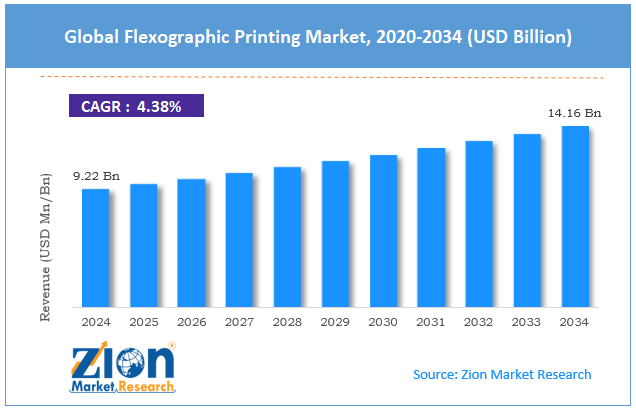
The global flexographic printing market size was worth around USD 9.22 billion in 2024 and is predicted to grow to around USD 14.16 billion by 2034, with a compound annual growth rate (CAGR) of roughly 4.38% between 2025 and 2034. The report analyzes the global flexographic printing market's drivers, restraints/challenges, and the effect they have on the demands during the projection period. In addition, the report explores emerging opportunities in the retail earplugs industry.
Key Insights:
- As per the analysis shared by our research analyst, the global flexographic printing market is estimated to grow annually at a CAGR of around 4.38% over the forecast period (2025-2034)
- In terms of revenue, the global flexographic printing market size was valued at around USD 9.22 billion in 2024 and is projected to reach USD 14.16 billion by 2034.
- The flexographic printing market is projected to grow at a significant rate due to the applications of printing technology continuing to gain acceptance in the F&B sector.
- Based on the application, the flexible packaging segment is growing at a high rate and will continue to dominate the global market, as per industry projections
- Based on the end-use, the food & beverage segment is anticipated to command the largest market share
- Based on region, the Asia-Pacific is projected to dominate the global market during the forecast period
Flexographic Printing Market: Overview
Flexographic printing is a highly efficient, roll-feed web printing method. According to industry research, flexographic printing can achieve a speed of over 2000 linear feet per minute. It is one of the most commonly used printing methods deployed for high volumes of flexible packaging and labels. However, extended applications are also witnessed in terms of an effective alternative for offset printing. Flexographic printing assists in producing higher volumes of corrugated packaging and folding cartons. The global demand for flexographic printing is expected to continue growing during the forecast period. The rising applications across major end-user industries, including food & beverages and packaging, will be critical drivers of market growth during the projection period.
On the other hand, advancements in flexographic printing technology, rising demand for eco-friendly printing solutions, and expansion into new markets will create novel growth opportunities for the industry players. The industry can expect growth limitations due to high competition from alternative solution providers and the high cost of initial investment.
Flexographic Printing Market Dynamics
Growth Drivers
How will growing applications in the food & beverage (F&B) sector contribute to flexographic printing market growth?
The global flexographic printing market is expected to register higher revenue as applications of the printing technology continue to gain acceptance in the F&B sector. As per industry analysis, flexographic printing is widely used in the food & beverages industry to produce safe, quick-drying labels and other prints. They are used during the production of flexible packaging for common food items such as snacks and candies.
On the other hand, they are also applied in producing labels for a wide range of F&B products. The rapid expansion of the food sector worldwide, driven by rising population and growing food demand, will prove beneficial for flexographic printing solution providers. In November 2025, Symrise AG announced plans to build a new large-scale mixing plant in Germany, aiming to expand its production capabilities for liquid flavors. The new complex is being built in association with GEA, leveraging its turnkey process technology.
Rising applications in carton production to promote market expansion in the future
Flexographic printing has growing applications in the production of corrugated cartons and folding boxes. As per industry analysis, flexographic printing is preferred for cartons or boxes production, as it provides cost-effective printing of large volumes of the end component. For instance, flexographic printing is helpful in printing on uneven surfaces.
Additionally, they are designed to print in large volumes with excellent speed. The growing demand for folding boxes and corrugated cartons. Recent statistics suggest that the rapid expansion of the e-commerce industry, along with greater use of consumer goods, has created amplified demand for corrugated cartons, as they offer durability and protection against damage. Additionally, folding boxes have found demand in essential sectors such as electronics, pharmaceuticals, and food & beverages. The global flexographic printing market is thus expected to generate significant revenue growth during the forecast period.
Restraints
Which cost barriers will limit the flexographic printing market growth trends?
The global flexographic printing industry is projected to be constrained by high start-up costs that industry players face during the initial stages of business operations. For instance, the average cost of an automated industrial-scale flexographic printing machine can reach over USD 4.9 million. In addition, flexo printing equipment requires additional ancillary support in the form of a plate mounter, anilox rollers, and drying or curing units. All these factors add to the overall expense associated with business operations, limiting market expansion.
Opportunities
Advancements in flexographic printing technology are creating job opportunities for the industry players
The global flexographic printing market is expected to generate growth opportunities due to the rising advancements in printing technology. Modern innovations are showing a heavier inclination toward advanced automation and integration with Artificial Intelligence (AI) for improved results. For instance, in July 2025, Giave announced the launch of the GIALUX flexo press. The technology delivers high-resolution and sharp UV ink printing.
Furthermore, it also offers reduced cleaning times. In September 2025, Brotech, another leading player in the market, launched the FF-X530. As per official claims, the novel offering is the world’s first AI-driven flexographic press. FF-X530 is expected to reshape the packaging and label production. In September 2025, XSYS, a dominant player in the prepress solutions sector, launched the Thermoflex Edge. It is the third generation of existing lines of renowned laser imagers. The product is expected to be launched in March 2026 and will offer productivity, precision, and superior quality.
Challenges
Which challenges will alternative solutions create in the flexographic printing market?
The global flexographic printing industry is projected to be challenged by the rising demand and technological innovations in alternative solutions. Some of the most prominent competitors against the flexo printing industry are digital printing solutions, offset lithography, and screen printing. Digital printing is expected to emerge as a widely popular printing method across industries in the coming years. In addition, the growing concerns of market players about the environmental impact of flexographic printing may further hinder market expansion in the long run.
Flexographic Printing Market: Segmentation
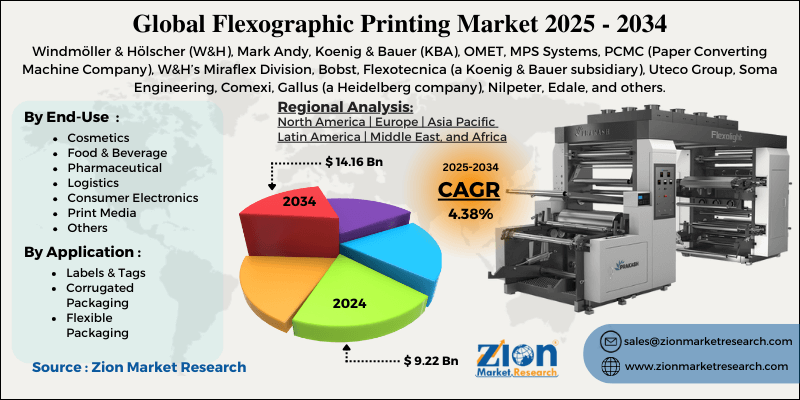
The global flexographic printing market is segmented based on application, end-use, and region. All the segments have been analyzed based on present and future trends and the market is estimated from 2023 to 2030.
Based on application, the global market is segmented into labels & tags, corrugated packaging, and flexible packaging. In 2024, around 44.23% of the global market share was held by the flexible packaging segment. It offers versatile and highly flexible packaging solutions. The most common forms of flexible packaging include foils, plastic films, and laminates. The label & tag segment is expected to generate a CAGR of 5.1% during the forecast period.
Based on end-use, the global market divisions are cosmetics, food & beverage, pharmaceuticals, logistics, consumer electronics, print media, and others. In 2024, the highest revenue was listed in the food & beverage sector. It accounted for over 36.82% of the global revenue. The rising demand for versatile packaging solutions in the food industry will fuel segmental expansion in the future. The logistics sector is expected to account for 6.21% in the coming years.
The Regional, this segment includes the current and forecast demand for North America, Europe, Asia Pacific, Latin America,and the Middle East and Africa.
Flexographic Printing Market: Report Scope
| Report Attributes | Report Details |
|---|---|
| Report Name | Flexographic Printing Market |
| Market Size in 2024 | USD 9.22 Billion |
| Market Forecast in 2034 | USD 14.16 Billion |
| Growth Rate | CAGR of 4.38% |
| Number of Pages | 216 |
| Key Companies Covered | Windmöller & Hölscher (W&H), Mark Andy, Koenig & Bauer (KBA), OMET, MPS Systems, PCMC (Paper Converting Machine Company), W&H’s Miraflex Division, Bobst, Flexotecnica (a Koenig & Bauer subsidiary), Uteco Group, Soma Engineering, Comexi, Gallus (a Heidelberg company), Nilpeter, Edale, and others. |
| Segments Covered | By Application, By End-Use, and By Region |
| Regions Covered | North America, Europe, Asia Pacific (APAC), Latin America, Middle East, and Africa (MEA) |
| Base Year | 2024 |
| Historical Year | 2019 to 2023 |
| Forecast Year | 2025 - 2034 |
| Customization Scope | Avail customized purchase options to meet your exact research needs. Request For Customization |
Flexographic Printing Market: Regional Analysis
Which factors will ensure dominance of Asia-Pacific in the flexographic printing market?
The global flexographic printing market is projected to witness the highest growth in the Asia-Pacific region during the forecast period. In 2024, the region held 33.45% of the global market share, with China and India emerging as prominent regional markets. The rapid industrialization and urbanization across major Asian countries in the last decade have been pivotal in shaping the demand for flexographic printing solutions. Furthermore, additional factors such as a sharp increase in food & beverage demand, consumer production consumption, and accelerated expansion of the e-commerce industry will fuel regional growth in the future.
The European market is projected to emerge as the second-highest revenue generator in the future. The presence of several key players across countries such as Germany and France will play a crucial role in driving regional growth. On the other hand, European countries are heavily emphasizing the deployment of eco-friendly solutions by innovating water-based flexo printing machines. Strict regulatory frameworks will further encourage regional innovation strategies. Additionally, the growing demand for flexible packaging and labels across Europe will promote improved revenue in the region.
Flexographic Printing Market: Competitive Analysis
The global flexographic printing market is led by players like:
- Windmöller & Hölscher (W&H)
- Mark Andy
- Koenig & Bauer (KBA)
- OMET
- MPS Systems
- PCMC (Paper Converting Machine Company)
- W&H’s Miraflex Division
- Bobst
- Flexotecnica (a Koenig & Bauer subsidiary)
- Uteco Group
- Soma Engineering
- Comexi
- Gallus (a Heidelberg company)
- Nilpeter
- Edale
Flexographic Printing Market: Key Market Trends
Eco-friendly and sustainable solutions
Flexographic printing solution providers are actively developing eco-friendly flexo machines that do not emit harmful substances into the environment. Sustainability-promoting flexographic printing tools will gain higher investments in the coming years.
Expansion into emerging markets
While the packaging industry continues to dominate the flexographic printing market, industry players are expected to tap into unexplored or emerging segments such as pharmaceuticals and healthcare. Expanding into new markets can ensure long-term survival for the industry players.
The global flexographic printing market is segmented as follows:
By Application
- Labels & Tags
- Corrugated Packaging
- Flexible Packaging
By End-Use
- Cosmetics
- Food & Beverage
- Pharmaceutical
- Logistics
- Consumer Electronics
- Print Media
- Others
By Region
- North America
- The U.S.
- Canada
- Europe
- France
- The UK
- Spain
- Germany
- Italy
- Rest of Europe
- Asia Pacific
- China
- Japan
- India
- South Korea
- Southeast Asia
- Rest of Asia Pacific
- Latin America
- Brazil
- Mexico
- Rest of Latin America
- Middle East & Africa
- GCC
- South Africa
- Rest of Middle East & Africa
Table Of Content
Methodology
FrequentlyAsked Questions

HappyClients

