
Dynamic Creative Optimization (DCO) Market Size, Share and Value 2034

Dynamic Creative Optimization (DCO) Market By Component (Software, Services), By Deployment Mode (Cloud-Based, On-Premises), By Organization Size (Small and Medium Enterprises, Large Enterprises), By Application (Display Advertising, Video Advertising, Social Media Advertising, Native Advertising, Mobile Advertising, and Others), By Industry Vertical (Retail and E-commerce, Media and Entertainment, Travel and Hospitality, Automotive, BFSI, Healthcare, Technology), By Advertising Format (Banner Advertisements, Rich Media, Video Advertisements, Interactive Advertisements), and By Region - Global and Regional Industry Overview, Market Intelligence, Comprehensive Analysis, Historical Data, and Forecasts 2025 - 2034
| Market Size in 2024 | Market Forecast in 2034 | CAGR (in %) | Base Year |
|---|---|---|---|
| USD 871.2 Million | USD 2,255.63 Million | 10.28% | 2024 |
Dynamic Creative Optimization (DCO) Industry Perspective
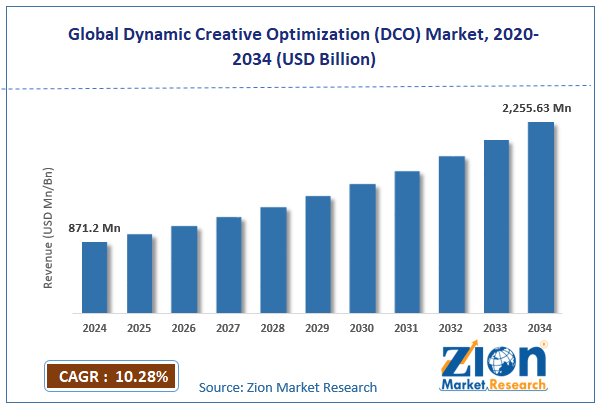
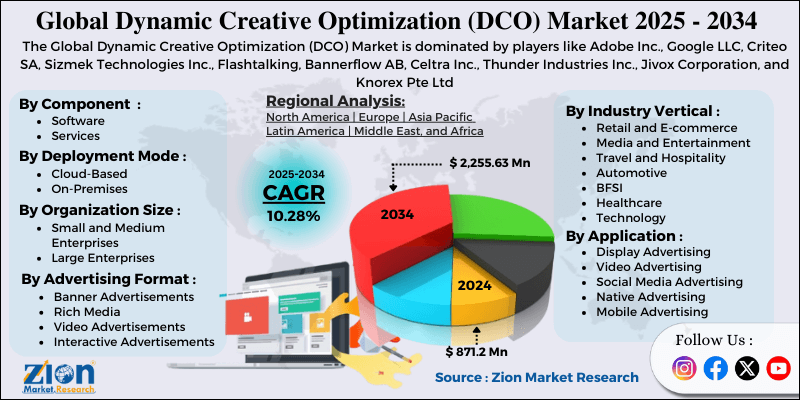
The global dynamic creative optimization market size was worth approximately USD 871.2 Million in 2024 and is projected to grow to around USD 2,255.63 Million by 2034, with a compound annual growth rate (CAGR) of roughly 10.28% between 2025 and 2034.
Key Insights
- As per the analysis shared by our research analyst, the global dynamic creative optimization market is estimated to grow annually at a CAGR of around 10.28% over the forecast period (2025-2034).
- In terms of revenue, the global dynamic creative optimization market size was valued at approximately USD 871.2 Million in 2024 and is projected to reach USD 2,255.63 Million by 2034.
- The dynamic creative optimization market is projected to grow significantly due to the increasing digital advertising spending, rising demand for personalized advertising experiences, growing adoption of programmatic advertising, and expanding use of artificial intelligence in marketing technology.
- Based on component, the software segment is expected to lead the dynamic creative optimization market, while the services segment is anticipated to experience significant growth.
- Based on deployment mode, the cloud-based segment is expected to lead the dynamic creative optimization market. In contrast, the on-premises segment is anticipated to witness notable growth in specific industries.
- Based on organization size, the large enterprises segment is the dominating segment, while the small and medium enterprises segment is projected to witness sizeable revenue over the forecast period.
- Based on application, the display advertising segment is expected to lead the market compared to the video advertising segment.
- Based on industry vertical, the retail and e-commerce segment is expected to lead the dynamic creative optimization market.
- Based on advertising format, the banner advertisements segment is expected to lead the dynamic creative optimization market during the forecast period.
- Based on region, North America is projected to dominate the global dynamic creative optimization market during the estimated period, followed by Europe.
Dynamic Creative Optimization (DCO) Market: Overview
Dynamic creative optimization is an automated advertising method that personalizes digital advertisements in real time by using data about each viewer to increase campaign performance. It studies information such as browsing activity, demographics, location, device type, time of day, and previous purchase behavior to select the most suitable creative elements for every individual. The system tests different headlines, images, messages, colors, and calls to action to identify versions that work best for specific audience groups.
Artificial intelligence improves these choices by learning from engagement and conversion results. Marketers provide a large set of images, text options, and design pieces, and the platform assembles personalized advertisements automatically. It can also work with real-time bidding, so the most relevant message reaches the right user. Brands use this technology to deliver consistent yet personalized content across display, video, social media, and mobile formats.
The growing complexity of digital advertising and increasing demand for personalized customer experiences are expected to drive growth in the dynamic creative optimization market throughout the forecast period.
Dynamic Creative Optimization (DCO) Market Dynamics
Growth Drivers
How is increasing digital advertising complexity driving the dynamic creative optimization market growth?
The dynamic creative optimization market is growing fast because digital advertising has become complex across many channels and devices, requiring advanced personalization. Consumers interact with brands through computers, phones, tablets, televisions, and wearables, and each device requires creative formats suited to user behavior. Marketers face challenges due to many advertising platforms, including search engines, social media, video services, mobile applications, and websites, requiring consistent personalized messages. Audience groups display varied interests and actions, so campaigns require detailed targeting that supports individual preferences. Users move across multiple devices during purchase journeys, so coordinated creative delivery is important across every platform. Real-time auctions demand quick, creative choices that match impression opportunities using available user information. Global campaigns require adjustments for language, culture, currency, and regional products while preserving overall brand direction across large advertising efforts.
Artificial intelligence and machine learning advancements
The dynamic creative optimization market is growing quickly because artificial intelligence and machine learning support personalized advertising with strong performance gains. Natural language processing studies written content to understand tone and meaning, creating headline options suited to different audience groups. Computer vision examines images and visual elements to predict which creative assets will attract attention and encourage engagement among demographic groups. Predictive analytics uses campaign data and market patterns to estimate which creative approaches will deliver strong results under various advertising conditions. Deep learning discovers patterns in user behavior data, revealing links between creative features and conversion outcomes across large campaigns. Automated testing systems explore multiple creative versions, identifying high-performing combinations and removing weaker elements without complex manual processes. Real-time dashboards give marketers insight into performance across audience groups, device types, time periods, and locations, supporting improvement across advertising efforts.
Restraints
High implementation costs and technical complexity are affecting adoption
The dynamic creative optimization market faces major challenges because organizations require significant investment and technical skill to manage advanced platforms across large marketing operations. Enterprise systems involve high licensing costs, often linked to media spending, creating pressure on budgets across growing campaigns. Integration with marketing tools, including demand-side platforms, data systems, customer platforms, and analytics software, requires time, planning, and technical resources. Creative teams must produce many asset variations, including headlines, images, calls to action, and layout elements, instead of single advertisements. Data systems must process user information, performance metrics, and creative decisions across millions of impressions in real time. Limited technical talent makes hiring difficult for companies building strong optimization capabilities. Marketing teams require training to use these platforms effectively, creating adjustment challenges within organizations moving from traditional processes.
Opportunities
How is expanding e-commerce and direct-to-consumer growth creating new opportunities for the dynamic creative optimization market?
The dynamic creative optimization industry is seeing strong opportunities as e-commerce growth and direct-to-consumer strategies drive heavy advertising demand across crowded digital markets. Online retail expansion increases competition for consumer attention, so personalized advertising becomes important for helping brands stand out across busy platforms. Direct-to-consumer brands depend heavily on digital advertising for customer acquisition, so improved creative performance supports efficient marketing outcomes. Large product catalogs across e-commerce stores create chances to show each shopper more relevant product options through personalized recommendations. Dynamic pricing and promotional messages can appear in creative versions, offering deals suited to different customer groups across varied shopping situations. Abandoned cart reminders benefit from personalized messages that highlight viewed products and offer suitable incentives to encourage completed purchases. Cross-selling opportunities increase when systems show items related to browsing history and previous purchases, supporting higher order values across major retail campaigns.
Challenges
How are privacy regulations and data restrictions creating challenges for the dynamic creative optimization industry?
The dynamic creative optimization industry faces major challenges because evolving privacy rules and growing limits on consumer data collection reduce personalization in digital advertising. European regulations require clear consent for personal data use, creating strict conditions for targeted creative delivery across many regions. United States privacy laws give consumers the right to control the use of personal information, reducing available audiences for advanced targeting across large campaigns. Changes to web browsers, such as removing third-party cookies, weaken traditional tracking methods used to understand user behavior across digital channels.
Mobile privacy updates from major operating systems reduce identifiers used to follow user actions across applications and websites. Consent management needs careful documentation across regions with different rules, creating extra work for marketing teams handling complex data operations. Cross-device restrictions make it difficult to connect user activity across phones, tablets, and computers, reducing personalization accuracy across varied shopping journeys.
Dynamic Creative Optimization (DCO) Market: Report Scope
| Report Attributes | Report Details |
|---|---|
| Report Name | Dynamic Creative Optimization Market Research Report |
| Market Size in 2024 | USD 871.2 Million |
| Market Forecast in 2034 | USD 2,255.63 Million |
| Growth Rate | CAGR of 10.28% |
| Number of Pages | 220 |
| Key Companies Covered | Adobe Inc., Google LLC, Criteo SA, Sizmek Technologies Inc., Flashtalking, Bannerflow AB, Celtra Inc., Thunder Industries Inc., Jivox Corporation, and Knorex Pte Ltd |
| Segments Covered | By Component, By Deployment Mode, By Organization Size, By Application, By Industry Vertical, By Advertising Format And By Region |
| Regions Covered | North America, Europe, Asia Pacific (APAC), Latin America, The Middle East and Africa (MEA) |
| Base Year | 2024 |
| Historical Year | 2019 to 2023 |
| Forecast Year | 2025 - 2034 |
| Customization Scope | Avail customized purchase options to meet your exact research needs. Request For Customization |
Dynamic Creative Optimization (DCO) Market: Segmentation
The global dynamic creative optimization market is segmented based on component, deployment mode, organization size, application, industry vertical, advertising format, and region.
Based on the component, the global dynamic creative optimization industry is segregated into software and services. Software leads the market due to the core platform capabilities enabling automated creative optimization and the recurring revenue nature of software licensing models.
Based on deployment mode, the industry is segmented into cloud-based and on-premises. Cloud-based solutions are expected to lead the market during the forecast period due to the real-time processing requirements of DCO and the integration advantages with cloud-based advertising platforms and marketing technology stacks.
Based on organization size, the global dynamic creative optimization market is classified into small and medium enterprises and large enterprises. Large enterprises hold the largest market share due to their substantial advertising budgets, complex marketing technology requirements, and diverse product portfolios requiring extensive personalization.
Based on application, the global market is divided into display advertising, video advertising, social media advertising, native advertising, mobile advertising, and others. Display advertising holds the largest market share due to the established standards for programmatic creative optimization and the relatively straightforward technical implementation compared to other formats.
Based on industry vertical, the global market is categorized into retail and e-commerce, media and entertainment, travel and hospitality, automotive, BFSI, healthcare, and technology. Retail and e-commerce hold the largest market share due to the direct correlation between advertising and sales, and the large product catalogs that enable extensive personalization opportunities.
Based on advertising format, the global market is classified into banner advertisements, rich media, video advertisements, and interactive advertisements. Banner advertisements hold the largest market share due to the widespread format adoption across advertising networks, the technical maturity of DCO implementations for display formats, and the large impression volumes available for optimization testing.
Dynamic Creative Optimization (DCO) Market: Regional Analysis
What factors are contributing to North America's dominance in the global dynamic creative optimization market?
North America leads the dynamic creative optimization market due to advanced digital advertising maturity and strong technology investment, creating ideal conditions for innovation across major industry segments. The United States leads global digital advertising spending, with brands allocating large budgets to online campaigns supported by optimization tools that improve overall performance. Silicon Valley hosts many marketing technology companies building platforms designed for global use after testing and refinement within competitive domestic markets. Major advertising platforms, including Google, Facebook, Amazon, and key programmatic exchanges, operate from North America, enabling early integration opportunities with leading optimization vendors across complex digital ecosystems. Large enterprises across multiple industries maintain specialized teams for automation, analytics, and performance improvement, supporting expanding adoption of dynamic creative solutions. Strong venture capital activity funds startups developing improved optimization models, accelerating product development, and broader market availability across regions.
E-commerce maturity across North America increases demand for personalized advertising, helping retailers compete effectively in crowded digital channels. Evolving privacy rules encourage the creation of compliant technology features designed for North American users before deployment across international markets. High smartphone usage and mobile advertising maturity support strong demand for mobile-optimized creative delivery across diverse audiences. Data-driven marketing culture supports constant improvement, motivating organizations to invest in systems promising measurable advertising gains across multiple channels. Canada reflects similar characteristics with strong digital maturity and bilingual communication needs, creating additional localization opportunities for dynamic creative optimization platforms. Together, these factors position North America as the central driver of global dynamic creative optimization growth, shaping market standards, influencing technology development, and accelerating worldwide adoption across multiple industries.
Europe maintains a substantial market presence.
Europe holds a strong position in the dynamic creative optimization market due to the advanced advertising industries, strict privacy rules, and diverse regional needs, which create supportive conditions for automated creative improvement across many sectors. The United Kingdom operates a mature programmatic advertising environment, with London serving as a major center for technology companies supporting complex digital campaigns. Germany maintains strong automotive and technology sectors with large advertising budgets and an engineering culture encouraging the adoption of precise optimization tools across competitive markets. France supports influential advertising and luxury industries where brand consistency and personalized messaging work together effectively through dynamic creative solutions, improving performance.
Privacy leadership through European regulations sets global standards for compliant technology design across many regions influenced by strict data requirements. Media and entertainment companies across Europe create strong advertising environments where creative performance improvements provide meaningful competitive advantages. Retail diversity across luxury brands and mass-market chains supports a wide range of dynamic creative use cases serving different consumer groups at multiple price levels. Financial services companies require compliant advertising tools supporting strict regional rules while enabling personalized communication across important customer segments. Consulting firms and agencies across Europe support enterprise adoption through training, implementation services, and performance management across long-term engagements.
Recent Developments
-
In August 2025, Clinch announced a new DCO enhancement in its Flight Control platform that links creative performance directly with media performance data.
Dynamic Creative Optimization (DCO) Market: Competitive Analysis
The leading players in the global dynamic creative optimization market are
- Adobe Inc
- Google LLC
- Criteo SA
- Sizmek Technologies Inc
- Flashtalking
- Bannerflow AB
- Celtra Inc
- Thunder Industries Inc
- Jivox Corporation
- Knorex Pte Ltd.
The global dynamic creative optimization (DCO) market is segmented as follows:
By Component
- Software
- Services
By Deployment Mode
- Cloud-Based
- On-Premises
By Organization Size
- Small and Medium Enterprises
- Large Enterprises
By Application
- Display Advertising
- Video Advertising
- Social Media Advertising
- Native Advertising
- Mobile Advertising
- Others
By Industry Vertical
- Retail and E-commerce
- Media and Entertainment
- Travel and Hospitality
- Automotive
- BFSI
- Healthcare
- Technology
By Advertising Format
- Banner Advertisements
- Rich Media
- Video Advertisements
- Interactive Advertisements
By Region
- North America
- The U.S.
- Canada
- Mexico
- Europe
- France
- The UK
- Spain
- Germany
- Italy
- Rest of Europe
- Asia Pacific
- China
- Japan
- India
- Australia
- South Korea
- Rest of Asia Pacific
- The Middle East & Africa
- Saudi Arabia
- UAE
- Egypt
- Kuwait
- South Africa
- Rest of the Middle East & Africa
- Latin America
- Brazil
- Argentina
- Rest of Latin America
Table Of Content
Methodology
FrequentlyAsked Questions

HappyClients

