
Carpet Market Size, Trend, Growth, Industry Analysis Report 2034

Carpet Market By Type (Woven Carpets, Tufted Carpets, Knotted Carpets, Needle Felt Carpets, and Handmade Artisan Carpets), By Material (Nylon Fiber Carpets, Polyester Fiber Carpets, Wool and Natural Fiber Carpets, Polypropylene Carpets, and Blended Synthetic Carpets), By Application (Residential Living Spaces, Commercial Offices and Retail Spaces, and Hospitality and Hotel Interiors), By Distribution Channel (Specialty Flooring Stores, Home Improvement and DIY Stores, Online Retail Platforms, Direct Sales to Builders and Contractors, and Interior Design and Renovation Consultants), and By Region - Global and Regional Industry Overview, Market Intelligence, Comprehensive Analysis, Historical Data, and Forecasts 2026 - 2034
| Market Size in 2025 | Market Forecast in 2034 | CAGR (in %) | Base Year |
|---|---|---|---|
| USD 94.94 Billion | USD 153.39 Billion | 5.30% | 2025 |
Carpet Industry Perspective:
What will be the size of the carpet market during the forecast period?
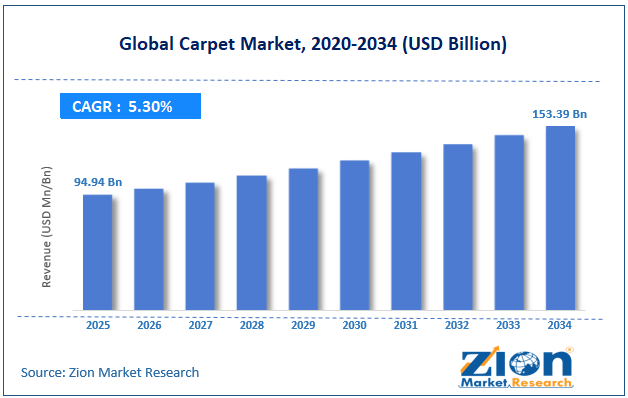
The global carpet market size was valued at approximately USD 94.94 billion in 2025 and is projected to reach around USD 153.39 billion by 2034, growing at a compound annual growth rate of approximately 5.30% between 2026 and 2034.
Key Insights
- As per the analysis shared by our research team, the global carpet market is estimated to grow at a compound annual growth rate of approximately 5.30% during the forecast period from 2026 to 2034.
- In terms of revenue, the global carpet market was valued at approximately USD 94.94 billion in 2025 and is projected to reach USD 153.39 billion by 2034.
- The carpet market is expected to grow steadily due to rising home renovation activity, increasing demand for stylish and durable flooring, growing popularity of eco-friendly fibers, and expansion of the hospitality sector worldwide.
- Based on type, tufted carpets lead the market because of their cost-effective production and design flexibility, while woven carpets are gaining attention among buyers who prefer a more premium, long-lasting product.
- Based on material, nylon carpets lead the market due to their durability and wear resistance. In contrast, wool and natural fiber carpets are the fastest-growing choice among consumers seeking sustainable flooring materials.
- Based on application, residential living spaces lead the market as homeowners continue to prioritize comfortable interiors, while hospitality and hotel interiors are growing quickly as properties invest in upgraded guest experiences.
- Based on distribution channel, specialty flooring stores lead the market due to personalized guidance and product variety, while online retail platforms are expanding rapidly as more shoppers prefer browsing and ordering carpets from home.
- Based on region, North America leads the global carpet market, while Asia Pacific is the fastest-growing region, driven by rapid urbanization and rising middle-class spending on home interiors.
Carpet Market: Overview
Carpets are textile floor coverings used in homes, offices, hotels, and vehicles to provide comfort, warmth, style, and noise reduction. The carpet market includes a wide range of products, from traditional handwoven carpets to large-scale, machine-made tufted carpets. Unlike hard flooring, carpets provide a soft surface underfoot and improve the overall look and feel of indoor spaces through different colors, patterns, textures, and designs. Modern buyers increasingly prefer carpets that match their interior décor while offering stain resistance, easy cleaning, durability, and long-lasting color. Commercial spaces such as hotels, offices, restaurants, and retail stores are also adopting carpets that can withstand heavy foot traffic while maintaining an attractive appearance. Rising interest in home renovation, interior design, and home makeover trends is further increasing demand for decorative and functional carpets. Carpet manufacturers are focusing on sustainable, durable, easy-to-clean, and health-friendly products, while digital sales and evolving interior preferences continue to create new market opportunities. The growth of online shopping is also making carpets more accessible, allowing customers to explore designs, compare prices, check product features, and order carpets for home delivery.
The carpet industry is expected to grow as consumers and businesses increasingly seek stylish, durable, comfortable, and sustainable flooring solutions for modern spaces.
Carpet Market: Strategic Perspective
Where is the carpet market heading?
The carpet market is moving toward products that combine style with practicality, as buyers increasingly want flooring that looks good, feels comfortable, and requires little upkeep. Stain-resistant fibers, eco-conscious materials, and carpets designed for specific rooms or purposes are expected to become far more common as consumer expectations continue to rise.
Where should businesses invest in the carpet market?
The carpet market offers strong investment potential in sustainable fiber production, advanced stain- and moisture-resistant coatings, and closer collaboration with interior designers and home renovation platforms. Companies that build efficient manufacturing processes and dependable supply chains stand to benefit as demand grows across both mature and developing housing markets.
What will reshape competition in the carpet market?
Competition in the carpet market will increasingly depend on how well companies balance affordability, quality, and sustainability. Brands that combine attractive designs, durable materials, responsible sourcing, and reliable customer service are likely to build stronger customer loyalty in a market where choices keep expanding.
Carpet Market: Technology Roadmap 2026–2034
What is the projected development roadmap of the carpet market over the forecast period?
The carpet market is evolving through better fiber engineering, improved stain and moisture resistance, wider adoption of recycled materials, and smarter manufacturing techniques that reduce waste while improving durability. The market is expected to grow at a compound annual growth rate of approximately 5.30% over the forecast period, supported by shifting consumer tastes, rising renovation spending, and continuous innovation in carpet production methods.
The following roadmap outlines key development phases expected through 2034.
2026–2028: Durability and Comfort Enhancement Phase
- Stain- and moisture-resistant treatments: Manufacturers are expected to introduce improved fiber coatings that help carpets resist spills, dirt, and everyday wear without losing their appearance.
- Softness and comfort engineering: Companies are likely to focus on producing carpets with improved cushioning and texture, giving homeowners a more comfortable underfoot experience.
- Room-specific product lines: Brands are expected to design carpets tailored to different spaces, such as high-traffic living rooms, quiet bedrooms, and moisture-prone areas like basements.
2029–2031: Sustainability and Customization Expansion Phase
- Recycled fiber adoption: The use of recycled polyester, reclaimed wool, and other sustainable materials is expected to grow as environmentally aware buyers seek greener flooring options.
- Custom design services: Companies are likely to offer more personalized color, pattern, and size options, allowing customers to design carpets that match their specific interior style.
- E-commerce and virtual visualization growth: Online platforms offering room visualization tools and direct-to-door delivery are expected to expand, making it easier for shoppers to picture carpets in their own homes before buying.
2032–2034: Smart and Sustainable Flooring Phase
- Advanced eco-manufacturing: Carpet production is expected to shift further toward low-waste processes, biodegradable backing materials, and reduced water usage during manufacturing.
- Allergy-friendly and air-quality-focused products: Carpets designed to trap fewer allergens and support better indoor air quality may become a standard offering across many brands.
- Fully tailored flooring solutions: Carpets could increasingly be developed around specific household needs, accounting for pets, children, climate, and the buyer's daily lifestyle patterns.
Carpet Market: Dynamics
Growth Drivers
What factors are driving changing consumer preferences in the carpet market?
Consumer preferences in the carpet market are changing as buyers increasingly prioritize comfort, easy maintenance, durability, and attractive designs. Many consumers now prefer carpets that can be cleaned easily at home instead of requiring frequent professional cleaning. This is increasing demand for stain-resistant, fade-resistant, easy-to-clean carpet fibers that maintain their appearance longer. Growing environmental awareness is also driving interest in sustainable and natural carpet materials. In smaller homes and apartments, area rugs and runners are gaining popularity, while wall-to-wall carpets remain widely used in larger homes, hotels, offices, and commercial spaces. Buyers are also considering factors such as texture, pile height, softness, color, and durability before purchasing. Online shopping is making the process easier through product details, customer reviews, and sample options. Consumers are also showing greater interest in pet-friendly, low-allergen, and low-chemical carpets as households become more focused on cleanliness and healthier indoor environments. These changing needs are encouraging buyers to evaluate carpets based on practical performance, comfort, maintenance requirements, and suitability for their living spaces.
Premium and design-focused products are creating opportunities in the carpet market.
The carpet market is creating new growth opportunities through premium products that combine superior comfort, distinctive designs, durability, and long-lasting performance. Manufacturers are using advanced fiber blends, natural dyes, detailed finishing, and high-quality materials to attract consumers seeking sophisticated flooring solutions. Wool, jute, and other natural-fiber carpets are gaining attention among buyers seeking premium materials with a refined appearance. Hotels, luxury homes, boutique offices, and high-end commercial spaces are increasingly using premium carpets to create distinctive interiors and enhance overall visual appeal. Custom-made carpets in specific sizes, patterns, colors, and shapes are also creating opportunities for manufacturers to serve specialized interior requirements. Modular carpet tiles and flexible installation formats allow businesses to replace selected sections rather than entire floors, improving cost efficiency and reducing material waste. Online marketplaces are helping artisanal and niche carpet brands reach customers beyond local markets. Extended warranties, installation services, and professional cleaning packages are also helping brands differentiate their offerings and generate additional revenue. These premiumization trends are expanding product value and creating new commercial opportunities across the carpet market.
Restraints
High production costs are a key challenge limiting growth in the carpet market.
The carpet market faces several challenges, including rising raw material costs, changing customer expectations, and strong competition from alternative flooring options. Prices of wool, nylon, polyester, and backing materials can fluctuate, making production costs difficult to manage. Consumers increasingly expect carpets to offer softness, durability, easy cleaning, and a long-lasting appearance, pressuring manufacturers to improve older production methods. Vinyl, laminate, and tile flooring also compete strongly with carpets, particularly in humid regions where carpets can be harder to maintain. Dust, moisture, stains, and heavy foot traffic can reduce carpet quality and lifespan over time. Disposing of used carpets is another growing concern as environmental regulations tighten and landfill waste increases. Limited access to carpet retailers in smaller towns can further restrict market reach. To overcome these challenges, manufacturers are focusing on cost control, stronger supply chains, durable materials, recycling, wider distribution, and better customer support to improve competitiveness and build consumer trust.
Opportunities
Comfort-driven product innovation is opening new opportunities in the carpet market.
Comfort-focused innovation is creating new opportunities in the carpet market as consumers increasingly want flooring that combines comfort, style, durability, and easy maintenance. Softer fibers, fade-resistant colors, and low-maintenance materials are helping manufacturers meet the needs of busy households. Advanced wool and synthetic fiber blends with better strength, reduced shedding, and longer life are also supporting premium carpet products for customers willing to pay more for quality. Modular carpet tiles and interchangeable rugs let homeowners and businesses refresh interiors without replacing entire floors, reducing costs and waste. Smaller area rugs suit apartments and rental homes, while wall-to-wall carpets remain popular in houses, hotels, offices, and commercial properties. Online carpet stores are helping regional and boutique brands reach customers beyond traditional retail markets. Growing demand for sustainable carpets and recyclable backing materials is also attracting environmentally conscious buyers. Manufacturers can further expand opportunities by offering pet-friendly carpets, allergy-conscious materials, custom sizes, and designs for specific interiors. Technological advances in carpet fibers, backing materials, and manufacturing processes are also improving stain resistance, durability, recyclability, and overall product performance.
Challenges
How are rising costs and supply challenges affecting the carpet market?
The carpet industry faces challenges from fluctuating raw material prices, supply chain disruptions, and rising customer expectations for comfort, durability, and easy maintenance. Changes in the cost of wool, synthetic fibers, dyes, and transportation can increase production expenses and make pricing difficult for manufacturers. Consumers also compare products based on softness, stain resistance, appearance, and lifespan before purchasing, pushing companies to improve fiber technology and product quality. Competition from hardwood, laminate, vinyl, and tile flooring adds pressure because these options are often promoted as easier to clean and maintain. Carpet disposal and recycling are also becoming important as environmental regulations tighten and consumers become more concerned about waste. Limited retail networks in developing regions can restrict access to different carpet products. Dependence on imported fibers and dyes can further expose manufacturers to currency changes and shipping delays. Companies can manage these challenges through local sourcing, sustainable materials, efficient production, and stronger supply chains, helping improve cost control and long-term market competitiveness.
Carpet Market: Report Scope
| Report Attributes | Report Details |
|---|---|
| Report Name | Carpet Market |
| Market Size in 2025 | USD 94.94 Billion |
| Market Forecast in 2034 | USD 153.39 Billion |
| Growth Rate | CAGR of 5.30% |
| Number of Pages | 228 |
| Key Companies Covered | Shaw Industries, Mohawk Industries, Interface Inc., Beaulieu International Group, Tarkett, Milliken and Company, Balta Group, Victoria PLC, Engineered Floors, Dixie Group, and others. |
| Segments Covered | By Type, By Material, By Application, By Distribution Channel, and By Region |
| Regions Covered | North America, Europe, Asia Pacific (APAC), Latin America, Middle East, and Africa (MEA) |
| Base Year | 2025 |
| Historical Year | 2020 - 2024 |
| Forecast Year | 2026 - 2034 |
| Customization Scope | Avail customized purchase options to meet your exact research needs. Request For Customization |
Carpet Market: Segmentation
The global carpet market is segmented by type, material, application, distribution channel, and region.
Why do tufted carpets lead the carpet market by type?
Based on type, the global carpet market is divided into woven carpets, tufted carpets, knotted carpets, needle felt carpets, and handmade artisan carpets. Tufted carpets hold about 45% of the market share, leading due to their faster production process, lower manufacturing cost, and wide availability across price ranges. Woven carpets hold around 21% market share. This segment is gaining renewed interest as buyers increasingly seek handcrafted quality and long-lasting durability for premium spaces.
How is nylon maintaining its lead in the carpet market by material?
Based on material, the carpet industry is classified into nylon fiber carpets, polyester fiber carpets, wool and natural fiber carpets, polypropylene carpets, and blended synthetic carpets. Nylon accounts for about 36% of the global market share, driven by its strong resistance to wear, crushing, and staining, making it a practical choice for busy households. Wool and natural fiber carpets hold around 19% market share. This is the fastest-growing material category as more buyers look for natural, biodegradable, and visually rich flooring options.
Where does residential application stand in the carpet market?
By application, the market is divided into residential living spaces, commercial offices and retail spaces, and hospitality and hotel interiors. Residential living spaces lead with about a 48% share because carpets remain a popular choice for bedrooms, living rooms, and family spaces across most housing types. Hospitality and hotel interiors hold around 20% market share. This segment is growing steadily as hotels and resorts continue upgrading interiors to improve guest comfort and overall property appeal.
Which distribution channel accounts for the largest share in the carpet market?
Based on distribution channel, the market is categorized into specialty flooring stores, home improvement and DIY stores, online retail platforms, direct sales to builders and contractors, and interior design and renovation consultants. Specialty flooring stores account for about 39% of the market, leading because of expert guidance, wide product selection, and the ability for customers to see and feel carpets before buying. Online retail platforms hold around 22% market share. This channel is expanding rapidly as more shoppers value the convenience of browsing and ordering carpets from home.
Carpet Market: Regional Analysis
What factors are strengthening North America's position in the carpet market?
North America holds a leading position in the global carpet market and is expected to grow at a CAGR of around 4.8% during the forecast period. Strong homeownership, frequent home renovations, and steady spending on interior improvements continue to support carpet demand across the region. The United States and Canada offer significant opportunities because of their large housing markets, active real estate sectors, and well-developed home improvement retail networks. Consumers are increasingly choosing sustainable, stain-resistant, durable, and allergy-friendly carpets that suit busy households and modern lifestyles. Rising disposable incomes are also encouraging homeowners to spend more on premium flooring and high-quality interior finishes. Growing interest in home renovation shows, interior design trends, and do-it-yourself projects is motivating consumers to replace outdated carpets with newer styles. Established domestic manufacturing also supports efficient production and distribution while helping companies manage costs. Specialty carpet stores, home improvement retailers, and online platforms are improving product availability across cities, suburbs, and smaller communities. Manufacturers are expanding their product ranges with eco-certified materials, modern designs, and region-specific styles. Growing demand for premium carpets, eco-friendly materials, and customized flooring solutions is creating additional opportunities for manufacturers across the region. Increasing commercial construction and hospitality investment are also expected to support carpet demand as businesses upgrade interiors and replace worn flooring.
How are changing lifestyles driving growth in the Asia Pacific carpet market?
The Asia Pacific carpet market is expected to grow at a volume CAGR of around 5.9% during the forecast period, supported by rapid urbanization, rising incomes, expanding construction, and growing demand for modern interiors. China, India, Japan, and Southeast Asian countries are key markets, driven by new housing projects, apartment developments, offices, hotels, and commercial buildings. Rising disposable incomes are encouraging consumers to choose carpets that offer greater comfort, attractive designs, and better indoor appeal than basic flooring options. Growing awareness of noise reduction, softness, durability, and interior aesthetics is also influencing flooring choices among residential and commercial buyers. The expanding hospitality sector is creating additional demand as hotels and resorts invest in attractive, comfortable, and durable flooring. Manufacturers are developing carpets suited to different regional climates, home sizes, cultural preferences, and consumer budgets. Retailers are also expanding their product ranges with stylish and affordable options, while online platforms are improving access to carpets across urban and emerging markets. Increasing investment in residential construction, commercial real estate, and urban infrastructure is expected to strengthen demand further, creating significant growth opportunities for the Asia Pacific market throughout the forecast period. The region is also benefiting from rising investments in hospitality, tourism, and commercial infrastructure, particularly in developing economies where modern flooring is increasingly used in new hotels, offices, and retail spaces.
Recent Market Developments
- In May 2026, Interface expanded its Open Air Neutrals carpet tile collection with eight new warm colorways, giving commercial interiors more design options.
- In June 2026, Shaw Contract unveiled its Cult Classics collection at NeoCon 2026, alongside new carpet tile and broadloom products, expanding its design-focused commercial flooring portfolio.
- In August 2026, Interface introduced its Between the Notes carpet tile collection, adding a new design-focused offering to its commercial carpet tile portfolio.
Carpet Market: Competitive Analysis
The leading players in the global carpet market are:
- Shaw Industries
- Mohawk Industries
- Interface Inc.
- Beaulieu International Group
- Tarkett
- Milliken and Company
- Balta Group
- Victoria PLC
- Engineered Floors
- Dixie Group
The global carpet market is segmented as follows:
By Type
- Woven Carpets
- Tufted Carpets
- Knotted Carpets
- Needle Felt Carpets
- Handmade Artisan Carpets
By Material
- Nylon Fiber Carpets
- Polyester Fiber Carpets
- Wool and Natural Fiber Carpets
- Polypropylene Carpets
- Blended Synthetic Carpets
By Application
- Residential Living Spaces
- Commercial Offices and Retail Spaces
- Hospitality and Hotel Interiors
By Distribution Channel
- Specialty Flooring Stores
- Home Improvement and DIY Stores
- Online Retail Platforms
- Direct Sales to Builders and Contractors
- Interior Design and Renovation Consultants
By Region
- North America
- The U.S.
- Canada
- Mexico
- Europe
- France
- The UK
- Spain
- Germany
- Italy
- Rest of Europe
- Asia Pacific
- China
- Japan
- India
- Australia
- South Korea
- Rest of Asia Pacific
- The Middle East & Africa
- Saudi Arabia
- UAE
- Egypt
- Kuwait
- South Africa
- Rest of the Middle East & Africa
- Latin America
- Brazil
- Argentina
- Rest of Latin America
Table Of Content
Methodology
FrequentlyAsked Questions
A carpet is a textile floor covering used in homes, offices, hotels, and vehicles to provide comfort, warmth, style, and noise reduction. It includes a wide range of products, from traditional handwoven carpets to large-scale, machine-made tufted carpets.
The global carpet market is expected to grow due to rising renovation activity, increasing demand for comfortable and durable flooring, growing preference for sustainable materials, and expansion of the hospitality sector worldwide.
According to research, the global carpet market was valued at approximately USD 94.94 billion in 2025 and is projected to reach approximately USD 153.39 billion by 2034.
The carpet market is expected to grow at a compound annual growth rate of approximately 5.30% from 2026 to 2034.
North America is expected to lead the global carpet market throughout the forecast period, driven by its strong home ownership culture, high renovation spending, and well-established retail infrastructure.
The major players in the global carpet market include Shaw Industries, Mohawk Industries, Interface Inc., Beaulieu International Group, Tarkett, Milliken and Company, Balta Group, Victoria PLC, Engineered Floors, and Dixie Group.
The report examines key aspects of the carpet market, including research and development drivers, adoption barriers, application opportunities, competitive landscape dynamics, detailed regional market performance analysis, and a comprehensive forward-looking outlook across all major types, materials, applications, distribution channels, and geographic regions through 2034.
Rising incomes and higher consumer spending on home improvement are supporting demand in the carpet market, especially for premium and design-focused products. However, inflation and rising raw material, manufacturing, and transportation costs may increase prices and push some consumers toward more affordable flooring alternatives.
The carpet market offers opportunities in sustainable fiber development, recycled material innovation, custom design services, home improvement retail partnerships, and online retail expansion. Collaborations between manufacturers, interior designers, and property developers can support further growth.
Prices in the carpet market are gradually rising as raw material, manufacturing, labor, and transportation costs increase. Premium products, including natural fiber, sustainable, and design-focused carpets, also cost more due to better materials and detailed craftsmanship. In contrast, standard synthetic carpets remain more budget-friendly for cost-sensitive buyers.

List of Contents
CarpetIndustry Perspective:Key InsightsOverviewStrategic PerspectiveTechnology Roadmap 20262034The following roadmap outlines key development phases expected through 2034.DynamicsReport ScopeSegmentationRegional AnalysisRecent Market DevelopmentsCompetitive AnalysisThe global carpet market is segmented as follows:HappyClients