
Polyester Fiber Market Size, Share, Trends, Value 2032

Polyester Fiber Market By Product (Solid and Hollow), By Grade (PET and PCDT), By Application (Apparel, Home Textile, Carpets & Rugs, Non-Woven Fiber, and Fiberfill), And By Region: Global Industry Perspective, Comprehensive Analysis, and Forecast, 2024-2032
| Market Size in 2023 | Market Forecast in 2032 | CAGR (in %) | Base Year |
|---|---|---|---|
| USD 1.76 Billion | USD 3.04 Billion | 6.3% | 2023 |
Polyester Fiber Industry Perspective
What will be the global Polyester Fiber market size during the forecast period?
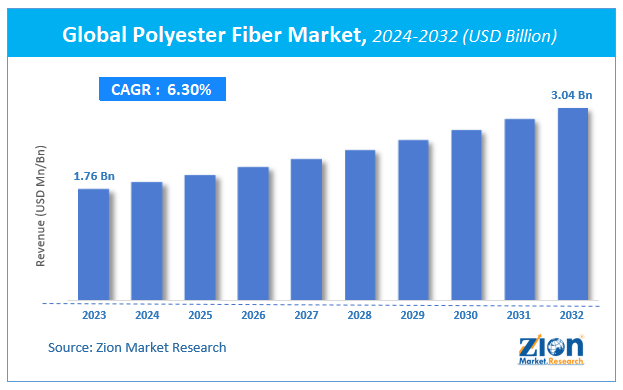
The global Polyester Fiber market size was worth around USD 1.76 billion in 2024 and is predicted to reach around USD 3.04 billion by 2034, with a compound annual growth rate (CAGR) of roughly 6.3% between 2025 and 2034. The Polyester Fiber Market is driven by exceptional physical properties such as elasticity, strength, and durability, along with easy access to raw materials and rising demand from apparel and home textiles.
Polyester Fiber Market: Overview
Polyester fiber is manufactured from polyethylene glycol and terephthalic acid and provides enhanced elasticity as well as abrasion resistance. These products are particularly utilized in apparel & home furnishing and upholstered furniture as well as other industrial applications such as car tire reinforcements, conveyors, and safety belts. Apart from this, when blended with polyester fiber, polyester fiber can be utilized for manufacturing high-quality fabrics and sportswear. Moreover, polyester fiber is used in construction, automotive, and private care & hygiene sectors. Apparently, polyester fibers are chemical-resistant, stretchable, less shrinkable, and wrinkle & mildew resistant. They are hydrophobic and dry instantly. In addition to this, these products can withstand wear & tear, provide insulation in hollow fiber form, and can retain shapes even in adverse climates.
Key Insights
- As per the analysis shared by our research analyst, the global Polyester Fiber market is estimated to grow annually at a CAGR of around 6.3% over the forecast period (2025-2034).
- In terms of revenue, the global Polyester Fiber market size was valued at around USD 1.76 billion in 2024 and is projected to reach USD 3.04 billion by 2034.
- The market is driven by exceptional physical product features including elasticity, strength, durability, and high modulus, along with easy access to raw materials and growing demand from apparel and home furnishing applications.
- Based on the Product, the Solid segment dominated the market with a share of approximately 62% in 2024, owing to its versatility, widespread use in apparel and home textiles, and suitability for a broad range of conventional textile manufacturing processes.
- Based on the Grade, the PET segment held the largest share of around 78% in 2024, driven by its excellent balance of cost, performance, processability, and compatibility with both virgin and recycled production streams.
- Based on the Application, the Apparel segment is projected to capture the largest market share of nearly 40% in 2024, because of continuous demand for cost-effective, durable, easy-care fabrics in fashion, sportswear, and everyday clothing.
- Based on region, Asia Pacific dominated the global market with a share of more than 45% in 2024, primarily due to the presence of major manufacturing hubs, expanding fashion and home furnishing industries, and rising consumer expenditure in countries such as China, India, Japan, and Malaysia.
Polyester Fiber Market: Dynamics
Growth Drivers
What factors are primarily accelerating the expansion of the Polyester Fiber market?
Exceptional physical properties, including elasticity, strength, durability, and high modulus, have driven large-scale adoption of polyester fiber across multiple end-use sectors. Easy availability of raw materials at relatively lower costs further supports market expansion.
Advances in polymerization systems and the versatility of melt spinning processes continue to improve production efficiency and product quality. Strong consumer preference for easy-care garments and durable fabrics for home furnishing, combined with the launch of innovative textile products, is expected to sustain growth over the coming years. Biotechnology applications in fabric treatment are also contributing to new performance attributes.
Restraints
What challenges are limiting the growth potential of the Polyester Fiber market?
Sustainability concerns related to petrochemical-based production and end-of-life disposal present notable restraints. Growing regulatory and consumer pressure for more environmentally responsible materials can limit unrestricted expansion of conventional polyester fiber.
Dependence on fluctuating raw material prices and the energy-intensive nature of manufacturing processes add further challenges for producers seeking consistent margins and long-term competitiveness.
Opportunities
What emerging prospects are expected to create new growth avenues in the market?
Rising demand for recycled polyester and circular economy initiatives create significant opportunities. Brands and manufacturers are increasingly incorporating recycled content to meet sustainability targets while retaining the performance benefits of polyester.
Growth in the textile industry, expanding use in apparel and home furnishings, and development of specialized technical and industrial applications further open new revenue streams for market participants.
Challenges
What obstacles must industry stakeholders overcome to sustain long-term growth?
Balancing cost competitiveness with environmental performance remains a key challenge. Producers must invest in recycling technologies, bio-based alternatives, and cleaner production processes while maintaining price points that support mass-market adoption.
Rapidly changing fashion cycles and competition from other synthetic and natural fibers require continuous product innovation and supply chain agility to retain market share.
Polyester Fiber Market: Segmentation
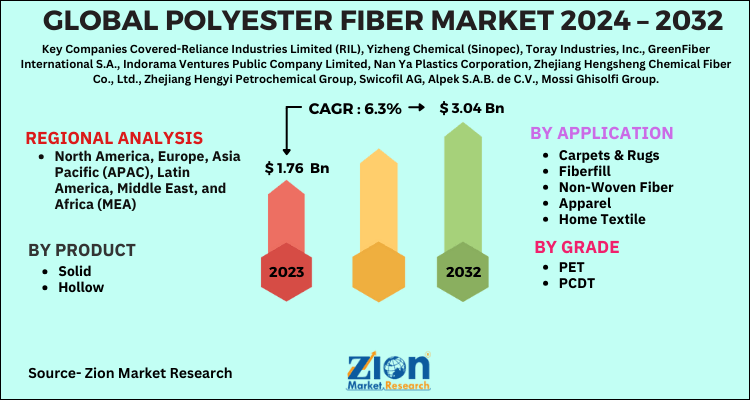
The Polyester Fiber market is segmented by product, grade, application, and region.
Based on Product Segment, the Polyester Fiber market is divided into solid and hollow. The solid segment currently dominates because of its broad applicability in apparel, home textiles, and general-purpose fabrics, offering a reliable combination of strength, durability, and processability at a competitive cost. Its extensive use in conventional spinning and weaving operations supports high-volume production and drives overall market growth. The hollow segment holds the second-largest position, valued for superior insulation properties that make it preferred in fiberfill, bedding, outerwear, and certain technical applications requiring thermal performance and lightweight characteristics.
Based on Grade Segment, the Polyester Fiber market is divided into PET and PCDT. The PET grade leads the market due to its excellent mechanical properties, chemical resistance, dyeability, and cost efficiency, making it the standard choice for the majority of apparel, home textile, and industrial applications. Its compatibility with both virgin and recycled feedstocks further reinforces dominance and supports market expansion. The PCDT grade ranks second, offering enhanced resilience and bulk that suit specialized uses such as carpets and certain high-performance textiles where greater recovery and durability are required.
Based on Application Segment, the Polyester Fiber market is divided into apparel, home textile, carpets & rugs, non-woven fiber, and fiberfill. The apparel segment dominates because of sustained global demand for affordable, durable, wrinkle-resistant, and easy-care clothing across fashion, sportswear, and everyday wear categories. Continuous product innovation and blending with other fibers keep polyester central to textile manufacturing and propel overall industry growth. The home textile segment is the second-most prominent, driven by rising expenditure on home furnishing, curtains, upholstery, and bedding that benefit from polyester’s durability, easy maintenance, and aesthetic versatility.
Polyester Fiber Market: Report Scope
| Report Attributes | Report Details |
|---|---|
| Report Name | Polyester Fiber Market |
| Market Size in 2023 | USD 1.76 Billion |
| Market Forecast in 2032 | USD 3.04 Billion |
| Growth Rate | CAGR of 6.3% |
| Number of Pages | 199 |
| Key Companies Covered | Reliance Industries Limited (RIL), Yizheng Chemical (Sinopec), Toray Industries, Inc., GreenFiber International S.A., Indorama Ventures Public Company Limited, Nan Ya Plastics Corporation, Zhejiang Hengsheng Chemical Fiber Co., Ltd., Zhejiang Hengyi Petrochemical Group, Swicofil AG, Alpek S.A.B. de C.V., Mossi Ghisolfi Group, William Barnet and Son, LLC, Stein Fibers Ltd., Far Eastern New Century Corporation, and Jiangsu Sanfangxiang Group |
| Segments Covered | By Product, By Grade, By Application and By Region |
| Regions Covered | North America, Europe, Asia Pacific (APAC), Latin America, Middle East, and Africa (MEA) |
| Base Year | 2023 |
| Historical Year | 2018 - 2022 |
| Forecast Year | 2024 - 2032 |
| Customization Scope | Avail customized purchase options to meet your exact research needs. Request For Customization |
Polyester Fiber Market: Regional Landscape
Why will Asia Pacific continue to dominate the global market during the projection period?
Asia Pacific is expected to maintain its leading position because of the strong presence of manufacturing capacity, rapid expansion of the fashion and home furnishing industries, rising consumer spending on textiles, and the concentration of major industry players across the region.
In Asia Pacific, China, India, Japan, and Malaysia serve as key growth engines. Expanding domestic consumption, export-oriented textile production, and continuous investment in production technology reinforce regional leadership and influence global supply dynamics and pricing.
North America maintains a significant share, supported by demand for technical textiles, home furnishings, and industrial applications, along with growing interest in recycled polyester solutions that align with sustainability goals.
Polyester Fiber Market: Competitive Analysis
The global Polyester Fiber market profiles key players such as:
- Reliance Industries Limited (RIL)
- Yizheng Chemical (Sinopec)
- Toray Industries, Inc
- GreenFiber International S.A
- Indorama Ventures Public Company Limited
- Nan Ya Plastics Corporation
- Zhejiang Hengsheng Chemical Fiber Co., Ltd
- Zhejiang Hengyi Petrochemical Group
- Swicofil AG
- Alpek S.A.B. de C.V.
- Mossi Ghisolfi Group
- William Barnet and Son, LLC
- Stein Fibers Ltd
- Far Eastern New Century Corporation
- Jiangsu Sanfangxiang Group
The global Polyester Fiber Market is segmented as follows:
By Product
By Grade
- PET
- PCDT
By Application
- Carpets & Rugs
- Fiberfill
- Non-Woven Fiber
- Apparel
- Home Textile
By Region
- North America
- The U.S.
- Canada
- Europe
- France
- The UK
- Spain
- Germany
- Italy
- Rest of Europe
- Asia Pacific
- China
- Japan
- India
- South Korea
- Southeast Asia
- Rest of Asia Pacific
- Latin America
- Brazil
- Mexico
- Rest of Latin America
- Middle East & Africa
- GCC
- South Africa
- Rest of the Middle East & Africa
Table Of Content
Methodology
FrequentlyAsked Questions
Polyester fiber is a synthetic textile material. It is durable, lightweight, and widely used in fabrics
The global Polyester Fiber market is expected to be driven by the demand from apparel, home textiles, and industrial applications. Cost efficiency and durability support widespread market adoption.
According to study, the global Polyester Fiber market size was worth around USD 1.76 Billion in 2023 and is predicted to grow to around USD 3.04 Billion By 2032.
The global Polyester Fiber market is expected to grow at a Compound Annual Growth Rate (CAGR) of around CAGR 6.3% during the forecast period from 2024-2032.
The global Polyester Fiber industry is projected to be challenged by Challenges include sustainability concerns and raw material dependency.
The Opportunities include recycled polyester demand, textile industry growth, apparel and home furnishing use, and circular economy initiatives will offer significant growth opportunities in the Polyester Fiber market.
Recycled and bio-based polyester; lightweight and high-strength fibers; demand from apparel and technical textiles are the emerging trends and innovations impacting the Polyester Fiber market.
The global Polyester Fiber market is expected to be led by APAC during the forecast period.
Some of the prominent players operating in the global Polyester Fiber market are; Reliance Industries Limited (RIL), Yizheng Chemical (Sinopec), Toray Industries, Inc., GreenFiber International S.A., Indorama Ventures Public Company Limited, Nan Ya Plastics Corporation, Zhejiang Hengsheng Chemical Fiber Co., Ltd., Zhejiang Hengyi Petrochemical Group, Swicofil AG, Alpek S.A.B. de C.V., Mossi Ghisolfi Group, William Barnet and Son, LLC, Stein Fibers Ltd., Far Eastern New Century Corporation, Jiangsu Sanfangxiang Group and others.
The report explores crucial aspects of the Polyester Fiber market, including a detailed discussion of existing growth factors and restraints, while also browsing future growth opportunities and challenges that impact the market.

HappyClients

