
Black Beauty Market Size, Trend, Growth, Industry Analysis Report 2034

Black Beauty Market By Product Type (Hair Care Products, Skin Care Products, Cosmetics and Makeup, Grooming Tools and Accessories), By Ingredient Type (Natural and Organic Formulations, Chemically Formulated Products, Herbal and Botanical Blends, Dermatologically Tested Formulations), By Distribution Channel (Specialty Beauty Stores, Salons and Wellness Centers, Online Retail Platforms, Mass Retail and Drugstores), By End User (Women Consumers, Men Consumers, Teen and Young Adult Consumers, Professional Salons and Spas), and By Region - Global and Regional Industry Overview, Market Intelligence, Comprehensive Analysis, Historical Data, and Forecasts 2026 - 2034
| Market Size in 2025 | Market Forecast in 2034 | CAGR (in %) | Base Year |
|---|---|---|---|
| USD 10.08 Billion | USD 34.39 Billion | 14.61% | 2025 |
Black Beauty Industry Perspective:
What will be the size of the black beauty market during the forecast period?
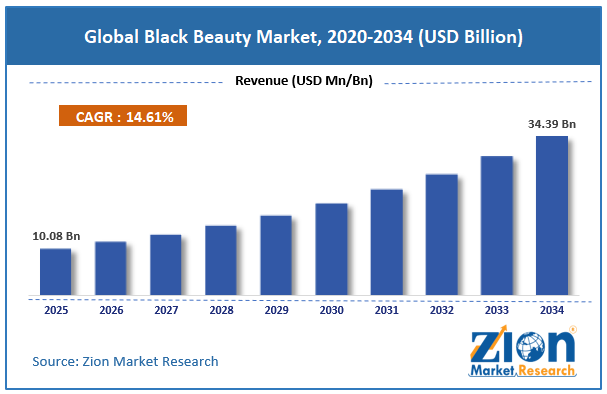
The global black beauty market size was valued at approximately USD 10.08 billion in 2025 and is projected to reach around USD 34.39 billion by 2034, growing at a compound annual growth rate of approximately 14.61% between 2026 and 2034.
Key Insights
- As per the analysis shared by our research team, the global black beauty market is estimated to grow at a compound annual growth rate of approximately 14.61% during the forecast period from 2026 to 2034.
- In terms of revenue, the global black beauty market was valued at approximately USD 10.08 billion in 2025 and is projected to reach USD 34.39 billion by 2034.
- The black beauty market is expected to grow steadily, driven by rising demand for textured haircare, growing shade inclusivity in cosmetics, increasing salon and grooming spending, and expanding retail and digital availability.
- Based on product type, hair care products lead the market because textured hair maintenance requires frequent, specialized purchases, while skin care products are gaining strong momentum as consumers seek formulas that address deeper skin tone concerns such as hyperpigmentation and uneven texture.
- Based on ingredient type, chemically formulated products lead the market due to their long-standing presence and proven performance. At the same time, natural and organic formulations are the fastest-growing segment as consumers move toward gentler, plant-based alternatives.
- Based on distribution channel, specialty beauty stores lead the market because of curated product selection and knowledgeable staff, while online retail platforms are steadily growing as consumers increasingly discover niche and independent brands through social media and digital marketplaces.
- Based on end user, women consumers lead the market due to the wide variety of haircare, skincare, and cosmetic routines built around them, while men consumers are growing rapidly as grooming brands expand their offerings for skin and beard care.
- Based on region, North America leads the global black beauty market, while the Middle East and Africa region is the fastest-growing due to a large youthful population and rapidly expanding beauty retail infrastructure.
Black Beauty Market: Overview
Black beauty refers to haircare, skincare, cosmetics, grooming, and personal care products created to meet the specific needs of Black consumers, including textured hair and deeper skin tones. The black beauty market includes shampoos, conditioners, hair oils, styling products, foundations, concealers, skincare formulas, grooming tools, and salon services designed for different hair textures and melanin-rich skin. Growing interest in natural hairstyles, cultural identity, and personal expression is encouraging consumers to choose products specifically suited to their beauty needs. Social media is helping Black-owned beauty brands reach wider audiences by making specialized products easier to discover, review, and purchase. Consumers are also paying closer attention to ingredients, product safety, skin compatibility, and inclusive foundation shades, pushing brands to improve formulas and expand product ranges. Established companies and independent brands are investing in research focused on textured hair and darker skin tones to develop more effective products. Retailers are also increasing shelf space and online collections for Black beauty products, improving accessibility for consumers. These developments support product innovation, wider availability, and continued growth across the global market.
The black beauty industry will continue to grow as independent founders, legacy personal care companies, and specialty retailers work together to deliver better-formulated, more representative, and more accessible beauty products to consumers worldwide.
Black Beauty Market: Strategic Perspective
Where is the black beauty market heading?
The black beauty market is expected to move toward deeper product specialization, wider shade ranges, and stronger emphasis on ingredient transparency as consumers become more selective about what they put on their hair and skin. Formulations built around specific curl patterns, skin undertones, and cultural haircare practices, along with growing demand for clean, gentle ingredient lists, are likely to gain more attention alongside long-standing conventional product lines.
Where should businesses invest in the black beauty market?
The black beauty market presents strong opportunities in expanded shade-matching technology, textured haircare research, men's grooming lines, and partnerships with Black-owned salons and beauty educators. Investing in inclusive product development, transparent ingredient sourcing, and efficient direct-to-consumer distribution can help brands build trust and loyalty while managing costs, particularly as demand continues to rise across both established and emerging markets.
What will reshape competition in the black beauty market?
Success in the black beauty market will increasingly depend on how well brands understand and represent the communities they serve, from formulation science to marketing authenticity. Companies that combine genuinely effective products with cultural credibility, inclusive shade ranges, fair pricing, and consistent retail availability are likely to stand out in an increasingly crowded and competitive beauty and personal care industry.
Black Beauty Market: Technology Roadmap 2026–2034
What is the projected development roadmap of the black beauty market over the forecast period?
The black beauty market is advancing through improved formulation science for textured hair and deeper skin tones, more precise shade-matching technology, and growing use of gentler, skin-friendly ingredients, making products more effective and better suited to a wider range of consumers. The market is expected to grow at a compound annual growth rate of approximately 14.61% over the forecast period, driven by rising cultural representation, evolving beauty standards, and continuous refinement of product formulation technology.
The following roadmap outlines key development phases expected through 2034.
2026–2028: Representation and Awareness Building Phase
- Shade-range expansion focus: Cosmetics brands are expected to widen their foundation and concealer ranges using more advanced pigment-matching research while keeping formulas skin-friendly.
- Textured haircare refinement: Brands are likely to focus more on moisture retention, curl definition, and scalp health formulas suited to coily and curly hair types.
- Consumer-specific product positioning: Manufacturers are expected to create product lines targeting specific groups, including men's grooming, children's haircare, and mature skin concerns.
2029–2031: Product Diversification and Distribution Expansion Phase
- Ingredient innovation growth: Products built around African botanicals, such as shea butter, baobab oil, and black soap extracts, are expected to gain greater shelf space alongside conventional formulas.
- New format experimentation: Brands are likely to introduce combinations using multi-use skincare, waterless beauty formats, and protective styling tools to differentiate products and attract loyal repeat buyers.
- Digital retail expansion: Social media storefronts, direct-to-consumer websites, and salon partnership programs are expected to give independent brands additional ways to reach consumers.
2032–2034: Personalized and Sustainable Beauty Phase
- Next-generation formulation science: Brands are expected to move toward biodegradable packaging, ethically sourced ingredients, and reduced water usage in manufacturing as sustainability becomes a stronger purchasing factor.
- Personalized beauty technology: Skin and hair analysis tools may increasingly help consumers identify the exact products suited to their tone, texture, and specific concerns.
- Customized formulation products: Black beauty products could increasingly be developed around individual hair porosity, skin undertone, and lifestyle needs, with offerings tailored to specific climates, routines, and personal preferences.
Black Beauty Market: Dynamics
Growth Drivers
What is driving changing consumer preferences in the black beauty market?
The black beauty market is growing as consumers increasingly embrace natural hairstyles, deeper skin tone representation, and products designed for their specific beauty needs. Shoppers are moving away from generic products toward formulas suited to textured hair and melanin-rich skin, especially as they become more aware of issues such as dryness, breakage, irritation, and poor shade matching. Social media is helping Black beauty influencers and content creators introduce independent brands to wider audiences through reviews, tutorials, and product recommendations. Younger consumers are also driving demand for curl-specific haircare, wider foundation shade ranges, gentle ingredients, and culturally relevant packaging.
Online shopping allows customers to compare ingredients, read reviews, and discover smaller brands more easily. Retailers are responding by giving black beauty products greater visibility through dedicated displays and online collections. Brands are also improving product information, including details about hair porosity, ingredients, skin compatibility, and shade matching. These changes are encouraging manufacturers to develop more effective, inclusive, and accessible beauty products while expanding opportunities across the market.
Growing salon and grooming spending is creating opportunities in the black beauty market.
The black beauty industry is creating new opportunities as demand grows for professional haircare, skincare, grooming, and beauty services designed for Black consumers. Salons, barbershops, natural hair studios, and wellness centers are becoming important channels for specialized products and expert services. Brands are introducing premium haircare ranges, advanced styling tools, scalp treatments, and skincare products to meet customers seeking better quality and professional guidance. Salon partnerships can strengthen brand awareness because stylists can demonstrate products and recommend suitable solutions based on individual hair and skin needs.
Men’s grooming is also expanding, with barbershops adding retail products such as beard oils, facial cleansers, moisturizers, and styling products. Growing interest in protective hairstyles and scalp care is creating demand for specialized products among braiding salons and textured hair specialists. Online marketplaces and direct-to-consumer websites are helping smaller Black-owned brands reach customers beyond their local markets. Additional opportunities exist in children’s textured haircare, hair extensions, postpartum beauty products, and personalized skincare. Loyalty programs, educational content, and collaborations with professional stylists can further strengthen customer relationships and encourage repeat purchases across the market.
Restraints
Limited mainstream retail shelf space is a key challenge limiting growth in the black beauty market.
The black beauty industry faces challenges from limited retail shelf space, strong competition, and higher costs for quality products. Smaller and independent brands may struggle to secure prominent placement in mainstream stores, reducing visibility among potential customers. Limited marketing budgets and smaller distribution networks can make it harder for new companies to compete with established personal care brands. Rising costs of ingredients, packaging, product testing, and manufacturing can also pressure profit margins.
Large beauty companies entering the segment may increase competition and put pressure on prices, making differentiation more important for independent brands. Social media, influencer marketing, and word-of-mouth can improve visibility, but building awareness through these channels may require continuous investment and consistent content. Direct-to-consumer websites and online marketplaces offer alternatives to traditional retail and let brands reach customers directly. Clear product information, strong branding, targeted digital marketing, and customer engagement can help companies improve visibility and build lasting customer relationships in the competitive market.
Opportunities
Will the expansion of men's grooming products open new opportunities in the black beauty market?
The Black beauty market is expanding beyond traditional haircare and cosmetics, with men’s grooming becoming a key growth area. Products for razor bumps, beard care, scalp health, and skincare are creating opportunities for brands that understand Black men's specific needs. Premium grooming products such as gentle shaving creams, moisturizing beard oils, facial cleansers, and targeted skincare treatments are attracting consumers who want complete grooming routines. Children’s haircare is also gaining attention as parents seek gentle, tear-free products suitable for textured hair. Protective styling products are supporting consumers who prefer low-maintenance hairstyles, while specialized treatments address scalp dryness, breakage, and other common concerns.
Barbershops, braiding salons, natural hair studios, and wellness centers are helping brands reach customers through professional advice and product recommendations. Online beauty stores and subscription services are allowing smaller brands to sell beyond their local markets. Demand for transparent ingredients, cruelty-free formulas, and culturally relevant products is also increasing. Limited-edition collections, collaborations with Black creators, and affordable starter kits are helping brands attract different customer groups. Together, these trends are creating new opportunities for product innovation, customer engagement, and market expansion.
Challenges
How are counterfeit products and formulation inconsistency affecting the black beauty market?
The black beauty market faces challenges from counterfeit products, inconsistent quality, supply issues, and limited manufacturing resources. Fake products that copy popular packaging can confuse shoppers and damage brand trust, especially when poor-quality formulas cause skin irritation or hair problems. Smaller brands may also struggle to maintain consistent quality across batches because of limited manufacturing experience or limited access to reliable ingredient suppliers. Companies that rely on overseas manufacturers may face longer delivery times, higher shipping costs, and quality-control challenges.
Limited monitoring across some online marketplaces can make it harder to identify unauthorized sellers and protect genuine products. Brands can reduce these risks by using secure packaging, authentication features, trusted manufacturing partners, and stronger relationships with retailers and e-commerce platforms. Regular quality testing and clear ingredient labeling can further reassure customers and improve product transparency. Building direct-to-consumer channels can also give companies greater control over product distribution and customer communication.
Black Beauty Market: Report Scope
| Report Attributes | Report Details |
|---|---|
| Report Name | Black Beauty Market |
| Market Size in 2025 | USD 10.08 Billion |
| Market Forecast in 2034 | USD 34.39 Billion |
| Growth Rate | CAGR of 14.61% |
| Number of Pages | 228 |
| Key Companies Covered | SheaMoisture, Carol's Daughter, Mielle Organics, Pattern Beauty, Fenty Beauty, Bevel, The Lip Bar, Camille Rose, TPH by Taraji, Uncle Funky's Daughter, and others. |
| Segments Covered | By Product Type, By Ingredient Type, By Distribution Channel, By End User, and By Region |
| Regions Covered | North America, Europe, Asia Pacific (APAC), Latin America, Middle East, and Africa (MEA) |
| Base Year | 2025 |
| Historical Year | 2020 - 2024 |
| Forecast Year | 2026 - 2034 |
| Customization Scope | Avail customized purchase options to meet your exact research needs. Request For Customization |
Black Beauty Market: Segmentation
The global black beauty market is segmented by product type, ingredient type, distribution channel, end user, and region.
Why do hair care products lead the black beauty market by product type?
Based on product type, the global black beauty industry is classified into hair care products, skin care products, cosmetics and makeup, and grooming tools and accessories. Hair care products hold about 40% of the market share, leading because textured hair requires frequent moisturizing, styling, and maintenance products that consumers purchase regularly. Skin care products hold around 25% market share. It is the fastest-growing segment because consumers are increasingly seeking formulas that address hyperpigmentation, uneven tone, and other concerns specific to deeper skin.
How are chemically formulated products maintaining their lead in the black beauty market?
By ingredient type, the black beauty market is divided into natural and organic formulations, chemically formulated products, herbal and botanical blends, and dermatologically tested formulations. Chemically formulated products account for approximately 35% of the global market share, driven by their long track record, strong styling performance, and widespread availability. Natural and organic formulations hold around 26% market share. This segment is the fastest-growing, driven by rising consumer interest in gentler, plant-based alternatives free from harsh chemicals.
Where do specialty beauty stores stand in the black beauty market distribution landscape?
Based on distribution channel, the market is divided into specialty beauty stores, salons and wellness centers, online retail platforms, and mass retail and drugstores. Specialty beauty stores lead with about a 39% share because of their curated selection, knowledgeable staff, and reputation as a trusted destination for hard-to-find products. Online retail platforms hold around 27% market share. They are growing steadily as more consumers discover niche and independent brands through social media and digital marketplaces.
Who accounts for the largest end-user share in the black beauty market?
By end user, the market is categorized into women consumers, men consumers, teen and young adult consumers, and professional salons and spas. Women consumers account for about 51% of the market, leading because of the wide range of haircare, skincare, and cosmetic routines built around them. Men account for around 22% of the market share. This segment is expanding quickly as grooming brands introduce more dedicated skincare, beard care, and scalp treatment products.
Black Beauty Market: Regional Analysis
What factors are strengthening North America's position in the black beauty market?
North America leads the global black beauty market and is expected to grow at a CAGR of around 7.4% during the forecast period. The region benefits from a large Black consumer base, strong cultural influence, and growing demand for beauty products designed for textured hair and deeper skin tones. The United States and Canada have many established and emerging brands that use social media, celebrity partnerships, and retail networks to reach consumers. Major retailers are also expanding shelf space and online collections for black beauty products, making them easier to find and purchase. Rising representation in advertising, growing demand for men’s grooming, and increased spending on professional salon services are further supporting market growth.
Local brands are developing products for different hair textures, skin tones, and climate conditions, helping meet varied consumer needs. Direct-to-consumer websites, beauty subscription services, and online marketplaces are improving product access while allowing smaller brands to reach customers nationwide. Growing investment in Black-owned beauty companies is also supporting product innovation and business expansion. These factors are strengthening the region’s role in the global market and supporting continued demand across haircare, skincare, cosmetics, and grooming categories.
How is a growing youthful population driving growth in the Middle East and Africa black beauty market?
The Middle East and Africa black beauty market is expected to grow at a volume CAGR of around 9.1% during the forecast period. Growth is supported by a large young population, rising urbanization, improving retail infrastructure, and increasing disposable incomes across several African economies. Nigeria, South Africa, Kenya, and Ghana are developing strong beauty and personal care sectors, supported by local entrepreneurs and established demand for haircare, skincare, and grooming products. Growing smartphone and internet use is helping consumers discover local and international brands through social media, online reviews, and beauty content. International companies are also expanding in the region to meet rising demand for quality products suitable for darker skin tones and textured hair. Local manufacturers are increasing production and improving ingredient sourcing to reduce import dependence and offer more affordable products.
Expanding supermarkets, beauty stores, salons, and barbershops are making personal care products more accessible in major cities. E-commerce is also giving smaller brands opportunities to reach customers beyond traditional retail locations. Rising consumer awareness, stronger local production, growing digital access, and expanding beauty services are creating new opportunities across the Middle East and Africa market, supporting continued demand for inclusive and specialized beauty products.
Recent Market Developments
- In September 2026, Zaron Cosmetics launched its new Zaron Hair Care line in Nigeria, expanding beyond cosmetics and skincare into haircare products designed to meet the needs of its core consumers across Africa.
- In August 2026, Thirteen Lune partnered with Takealot for its first international expansion into South Africa, bringing a portfolio of founder-led beauty brands across skincare, haircare, cosmetics, wellness, and fragrance to South African consumers.
Black Beauty Market: Competitive Analysis
The leading players in the global black beauty market are:
- SheaMoisture
- Carol's Daughter
- Mielle Organics
- Pattern Beauty
- Fenty Beauty
- Bevel
- The Lip Bar
- Camille Rose
- TPH by Taraji
- Uncle Funky's Daughter
The global black beauty market is segmented as follows:
By Product Type
- Hair Care Products
- Skin Care Products
- Cosmetics and Makeup
- Grooming Tools and Accessories
By Ingredient Type
- Natural and Organic Formulations
- Chemically Formulated Products
- Herbal and Botanical Blends
- Dermatologically Tested Formulations
By Distribution Channel
- Specialty Beauty Stores
- Salons and Wellness Centers
- Online Retail Platforms
- Mass Retail and Drugstores
By End User
- Women Consumers
- Men Consumers
- Teen and Young Adult Consumers
- Professional Salons and Spas
By Region
- North America
- The U.S.
- Canada
- Mexico
- Europe
- France
- The UK
- Spain
- Germany
- Italy
- Rest of Europe
- Asia Pacific
- China
- Japan
- India
- Australia
- South Korea
- Rest of Asia Pacific
- The Middle East & Africa
- Saudi Arabia
- UAE
- Egypt
- Kuwait
- South Africa
- Rest of the Middle East & Africa
- Latin America
- Brazil
- Argentina
- Rest of Latin America
Table Of Content
Methodology
FrequentlyAsked Questions
The black beauty market refers to haircare, skincare, cosmetics, grooming, and personal care products created to meet the specific needs of Black consumers, including textured hair and deeper skin tones.
The global black beauty market is expected to grow due to rising cultural representation, growing demand for textured haircare and shade-inclusive cosmetics, increasing grooming and salon spending, and expanding retail and digital distribution worldwide.
According to research, the global black beauty market was valued at approximately USD 10.08 billion in 2025 and is projected to reach approximately USD 34.39 billion by 2034.
The compound annual growth rate of the black beauty market is expected to be approximately 14.61% from 2026 to 2034.
North America is expected to lead the global black beauty market throughout the forecast period, driven by its large consumer base, strong brand ecosystem, and expanding mainstream retail acceptance.
The major players in the global black beauty market include SheaMoisture, Carol's Daughter, Mielle Organics, Pattern Beauty, Fenty Beauty, Bevel, The Lip Bar, Camille Rose, TPH by Taraji, and Uncle Funky's Daughter.
The report examines key aspects of the black beauty market, including research and development drivers, adoption barriers, opportunity areas, competitive landscape dynamics, detailed regional market performance analysis, and a comprehensive forward-looking outlook across all major product types, ingredient types, distribution channels, end-user segments, and geographic regions through 2034.
Technological advancements are making the black beauty market more inclusive and effective through better shade-matching technology, deeper research into textured hair science, and improved gentle-ingredient formulations. These advances help consumers find products that genuinely fit their hair texture, skin tone, and personal care needs.
Haircare, skincare, and men's grooming will offer strong opportunities in the black beauty market, as consumers increasingly seek products built specifically for their hair texture, skin tone, and everyday grooming routines.
Emerging trends in the black beauty market include expanding shade ranges, growing demand for natural and botanical ingredients, rising men's grooming culture, and stronger representation across mainstream retail, helping brands deliver more effective, accessible, and culturally authentic products.

HappyClients

