
Automotive E-Compressor Market Size, Share, Value and Forecast 2034

Automotive E-Compressor Market By Technology (Scroll Type E-Compressors, Rotary Type E-Compressors, Reciprocating Type E-Compressors, Swing Type E-Compressors), By Application (Battery Electric Vehicles, Hybrid Electric Vehicles, Plug-in Hybrid Electric Vehicles, Fuel Cell Electric Vehicles), By End-User (Passenger Vehicle Manufacturers, Commercial Vehicle Manufacturers, Electric Vehicle Fleet Operators, Automotive Aftermarket Service Providers), By Voltage Type (Low Voltage E-Compressors, High Voltage E-Compressors), and By Region - Global and Regional Industry Overview, Market Intelligence, Comprehensive Analysis, Historical Data, and Forecasts 2026 - 2034
| Market Size in 2025 | Market Forecast in 2034 | CAGR (in %) | Base Year |
|---|---|---|---|
| USD 1.74 Billion | USD 8.41 Billion | 19.12% | 2025 |
Automotive E-Compressor Industry Perspective:
What will be the size of the automotive e-compressor market during the forecast period?
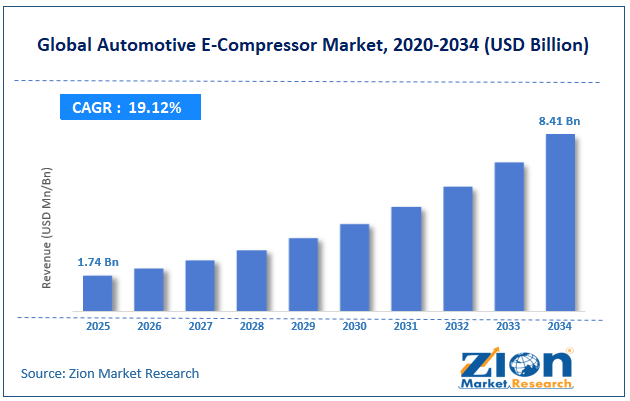
The global automotive e-compressor market size was approximately USD 1.74 billion in 2025 and is projected to reach around USD 8.41 billion by 2034, with a compound annual growth rate of roughly 19.12% between 2026 and 2034.
Key Insights
- As per the analysis shared by our research analyst, the global automotive e-compressor market is estimated to grow annually at a compound annual growth rate of around 19.12% over the forecast period from 2026 to 2034.
- In terms of revenue, the global automotive e-compressor market size was valued at approximately USD 1.74 billion in 2025 and is projected to reach USD 8.41 billion by 2034.
- The automotive e-compressor market is expected to grow steadily, driven by rising electric vehicle sales, growing demand for efficient battery cooling systems, expanding commercial electric vehicle fleets, and continuous improvements in compressor efficiency and noise reduction.
- Based on technology, scroll-type e-compressors are expected to lead the market. In contrast, rotary-type e-compressors are anticipated to grow steadily as demand rises for compact, low-noise cooling solutions in smaller vehicle models.
- Based on application, battery electric vehicles are expected to lead the automotive e-compressor market. In contrast, plug-in hybrid electric vehicles are anticipated to grow rapidly, driven by rising consumer interest in flexible charging options.
- Based on end-user, passenger vehicle manufacturers form the largest current end-user group. In contrast, electric vehicle fleet operators are expected to grow rapidly during the forecast period as more companies transition to electric delivery and transport fleets.
- Based on voltage type, high-voltage e-compressors are expected to lead the market. In contrast, low-voltage e-compressors are anticipated to grow steadily as demand increases in mild-hybrid vehicle applications.
- Based on region, the Asia Pacific is projected to dominate the global automotive e-compressor market during the estimated period, followed by Europe.
Automotive E-Compressor Market: Overview
An automotive e-compressor is an electric compressor that cools a vehicle's cabin and battery without depending on the engine, making it an important part of modern electric and hybrid vehicles. Unlike traditional compressors powered by engine belts, an automotive e-compressor runs directly on the vehicle's battery, allowing the air conditioning system to work even when the engine is off. It helps keep passengers comfortable while also maintaining the right temperature for the battery and electric motor, improving performance and safety. This advanced cooling technology also improves overall vehicle reliability by preventing overheating of critical electrical components. Efficient cooling also reduces unnecessary battery usage, which can help extend the driving range of electric vehicles. Most automotive e-compressors use compact scroll or rotary designs that operate quietly and adjust their speed based on cooling needs, improving overall energy efficiency. The growing adoption of electric vehicles and the rising need for efficient battery thermal management are driving the automotive e-compressor market. Government support for clean transportation and stricter emissions regulations is further increasing demand for passenger and commercial vehicles worldwide.
The automotive e-compressor industry is growing due to rising electric vehicle production, increasing focus on battery thermal management, and growing demand for energy-efficient cabin cooling systems.
Impact of the USA-Israel War on Iran on the Automotive E-Compressor Market
Tensions among the United States, Israel, and Iran could create short-term challenges for the automotive component supply chain, particularly for semiconductor chips and electronic control units used inside e-compressor systems that pass through affected trade regions. Some component manufacturers may experience temporary delays in sourcing certain electronic parts, which could slow near-term production timelines. However, steady demand from electric vehicle manufacturers and fleet operators is expected to keep the automotive e-compressor market on a stable growth path despite short-term regional disruptions.
Automotive E-Compressor Market: Technology Roadmap 2026–2034
What is the projected development roadmap for the automotive e-compressor market over the forecast period?
The automotive e-compressor market is progressing through more efficient compressor designs, smarter thermal management software, and integration with wider vehicle energy systems. The market is expected to grow at a compound annual growth rate of around 19.12% over the forecast period, supported by rising global demand for electric vehicles and energy-efficient cooling technology.
The following roadmap outlines key development phases expected through 2034.
2026–2028: Compressor Efficiency and Noise Reduction Phase
- Manufacturers are expected to develop quieter, more compact e-compressors that improve passenger comfort without adding unnecessary weight to the vehicle.
- Variable-speed control technology is expected to expand, allowing compressors to adjust output based on real-time cooling needs rather than running at a constant speed.
- Improved motor winding and refrigerant-handling designs are expected to extend the working life of e-compressors, reducing maintenance needs over the vehicle's lifetime.
2029–2032: Integrated Thermal Management and Software Optimization Phase
- Companies are expected to integrate e-compressor operation with vehicle-wide thermal management software to balance cabin cooling and battery temperature control more efficiently.
- Integration between e-compressor systems and vehicle battery management systems is expected to grow, giving automakers better control over energy use and driving range.
- Cloud-connected diagnostic platforms are expected to help fleet operators monitor compressor health across thousands of vehicles simultaneously, improving maintenance planning and reducing downtime.
2033–2034: Fully Integrated Smart Thermal Ecosystem Phase
- E-compressors are expected to become part of larger connected-vehicle thermal ecosystems that integrate cabin, battery, and motor cooling into a single coordinated system.
- Self-diagnosing compressor units are expected to reduce the need for manual servicing, making long-term vehicle ownership more convenient and less dependent on workshop visits.
- Fully automated thermal alert systems are expected to notify drivers and fleet managers instantly when a compressor issue is detected, improving vehicle reliability and passenger safety.
Automotive E-Compressor Market: Dynamics
Growth Drivers
Rising adoption of electric vehicles is driving growth in the automotive e-compressor market.
The automotive e-compressor market is growing as more people and businesses choose electric and hybrid vehicles. Unlike traditional compressors, automotive e-compressors run on the vehicle's battery instead of the engine, making them essential for modern electric vehicles. They keep the cabin cool and comfortable while also preventing the battery and electric motor from overheating. This helps improve vehicle performance, battery life, and driving efficiency. As more electric vehicle models are launched worldwide, the demand for lightweight, compact, and energy-efficient e-compressors continues to increase. These compressors also support battery preconditioning, which keeps the battery at the right temperature for faster charging and longer life. Automakers are focusing on advanced compressor technologies that reduce energy use, lower noise levels, and improve overall vehicle comfort. Government incentives for electric vehicle adoption and stricter emission regulations are further supporting market growth. Rising investments in electric mobility and battery technology are also creating new opportunities for manufacturers.
As a result, the automotive e-compressor market is witnessing strong demand across passenger cars, commercial vehicles, and electric fleets worldwide.
How is rising investment in commercial electric fleets and battery thermal management driving the automotive e-compressor market?
The automotive e-compressor industry is growing as logistics companies and public transport operators adopt more electric commercial vehicles. These compressors help maintain a comfortable cabin while keeping batteries cool during long journeys and frequent charging, improving vehicle performance and battery life. The growing use of electric vans, buses, and delivery vehicles is driving strong demand for reliable, energy-efficient automotive e-compressors. Manufacturers are developing compact, lightweight compressors that deliver better cooling while using less battery power. Many automakers are also introducing advanced thermal management systems that combine battery, motor, and cabin cooling into a single efficient solution. This improves vehicle reliability, reduces energy consumption, and supports longer driving range.
At the same time, aftermarket companies are expanding maintenance and replacement services for aging e-compressor systems, helping fleet operators reduce downtime. Growing investments in electric mobility, charging infrastructure, and fleet electrification are further boosting market growth. As businesses continue to focus on operational efficiency and lower emissions, demand for automotive e-compressors is expected to rise across passenger and commercial vehicles worldwide.
Restraints
High component costs and technical complexity are key challenges in the automotive e-compressor market.
The automotive e-compressor market faces several challenges that may limit its growth. One of the biggest challenges is the high cost of developing and manufacturing advanced e-compressors that are efficient, durable, and quiet. These systems require precise control electronics and high-quality components to deliver reliable cooling under different driving conditions. Many small manufacturers find it difficult to invest in the research and technology needed to compete in the market. Safe refrigerant management is another challenge, as compressors must prevent leaks while maintaining consistent performance. Long-term reliability is also essential because compressor failures can affect cabin cooling, battery temperature, and overall vehicle performance.
In addition, shortages of electronic components and rising raw material costs can delay production and increase manufacturing expenses. The need to meet strict automotive safety and quality standards further adds to development costs. Although automotive e-compressors offer significant benefits, these technical and cost-related challenges continue to slow their widespread adoption across the global automotive industry.
Opportunities
Expanding electric vehicle infrastructure and rising commercial fleet electrification are driving growth in the automotive e-compressor market.
The automotive e-compressor industry offers strong growth opportunities as electric vehicle adoption continues to increase worldwide. Rising investments in electric vehicle infrastructure and the rapid electrification of commercial fleets are creating new demand for advanced cooling systems. Many countries across the Asia-Pacific, Latin America, and the Middle East are witnessing higher sales of electric passenger cars, buses, and delivery vehicles, creating new opportunities for automotive e-compressor manufacturers. The growing use of electric delivery vans and ride-sharing fleets is prompting companies to develop durable, energy-efficient compressors for continuous operation. Automakers are also introducing high-voltage e-compressors that improve battery cooling, support faster charging, and enhance overall vehicle performance. The expansion of public charging stations is increasing consumer confidence in electric vehicles, further boosting demand for automotive e-compressors.
In addition, advances in electric motors, control software, and lightweight compressor designs are making these systems more affordable and easier to integrate into different vehicle models. These developments are expected to support long-term market growth while improving energy efficiency, passenger comfort, battery life, and overall electric vehicle performance.
Challenges
What challenges does the automotive e-compressor market face in reliability and supply chain readiness amid rising competition?
The automotive e-compressor market faces several challenges that could slow its growth. One major challenge is ensuring reliable performance in different climates, road conditions, and vehicle types. Poor compressor performance can reduce cabin comfort, affect battery cooling, and increase maintenance or warranty costs. Manufacturers must invest heavily in research, testing, and quality control to develop compressors that work efficiently in passenger cars, SUVs, buses, and commercial vehicles. Another challenge is the shortage of skilled engineers with expertise in electric motors, thermal management, and automotive software integration.
As e-compressors become smarter and more software-driven, the demand for specialized talent continues to rise. Growing competition from established automotive suppliers and new technology companies is also putting pressure on manufacturers to deliver better products at lower prices. In addition, rapid technological changes require continuous innovation and investment. These technical, financial, and workforce challenges can delay product development and slow the adoption of advanced automotive e-compressors, particularly among smaller manufacturers with limited resources.
Automotive E-Compressor Market: Report Scope
| Report Attributes | Report Details |
|---|---|
| Report Name | Automotive E-Compressor Market |
| Market Size in 2025 | USD 1.74 Billion |
| Market Forecast in 2034 | USD 8.41 Billion |
| Growth Rate | CAGR of 19.12% |
| Number of Pages | 229 |
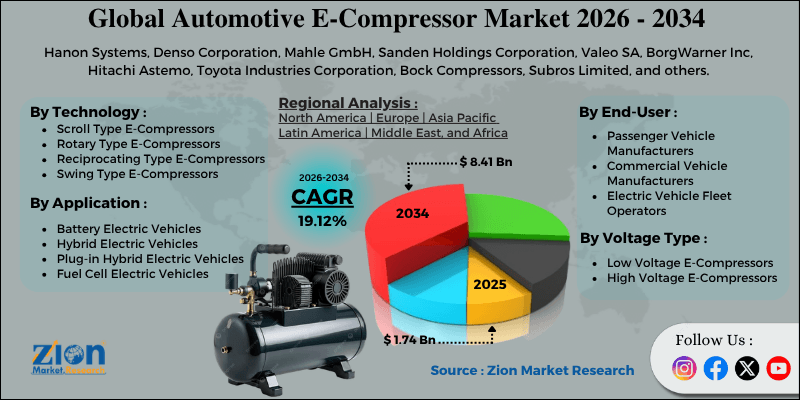
| Key Companies Covered | Hanon Systems, Denso Corporation, Mahle GmbH, Sanden Holdings Corporation, Valeo SA, BorgWarner Inc, Hitachi Astemo, Toyota Industries Corporation, Bock Compressors, Subros Limited, and others. |
| Segments Covered | By Technology, By Application, By End-User, By Voltage Type, and By Region |
| Regions Covered | North America, Europe, Asia Pacific (APAC), Latin America, Middle East, and Africa (MEA) |
| Base Year | 2025 |
| Historical Year | 2020 - 2024 |
| Forecast Year | 2026 - 2034 |
| Customization Scope | Avail customized purchase options to meet your exact research needs. Request For Customization |
Automotive E-Compressor Market: Segmentation
The global automotive e-compressor market is segmented by technology, application, end-user, voltage type, and region.
What makes scroll-type e-compressors the expected leader in the automotive e-compressor market?
Based on technology, the global automotive e-compressor industry is classified into scroll, rotary, reciprocating, and swing types. Scroll type e-compressors hold about 44% of the market share, leading due to their compact design, low vibration, and consistent performance across a wide range of speeds. Rotary type e-compressors hold around 25% of the market share. It is one of the fastest-growing segments, driven by increasing demand for cost-effective compressors in smaller and mid-sized electric vehicle models.
How does the battery electric vehicle application segment maintain its leading position in the automotive e-compressor market?
Based on application, the automotive e-compressor market is divided into battery electric vehicles, hybrid electric vehicles, plug-in hybrid electric vehicles, and fuel cell electric vehicles. The battery electric vehicle segment accounts for about 45% of the global automotive e-compressor market, driven by rising global electric vehicle sales and growing demand for efficient thermal management systems. The plug-in hybrid electric vehicle segment holds around 22% of the market share. It is one of the fastest-growing segments, driven by rising consumer interest in vehicles that combine electric range with the flexibility of a traditional fuel tank.
What makes passenger-vehicle manufacturers the leading end users of automotive e-compressors?
Based on end user, the market is categorized into passenger vehicle manufacturers, commercial vehicle manufacturers, electric vehicle fleet operators, and automotive aftermarket service providers. Passenger vehicle manufacturers lead with about a 40% share, driven by rising production of electric passenger vehicles across nearly every major automotive brand. Electric vehicle fleet operators hold around 24% of the market share. It is growing rapidly as logistics and transportation companies increasingly adopt electric trucks and vans.
How do high-voltage e-compressors dominate the voltage type landscape in the automotive e-compressor market?
Based on voltage type, the automotive e-compressor market is segregated into low-voltage and high-voltage e-compressors. High-voltage e-compressors account for about 63% of the market, due to their ability to deliver faster cooling performance and support the higher power demands of fully electric vehicles. Low-voltage e-compressors hold around 37% share. They are growing steadily as demand for mild hybrid vehicles increases, a trend that requires simpler, more cost-effective cooling systems.
Automotive E-Compressor Market: Regional Analysis
What is driving Asia Pacific's leadership in the automotive e-compressor market?
The Asia Pacific automotive e-compressor market accounts for around 42% of the global market, making it the largest regional market. This leadership is driven by the region's strong electric vehicle production, supportive government policies, and rising demand for clean transportation. China holds the largest market share because of its high electric vehicle manufacturing capacity, well-developed charging infrastructure, and strong automotive supply chain. Japan and South Korea are also major contributors, with automakers adopting advanced automotive e-compressors to improve battery cooling, energy efficiency, and overall vehicle performance. The growing demand for electric passenger cars, buses, delivery vans, and two-wheelers is further increasing the need for efficient thermal management systems. India is emerging as an important market due to government incentives, expanding EV production, and rising consumer interest in affordable electric vehicles.
Manufacturers across the region are investing in lightweight, energy-efficient compressor technologies that help extend battery life and driving range. Strong collaboration between automakers, battery manufacturers, and compressor suppliers is accelerating innovation and product development. Continuous investments in charging infrastructure, battery technology, and sustainable mobility solutions are expected to keep Asia Pacific at the forefront of the global automotive e-compressor market in the coming years.
What factors are supporting the expansion of the automotive e-compressor market across Europe?
The European automotive e-compressor market accounts for around 29% of the global market, making it the second-largest regional market. Strict emission regulations, strong environmental policies, and increasing adoption of electric and hybrid vehicles drive growth in this region. Germany leads the regional market due to its advanced automotive industry, strong research capabilities, and continuous investment in electric mobility. Leading automakers are using advanced automotive e-compressors to improve battery cooling, energy efficiency, and passenger comfort.
The United Kingdom is also experiencing steady market growth, supported by expanding charging infrastructure and the launch of new electric vehicle models. France, Italy, the Nordic countries, and the Benelux (Belgium, the Netherlands, Luxembourg) region are increasing the use of e-compressors across passenger cars, commercial vehicles, and public transportation fleets. Government incentives for electric vehicle purchases and ambitious carbon reduction targets are encouraging faster adoption of clean transportation. Automotive suppliers are developing compact, lightweight, and energy-efficient e-compressors to meet evolving vehicle requirements. Ongoing investments in battery technology, thermal management systems, and electric vehicle production are creating new growth opportunities. These factors are expected to support the long-term expansion of the European automotive e-compressor market while improving vehicle performance, battery life, and overall energy efficiency.
Recent Market Developments
- In March 2026, Hanon Systems announced the supply of its highly integrated cooling entity for electric vehicles, combining an e-compressor, electronic expansion valve, condenser, chiller, and sensors into a compact thermal management module to improve energy efficiency, battery thermal performance, and driving range.
Automotive E-Compressor Market: Competitive Analysis
The leading players in the global automotive e-compressor market are:
- Hanon Systems
- Denso Corporation
- Mahle GmbH
- Sanden Holdings Corporation
- Valeo SA
- BorgWarner Inc
- Hitachi Astemo
- Toyota Industries Corporation
- Bock Compressors
- Subros Limited
The global automotive e-compressor market is segmented as follows:
By Technology
- Scroll Type E-Compressors
- Rotary Type E-Compressors
- Reciprocating Type E-Compressors
- Swing Type E-Compressors
By Application
- Battery Electric Vehicles
- Hybrid Electric Vehicles
- Plug-in Hybrid Electric Vehicles
- Fuel Cell Electric Vehicles
By End-User
- Passenger Vehicle Manufacturers
- Commercial Vehicle Manufacturers
- Electric Vehicle Fleet Operators
- Automotive Aftermarket Service Providers
By Voltage Type
- Low Voltage E-Compressors
- High Voltage E-Compressors
By Region
- North America
- The U.S.
- Canada
- Mexico
- Europe
- France
- The UK
- Spain
- Germany
- Italy
- Rest of Europe
- Asia Pacific
- China
- Japan
- India
- Australia
- South Korea
- Rest of Asia Pacific
- The Middle East & Africa
- Saudi Arabia
- UAE
- Egypt
- Kuwait
- South Africa
- Rest of the Middle East & Africa
- Latin America
- Brazil
- Argentina
- Rest of Latin America
Table Of Content
Methodology
FrequentlyAsked Questions
An automotive e-compressor is an electrically powered component used in vehicle air conditioning and thermal management systems, allowing cabin cooling and battery temperature control to function independently of the engine.
The global automotive e-compressor market is expected to grow, driven by rising electric vehicle adoption, growing focus on battery thermal management, expanding commercial fleet electrification, and continuous improvements in compressor efficiency and reliability.
According to research, the global automotive e-compressor market size was valued at around USD 1.74 billion in 2025 and is projected to reach around USD 8.41 billion by 2034.
The compound annual growth rate value of the automotive e-compressor market is expected to be around 19.12% during 2026 to 2034.
Asia Pacific is expected to lead the global automotive e-compressor market during the forecast period, driven by strong electric vehicle production, expanding charging infrastructure, and rising consumer demand for electric mobility.
The major players in the global automotive e-compressor market include Hanon Systems, Denso Corporation, Mahle GmbH, Sanden Holdings Corporation, Valeo SA, BorgWarner Inc, Hitachi Astemo, Toyota Industries Corporation, Bock Compressors, and Subros Limited.
The report examines key aspects of the automotive e-compressor market, including growth drivers, restraints, emerging opportunities, challenges, a competitive landscape analysis, regional breakdowns, and a detailed future outlook across all major technologies, applications, end users, and geographies.
The automotive e-compressor market is advancing through variable-speed motor control, integrated battery and cabin thermal management software, cloud-connected diagnostic systems, and self-diagnosing compressor units, thereby improving reliability, efficiency, and vehicle performance.
What strategies should stakeholders adopt to stay competitive in the automotive e-compressor market?
The automotive e-compressor market requires stakeholders to invest in energy-efficient compressor technologies, lightweight designs, advanced thermal management systems, strategic partnerships with EV manufacturers, and continuous product innovation. Expanding production capacity, strengthening supply chains, and investing in research and development can also improve long-term competitiveness.
The automotive e-compressor market is driven by stricter emission norms, fuel-efficiency standards, EV incentives, refrigerant regulations, carbon-reduction goals, and clean mobility policies that promote energy-efficient compressor technologies.

HappyClients

