
Smart Electric Mobility Market Size, Growth, Global Trends, Forecast 2034

Smart Electric Mobility Market By Service Type (Subscription Services, Ride-Hailing Services, Vehicle-as-a-Service, Car Sharing Services, and Others), By Technology (Electric Vehicle (EV) Charging Infrastructure, Connected Vehicles, Intelligent Transportation Systems (ITS), Autonomous Vehicles, and Others), By Application (Shared Mobility, Logistics & Delivery, Public Transportation, Personal Mobility, and Others), By Mode of Transport (Electric Buses, Electric Scooters, Electric Bicycles, Electric Cars, and Others), and By Region - Global and Regional Industry Overview, Market Intelligence, Comprehensive Analysis, Historical Data, and Forecasts 2025 - 2034
| Market Size in 2024 | Market Forecast in 2034 | CAGR (in %) | Base Year |
|---|---|---|---|
| USD 28.84 Billion | USD 111.85 Billion | 16.25% | 2024 |
Smart Electric Mobility Industry Perspective:
What will be the global smart electric mobility market size during the forecast period?
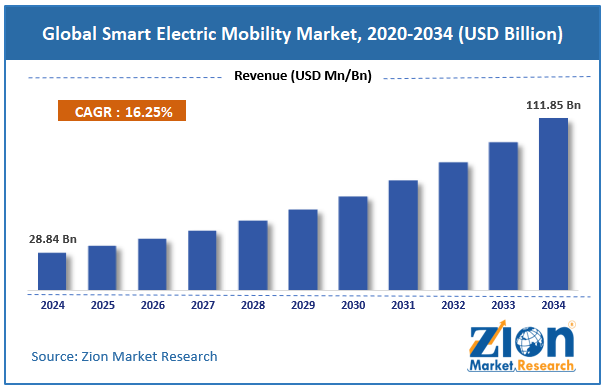
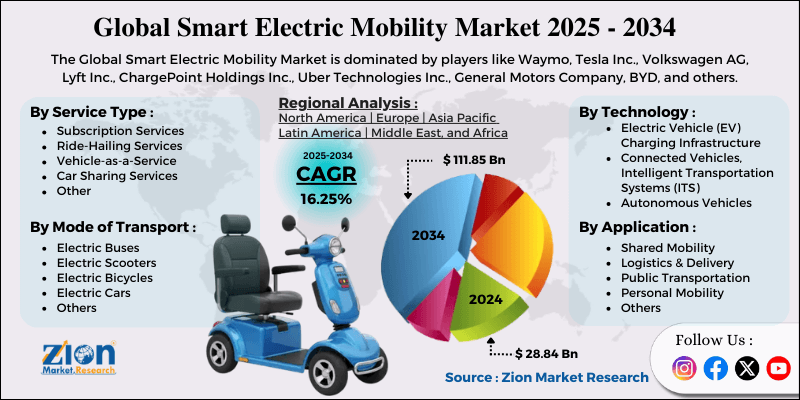
The global smart electric mobility market size was worth around USD 28.84 billion in 2024 and is predicted to grow to around USD 111.85 billion by 2034, with a compound annual growth rate (CAGR) of roughly 16.25% between 2025 and 2034.
Key Insights:
- As per the analysis shared by our research analyst, the global smart electric mobility market is estimated to grow annually at a CAGR of around 16.25% over the forecast period (2025-2034)
- In terms of revenue, the global smart electric mobility market size was valued at around USD 28.84 billion in 2024 and is projected to reach USD 111.85 billion by 2034.
- The global smart electric mobility market is projected to grow at a significant rate due to the growing concerns over traffic congestion across the globe
- Based on the service type, the ride-hailing services segment is growing at a high rate and will continue to dominate the global market, as per industry projection
- Based on the technology, the electric vehicle (EV) charging infrastructure segment is anticipated to command the largest market share
- Based on application, the shared mobility segment is anticipated to dominate with the highest market share
- Based on mode of transportation, the electric cars segment is projected to emerge as the prominent market share holder
- Based on region, Asia-Pacific is projected to dominate the global market during the forecast period
Smart Electric Mobility Market: Overview
Smart electric mobility refers to a new and revolutionary method of commuting or transportation that relies on electric vehicles (EVs). It aims to encourage the use of different modes of transportation instead of a fuel-powered personal vehicle. Smart electric mobility can take several forms, such as car sharing, ride-sharing, and electric biking, among others. The demand for smart electric mobility is encouraged by the growing need to reduce the environmental impact of the surge in the number of personal car users across the globe. Smart electric mobility promotes sustainable, cleaner, connected, and more efficient forms of transportation by leveraging the offerings of advanced technologies such as big data analytics, Internet of Things (IoT), and EVs.
During the forecast period, the smart electric mobility market is expected to continue to grow due to rising traffic congestion worldwide and a surge in accidents. Furthermore, increased expansion of ride-sharing services may further help the industry thrive. A major drawback for market players is the lack of ancillary infrastructure supporting large-scale deployment of smart electric mobility services and increased demand for personal vehicles.
Smart Electric Mobility Market: Dynamics
Growth Drivers
How will growing concerns over traffic congestion influence smart electric mobility market growth?
The global smart electric mobility market is expected to be driven by the growing concerns over traffic congestion across the globe. According to official research, the US lost more than USD 300 billion in 2017 due to heavy traffic registered across the country. Similar trends are observed in other urban parts of the world, including European and Asian countries.
The growing traffic congestion rate has severe economic and non-economic implications, including environmental damage, loss of productive time, accidents, and higher transportation costs. These factors have led to increased demand for more efficient transportation systems that not only reduce overall cost but also have a lesser impact on the environment. Smart electric mobility systems are designed to enroll battery-powered vehicles, allowing clean and effective transportation of people and goods.
Increased demand for sustainable transportation to influence industry revenue in the long run
The global travel and transportation industry is among the largest sources of environmental pollution. Internal combustion engine (ICE)-powered commercial and passenger vehicles contribute to more than 89% of total harmful emissions. This has led to increased focus on developing and employing sustainable transportation options such as electrified public transport systems.
In October 2025, Singapore’s Land Transport Authority (LTA) announced that it had awarded a breakthrough contract to a joint venture by Zhidao Network Technology, MKX Technologies, and BYD Singapore to deploy Level 4 autonomous electric buses on public roads in 2026. Such advancements are likely to work in favor of the global smart electric mobility market in the coming years.
Restraints
Why will the lack of ancillary infrastructure impede smart electric mobility market growth trends?
The global smart electric mobility industry is projected to be restricted due to the lack of sufficient ancillary infrastructure. For instance, several countries lack sufficient charging infrastructure to support the large-scale deployment of electric vehicles, particularly in rural areas. Additionally, the high cost of developing the infrastructure along with the deployment of sufficient numbers of electric vehicles, may further add to the limited expansion rate reported in the industry.
Opportunities
Rising government support and initiatives to deliver improved growth opportunities to the market players
The global smart electric mobility market is anticipated to benefit from growing government support and initiatives directed toward the industry. Regional governments in developed and emerging economies are offering tax rebates and subsidies to increase EV manufacturing. Additionally, new policies are being introduced to support larger deployment of electric vehicles, especially in public transport systems.
For instance, in February 2024, Thailand government announced the approval of new incentives for commercial transportation companies switching to battery electric vehicles. Additionally, the government is expected to provide cash grants to EV battery cell producers, thereby further supporting revenue for smart electric mobility.
How will the expansion of ride-sharing services open new growth avenues for the smart electric mobility market?
In recent years, demand for ride-sharing services has increased worldwide. In 2025, the global ride-sharing market was valued at over USD 140 billion and is expected to deliver higher results in the coming years. Several advantages associated with ride-sharing, including lower transportation costs, reduced greenhouse gas emissions, and decreased fuel consumption, will help accelerate demand for ride-sharing services. Most industry leaders, including Uber Technologies, Lyft, Ola Cabs, Yango Group, and many others, are increasingly investing in fleet electrification, thereby driving revenue in smart electric mobility.
Challenges
Increased demand for personal vehicles to remain a prominent challenge for industry players
The global smart electric mobility industry is expected to be challenged by the growing demand for personal vehicles. According to industry analysis, a growing number of people are preferring personal vehicles because they offer greater convenience and flexibility. The lack of smart electric mobility in the majority of parts of the world further drives the need for personal vehicles. This trend will continue to challenge the expansion of smart electric mobility in the coming years.
Smart Electric Mobility Market: Report Scope
| Report Attributes | Report Details |
|---|---|
| Report Name | Smart Electric Mobility Market |
| Market Size in 2024 | USD 28.84 Billion |
| Market Forecast in 2034 | USD 111.85 Bllion |
| Growth Rate | CAGR of 16.25% |
| Number of Pages | 221 |
| Key Companies Covered | Waymo, Tesla Inc., Volkswagen AG, Lyft Inc., ChargePoint Holdings Inc., Uber Technologies Inc., General Motors Company, BYD, and others. |
| Segments Covered | By Service Type, By Technology, By Application, By Mode of Transport, and By Region |
| Regions Covered | North America, Europe, Asia Pacific (APAC), Latin America, Middle East, and Africa (MEA) |
| Base Year | 2024 |
| Historical Year | 2019 to 2023 |
| Forecast Year | 2025 - 2034 |
| Customization Scope | Avail customized purchase options to meet your exact research needs. Request For Customization |
Smart Electric Mobility Market: Segmentation
The global smart electric mobility market is segmented based on service type, technology, application, mode of transport, and region.
Why will ride-hailing services offer a higher CAGR during the forecast period in the smart electric mobility market?
Based on service type, the global market segments are subscription services, ride-hailing services, vehicle-as-a-service, car sharing services, and others. In 2024, the ride-hailing services segment recorded the highest growth, accounting for approximately 60% of the total market share. It is expected to generate a CAGR of over 7.5% in the coming years due to the rapid business expansion of major companies such as Uber and Lyft. Additionally, increased traffic congestion and limited parking spaces in urban areas will facilitate segmental dominance during the projection period.
What contributes to the electric vehicle (EV) charging infrastructure emerging as a leading segment in the smart electric mobility industry?
Based on technology, the global smart electric mobility industry is divided into electric vehicle (EV) charging infrastructure, connected vehicles, intelligent transportation systems (ITS), autonomous vehicles, and others. The electric vehicle (EV) charging infrastructure is expected to dominate the market in the coming years with a CAGR of 25%. It accounted for more than 40.05% of the total market share in 2024, driven by rising government and private investments in upgrading charging infrastructure in developed and emerging nations.
Which factors are responsible for positioning shared mobility as the dominant segment in the smart electric mobility sector?
Based on application, the global industry segments are shared mobility, logistics & delivery, public transportation, personal mobility, and others. In 2024, the shared mobility segment was the leading revenue generator with control over 25% of the total market share. It is anticipated to grow at a 16% CAGR over the coming years, driven by increased adoption of car-sharing and ride-hailing services. The logistics & delivery segment, along with public transportation, will continue to remain significant growth drivers for the smart electric mobility market during the forecast period.
Why does the electric car segment lead the smart electric mobility industry?
Based on mode of transportation, the global market segments are electric buses, electric scooters, electric bicycles, electric cars, and others. In 2024, the highest revenue was listed in the electric cars segment, accounting for 39.05% of total revenue. The segment is expected to achieve a CAGR of approximately 14.9% over the coming years, driven by rising demand for private, energy-efficient vehicles and declining production costs for electric cars.
Smart Electric Mobility Market: Regional Analysis
Why will Asia-Pacific continue to lead the smart electric mobility market during the projection period?
The global smart electric mobility market is expected to be led by Asia-Pacific in the coming years. The region is anticipated to deliver a CAGR of over 25.01% in the coming years. Countries such as China, Singapore, and South Korea are some of the leading early adopters of smart electric mobility infrastructure. According to official reports, Shenzhen, China, became the world’s first city to operate 100% electric public transport buses in 2017. Since then, the country has emerged as the leading producer of EVs as well as the largest provider of supportive charging infrastructure.
Which factors will contribute to Europe’s emergence as the second leading region in the smart electric mobility market?
Europe is the second-largest revenue generator, with an expected CAGR of approximately 22.05% over the forecast period. It is one of the first regions to deploy sustainable and clean transport solutions across prominent countries such as Norway, Germany, and Spain, among others. The growing popularity of e-bicycles has been a major propeller for smart electric mobility in the region. Additionally, greater public awareness, growing demand to reduce transportation costs, and increasing government support will increase revenue in the region.
Smart Electric Mobility Market: Competitive Analysis
The global smart electric mobility market is led by players like:
- Waymo
- Tesla Inc.
- Volkswagen AG
- Lyft Inc.
- ChargePoint Holdings Inc.
- Uber Technologies Inc.
- General Motors Company
- BYD
Smart Electric Mobility Market: Key Market Trends
How are advancements in digital platforms emerging as key trends in the smart electric mobility market?
A promising trend expected to reshape the smart electric mobility industry is the ongoing advancement of digital platforms, including applications and websites. These platforms are designed to facilitate access to smart electric mobility by offering services such as digital ticket booking, payment, and vehicle tracking.
How will integration with renewable energy sources shape the smart electric mobility industry in the future?
Ongoing efforts to integrate other forms of renewable energy, such as solar and wind power, with modern smart electric mobility infrastructure are expected to emerge as a breakthrough trend in the industry. It can help encourage a self-sufficient energy environment for the transportation segment.
The global smart electric mobility market is segmented as follows:
By Service Type
- Subscription Services
- Ride-Hailing Services
- Vehicle-as-a-Service
- Car Sharing Services
- Other
By Technology
- Electric Vehicle (EV) Charging Infrastructure
- Connected Vehicles, Intelligent Transportation Systems (ITS)
- Autonomous Vehicles
- Others
By Application
- Shared Mobility
- Logistics & Delivery
- Public Transportation
- Personal Mobility
- Others
By Mode of Transport
- Electric Buses
- Electric Scooters
- Electric Bicycles
- Electric Cars
- Others
By Region
- North America
- The U.S.
- Canada
- Europe
- France
- The UK
- Spain
- Germany
- Italy
- Rest of Europe
- Asia Pacific
- China
- Japan
- India
- South Korea
- Southeast Asia
- Rest of Asia Pacific
- Latin America
- Brazil
- Mexico
- Rest of Latin America
- Middle East & Africa
- GCC
- South Africa
- Rest of Middle East & Africa
Table Of Content
Methodology
FrequentlyAsked Questions

HappyClients

