
Global Trans 1-2 Dichloroethylene Market Size, Share, Value and Forecast 2034

Trans 1-2 Dichloroethylene Market By Grade (Industrial Grade, Electronic Grade, and Pharmaceutical Grade), By Application (Solvent, Chemical Intermediate, Cleaning Agent, Refrigerant, and Others), By End-User (Chemicals, Pharmaceuticals, Electronics & Semiconductors, Automotive, and Others), and By Region - Global and Regional Industry Overview, Market Intelligence, Comprehensive Analysis, Historical Data, and Forecasts 2026 - 2034
| Market Size in 2025 | Market Forecast in 2034 | CAGR (in %) | Base Year |
|---|---|---|---|
| USD 1.4 Billion | USD 2.5 Billion | 6.9% | 2025 |
Trans 1-2 Dichloroethylene Market: Industry Perspective
What will be the size of the global Trans 1-2 Dichloroethylene market during the forecast period?
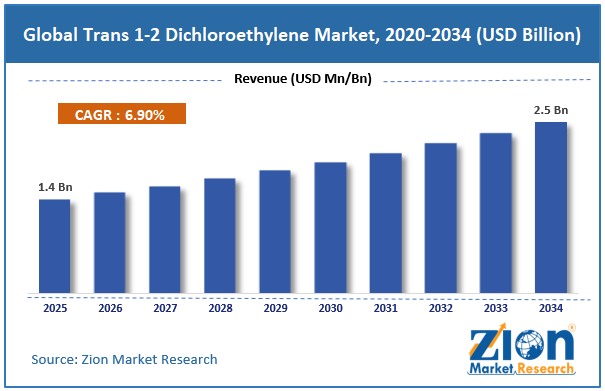
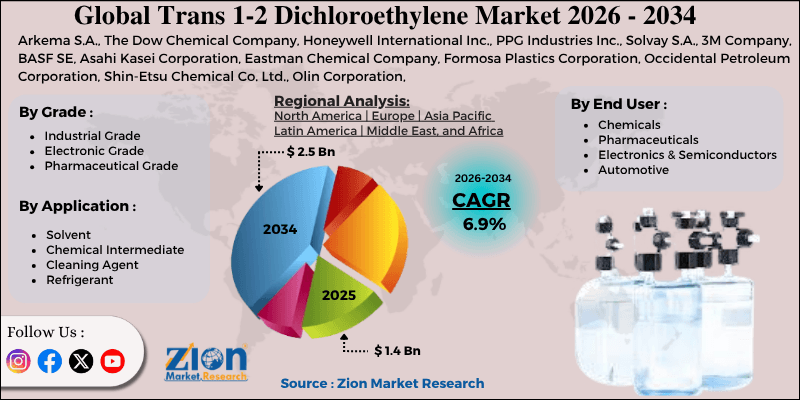
The global trans 1-2 dichloroethylene market size was worth around USD 1.4 billion in 2025 and is predicted to grow to around USD 2.5 billion by 2034, with a compound annual growth rate (CAGR) of roughly 6.9% between 2026 and 2034.
Key Insights
- As per the analysis shared by our research analyst, the global trans 1-2 dichloroethylene market is estimated to grow annually at a CAGR of around 6.9% over the forecast period (2026-2034).
- In terms of revenue, the global trans 1-2 dichloroethylene market size was valued at around USD 1.4 billion in 2025 and is projected to reach USD 2.5 billion by 2034.
- Growth in agrochemical production is expected to propel the trans 1-2 dichloroethylene market over the projected period.
- Based on the grade, the industrial grade segment held the largest revenue share in 2025 of 78%.
- Based on the application, the solvent segment held a prominent market share of 44% in 2025.
- Based on the end-user, the chemical segment captures a prominent revenue share of 48% in 2025.
- Based on region, North America dominates the trans 1-2 dichloroethylene market with a revenue share of 42% in 2025.
Trans 1-2 Dichloroethylene Market: Overview
Trans-1,2-Dichloroethylene (trans-1,2-DCE) is a colorless, volatile chlorinated hydrocarbon with the chemical formula C2 H2 Cl2. In trans-1,2-DCE, the two chlorine atoms are positioned on the opposite side of the carbon-carbon double bond. Trans-1,2-dichloroethylene is primarily generated as an intermediate in the production of chlorinated solvents. It can be used as a solvent for waxes, resins, adhesives, and extraction purposes. Compared to its isomer cis-1,2-dichloroethylene, trans-1,2-dichloroethylene has a higher melting point, a lower boiling point, and is less polar. Therefore, it is suitable for certain industrial applications. Trans-1,2-dichloroethylene is highly flammable and needs to be handled with care; prolonged exposure may cause adverse effects on human health and the environment.
Impact of the USA-Israel War on Iran on the Trans 1-2 Dichloroethylene Market
The USA-Israel war with Iran impacts the Trans-1,2 Dichloroethylene market in the short term by disrupting petrochemical supply chains, raising feedstock and energy prices, and increasing freight and insurance costs for chemical transportation. Being a petrochemical product traded in global markets, trans-1,2 dichloroethylene’s supply depends on the stability of petrochemical supply routes. The confluence of geopolitical tensions in the Middle East and the Strait of Hormuz increases the risks of global supply disruptions, resulting in higher prices for trans-1,2 dichloroethylene. Meanwhile, the demand for trans-1,2 dichloroethylene in the industrial end-use sector remains stable. At the same time, its production and supply chains face higher production costs, logistics expenses, and geopolitical risks during the military conflict.
Trans 1-2 Dichloroethylene Market: Dynamics
Growth Drivers
Does the growing demand from the chemical industry drive the trans 1-2 dichloroethylene market?
Growing demand from the chemical sector is driving demand for Trans-1,2-Dichloroethylene, as it is used as an intermediate and solvent in the production of various products such as specialty chemicals, pharmaceuticals, adhesives, and cleaning agents. As per government data, the chemical industry is thriving in the country, which in turn is supporting the demand for dichloroethylene. As per India’s Department of Chemicals and Petrochemicals, the chemicals and petrochemicals sector contributed 8.1% to the country’s manufacturing Gross Value Added (GVA) in FY2024. Besides, the production of major chemicals and petrochemicals has recorded a significant increase from 45.6 MM tonnes in FY2016 to 58.6 MM tonnes in FY2025, registering a CAGR of 2.8% during the period. Growth in the chemical manufacturing sector and downstream industries is expected to propel consumption of chlorinated products such as dichloroethylene and dichloroethane.
Restraints
How does the stringent environmental regulations act as a major restraint to the trans 1-2 dichloroethylene industry's growth?
Stringent regulations to reduce volatile organic compound emissions and restrictions on the production and use of chlorinated solvents are major restraints to the trans 1-2 dichloroethylene market. The chemical is classified as a hazardous volatile organic compound, or VOC, and chlorinated solvent, and its production, use, storage, emission, and disposal are strictly regulated by authorities like the U.S. Environmental Protection Agency (EPA), the European Chemicals Agency (ECHA), etc. The implementation of these norms by different regulatory agencies makes the production and use of trans-1,2 dichloroethylene expensive and non-feasible. At the same time, they promote the use of low-VOC and low-toxicity solvents in place of dichloroethylene. As a result, the demand for dichloroethylene in the dichloroethylene derivatives market is reduced, and the usage of trans-1,2 dichloroethylene in various other applications is minimized too.
Opportunities
How do advancements in chemical processing technologies offer a lucrative opportunity for the trans 1-2 dichloroethylene market?
Recent developments in chemical processing can be leveraged to improve the production of trans-1,2-dichloroethylene. Recent techniques such as catalytic processes, intensified processes, continuous manufacturing, and advanced purification methods can facilitate production that is both cost-effective and environmentally friendly. This will allow manufacturers to offer high-quality products that are free from impurities and ensure compliance with the relevant regulations. In addition, this will also enable meeting the increasing demand for the trans-1,2 dichloroethylene for use in various end-use industries and applications.
Challenges
Increasing waste management and disposal costs pose a significant challenge to the growth of the trans 1-2 dichloroethylene industry
Growing waste management and disposal costs represent a significant threat to the trans-1,2 dichloroethylene market. Both the chemical itself and its waste products are considered hazardous, which means that they should be collected, processed, and disposed of in special ways. This raises the costs that producers and consumers of the product have to bear, as they can no longer use standard waste management methods. Emission standards and other regulations raise expenses for firms in the production and solvent use industry, cutting down on their profits. This makes them reconsider using more expensive, environmentally friendly solvents and instead turn to cheaper options.
Trans 1-2 Dichloroethylene Market: Report Scope
| Report Attributes | Report Details |
|---|---|
| Report Name | Trans 1-2 Dichloroethylene Market |
| Market Size in 2025 | USD 1.4 Billion |
| Market Forecast in 2034 | USD 2.5 Billion |
| Growth Rate | CAGR of 6.9% |
| Number of Pages | 227 |
| Key Companies Covered | Arkema S.A., The Dow Chemical Company, Honeywell International Inc., PPG Industries Inc., Solvay S.A., 3M Company, BASF SE, Asahi Kasei Corporation, Eastman Chemical Company, Formosa Plastics Corporation, Occidental Petroleum Corporation, Shin-Etsu Chemical Co. Ltd., Olin Corporation, INEOS Group Holdings S.A., Mitsubishi Chemical Corporation, Akzo Nobel N.V., Toray Industries Inc., SABIC (Saudi Basic Industries Corporation), LG Chem Ltd., and others. |
| Segments Covered | By Grade, By Application, By End User, and By Region |
| Regions Covered | North America, Europe, Asia Pacific (APAC), Latin America, Middle East, and Africa (MEA) |
| Base Year | 2025 |
| Historical Year | 2020 to 2024 |
| Forecast Year | 2026 - 2034 |
| Customization Scope | Avail customized purchase options to meet your exact research needs. Request For Customization |
Trans 1-2 Dichloroethylene Market: Segmentation
Grade Insights
Why does the industrial grade segment hold a prominent position in the trans 1-2 dichloroethylene market?
The industrial grade segment held the largest revenue share of the trans 1-2 dichloroethylene market in 2025 of 78%. This growth is driven by its wide applications in metal cleaning, degreasing, and chemical production. The high solvency power and cost-effectiveness ensure its popularity in the automobile, aircraft, and heavy equipment industries. Additionally, high consumption in large-scale industrial applications remains robust, supporting strong demand for the product in the region. Moreover, the segment exhibits a strong competitive advantage over the others since the end-use industries are well-established and offer stable growth for the chemical.
Application
How does the solvent segment capture the largest market share in the trans 1-2 dichloroethylene market?
The solvent segment held a prominent share of the trans 1-2 dichloroethylene industry of 44% in 2025. The main reason is its wide range of applications in industrial processes, chemical production, and metal degreasing. The substance is in demand because of its high solvency, fast evaporation rate, and cost-effectiveness. Moreover, consistent demand in the automobile, aerospace, and polymer industries contributes to its popularity. Thus, the segment is expected to maintain its high level of consumption due to the constant need in the mentioned industries.
End-User Insights
Does the chemical segment capture the largest market share in the trans 1-2 dichloroethylene market?
The chemical segment captures a prominent revenue share of the trans 1-2 dichloroethylene market of 48% in 2025. The primary factor driving the growth of the DCE market is its widespread application as an intermediate in synthesizing a number of products. The compound’s compatibility and effectiveness in the formulation make it in demand. Furthermore, the well-established supply chain and consumption trends have also contributed to its high share in the overall market.
Regional Insights
What factors drive the North America region in the trans 1-2 dichloroethylene market?
North America dominates the trans 1-2 dichloroethylene market with a revenue share of 42% in 2025. Regional growth is attributed to the region’s industrial and chemical sector development, including increased production of chemicals for pharmaceutical purposes and consistent demand for chemical solvents used in various industrial applications.
Moreover, the provision of high-end specialized chemicals, the implementation of advanced technological processes, and the emphasis on R&D activities contribute to the regional market growth. The presence of major chemical manufacturers, petrochemical infrastructure, and strong demand in end-use industries, including the pharmaceutical industry, electronics, and industrial processing, support the continuous rise in the regional revenue.
Trans 1-2 Dichloroethylene Market: Competitive Analysis
The global trans 1-2 dichloroethylene market is dominated by players like:
- Arkema S.A.
- The Dow Chemical Company
- Honeywell International Inc.
- PPG Industries Inc.
- Solvay S.A.
- 3M Company
- BASF SE
- Asahi Kasei Corporation
- Eastman Chemical Company
- Formosa Plastics Corporation
- Occidental Petroleum Corporation
- Shin-Etsu Chemical Co. Ltd.
- Olin Corporation
- INEOS Group Holdings S.A.
- Mitsubishi Chemical Corporation
- Akzo Nobel N.V.
- Toray Industries Inc.
- SABIC (Saudi Basic Industries Corporation)
- LG Chem Ltd.
The global trans 1-2 dichloroethylene market is segmented as follows:
By Grade
- Industrial Grade
- Electronic Grade
- Pharmaceutical Grade
By Application
- Solvent
- Chemical Intermediate
- Cleaning Agent
- Refrigerant
- Others
By End User
- Chemicals
- Pharmaceuticals
- Electronics & Semiconductors
- Automotive
- Others
By Region
- North America
- The U.S.
- Canada
- Mexico
- Europe
- France
- The UK
- Spain
- Germany
- Italy
- Rest of Europe
- Asia Pacific
- China
- Japan
- India
- Australia
- South Korea
- Rest of Asia Pacific
- The Middle East & Africa
- Saudi Arabia
- UAE
- Egypt
- Kuwait
- South Africa
- Rest of the Middle East & Africa
- Latin America
- Brazil
- Argentina
- Rest of Latin America
Table Of Content
Methodology
FrequentlyAsked Questions
Trans-1,2-Dichloroethylene (trans-1,2-DCE) is a colorless, volatile chlorinated hydrocarbon with the chemical formula C2 H2 Cl2. In trans-1,2-DCE, the two chlorine atoms are positioned on the opposite side of the carbon-carbon double bond.
The Trans-1,2 Dichloroethylene market is primarily driven by increasing demand from the chemical, pharmaceutical, and specialty solvent industries, where the compound is widely used as an intermediate and industrial solvent. Growing industrialization, expanding production of specialty chemicals, and rising use in precision cleaning and degreasing applications are further supporting market growth.
The trans-1,2 dichloroethylene market faces several challenges, including stringent environmental regulations governing the production, handling, and disposal of chlorinated solvents, as well as rising compliance and hazardous waste management costs. Health and safety concerns associated with exposure to the compound, increasing adoption of environmentally friendly alternative solvents, and volatility in petrochemical feedstock prices also restrain market growth.
Based on the application, the solvent segment is expected to dominate the trans 1-2 dichloroethylene market growth during the projected period.
The Trans-1,2 Dichloroethylene market is being shaped by advancements in continuous chemical processing, catalytic production technologies, and high-purity purification methods, which improve production efficiency while reducing energy consumption and emissions. Manufacturers are increasingly investing in environmentally compliant manufacturing processes, solvent recovery and recycling systems, and emission-control technologies to meet stricter regulatory standards.
According to the report, the global trans 1-2 dichloroethylene market size was worth around USD 1.4 billion in 2025 and is predicted to grow to around USD 2.5 billion by 2034.
The global trans 1-2 dichloroethylene market is expected to grow at a CAGR of 6.9% during the forecast period.
The global trans 1-2 dichloroethylene industry growth is expected to be led by North America over the forecast period.
The global trans 1-2 dichloroethylene market is dominated by players like Arkema S.A., The Dow Chemical Company, Honeywell International Inc., PPG Industries, Inc., Solvay S.A., 3M Company, BASF SE, Asahi Kasei Corporation, Eastman Chemical Company, Formosa Plastics Corporation, Occidental Petroleum Corporation, Shin-Etsu Chemical Co., Ltd., Olin Corporation, INEOS Group Holdings S.A., Mitsubishi Chemical Corporation, Akzo Nobel N.V., Toray Industries, Inc., SABIC (Saudi Basic Industries Corporation), and LG Chem Ltd., among others.
The trans 1-2 dichloroethylene market report covers the geographical market along with a comprehensive competitive landscape analysis. It also includes cash flow analysis, profit ratio analysis, market basket analysis, market attractiveness analysis, sentiment analysis, PESTLE analysis, trend analysis, SWOT analysis, trade area analysis, demand & supply analysis, Porter’s five forces analysis, and value chain analysis.

HappyClients

