
Industrial and Institutional Cleaning Chemicals Market Size, Share Report 2034

Industrial and Institutional Cleaning Chemicals Market By Raw Material (Chlor-alkali, Phosphates, Solvents, Surfactant, Biocides, and Others), By Product (General Purpose Cleaners, Vehicle Wash Products, Disinfectants and Sanitizers, Laundry Care Products, and Others), By End Use (Commercial and Manufacturing), and By Region - Global and Regional Industry Overview, Market Intelligence, Comprehensive Analysis, Historical Data, and Forecasts 2025 - 2034
| Market Size in 2024 | Market Forecast in 2034 | CAGR (in %) | Base Year |
|---|---|---|---|
| USD 83.5 Billion | USD 178.6 Billion | 7.9% | 2024 |
Industrial and Institutional Cleaning Chemicals Industry Perspective:
What will be the size of the global industrial and institutional cleaning chemicals market during the forecast period?
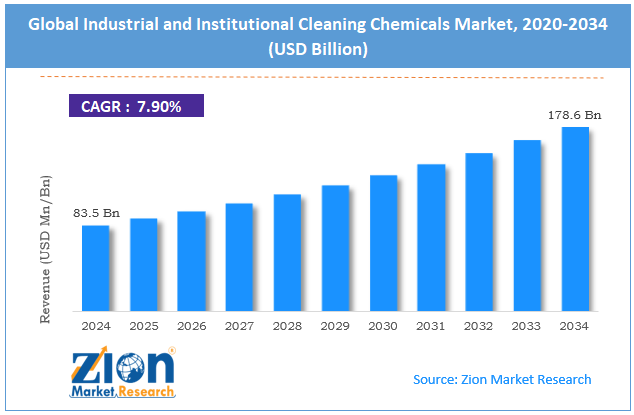
The global industrial and institutional cleaning chemicals market size was worth around USD 83.5 billion in 2024 and is predicted to grow to around USD 178.6 billion by 2034, with a compound annual growth rate (CAGR) of roughly 7.9% between 2025 and 2034.
Key Insights
- As per the analysis shared by our research analyst, the global industrial and institutional cleaning chemicals market is estimated to grow annually at a CAGR of around 7.9% over the forecast period (2025-2034).
- In terms of revenue, the global industrial and institutional cleaning chemicals market size was valued at around USD 83.5 billion in 2024 and is projected to reach USD 178.6 billion by 2034.
- Growing awareness about cleanliness and infection prevention in workplaces, hospitals, schools, and public facilities is a major factor boosting demand for industrial and institutional cleaning chemicals.
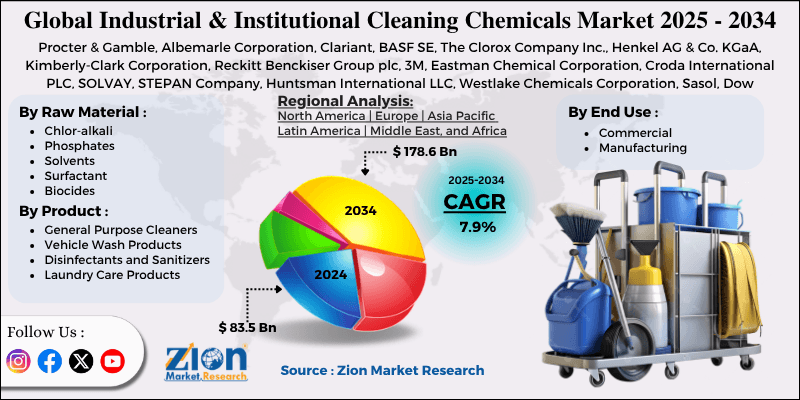
- Based on the raw material, the surfactant holds the largest market share of 30% in 2024 and is likely to grow at the highest CAGR over the projected period.
- Based on the product, general purpose cleaners dominate industry growth, accounting for more than 34% of the market share.
- Based on the end-use, the manufacturing segment accounted for the largest revenue share, over 70%, in 2024.
- Based on region, North America captured the largest revenue share, over 30%, in 2024.
Industrial and Institutional Cleaning Chemicals Market: Overview
Industrial and institutional cleaning chemicals are chemical compounds used to clean, disinfect, and maintain hygiene in various commercial, industrial, and public environments. These products are engineered to remove dirt, grease, stains, bacteria, and other nasties from surfaces and machinery in places such as food manufacturing plants, hospitals, schools, offices, hotels, and restaurants. Usual industrial and institutional cleaning chemicals, mainly used by professionals on a large scale, are generally top-rated degreasers, floor cleaners, surface cleaners, disinfectants, sanitizers, and detergents. They are all effective, safe, and hygienic. Market expansion is fueled by rising awareness of hygiene, infection control, and sanitation in workplaces, healthcare centers, food processing units, the food service industry, hotels, commercial establishments, malls, and shopping portals. Increasing levels of urbanization and industrialization, especially in developing nations, are driving demand for professional cleaning chemicals in manufacturing plants, office buildings, commercial complexes, amenities, and other public infrastructure systems. The growth of healthcare infrastructure and tightened regulatory standards regarding food safety and cleanliness compel industrial owners to invest in decontaminating and sanitizing chemicals, such as cleaning products.
The market, however, faces constraints such as the need to develop more environmentally friendly chemistries that meet demanding, dynamic regulatory standards, unpredictable raw material input costs, and the environmental impact of traditional cleaning chemicals.
Industrial and Institutional Cleaning Chemicals Market: Dynamics
Growth Drivers
How does the growth of commercial and hospitality infrastructure drive the expansion of the industrial and institutional cleaning chemicals market?
Developments in hospitality and commercial infrastructure are a key driver of growth in the global industrial and institutional cleaning chemicals market. The rise in the number of hotels, restaurants, shopping malls, corporate offices, airports, and entertainment complexes worldwide has created a significant global demand for professional cleaning and sanitation formulations. These infrastructures clearly require frequent, large-scale cleaning to maintain hygiene and ensure customer safety and comfort. Therefore, the demand for professional, high-quality cleaning agents such as disinfectants, floor cleaners, surface cleaning chemicals, and degreasers has increased significantly.
In addition, the growing travel and tourism industry, as well as the organized retail and corporate sectors across the globe, are constantly developing hospitality and commercial set-ups in emerging economies. Strict government regulatory standards and cleanliness policies mandated by such sectors are enhancing consumer demand for advanced I&I cleaning chemicals. The adoption of professional facilities management systems and services across large commercial sectors is also driving demand for specialized chemical products.
For instance, according to the UN World Tourism Organization, an estimated 1.52 billion international tourists were recorded worldwide in 2025, almost 60 million more than in 2024.
Restraints
Why do the rising raw material costs pose a significant restraint to the industrial and institutional cleaning chemicals market?
The increase in raw material prices is one of the most important factors inhibiting growth in the industrial and institutional cleaning chemicals market, as many chemicals, such as surfactants, solvents, builders, enzymes, and specialty additive ingredients, are derived from petrochemicals or natural oils. Any increase in crude oil, chemical intermediates, or feedstock prices will raise the production costs of cleaning chemicals.
Often, the manufacturer has to either bear the pressure of higher costs and accept lower profit margins or pass them on to its customers by increasing product prices. Industrial and Institutional end users, including hospitals, hotels, manufacturing units, and Facilities Management players, are extremely price-conscious because they purchase cleaning chemicals in high volumes. Price increases due to rising raw material costs may limit the quantity purchased or prompt users to seek low-cost substitutes, such as bulk concentrates or private-label products. Disruptions along the supply chain may also inhibit product availability and cause manufacturing and inventory issues for the provider.
For instance, the ongoing war between Israel and Iran might be impacting the market growth.
Opportunities
Does the expansion of key players' footprints present an opportunity for the industrial and institutional cleaning chemicals market?
The wider presence of key players poses an excellent opportunity for the industrial and institutional cleaning chemicals market. When major producers of I&I cleaning chemicals expand their geographic reach by establishing new production facilities, distribution channels, alliances, or acquisitions, they can serve a wider customer base in developing and underserved regions. This will strengthen supply chains, meet rising demand, and make products available to new markets in the health care, travel, food manufacturing, and institutional sectors.
By entering new geographical regions, companies will also be able to take advantage of fast-growing economies, with rising levels of urbanization, industrialization, infrastructure, and employment stimulating demand for advanced cleaning, cleaning chemicals, and sanitation products and services. Improved presence will enable key players to innovate and introduce a new line of environmentally friendly, campus-specific cleaning chemicals designed to meet regional legislative requirements and clients’ needs.
For instance, in November 2025, BASF confirmed plans for a new plant at its Bangpakong site in Thailand to expand its APGs operations in Asia. This significant investment reflects BASF's strategy to increase its presence in a high-growth market and to meet customer needs in a fast-changing environment through a flexible, regional network.
Challenges
The availability of alternative cleaning technologies significantly challenges the industrial and institutional cleaning chemicals market growth
The emergence of alternative cleaning technology has become a major threat to the growth of the industrial and institutional cleaning chemicals sector. Commercial and industrial organizations are opting for alternative cleaning technologies, such as steam cleaning, ultraviolet (UV) disinfection, ozone-based cleaning systems, enzymatic cleaning systems, and automatic cleaning systems.
Many organizations are also opting for the most environmentally friendly cleaning systems that have fewer hazardous chemicals. They also achieve the required cleaning efficiency and remove infection-causing impurities better than conventional cleaning systems. Cheaper, alternative cleaning technologies and solutions that require less chemical use and are safer for the environment are likely to replace most traditional cleaning systems in commercial and industrial organizations, thereby restraining market growth.
Industrial and Institutional Cleaning Chemicals Market: Report Scope
| Report Attributes | Report Details |
|---|---|
| Report Name | Industrial and Institutional Cleaning Chemicals Market |
| Market Size in 2024 | USD 83.5 Billion |
| Market Forecast in 2034 | USD 178.6 Bllion |
| Growth Rate | CAGR of 7.9% |
| Number of Pages | 225 |
| Key Companies Covered | Procter & Gamble, Albemarle Corporation, Clariant, BASF SE, The Clorox Company Inc., Henkel AG & Co. KGaA, Kimberly-Clark Corporation, Reckitt Benckiser Group plc, 3M, Eastman Chemical Corporation, Croda International PLC, SOLVAY, STEPAN Company, Huntsman International LLC, Westlake Chemicals Corporation, Sasol, Dow, and others. |
| Segments Covered | By Raw Material, By Product, By End Use, and By Region |
| Regions Covered | North America, Europe, Asia Pacific (APAC), Latin America, Middle East, and Africa (MEA) |
| Base Year | 2024 |
| Historical Year | 2019 to 2023 |
| Forecast Year | 2025 - 2034 |
| Customization Scope | Avail customized purchase options to meet your exact research needs. Request For Customization |
Industrial and Institutional Cleaning Chemicals Market: Segmentation
Raw Material Insights
Does surfactant capture a significant market share in the industrial and institutional cleaning chemicals market?
The surfactant holds the largest market share of 30% in 2024 and is likely to grow at the highest CAGR over the projected period. The demand for this segment is driven by the widespread use of surfactants for a variety of major cleaning tasks due to their properties, which include reducing surface tension and enabling grease, oil, and dirt to be loosened and rinsed off. Surfactants are essential ingredients in most disinfectants, detergents, degreasers, and institutional cleaners, which are widely used across industries such as healthcare, food and beverage processing, and hospitality. The movement toward greener surfactants is also prompting the use of organic, sustainable, and biodegradable surfactants that require few, if any, hazardous co-additives and are safe to use and dispose of. This is also boosting product innovation and performance.
Product Insights
Why does general purpose cleaners grow substantially in the industrial and institutional cleaning chemicals market?
General purpose cleaners dominate industry growth, accounting for more than 34% of the market share. The versatility and extensive application of general purpose cleaners in commercial buildings, schools, offices, hospitals, and industries have driven the industry's growth. These cleaners are designed to remove a wide range of dirt, soil, stains, and grease from various surfaces and are thus considered essential for daily cleaning and hygiene. The demand for general-purpose cleaners is increasing with greater awareness of workplace cleanliness and stringent facility management standards. Globally, the market for general purpose cleaners is also growing as a result of the increasing adoption of low-toxic, green formulations that reduce a company's environmental footprint while ensuring high cleaning efficiency, thus strengthening its market dominance.
End-Use Insights
Why manufacturing segment contribute a significant share to the industrial and institutional cleaning chemicals market?
The manufacturing segment accounted for the largest revenue share, over 70%, in 2024. The segments in this market are driven by growth in the industries they serve and by the need to maintain systems with requisite cleanliness, safety, and efficiency. Manufacturing industries such as automotive, electronics, chemicals, food and beverages, and other processing industries require various types of cleaning chemicals and agents to remove grease, metals, oils, and other residues that can adhere to systems, machinery, equipment, or production surfaces. Regular cleaning of certain machinery helps eliminate malfunctions, improve product quality, and comply with factory safety standards. Industries are increasingly replacing semi-automated production lines with fully automated systems and machinery that incorporate innovative manufacturing processes, thereby increasing the demand for various manufactured fast-cleaning agents, surface cleaners, disinfectants, and certain chemical agents to facilitate inspection and regular maintenance of the existing systems.
Foreign and domestic regulations on environmental issues and workplace safety also promote the regular use of hygienic personnel working environments in the industrial and food manufacturing sectors. This factor, along with the growth of industrial activity worldwide, especially in developing and advanced industrialized economies, is expected to support a reasonably stable revenue growth rate in this market.
Regional Insights
Why does North America lead the industrial and institutional cleaning chemicals market?
North America captured the largest revenue share, over 30%, in 2024. It captures a significant market share owing to high standards of health and hygiene protocols across healthcare, food processing, food service, and institutional segments. Extensive infrastructure investments and persistently high hygiene standards reinforced the need for disinfectants, sanitizers, and eco-friendly formulations, with a focus on enzyme-based, biodegradable, and automation-compatible products. Region-specific trends favor formulating products in line with industry-specific regulations and government hygiene campaigns. The growing market competitiveness has prompted players to adopt strategies that include intensive R&D, strategic mergers and acquisitions, and new product development.
For instance, in August 2025, SC Johnson Professional, a total solutions provider for industrial, institutional, and healthcare users, introduced the TruShot 2.0(R) No Rinse Sanitizer. The powerful no-rinse sanitizer is used on hard, non-porous, food-contact surfaces. It provides a hassle-free cleaning solution for high-traffic areas and custodial professionals, eliminating the need to mix and rinse.
Industrial and Institutional Cleaning Chemicals Market: Competitive Analysis
The global industrial and institutional cleaning chemicals market is dominated by players like:
- Procter & Gamble
- Albemarle Corporation
- Clariant
- BASF SE
- The Clorox Company Inc.
- Henkel AG & Co. KGaA
- Kimberly-Clark Corporation
- Reckitt Benckiser Group plc
- 3M
- Eastman Chemical Corporation
- Croda International PLC
- SOLVAY
- STEPAN Company
- Huntsman International LLC
- Westlake Chemicals Corporation
- Sasol
- Dow
The global industrial and institutional cleaning chemicals market is segmented as follows:
By Raw Material
- Chlor-alkali
- Phosphates
- Solvents
- Surfactant
- Biocides
- Others
By Product
- General Purpose Cleaners
- Vehicle Wash Products
- Disinfectants and Sanitizers
- Laundry Care Products
- Others
By End Use
- Commercial
- Manufacturing
By Region
- North America
- The U.S.
- Canada
- Mexico
- Europe
- France
- The UK
- Spain
- Germany
- Italy
- Rest of Europe
- Asia Pacific
- China
- Japan
- India
- Australia
- South Korea
- Rest of Asia Pacific
- The Middle East & Africa
- Saudi Arabia
- UAE
- Egypt
- Kuwait
- South Africa
- Rest of the Middle East & Africa
- Latin America
- Brazil
- Argentina
- Rest of Latin America
Table Of Content
Methodology
FrequentlyAsked Questions

HappyClients

