
Protein Bar Market Size, Share, Value and Forecast Report 2034

Protein Bar Market By Source (Plant Blends, Non-Dairy Animal, Hybrid, Single Source Plant, and Dairy Animal), By Product Type (Protein Nutrition Bars, Protein Dessert-Style Bars, Protein Snack Bars, Protein Meal/Weight Management Bars, Protein Clinical Bars, Protein Breakfast Bars, and Others), By Protein Content (Light, Moderate, High, and Ultra-High), By Distribution Channel (Offline and Online), and By Region - Global and Regional Industry Overview, Market Intelligence, Comprehensive Analysis, Historical Data, and Forecasts 2025 - 2034
| Market Size in 2024 | Market Forecast in 2034 | CAGR (in %) | Base Year |
|---|---|---|---|
| USD 5.47 Billion | USD 10.59 Billion | 7.59% | 2024 |
Protein Bar Industry Perspective:
What is the anticipated CAGR for the protein bar market during the projection period?
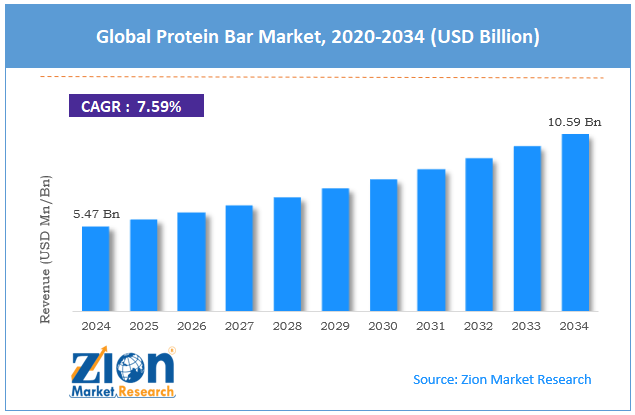
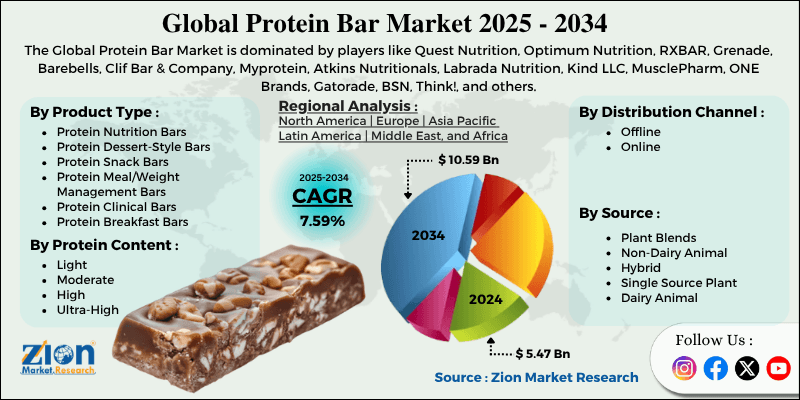
The global protein bar market size was worth around USD 5.47 billion in 2024 and is predicted to grow to around USD 10.59 billion by 2034 with a compound annual growth rate (CAGR) of roughly 7.59% between 2025 and 2034.
Key Insights:
- As per the analysis shared by our research analyst, the global protein bar market is estimated to grow annually at a CAGR of around 7.59% over the forecast period (2025-2034)
- In terms of revenue, the global protein bar market size was valued at around USD 5.47 billion in 2024 and is projected to reach USD 10.59 billion by 2034.
- The market is projected to grow at a significant rate due to the rapid urbanization across the globe.
- Based on the source, the plant blends segment is growing at a high rate and will continue to dominate the global market, as per industry projections
- Based on the product type, the protein nutrition segment is anticipated to command the largest market share
- Based on the protein content, the moderate segment is expected to lead the market growth trends
- Based on the distribution channel, the offline segment is projected to influence revenue in the market
- Based on region, the Asia-Pacific is projected to dominate the global market during the forecast period
Protein Bar Market: Overview
A protein bar is a convenient snacking item that can provide easy access to protein, minerals, fiber, and vitamins. They are designed to emerge as a convenient source of essential nutrition, especially for people with busy lifestyles. Depending on the brand and protein bar type, the exact composition of the snacking item may differ. However, an average protein bar consists of 25-35 grams of carbs, 5-10 grams of fat, and 5-10 grams of fiber. Most protein bars are made of dried fruits, dates, nuts & seeds, and whole grains such as quinoa. However, research also indicates an upward trend in the use of artificial sweeteners that are unhealthy in the long term.
During the forecast period, demand for protein bars is expected to continue growing, driven by evolving consumer lifestyles, urbanization, and increased awareness. Additionally, product innovation and online sales channels are expected to offer new growth opportunities for the market players. The industry may face growth limitations due to the high cost of protein bars, and the lack of sufficient research on the health implications of protein bars may impact business revenue in the long run.
Protein Bar Market: Dynamics
Growth Drivers
How will urbanization influence demand in the protein bar market?
The global protein bar market is expected to benefit from the rapid urbanization across the globe. Most urban populations live a busy life with long work timings and extensive commute hours. According to official reports, an average US consumer in an urban city spends nearly 30 to 40 minutes commuting to work. The hidden cost of traveling to work every day has been a growing cause of concern among organizations. This leads to limited time availability for an urban citizen to spend on cooking meals every day. Protein bars are an excellent source of quick and convenient nutrition. Hence, they are considered ideal snacking items for an urban lifestyle. This is further facilitated by high disposable income or urban consumers, leading to extended market revenue.
Evolving health and fitness trends globally to influence improved market revenue in the long run
Health and fitness trends are rapidly evolving across the globe. The general population is increasingly becoming aware of the importance of maintaining a well-balanced lifestyle and diet. In addition, people are indulging in several forms of physical sport, ranging from weight lifting to aerobic activities. An essential part of ensuring optimal health is regular intake of protein in several forms, especially for older citizens. During the forecast period, improvements in health awareness will help fuel demand in the global protein bar market.
Restraints
How will cost barriers affect the protein bar industry's growth during the forecast period?
The global protein bar industry is expected to be restricted due to the high cost of the snacks, which may range from USD 2 to USD 4 per bar depending on the brand and the product ingredients. Growing economic volatility and increasing efforts by the general population to curb unnecessary spending may limit market growth trends. Furthermore, competition from other sources of pure protein, such as eggs, yogurt, protein powders, and natural high-protein food items, may impact business growth in the long run.
Opportunities
Product innovation and online sales medium to offer renewed growth opportunities to the market leaders
The global protein bar market is anticipated to experience new growth opportunities due to rising production innovation reported in the market. These innovations are directed toward enhancing product flavor, novel packaging, and experimenting with new ingredients. For instance, in March 2026, Cutis Consumer Pvt. Ltd., one of India’s fast-rising wellness and nutrition brands, announced the launch of its flagship protein bar costing INR 20. The company aims to make daily protein intake more affordable for Indian homes.
In January 2026, RiteBite Max Protein, a Zydus Wellness protein snack brand, launched a new range of Millet Wafer Protein Bars. These products are available in wafer format and are produced using nutritious millets. In February 2026, RAW Nutrition, a fast-growing sports nutrition brand, launched RAW Protein Bars inspired by a candy bar. The product is available in 4 flavors and offers 18-21 grams of protein. Furthermore, expansion of product sales through online sales channels such as e-commerce and quick commerce websites will work in favor of the market players.
Challenges
What will be the impact of intense competition on the protein bar market during the forecast period?
The global protein bar industry is projected to be challenged by intense competition within the industry. At present, several regional and international brands continue to target the same set of consumer groups. This can lead to consumers feeling overwhelmed with multiple options. It also restricts market innovation and drives up the price of raw materials. Furthermore, a lack of sufficient research on the long-term impact of regular protein bar consumption may affect business revenue during the forecast period.
Protein Bar Market: Report Scope
| Report Attributes | Report Details |
|---|---|
| Report Name | Protein Bar Market |
| Market Size in 2024 | USD 5.47 Billion |
| Market Forecast in 2034 | USD 10.59 Billion |
| Growth Rate | CAGR of 7.59% |
| Number of Pages | 229 |
| Key Companies Covered | Quest Nutrition, Optimum Nutrition, RXBAR, Grenade, Barebells, Clif Bar & Company, Myprotein, Atkins Nutritionals, Labrada Nutrition, Kind LLC, MusclePharm, ONE Brands, Gatorade, BSN, Think!, and others. |
| Segments Covered | By Source, By Product Type, By Protein Content, By Distribution Channel, and By Region |
| Regions Covered | North America, Europe, Asia Pacific (APAC), Latin America, Middle East, and Africa (MEA) |
| Base Year | 2024 |
| Historical Year | 2019 to 2023 |
| Forecast Year | 2025 - 2034 |
| Customization Scope | Avail customized purchase options to meet your exact research needs. Request For Customization |
Protein Bar Market: Segmentation
The global protein bar market is segmented based on source, product type, protein content, distribution channel, and region.
Why will the plant blends segment lead the protein bar industry revenue during the forecast period?
Based on the source, the global market divisions are plant blends, non-dairy animals, hybrid, single-source plant, and dairy animals. In 2024, the highest growth was listed in the dairy animal segment, accounting for 61% of the global revenue. It is expected to deliver a CAGR of 5.1% during the forecast period, while plant blends are expected to emerge as the fastest-growing segment with a CAGR of 6.2%, driven by high demand for sustainable food products.
Which will be the fastest-growing product type during the forecast period in the protein bar market?
Based on product type, the global market divisions are protein nutrition bars, protein dessert-style bars, protein snack bars, protein meal/weight management bars, protein clinical bars, protein breakfast bars, and others. In 2024, the highest revenue was generated by the protein nutrition bars segment, accounting for 42% of the global revenue. It will continue leading the market with a CAGR of 6.5%, driven by growing health awareness among the general population.
Why will the moderate segment account for the highest market share in the protein bar industry in the coming years?
Based on protein content, the global market is fragmented into light, moderate, high, and ultra-high. The protein bar market was led by the moderate segment in 2024, resulting in 46% of the global revenue. These protein bars cater to the nutritional needs of a larger consumer group and will continue to grow at a CAGR of 6.25% during the forecast period.
What is the projected CAGR for the bottles & jars segment in the molded plastic packaging industry during the forecast period?
Based on the distribution channel, the global market divisions are offline and online. In 2024, around 70% of the global revenue was listed in the offline segment, and it will continue leading the market with a CAGR of 6.69%. Offline channels include retail stores, supermarkets & hypermarkets, and specialty stores designed to offer a wider range of protein bars. Additionally, growing concerns over online fraud will lead to an increase in the offline segment during the forecast period.
Protein Bar Market: Regional Analysis
Which factors drive demand in the North American protein bar market?
The global protein bar market is currently led by North America. In 2024, the region accounted for 39% of the global revenue and is projected to grow at 6.1% CAGR during the forecast period. The presence of a growing fitness trend across the US and Canada, along with higher consumer awareness, is helping the region thrive. Furthermore, strict regulatory guidelines ensuring the production of superior quality protein bars and retail expansion strategies will work in favor of the regional players during the forecast period.
Why will Asia-Pacific emerge as the fastest-growing region in the protein bar market during the forecast period?
Asia-Pacific is set to emerge as the fastest-growing region in the protein bar market during the forecast period, growing at a CAGR of 6.6%. In 2024, it accounted for 23% of the global revenue. Growing consumer base across Asia-Pacific, rising demand for convenient food items, and a surge in health consciousness among the general population will aid regional growth. Moreover, the emergence of several regional players offering affordable protein bars along with the presence of exceptional manufacturing capabilities will allow the Asia-Pacific to deliver optimal results in the coming years.
Protein Bar Market: Competitive Analysis
The global protein bar market is led by players like;
- Quest Nutrition
- Optimum Nutrition
- RXBAR
- Grenade
- Barebells
- Clif Bar & Company
- Myprotein
- Atkins Nutritionals
- Labrada Nutrition
- Kind LLC
- MusclePharm
- ONE Brands
- Gatorade
- BSN
- Think!
What are the latest key trends in the protein bar market?
Organic protein bars
Growing demand for organic and clean-label protein bars is a promising market trend. It includes products made of chemical-free ingredients and promotes sustainability in the food industry.
Sustainable packaging
Industry players are increasingly investing in sustainable packaging and production procedures to comply with regional guidelines and also cater to the evolving consumer expectations. Use of recycled plastic or biodegradable packaging materials can help the market players stand out from the rest of the competition.
The global protein bar market is segmented as follows:
By Source
- Plant Blends
- Non-Dairy Animal
- Hybrid
- Single Source Plant
- Dairy Animal
By Product Type
- Protein Nutrition Bars
- Protein Dessert-Style Bars
- Protein Snack Bars
- Protein Meal/Weight Management Bars
- Protein Clinical Bars
- Protein Breakfast Bars
- Others
By Protein Content
- Light
- Moderate
- High
- Ultra-High
By Distribution Channel
- Offline
- Online
By Region
- North America
- The U.S.
- Canada
- Mexico
- Europe
- France
- The UK
- Spain
- Germany
- Italy
- Rest of Europe
- Asia Pacific
- China
- Japan
- India
- Australia
- South Korea
- Rest of Asia Pacific
- The Middle East & Africa
- Saudi Arabia
- UAE
- Egypt
- Kuwait
- South Africa
- Rest of the Middle East & Africa
- Latin America
- Brazil
- Argentina
- Rest of Latin America
Table Of Content
Methodology
FrequentlyAsked Questions
A protein bar is a convenient snacking item that can provide easy access to protein, minerals, fiber, and vitamins.
The global protein bar market is expected to benefit from the rapid urbanization across the globe.
According to study, the global protein bar market size was worth around USD 5.47 billion in 2024 and is predicted to grow to around USD 10.59 billion by 2034.
The CAGR value of protein bar market is expected to be around 7.59% during 2025-2034.
The global protein bar industry is projected to be challenged by intense competition within the industry.
Organic protein bars and sustainable packaging are the emerging trends and innovations impacting the protein bar market.
The global protein bar market has performed well so far and will offer similar trends in the coming years.
Asia-Pacific is set to emerge as the fastest-growing region in the protein bar market during the forecast period.
The global protein bar market is led by players like Quest Nutrition, Optimum Nutrition, RXBAR, Grenade, Barebells, Clif Bar & Company, Myprotein, Atkins Nutritionals, Labrada Nutrition, Kind LLC, MusclePharm, ONE Brands, Gatorade, BSN, and Think!.
The report explores crucial aspects of the protein bar market including detailed discussion of existing growth factors and restraints while also browsing future growth opportunities and challenges that impact the market.

HappyClients

