
Global Encapsulated Flavors Market Trend, Share, Growth, Size, and Forecast 2032

Encapsulated Flavors Market By Flavor Type (Vanilla, Chocolate, Exotic Fruit, General Fruit, Nut, Spice, Berry, Citric, and Other Flavors), By Encapsulation Process (Spray Congealing/Chilling, Sprays Drying, Glass Encapsulation, Fluid Bed Coating, and Others), By Application (Pharmaceutical and Personal Care, Beverages and Instant Drinks, Dairy Products, Frozen Food, Snacks, Cereal and Oatmeal, Bakery and Confectionary, and Others), and By Region: Global and Regional Industry Overview, Market Intelligence, Comprehensive Analysis, Historical Data, and Forecasts 2024 - 2032
| Market Size in 2023 | Market Forecast in 2032 | CAGR (in %) | Base Year |
|---|---|---|---|
| USD 3.34 Billion | USD 5.40 Billion | 5.5% | 2023 |
What is the projected value for the Encapsulated Flavors Market during 2024 to 2032?
What will be the global Encapsulated Flavors market size during the forecast period?
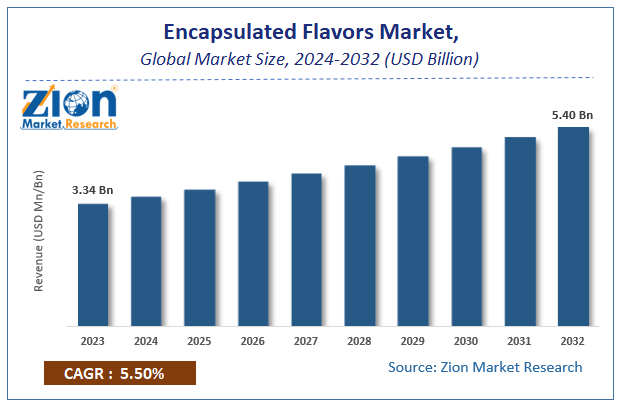
Zion Market Research has published a report on the global encapsulated flavors market, estimating its value at USD 3.34 billion in 2023, with projections indicating that it will reach USD 5.40 billion by 2032. The market is expected to expand at a compound annual growth rate (CAGR) of 5.5% over the forecast period 2024-2032.
This report provides a comprehensive analysis of the growth drivers, restraints, and challenges shaping demand across the global encapsulated flavors market throughout the forecast period, while highlighting high-potential emerging opportunities within the industry.
Key Insights
- As per the analysis shared by our research analyst, the global Encapsulated Flavors market is estimated to grow annually at a CAGR of around 5.5% over the forecast period (2024-2032).
- In terms of revenue, the global Encapsulated Flavors market size was valued at around USD 3.34 billion in 2023 and is projected to reach USD 5.40 billion by 2032.
- The market is driven by prospective applications across food and beverages, pharmaceuticals, and personal care, along with benefits such as protection from oxidation, controlled release, and growing consumption of functional foods.
- Based on the encapsulation process, the spray drying segment is growing at a high rate and is projected to dominate the global market.
- Based on the application, the bakery and confectionery segment held the largest market share in 2023 and is expected to grow at a significant rate over the forecast period
- Based on the regional segment, North America held a major share of the market, driven by a strong focus on product shelf life, rising health consciousness, and high consumption of functional foods
Encapsulated Flavors Market: Overview
The method of encapsulation is used to entrap or coat material with another material. The coating materials are known as encapsulated materials or shells, wherein the coated material is known as core or active materials. Flavors are sensitive and costly products that are generally utilized as additives in food and food items. To maintain these flavors’ stability and integrity for their long-term usage, these flavors are protected or encapsulated. The demand and popularity of the global encapsulated flavors market can be attributed to the various encapsulation benefits, such as protecting flavor particularly from oxidation, evaporation, moisture uptake etc.
Encapsulated Flavors Market: Growth Drivers
What factors are primarily accelerating demand for encapsulated flavors?
The major growth driver in the global encapsulated flavors market is their prospective applications in various industries, such as food and beverages, textiles, personal care, pharmaceuticals, etc. Characteristics like odour and flavor masking, controlled release features, and accuracy in producing nutrients are further fuelling the expansion of the market for encapsulated flavors market. Technological advancements and growing investments made in research and development are also contributing to this market’s development on a global scale.
Several major key market players are expected to focus on new item launches as well as innovations to achieve market growth. Furthermore, growing health consciousness of consumers and rising consumption of functional foods is also driving the encapsulation flavors market globally.
Encapsulated Flavors Market: Restraints
What challenges could limit the expansion of the encapsulated flavors market?
The relatively higher cost of encapsulated flavors compared with conventional flavors can constrain adoption in price-sensitive applications and markets. Technical complexities associated with achieving optimal encapsulation efficiency, release profiles, and compatibility with diverse food matrices also present challenges.
Regulatory requirements related to food additives and labeling, along with the need for specialized equipment and expertise, can further limit broader market penetration, particularly among smaller manufacturers.
Encapsulated Flavors Market: Report Scope
| Report Attributes | Report Details |
|---|---|
| Report Name | Encapsulated Flavors Market |
| Market Size in 2023 | USD 3.34 Billion |
| Market Forecast in 2032 | USD 5.40 Billion |
| Growth Rate | CAGR of 5.5% |
| Number of Pages | 210 |
| Key Companies Covered | Balchem Corporation, Archer Daniels Midland, Glatt GmbH, Etosha Pan (India) Pvt. Ltd., LycoRed Limited, Friesland Campina Kievit, Tate & Lyle PLC, Groupe Legris Industries, Ingredion Incorporated, BUCHI Labortechnik, Synthite Industries, Sensient Technologies Corporation, Fona International, Carmi Flavor & Fragrance, Cargill, AVEKA Group, Symrise AG, Naturex, Nexira, and International Flavours & Fragrances, among others |
| Segments Covered | By Flavor Type, By Encapsulation Process, By Application, and By Region |
| Regions Covered | North America, Europe, Asia Pacific (APAC), Latin America, Middle East, and Africa (MEA) |
| Base Year | 2023 |
| Historical Year | 2018 - 2022 |
| Forecast Year | 2024 - 2032 |
| Customization Scope | Avail customized purchase options to meet your exact research needs. Request For Customization |
Encapsulated Flavors Market: Segmentation
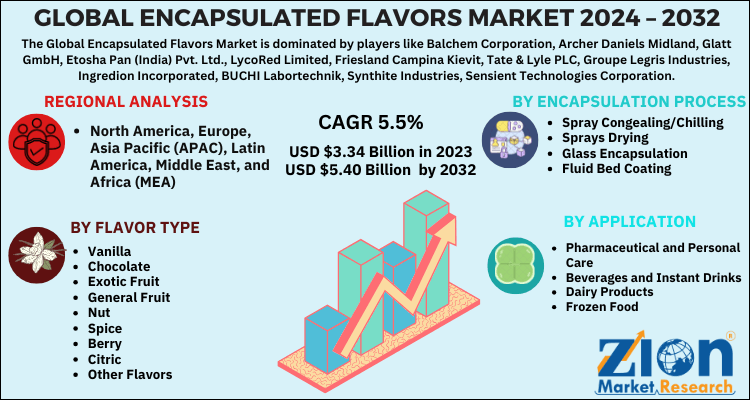
The encapsulated flavors market is classified based on flavor type, encapsulation process, application, and region.
On the basis of flavor type, the encapsulated flavors market is fragmented into vanilla, chocolate, exotic fruit, general fruit (apple, mango, and banana), nut, spice, berry, and citric, among other flavors. Vanilla represents the leading segment due to its extensive use across bakery, confectionery, beverages, dairy, and snack applications. These flavors benefit significantly from encapsulation because it preserves their characteristic profiles against heat, moisture, and oxidation during processing and storage, supporting consistent product quality and driving substantial market volume.
Based on the encapsulation process, the market for encapsulated flavors is classified into spray congealing/chilling, sprays drying, glass encapsulation, and fluid bed coating, among others. The spray drying segment is the most popular in the market, due to its extensive use for creating a secondary shell around products. The technique offers scalability, relatively efficient production, and effective protection against environmental degradation, making it the preferred choice for many commercial flavor encapsulation applications and a key driver of market volume.
By application, the encapsulated flavors market is fragmented into pharmaceutical and personal care, beverages and instant drinks, dairy products, frozen food, snacks, cereal and oatmeal, and bakery and confectionary, among others. Bakery and confectionery, along with beverages and instant drinks, constitute major application segments because these categories subject flavors to significant heat, moisture, and processing stresses. Encapsulation ensures flavor retention and consistent sensory delivery, making it highly valuable and supporting strong demand.
Encapsulated Flavors Market: Regional Analysis
Why will North America continue to dominate the global market during the projection period?
North America is anticipated to hold a major share of the global encapsulated flavors market during the forecast period. The region benefits from strong industry focus on extending product shelf life, high levels of consumer health consciousness, and rising consumption of functional and processed foods that require stable, high-performance flavors. Advanced food processing infrastructure and continuous innovation in encapsulation technologies further support demand. Leading countries such as the United States drive regional leadership through established food and beverage manufacturing and rigorous quality standards that favor protected flavor systems.
The Asia Pacific region is likely to show the fastest rate of growth in the global encapsulated flavors market in the upcoming years. This growth can be attributed to the growing population and increasing disposable income of people, especially in the emerging markets, such as India and China. The North American region is anticipated to hold a major share in the market for encapsulated flavors in the forecast timeframe. This is due to the growing concerns related to improving the shelf life of various products, growing health consciousness of consumers, and rising consumption of functional foods.
Some key players of the global encapsulated flavors market include-
- Balchem Corporation
- Archer Daniels Midland
- Glatt GmbH
- Etosha Pan (India) Pvt. Ltd.
- LycoRed Limited
- Friesland Campina Kievit
- Tate & Lyle PLC
- Groupe Legris Industries
- Ingredion Incorporated
- BUCHI Labortechnik
- Synthite Industries
- Sensient Technologies Corporation
- Fona International
- Carmi Flavor & Fragrance
- Cargill
- AVEKA Group
- Symrise AG
- Naturex
- Nexira
- International Flavours & Fragrances
The global Encapsulated Flavors market is segmented as follows:
By Flavor Type
- Vanilla
- Chocolate
- Exotic Fruit
- General Fruit
- Nut
- Spice
- Berry
- Citric
- Other Flavors
By Encapsulation Process
- Spray Congealing/Chilling
- Sprays Drying
- Glass Encapsulation
- Fluid Bed Coating
- Others
By Application
- Pharmaceutical and Personal Care
- Beverages and Instant Drinks
- Dairy Products
- Frozen Food
- Snacks
- Cereal and Oatmeal
- Bakery and Confectionary
- Others
By Region
- North America
- The U.S.
- Canada
- Mexico
- Europe
- France
- The UK
- Spain
- Germany
- Italy
- Rest of Europe
- Asia Pacific
- China
- Japan
- India
- Australia
- South Korea
- Rest of Asia Pacific
- The Middle East & Africa
- Saudi Arabia
- UAE
- Egypt
- Kuwait
- South Africa
- Rest of the Middle East & Africa
- Latin America
- Brazil
- Argentina
- Rest of Latin America
Table Of Content
Methodology
FrequentlyAsked Questions
Flavours classified as encapsulated are those which have been sealed inside a shell or protective layer to maintain their quality, improve their stability and control their release during processing or consumption. This method surrounds taste particles with a coating substance that shields them from environmental elements including heat, light, and moisture, therefore preventing their degradation over time.
Demand for encapsulated flavors is being driven by processed, ready-to-eat, and rapid food's increasing appeal. These goods call for flavors that will withstand long shelf life, intense heat, pressure, or processing conditions.
Zion Market Research has published a report on the global Encapsulated Flavors Market, estimating its value at USD 3.34 Billion in 2023, with projections indicating that it will reach USD 5.40 Billion by 2032.
The market is expected to expand at a compound annual growth rate (CAGR) of 5.5% over the forecast period 2024-2032.
North America is anticipated to hold a major share, while Asia Pacific is expected to record the fastest growth rate during the forecast period.
Balchem Corporation, Archer Daniels Midland, Glatt GmbH, Etosha Pan (India) Pvt. Ltd., LycoRed Limited, Friesland Campina Kievit, Tate & Lyle PLC, Groupe Legris Industries, Ingredion Incorporated, BUCHI Labortechnik, Synthite Industries, Sensient Technologies Corporation, Fona International, Carmi Flavor & Fragrance, Cargill, AVEKA Group, Symrise AG, Naturex, Nexira, and International Flavours & Fragrances, among others
The report provides comprehensive analysis of market size and forecasts, growth drivers and restraints, detailed segmentation by flavor type, encapsulation process, and application, regional insights, competitive landscape, and strategic perspectives for industry stakeholders.

HappyClients

