
Pigment Market Size, Trend, Growth, Industry Analysis 2034

Pigment Market By Product Type (Organic Pigments, Specialty Pigments and Inorganic Pigments), By Application (Paints and Coatings, Printing Inks, Plastics, Construction Materials and Others) and By Region - Global and Regional Industry Overview, Market Intelligence, Comprehensive Analysis, Historical Data, and Forecasts 2025 - 2034
| Market Size in 2024 | Market Forecast in 2034 | CAGR (in %) | Base Year |
|---|---|---|---|
| USD 32.4 Billion | USD 50.3 Billion | 4.5% | 2024 |
Pigment Industry Perspective:
What will be the size of the global pigment market during the forecast period?
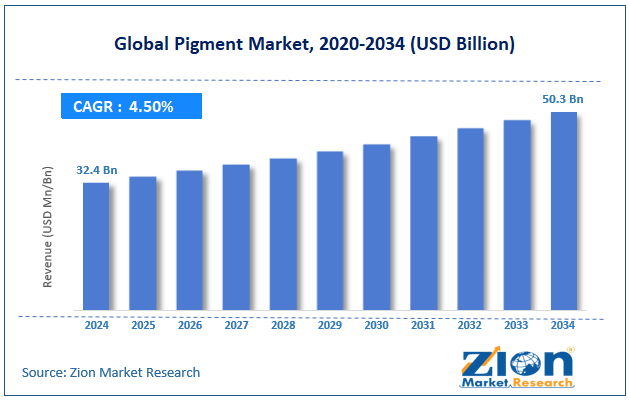
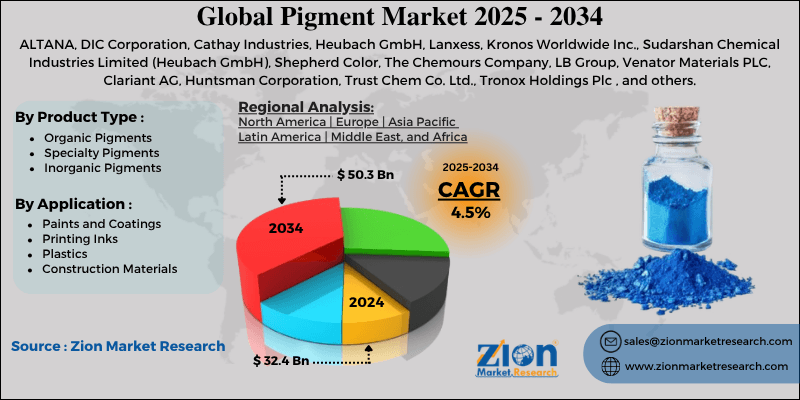
The global pigment market size was worth around USD 32.4 billion in 2024 and is predicted to grow to around USD 50.3 billion by 2034 with a compound annual growth rate (CAGR) of roughly 4.5% between 2025 and 2034.
Pigment Market: Overview
Pigments are naturally occurring or synthetic, finely divided solid substances that give the product color, opacity, gloss, surface brightening, and are protective agents. Pigments are insoluble in both the medium in which they are used and in water, but rather disperse as solid particles, using them to both produce the desired color and provide weatherable, chemically stable products. Paints and coatings, plastics, printing inks, textiles, building materials, cosmetics, paper, ceramics, and other areas are among those where pigments are used on a large scale. Depending on the nature of their components and applications, the market is divided into inorganic, organic, and other specialty categories. Other diverse applications include titanium dioxide, iron oxide, carbon black, and azo pigments. Due to rising urbanization, industrialization, and other socioeconomic factors, the global pigment market is witnessing immense growth.
Key Insights
- As per the analysis shared by our research analyst, the global pigment market is estimated to grow annually at a CAGR of around 4.5% over the forecast period (2025-2034).
- In terms of revenue, the global pigment market size was valued at around USD 32.4 billion in 2024 and is projected to reach USD 50.3 billion by 2034.
- Rising demand for High-Performance Pigments (HPPs) is expected to propel the pigment market over the projected period.
- Based on the product type, the inorganic pigments segment captures the largest market share in 2024 of over 70%.
- Based on the application, the paints and coatings dominated the market with a highest revenue share of over 54%.
- Based on region, the Asia Pacific captures the largest market share in 2024 of over 44%.
Impact of the USA-Israel War on Iran on the Pigment Market
The long-standing USA-Israel war involving Iran continues to cause uncertainty in the world pigment market by disrupting the petrochemical supply chain, driving up crude oil prices, and increasing the cost of transportation and manufacturing. Due to the heavily petrochemical nature of pigment manufacture, the use of petrochemical derivatives, titanium dioxide feedstocks, solvents, and energy-intensive labor has driven up raw material costs and created a supply crunch. Meanwhile, the involvement of the Strait of Hormuz, a crucial oil and chemical trading route, in the recent conflict is causing increased freight costs, shipping delays, and insurance premiums, impacting manufacturing systems and end-market industries worldwide. Corporations involved in paints & coatings, plastics, printing inks, and packaging, i.e., Asia and Europe, are particularly affected.
Pigment Market: Dynamics
Growth Drivers
Why does the growing paints & coatings industry drive the pigment market?
The expanding growth of the paints and coatings industry is a major factor for the growth of the pigment industry, as the pigments are extensively used in the formulation of various paints and coatings to impart specific properties such as color, opacity, gloss, durability, resistance to UV radiation, oil & chemical resistance, and weather stability to the formulation. The growing demand for high-performance, high-quality pigments from construction and infrastructure activities, and the automotive & industrial manufacturing sectors is expected to drive demand for decorative & industrial coatings, ultimately increasing the use of pigments. The demand for architectural paints requires pigments, as they provide aesthetics and surface protection, while automotive & industrial paints offer scratch & heat resistance and long-term durability. Consumers seeking high-quality, customized colors and finishes for residential, commercial, and industrial sectors are also expected to fuel demand for high-performance and specialty pigments.
Restraints
Stringent environmental regulations hinder the growth of the pigment industry
Strict environmental regulations are among the factors responsible for constrained growth in the pigment industry. The use of hazardous chemicals, heavy metals, high emission processes in manufacturing the pigment has been restricted by authorities in North America and Europe. Strict regulatory measures regarding wastewater disposal standards, air emissions, VOC limits, and restrictions on the use of toxic elements such as lead, chromium, and cadmium-based pigments have been put in place by authorities in North America and Europe. These regulatory measures demand heavy investments in pollution control systems, Waste treatment facilities, Green raw materials, and environmentally friendly production methods, resulting in higher production & operation costs. Stringent approval procedures and restriction of conventional inorganic pigments may further affect product availability and innovation.
Opportunities
How does the increasing expansion of company product portfolio offer a lucrative opportunity for the pigment market?
The growing expansion of company product portfolio offers a lucrative opportunity for the development of the pigment market during the forecast period. For instance, in February 2025, Specialty chemicals company LANXESS will offer a highly sustainable variant of its Bayferrox iron oxide yellow pigment in the future. The pigments marketed under the company’s own Scopeblue label have a significantly reduced carbon footprint due to the use of more eco-efficient raw materials. This reflects the growing awareness of the raw material product carbon footprint (PCF) in the paint and coatings industry and the resulting demand for sustainably manufactured pigments. LANXESS is responding to this development by gradually introducing the Scopeblue product lines as part of its sustainability strategy. The Scopeblue label indicates products made from a high proportion of sustainable raw materials and that have a significantly lower carbon footprint than conventional products.
Challenges
Why does the volatility in raw material prices pose a significant challenge to the pigment market?
Price fluctuations in commodities used as raw materials are a major problem for the pigment industry, as the production of pigment is heavily reliant on the market prices of commodities such as titanium dioxide, iron oxides, petrochemical derivatives, carbon black and various other metallic compounds which are subject to frequent market fluctuations caused by volatile crude oil prices, mine production, energy costs, geopolitical issues and transportation linkages. The sharp rise in raw material prices would significantly increase production costs and pressure margins for pigment producers, making long-term pricing and contract stability difficult for both parties. Sharp increases would create planning uncertainties and inventory build-ups, especially for small- to medium-sized companies with smaller buffers, which can impact the prices of end-use products, paints, plastics, print and packaging inks, and construction materials.
Pigment Market: Report Scope
| Report Attributes | Report Details |
|---|---|
| Report Name | Pigment Market |
| Market Size in 2024 | USD 32.4 Billion |
| Market Forecast in 2034 | USD 50.3 Billion |
| Growth Rate | CAGR of 4.5% |
| Number of Pages | 228 |
| Key Companies Covered | ALTANA, DIC Corporation, Cathay Industries, Heubach GmbH, Lanxess, Kronos Worldwide Inc., Sudarshan Chemical Industries Limited (Heubach GmbH), Shepherd Color, The Chemours Company, LB Group, Venator Materials PLC, Clariant AG, Huntsman Corporation, Trust Chem Co. Ltd., Tronox Holdings Plc , and others. |
| Segments Covered | By Product Type, By Application, and By Region |
| Regions Covered | North America, Europe, Asia Pacific (APAC), Latin America, Middle East, and Africa (MEA) |
| Base Year | 2024 |
| Historical Year | 2019 - 2023 |
| Forecast Year | 2025 - 2034 |
| Customization Scope | Avail customized purchase options to meet your exact research needs. Request For Customization |
Pigment Market: Segmentation
Product Type Insights
Why does the inorganic pigments dominate the pigment market?
The inorganic pigments segment captures the largest market share in 2024 of over 70%. Compared with many organic alternatives, greater durability, heat resistance, opacity, chemical stability, and affordability all contribute to the segment's growth. Inorganic pigments such as titanium dioxide, iron oxides, chromium compounds, and ultramarine pigments are also used extensively in paints and coatings, building materials, plastics, ceramics, and printing inks due to their excellent weather resistance, corrosion protection, UV stability, and durable coloration. The growth of infrastructure, residential and commercial construction, automobile manufacturing, and industrial manufacturing is likely to be a major factor contributing to the increasing demand for inorganic pigments, especially for use in architectural coatings and concrete.
Application Insights
How does the paints and coatings capture the largest market share in the pigment market?
The paints and coatings dominated the market with a highest revenue share of over 54%. This is driven by increasing construction activity, infrastructure development, automotive manufacturing, and industrial manufacturing worldwide. Pigments play an important role in paints and coatings, delivering color, opacity, gloss, corrosion protection, weather durability, surface enhancement, and UV stability. Increasing demand for decorative paints in both residential and commercial sectors is a contributing factor to higher pigment consumption, while demand for protective industrial coatings for automotive, marine, aerospace, and general manufacturing applications is also rising.
Regional Insights
Why does the Asia Pacific lead the pigment market?
The Asia Pacific captures the largest market share in 2024 of over 44%. This exceptional regional growth can be attributed to rapid rates of industrialization, urbanization, infrastructure development, and a marked rise in manufacturing activity in economies such as China, India, Japan, and South Korea. Growing momentum across the construction, automotive, plastics, packaging, textiles, and paints & coatings sectors has significantly boosted demand in the Asia Pacific. Indicators such as rising levels of residential & commercial construction, enhanced government investments in the development of smart cities, transport infrastructure, and the industrial base are igniting a surge in consumption of decorative & protective coatings, which directly impacts consumption of high-value-added pigments.
Moreover, the availability of significant quantities of raw materials, the infrastructure for large-scale manufacture of high-volume pigments, companies' efforts to develop cheaper sources of raw materials, surging consumer product consumption, and rising demand for packaging materials are expected to result in exponential gains. Additionally, the growing adoption of eco-friendly coatings & high-performance pigments in the automotive and industrial sectors is further accentuating revenue growth.
Pigment Market: Competitive Analysis
The global pigment market is dominated by players like
- ALTANA
- DIC Corporation
- Cathay Industries
- Heubach GmbH
- Lanxess
- Kronos Worldwide Inc.
- Sudarshan Chemical Industries Limited (Heubach GmbH)
- Shepherd Color
- The Chemours Company
- LB Group
- Venator Materials PLC
- Clariant AG
- Huntsman Corporation
- Trust Chem Co. Ltd.
- Tronox Holdings Plc ,
The global pigment market is segmented as follows:
By Product Type
- Organic Pigments
- Specialty Pigments
- Inorganic Pigments
By Application
- Paints and Coatings
- Printing Inks
- Plastics
- Construction Materials
- Others
By Region
- North America
- The U.S.
- Canada
- Mexico
- Europe
- France
- The UK
- Spain
- Germany
- Italy
- Rest of Europe
- Asia Pacific
- China
- Japan
- India
- Australia
- South Korea
- Rest of Asia Pacific
- The Middle East & Africa
- Saudi Arabia
- UAE
- Egypt
- Kuwait
- South Africa
- Rest of the Middle East & Africa
- Latin America
- Brazil
- Argentina
- Rest of Latin America
Table Of Content
Methodology
FrequentlyAsked Questions
Pigments are naturally occurring or synthetic, finely divided solid substances that give the product color, opacity, gloss, surface brightening, and are protective agents. Pigments are insoluble in both the medium in which they are used and in water, but rather disperse as solid particles, using them to both produce the desired color and provide weatherable, chemically stable products.
Key growth drivers for the pigment market include rising demand from paints & coatings, construction, plastics, packaging, automotive, and printing ink industries, along with increasing adoption of high-performance and eco-friendly pigments.
Major challenges restraining the growth of the pigment market include stringent environmental regulations, volatility in raw material prices, high production costs, and supply chain disruptions.
Based on the product type, the inorganic pigments segment is expected to dominate the pigment market growth during the projected period.
Emerging trends and innovations impacting the pigment market include the development of eco-friendly and bio-based pigments, high-performance specialty pigments, nanopigments, smart pigments, and advanced color technologies for sustainable and durable applications.
According to the report, the global pigment market size was worth around USD 32.4 billion in 2024 and is predicted to grow to around USD 50.3 billion by 2034.
The global pigment market is expected to grow at a CAGR of 4.5% during the forecast period.
The global Pigment industry growth is expected to be led by the Asia Pacific over the forecast period.
The global pigment market is dominated by players like ALTANA, DIC Corporation, Cathay Industries, Heubach GmbH, Lanxess, Kronos Worldwide, Inc., Sudarshan Chemical Industries Limited (Heubach GmbH), Shepherd Color, The Chemours Company, LB Group, Venator Materials PLC, Clariant AG, Huntsman Corporation, Trust Chem Co., Ltd. and Tronox Holdings Plc among others.
The market report covers the geographical market along with a comprehensive competitive landscape analysis. It also includes cash flow analysis, profit ratio analysis, market basket analysis, market attractiveness analysis, sentiment analysis, PESTLE analysis, trend analysis, SWOT analysis, trade area analysis, demand & supply analysis, Porter’s five forces analysis, and value chain analysis.

HappyClients

