
Global Nanosensors Market Size, Share, Growth and Forecast 2034

Nanosensors Market By Product Type (Optical Nanosensors, Electrochemical Nanosensors and Electromagnetic Nanosensors), By Application (Defense & Military, Automotive & Aerospace, Consumer Electronics, Biomedical & Healthcare, Industrial Monitoring, and Others), By Technology (Bottom-Up Assembly, Top-Down Assembly, and Molecular Self-Assembly), By End-User (Automotive, Industrial, Aerospace & Defense, Healthcare & Life Sciences, Industrial, and Others), and By Region - Global and Regional Industry Overview, Market Intelligence, Comprehensive Analysis, Historical Data, and Forecasts 2026 - 2034
| Market Size in 2025 | Market Forecast in 2034 | CAGR (in %) | Base Year |
|---|---|---|---|
| USD 901.78 Million | USD 1,838.11 Million | 8.23% | 2025 |
Nanosensors Industry Perspective:
What is the anticipated size of the nanosensors market during the projection period?
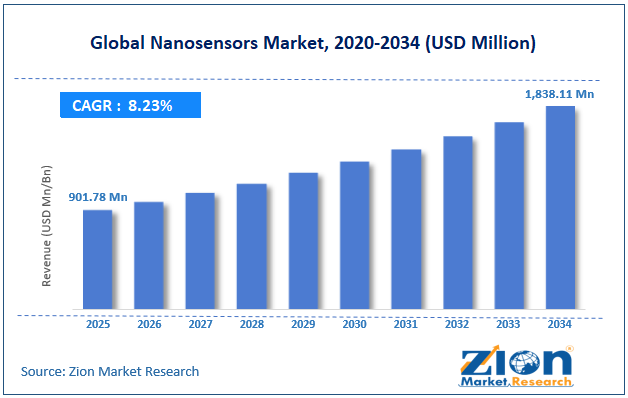
The global nanosensors market size was worth around USD 901.78 million in 2025 and is predicted to grow to around USD 1,838.11 million by 2034, with a compound annual growth rate (CAGR) of roughly 8.23% between 2026 and 2034.
Key Insights:
- As per the analysis shared by our research analyst, the global nanosensors market is estimated to grow annually at a CAGR of around 8.23% over the forecast period (2026-2034)
- In terms of revenue, the global nanosensors market size was valued at around USD 901.78 million in 2025 and is projected to reach USD 1,838.11 million, by 2034.
- The nanosensors market is projected to grow at a significant rate due to the growing investments in healthcare technologies, environmental monitoring, and industrial automation.
- Based on the product type, the electrochemical nanosensors segment is growing at a high rate and will continue to dominate the global market as per industry projections.
- Based on the application, the biomedical & healthcare segment is anticipated to command the largest market share.
- Based on the technology, the molecular self-assembly will grow at the fastest CAGR.
- Based on the end-user, the healthcare & life sciences segment was the largest market share holder, accounting for 31.07% of the global revenue.
- Based on region, Asia-Pacific is projected to dominate the global market during the forecast period.
Nanosensors Market: Overview
Nanosensors are unique mechanical or chemical sensors. They are used for detecting the presence of nanoparticles and chemical species. In addition, nanosensors can monitor physical parameters such as temperature at the nanoscale level. Common applications of nanosensors are food and water testing, medical diagnostic equipment, and consumer electronics. The nanosensors market is currently led by different types such as photoacoustic-based nanosensors, plasmon coupling–based nanosensors, carbon nanotubes, multimodal nanosensors, and magnetic resonance imaging-based nanosensors, among others. During the forecast period, demand for nanosensors is expected to be driven by growing investments in healthcare technologies, environmental monitoring, and industrial automation. However, nanosensors are highly sensitive to environmental conditions, which act as a major growth limitation for the market players. Moreover, challenges with integrating nanosensors into existing systems may hinder market revenue during the forecast period.
Impact of the USA-Israel and Iran war on the Nanosensors Market:
The USA-Israel and Iran war has affected the supply chain of chips, semiconductors, printed circuit boards, and other raw materials required for nanosensor production. In addition, an increase in transportation costs has reduced profit margins for market players, ultimately increasing technology ownership costs. During the forecast period, the war will encourage more focus on domestic production and transport route optimization strategies.
Nanosensors Market: Dynamics
Growth Drivers
Which healthcare and diagnostic applications will influence growth in the nanosensors market?
The global nanosensors market is expected to be driven by rising applications of the sensors in point-of-care diagnosis, healthcare monitoring, and precision medicine. In addition, nanosensors are widely used in advanced diagnostic technologies, playing a crucial role in early disease diagnosis. In June 2026, an international team of scientists developed a new fluorescent nanosensor, powered by carbon nanotubes. According to official reports, the novel nanosensor can detect emerging biomarkers linked to gut health and disease in early stages. Furthermore, the emergence and rapid proliferation of wearable health devices has intensified demand for nanosensors in the medical care sector. The Royal Society of Chemistry published a report in 2025, claiming that nanosensors in healthcare are allowing real-time disease monitoring and management.
Demand for environmental monitoring technologies to encourage market growth
Nanosensors are widely used in environmental testing and monitoring systems such as water quality assessment, air quality monitoring, and soil contamination detection. Growing pollution and ecosystem damage have propelled demand for real-time environmental testing, monitoring, and management technologies. This has led to higher revenue in the global nanosensors market. As per recent industry trends, optical nanosensors have emerged as promising analytical tools for environmental monitoring. They offer high selectivity and sensitivity, thus ensuring optimal results.
Restraints
Which is the leading growth inhibitor in the nanosensors industry?
Growth in the global nanosensors industry will be restricted due to the high sensitivity of the sensors to environmental factors. As nanosensors are designed to be highly sensitive to external factors such as temperature and electromagnetic interference, this trait also leads to technical vulnerabilities in the technology. For instance, optical nanosensors perform optimally when exposed to stable light sources. However, a lack of the same can limit nanosensor performance in harsh conditions.
Opportunities
Will rapid industrial automation generate growth opportunities for the nanosensors industry leaders?
The global nanosensors market is anticipated to generate growth opportunities due to rapid industrial automation. Integration of automated and robotic systems in industrial facilities is driven by the growing demand for real-time process and equipment monitoring. In addition, predictive maintenance and remote monitoring systems rely heavily on nanosensors. According to official reports, the number of industrial facilities undergoing automation has increased steadily in the last few years. For instance, the automotive sector is one of the largest beneficiaries of Industry 4.0 trends.
In July 2026, BMW Group announced that it had employed Artificial Intelligence (AI) and Virtual Reality (VR) training at its Woodruff facility in South Carolina. The company expects to leverage these technologies to deliver zero-defect Gen6 batteries for the fully electric BMW iX5 in December 2026.
Challenges
Which are the leading challenges faced by the nanosensors market players?
The global nanosensors industry will be challenged by complexities in integrating the sensors with existing systems. Differences in power requirements, signal formats, and data protocols between nanosensors and legacy systems will create growth barriers. Most basic systems cannot handle integration with modern nanosensors, thus requiring customized solutions. The implications of this can be seen in development cost.
Nanosensors Market: Report Scope
| Report Attributes | Report Details |
|---|---|
| Report Name | Nanosensors Market |
| Market Size in 2025 | USD 901.78 Million |
| Market Forecast in 2034 | USD 1,838.11 Million |
| Growth Rate | CAGR of 8.23% |
| Number of Pages | 229 |
| Key Companies Covered | Altair Nanotechnologies, Biosensors International Group, Analog Devices, OMRON Corporation, Applied Nanotech (Nano Magic), Texas Instruments, Agilent Technologies, Kleindiek Nanotechnik, Samsung Electronics, Bruker Corporation, Lockheed Martin, Nanowear, Honeywell International, Oxonica Limited, Sensigent, and others. |
| Segments Covered | By Product Type, By Application, By Technology, By End-User, and By Region |
| Regions Covered | North America, Europe, Asia Pacific (APAC), Latin America, Middle East, and Africa (MEA) |
| Base Year | 2025 |
| Historical Year | 2020 - 2024 |
| Forecast Year | 2026 - 2034 |
| Customization Scope | Avail customized purchase options to meet your exact research needs. Request For Customization |
Nanosensors Market: Segmentation
The global nanosensors market is segmented based on product type, application, technology, end-user, and region.
Why will the electrochemical nanosensors segment lead the nanosensors industry revenue during the forecast period?
Based on product type, the global market segments are optical nanosensors, electrochemical nanosensors, and electromagnetic nanosensors. In 2025, the highest growth was listed in the electrochemical nanosensors segment. It accounted for 40.52% of the global revenue. During the forecast period, it is projected to deliver a CAGR of 8.32% due to higher applications in healthcare diagnostics, food safety testing, and environmental monitoring.
Which will be the fastest-growing application during the forecast period in the nanosensors market?
Based on application, the global nanosensors industry is divided into defense & military, automotive & aerospace, consumer electronics, biomedical & healthcare, industrial monitoring, and others. In 2025, the biomedical & healthcare segment was the highest revenue generator. It contributed over 32% of the global revenue and will continue to lead the market growth in the coming years. Growing demand for next-generation healthcare diagnostic tools, early disease diagnosis, and precision medicine will aid segmental prominence during the forecast period.
Which factors drive demand in the molecular self-assembly segment in the nanosensors industry?
Based on technology, the global market is divided into bottom-up assembly, top-down assembly, and molecular self-assembly. In 2025, bottom-up assembly contributed the largest share of total revenue because it is more cost-effective and offers precise fabrication of nanoscale structures. During the forecast period, molecular self-assembly will grow at the fastest CAGR. The segmental growth will be driven by advancements in nanoelectronics and nanomedicine.
What will be the influence of the healthcare & life sciences segment on the nanosensors market?
Based on end-user, the global market is fragmented into automotive, industrial, aerospace & defense, healthcare & life sciences, and others. In 2025, healthcare & life sciences was the largest market share holder, accounting for 31.07% of the global revenue. In the coming years, it will continue leading the market with significant CAGR, driven by the growing prevalence of medical conditions, healthcare digitalization, and rising demand for wearables.
Nanosensors Market: Regional Analysis
Why will North America lead the nanosensors market in the coming years?
The global nanosensors market is currently led by North America. In 2025, it accounted for 38.0.7% of the global revenue and will grow at a CAGR of 8.51% during the forecast period. North America is witnessing rapid expansion of large-scale commercial banks. The presence of advanced healthcare infrastructure, early adoption trends, and growing investments in research & development (R&D) will encourage regional growth in the coming years.
Why will Asia-Pacific generate the fastest CAGR in the nanosensors market during the forecast period?
Asia-Pacific is expected to emerge as the fastest-growing region in the nanosensors market with a CAGR of 10.81% during the forecast period. In 2025, it accounted for 25% of the global revenue. Countries such as China, India, South Korea, and Japan will emerge as leading regional players. Rapid industrial automation, the emergence of fully automated manufacturing plants, and advancements in medical diagnostic technologies will propel growth across Asia-Pacific. Additionally, investments in 5G and 6G networks and a higher focus on domestic production will pave the way for new growth avenues in the region.
Nanosensors Market: Competitive Analysis
The global nanosensors market is led by players like:
- Altair Nanotechnologies
- Biosensors International Group
- Analog Devices
- OMRON Corporation
- Applied Nanotech (Nano Magic)
- Texas Instruments
- Agilent Technologies
- Kleindiek Nanotechnik
- Samsung Electronics
- Bruker Corporation
- Lockheed Martin
- Nanowear
- Honeywell International
- Oxonica Limited
- Sensigent
What are the latest key trends in the nanosensors market?
Point-of-care diagnosis
The growing demand for technologies enabling point-of-care diagnosis will emerge as a prominent market trend. It allows the development of nanosensors with high sensitivity toward biomarkers at extremely low concentrations, ensuring accurate and quick diagnosis at the point of care.
Advancements in nanomaterials
Recent advancements in nanomaterials, such as the introduction of quantum dots and carbon nanotubes (CNTs), have opened several new growth opportunities for industry players. These next-generation nanomaterials have broader applications and a performance range.
The global nanosensors market is segmented as follows:
By Product Type
- Optical Nanosensors
- Electrochemical Nanosensors
- Electromagnetic Nanosensors
By Application
- Defense & Military
- Automotive & Aerospace
- Consumer Electronics
- Biomedical & Healthcare
- Industrial Monitoring
- Others
By Technology
- Bottom-Up Assembly
- Top-Down Assembly
- Molecular Self-Assembly
By End-User
- Automotive
- Industrial
- Aerospace & Defense
- Healthcare & Life Sciences
- Industrial
- Others
By Region
- North America
- The U.S.
- Canada
- Mexico
- Europe
- France
- The UK
- Spain
- Germany
- Italy
- Rest of Europe
- Asia Pacific
- China
- Japan
- India
- Australia
- South Korea
- Rest of Asia Pacific
- The Middle East & Africa
- Saudi Arabia
- UAE
- Egypt
- Kuwait
- South Africa
- Rest of the Middle East & Africa
- Latin America
- Brazil
- Argentina
- Rest of Latin America
Table Of Content
Methodology
FrequentlyAsked Questions
Nanosensors are unique mechanical or chemical sensors. They are used for detecting the presence of nanoparticles and chemical species.
During the forecast period, demand for nanosensors is expected to be driven by growing investments in healthcare technologies, environmental monitoring, and industrial automation.
According to study, the global nanosensors market size was worth around USD 901.78 million in 2025 and is predicted to grow to around USD 1,838.11 million by 2034.
The CAGR value of the nanosensors market is expected to be around 8.23% during 2026-2034.
The global nanosensors industry will be challenged by complexities in integrating the sensors with existing systems.
Point-of-care diagnosis and advancements in nanomaterials are the emerging trends and innovations impacting the nanosensors market.
The global nanosensors market has performed well so far and will offer similar trends in the coming years.
Asia-Pacific will contribute notably towards the nanosensors market value.
The global nanosensors market is led by players like Altair Nanotechnologies, Biosensors International Group, Analog Devices, OMRON Corporation, Applied Nanotech (Nano Magic), Texas Instruments, Agilent Technologies, Kleindiek Nanotechnik, Samsung Electronics, Bruker Corporation, Lockheed Martin, Nanowear, Honeywell International, Oxonica Limited, and Sensigent.
The report explores crucial aspects of the nanosensors market, including a detailed discussion of existing growth factors and restraints, while also browsing future growth opportunities and challenges that impact the market.

HappyClients

