Global Meat Processing Equipment Market Size, Share, Trends, Growth and Forecast 2034

Meat Processing Equipment Market By Type (Cutting Equipment, Blending Equipment, Tenderizing Equipment, Filling Equipment, Dicing Equipment, Grinding Equipment, Smoking Equipment, Massaging Equipment, Others), By Meat Type (Processed Beef, Processed Pork, Processed Mutton, Others), By Product Type (Fresh Processed Meat, Raw Cooked Meat, Precooked Meat, Raw Fermented Sausages, Cured Meat, Dried Meat, Others), By Application (Slicing, Dicing, Grinding, Smoking, Massaging, Filling, Others), By Distribution Channel (Direct Sales, Indirect Sales), and By Region - Global and Regional Industry Overview, Market Intelligence, Comprehensive Analysis, Historical Data, and Forecasts 2025 - 2034
| Market Size in 2024 | Market Forecast in 2034 | CAGR (in %) | Base Year |
|---|---|---|---|
| USD 12.34 Billion | USD 19.73 Billion | 4.8% | 2024 |
Meat Processing Equipment Industry Perspective
What will be the global meat processing equipment market size during the forecast period?
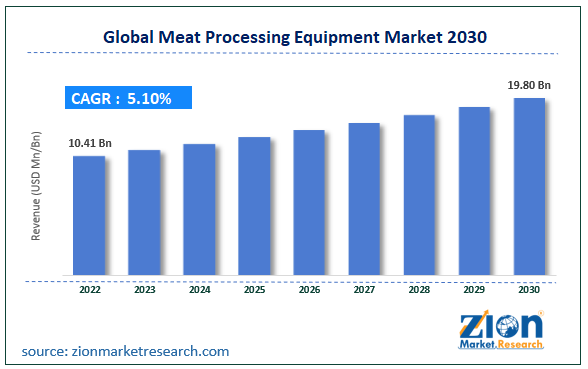
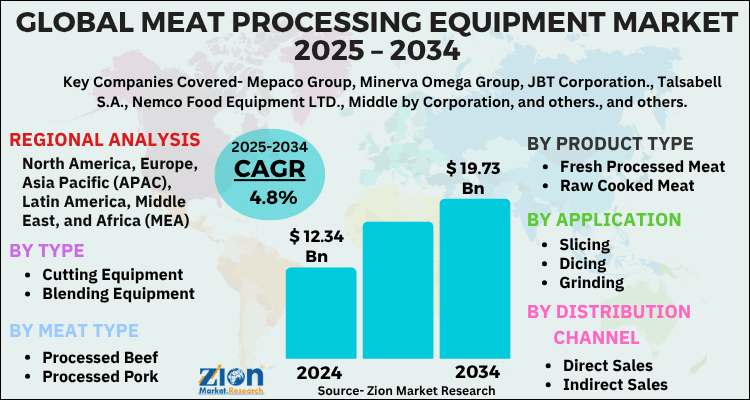
The global meat processing equipment market size was worth around USD 12.34 billion in 2024 and is predicted to grow to around USD 19.73 billion by 2034, with a compound annual growth rate (CAGR) of roughly 4.8% between 2025 and 2034.
This report provides a comprehensive analysis of the growth drivers, restraints, and challenges shaping demand across the global meat processing equipment market throughout the forecast period, while highlighting high-potential emerging opportunities within the industry.
Key Insights
- As per the analysis shared by our research analyst, the global meat processing equipment market is estimated to grow annually at a CAGR of around 4.8% over the forecast period (2025-2034).
- In terms of revenue, the global meat processing equipment market size was valued at around USD 12.34 billion in 2024 and is projected to reach USD 19.73 billion by 2034.
- The meat processing equipment market is projected to grow at a significant rate due to increasing global meat consumption, technological advancements in automation, and demand for processed meat products.
- Based on the type segment, the cutting equipment segment is expected to lead the global market because of its essential role in primary processing and high utilization across beef, pork, and other meat lines.
- Based on the meat type segment, the processed beef segment is growing at a high rate and will continue to dominate the global market, supported by strong consumer demand and established processing infrastructure.
- Based on the product type segment, the fresh processed meat segment is projected to swipe the largest market share as it aligns with convenience and fast-food consumption patterns.
- Based on the application segment, the slicing segment is expected to dominate the global market due to its widespread use in portioning and value-added product preparation.
- Based on the distribution channel segment, the direct sales segment is anticipated to command the largest market share through closer manufacturer-processor relationships and customized solutions.
- Based on the region, North America is predicted to dominate the global market during the forecast period, driven by continuous growth in the food and beverage industry and strategic investments by key players.
Meat Processing Equipment Market: Overview
Meat Processing Equipment is widely used to perform various operations such as tumbling, mixing, comminuting, chopping, salting, curing, etc. This machine is useful to reduce the number of harmful bacteria and prepare meat for human consumption. Growing investments in meat processing machinery, along with advancements in technology, are supporting the meat processing equipment industry’s growth to a great extent.
Furthermore, strict government regulations regarding trading, selling, and transporting meat to avoid spoilage of nutrient values are anticipated to boost the demand for meat processing equipment during the study period. On the flip side, the negative effect of the COVID outbreak coupled with low product awareness will hamper the market growth in the future.
Meat Processing Equipment Market: Growth Drivers
Adoption of fully automated technologies will drive market growth
The worldwide meat processing equipment market is mainly driven by the strong expansion of the food processing industry in recent years and is expected to witness the same trend in the future. The meat processing industry is growing owing to the rising adoption of advanced & automated technologies and inbuilt sensor systems in process equipment. Furthermore, the rising efficiency of processing machines, growing equipment speed, and rising adoption of automated processing systems are projected to support the overall industry growth positively during the forecast period.
In addition to this, growing lifestyle changes and rising inclination in preferences of consumers for meat products will spur market growth. Increasing demand for packaged foods & processed meat products coupled with the rising demand for food safety will further drive the overall industry development during the study period.
Meat Processing Equipment Market: Restraints
High cost of machinery likely to restrict industry expansion
The average product pricing of meat processing equipment in developed countries would range from USD 2,500 – USD 3,500. Whereas the cost of this product in developing regions ranges from USD 2,000 – USD 2,200. In addition, the research and development cost of this product is considered to be on the higher side. Such high cost of this product restricts small-scale players from entering this market. This would, in turn, hamper the global meat processing equipment market growth to some extent.
Meat Processing Equipment Market: Opportunities
Rising trade flow of meat to spur growth avenues for the market
Rapid increases in meat trade generate complex global networks across regions/countries. An increase in the trade flow of meat has boosted the demand for processed meat with shelf life and high durability, which is fueling the meat processing equipment industry growth. In addition, the steep dietary transition toward high meat consumption accelerates countries’ dependence on meat trade to fulfill increased domestic demands, which would, in turn, support the product demand globally.
Meat Processing Equipment Market: Challenges
What key challenges must the industry address?
Balancing automation investments with operational costs and demonstrating clear returns through improved yield, reduced waste, and enhanced hygiene remains a challenge. Supply chain variability and differing regional regulatory requirements can further complicate equipment selection and deployment. Manufacturers must continue to deliver measurable performance gains in efficiency and food safety to overcome buyer caution in capital-intensive purchasing decisions.
Meat Processing Equipment Market: Report Scope
| Report Attributes | Report Details |
|---|---|
| Report Name | Meat Processing Equipment Market |
| Market Size in 2024 | USD 12.34 Billion |
| Market Forecast in 2034 | USD 19.73 Billion |
| Growth Rate | CAGR of 4.8% |
| Number of Pages | 265 |
| Key Companies Covered | Mepaco Group, Minerva Omega Group, JBT Corporation., Talsabell S.A., Nemco Food Equipment LTD., Middle by Corporation, and others., and others. |
| Segments Covered | By Type, By Meat Type, By Product Type, By Application, By Distribution Channel, and By Region |
| Regions Covered | North America, Europe, Asia Pacific (APAC), Latin America, The Middle East and Africa (MEA) |
| Base Year | 2024 |
| Historical Year | 2020 - 2024 |
| Forecast Year | 2025 to 2034 |
| Customization Scope | Avail customized purchase options to meet your exact research needs. Request For Customization |
Meat Processing Equipment Market: Segmentation
The meat processing equipment market is segmented by type, meat type, product type, application, distribution channel, and region. All segments of the meat processing equipment market have been analyzed based on present and future trends and the market is estimated from 2025 to 2034.
Based on Type, the meat processing equipment market is divided into cutting equipment, blending equipment, tenderizing equipment, filling equipment, dicing equipment, grinding equipment, smoking equipment, massaging equipment, and others. Cutting equipment is expected to lead the market because of its fundamental role in primary processing and high utilization across beef, pork, and other meat categories. This dominance sustains consistent demand for robust, high-capacity systems. Blending and grinding equipment form strong complementary categories that support product uniformity and texture development; together, these equipment types drive overall market growth through higher efficiency and broader process coverage.
Based on Meat Type, the meat processing equipment market is divided into processed beef, processed pork, processed mutton, and others. Processed beef accounts for a significant share and continues to dominate because of sustained consumer demand and well-established processing infrastructure in major markets. This leadership supports high utilization of specialized cutting, grinding, and further-processing systems. Processed pork represents a substantial second category, particularly in regions with strong pork consumption traditions; the combined strength of these meat types underpins steady equipment investment and technological advancement.
Based on Product Type, the meat processing equipment market is divided into fresh processed meat, raw cooked meat, precooked meat, raw fermented sausages, cured meat, dried meat, and others. Fresh processed meat is projected to hold the largest share as it aligns closely with convenience and fast-food consumption patterns among working populations. This preference sustains demand for equipment that delivers consistent quality, safety, and portion control. Raw, cooked, and precooked categories contribute meaningful volume for ready-to-eat applications; together, these product forms reinforce the need for versatile processing lines and encourage continuous improvement in automation and hygiene design.
Based on Application, the meat processing equipment market is divided into slicing, dicing, grinding, smoking, massaging, filling, and others. Slicing is expected to dominate because of its widespread use in portioning and value-added product preparation across retail and foodservice channels. Grinding and dicing support high-volume primary and secondary processing needs. Smoking and massaging applications grow in importance for flavor development and yield optimization; the breadth of these applications drives innovation in integrated equipment and supports overall market expansion.
Based on Distribution Channel, the meat processing equipment market is divided into direct sales and indirect sales. Direct sales are anticipated to command the largest share through closer relationships between manufacturers and processors, enabling customized solutions, technical support, and long-term service agreements. Indirect sales channels expand market reach, particularly for standardized equipment and smaller buyers; the combination of both channels broadens accessibility and supports sustained market growth.
Meat Processing Equipment Market: Regional Analysis
Why will North America continue to dominate the global market during the projection period?
North America is expected to dominate the meat processing equipment market during the forecast period. Continuous growth in the food and beverage industry, combined with strategic investments by leading equipment suppliers, underpins regional leadership. The United States benefits from a mature processing sector, high standards for food safety and efficiency, and ongoing modernization of production facilities. Strong demand for both fresh and further-processed meat products, together with advanced automation adoption, enables the region to set technology benchmarks and sustain its contribution to global market growth, innovation, and expansion.
Europe maintains a significant position through established meat processing industries, stringent regulatory requirements for hygiene and quality, and steady investment in automated systems. Collaborative supply chains and focus on value-added products support continued equipment demand across major producing countries.
Asia Pacific is anticipated to grow at a promising rate. Rising meat consumption, expanding middle-class populations, and increasing investment in modern processing capacity in countries such as China and India are expected to elevate regional demand and create substantial long-term opportunities for equipment suppliers.
Recent Developments
- In July 2022, JBT Corporation announced its strategic acquisition of Alco-food-machines GmbH & Co. KG. This acquisition is aimed at expanding the company’s product offering in the processing category.
- In April 2021, BAADER announced the introduction of the BAADER 608 machine, positioned as the most powerful and largest member of its BAADERING technology range.
- In 2024–2025, JBT completed the takeover of Marel, forming JBT Marel and creating a combined global platform for protein and food processing equipment and software.
Meat Processing Equipment Market: Competitive Analysis
Some of the major players in the global meat processing equipment market include;
- Mepaco Group
- Minerva Omega Group
- JBT Corporation.
- Talsabell S.A.
- Nemco Food Equipment LTD.
- Middle by Corporation
- Talsabell S.A.
- Nemco Food Equipment, LTD.
Middle by Corporation accounted for a notable revenue share. Industry players are actively engaged in strategic collaboration to enhance their market share.
Segments Covered
The global meat processing equipment market is segmented as follows:
By Type
- Cutting Equipment
- Blending Equipment
- Tenderizing Equipment
- Filling Equipment
- Dicing Equipment
- Grinding Equipment
- Smoking Equipment
- Massaging Equipment
- Others
By Meat Type
- Processed Beef
- Processed Pork
- Processed Mutton
- Others
By Product Type
- Fresh Processed Meat
- Raw Cooked Meat
- Precooked Meat
- Raw Fermented Sausages
- Cured Meat
- Dried Meat
- Others
By Application
- Slicing
- Dicing
- Grinding
- Smoking
- Massaging
- Filling
- Others
By Distribution Channel
- Direct Sales
- Indirect Sales
By Region
- North America
- The U.S.
- Canada
- Mexico
- Europe
- France
- The UK
- Spain
- Germany
- Italy
- Rest of Europe
- Asia Pacific
- China
- Japan
- India
- Australia
- South Korea
- Rest of Asia Pacific
- The Middle East & Africa
- Saudi Arabia
- UAE
- Egypt
- Kuwait
- South Africa
- Rest of the Middle East & Africa
- Latin America
- Brazil
- Argentina
- Rest of Latin America
Table Of Content
Methodology
FrequentlyAsked Questions
Meat Processing Equipment is widely used to perform various operations such as tumbling, mixing, comminuting, chopping, salting curing, etc. This machine is useful to reduce the number of harmful bacteria and prepare meat for human consumption.
The global meat processing equipment market is expected to grow due to increasing global meat consumption, technological advancements in automation, and demand for processed meat products.
According to a study, the global meat processing equipment market size was worth around USD 12.34 Billion in 2024 and is expected to reach USD 19.73 Billion by 2034.
The global meat processing equipment market is expected to grow at a CAGR of 4.8% during the forecast period.
The global Meat Processing Equipment market growth is expected to be driven by North America. It is currently the world’s highest revenue-generating market owing to the increasing product demand.
The global Meat Processing Equipment market is dominated by players like Mepaco Group, Minerva Omega Group, and JBT Corporation. Other players such as Talsabell S.A., Nemco Food Equipment, LTD., and Middleby Corporation.
The report analyzes the global Meat Processing Equipment market’s drivers, restraints/challenges, and the effect they have on the demands during the projection period. In addition, the report explores emerging opportunities in the Meat Processing Equipment market.

HappyClients