
Global Live Entertainment Market Size, Share and Forecast 2034

Live Entertainment Market By Type (Concerts, Live Music, Acoustic or Intimate Recitals, Music Festivals, DJ Sets & Electronic Music Events, and Others), By Performing Arts (Musicals, Theatre, Opera & Ballet, Stand-Up Comedy & Improv, and Others), By Sports Events (Extreme Sport Competitions, Stadium Matches, Wrestling & Mixed Martial Arts, and Others), By Immersive & Performance Experiences (Exhibitions, Immersive Theatre Experiences, Live Interactive Installations, Experimental Theatre, Circus and Acrobatic Shows, and Others), By Social & Cultural Events (Traditional or Folk Performances, Food & Cultural Festivals, Carnivals & Parades, and Others), By Digital Live Entertainment (Virtual Concerts & VR Events, Live Podcasts & Interactive Shows, Live Game Streaming, and Others), and By Region - Global and Regional Industry Overview, Market Intelligence, Comprehensive Analysis, Historical Data, and Forecasts 2026 - 2034
| Market Size in 2025 | Market Forecast in 2034 | CAGR (in %) | Base Year |
|---|---|---|---|
| USD 535.4 Billion | USD 859.5 Billion | 5.39% | 2025 |
Live Entertainment Industry Perspective:
What is the anticipated size of the live entertainment market during the projection period?
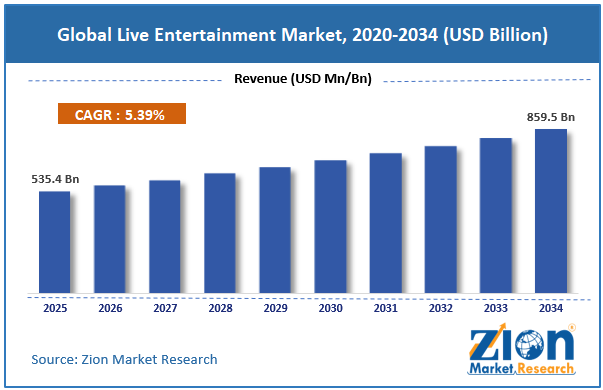
The global live entertainment market size was worth around USD 535.4 billion in 2025 and is predicted to grow to around USD 859.5 billion by 2034, with a compound annual growth rate (CAGR) of roughly 5.39% between 2026 and 2034.
 Request Free Sample
Key Insights:
- As per the analysis shared by our research analyst, the global live entertainment market is estimated to grow annually at a CAGR of around 5.39% over the forecast period (2026-2034)
- In terms of revenue, the global live entertainment market size was valued at around USD 535.4 billion in 2025 and is projected to reach USD 859.5 billion, by 2034.
- The live entertainment market is projected to grow at a significant rate due to the rising popularity of concerts & musical festivals, changing consumer lifestyle, emergence of experimental marketing, and integration of next-generation technologies.
- Based on the type, the concerts segment is growing at a high rate and will continue to dominate the global market as per industry projections.
- Based on the performing arts, the musicals segment is anticipated to command the largest market share.
- Based on sports events, the stadium matches segment is expected to lead the market growth trends.
- Based on immersive & performance experiences, the circus and acrobatic shows segment is projected to influence revenue in the market.
- Based on social & cultural events, the food & cultural festivals segment will emerge as the fastest-growing segment.
- Based on digital live entertainment, live game streaming will lead market growth during the forecast period.
- Based on region, North America is projected to dominate the global market during the forecast period.
Live Entertainment Market: Overview
Live entertainment refers to performances and events held in front of a live audience. This form of entertainment differs from recorded events because live entertainment allows speakers and performers to receive immediate audience feedback. Some common forms of live entertainment include musical concerts, sports & games, magic shows, and theatre or comedy. Over the years, live entertainment has changed drastically in how it is performed and consumed by audiences. For instance, the integration of digital technologies such as Virtual Reality (VR) and interactive digital platforms has made live entertainment more accessible and immersive. During the forecast period, the live entertainment market is expected to grow due to the rising popularity of concerts & musical festivals, changing consumer lifestyles, the emergence of experimental marketing, and the integration of next-generation technologies. However, high capital investment, security risks, geopolitical instability, and economic uncertainty may impact overall market revenue in the long run.
Impact of the USA-Israel and Iran war on the Live Entertainment Market:
The USA-Israel and Iran war significantly affected the live entertainment market. During the peak of the war, several event cancellations were reported worldwide. The market was also affected by flight cancellations, especially those moving through Middle Eastern airspace. At present times, live entertainment events are gaining stability, and the future outlook is expected to remain positive.
Live Entertainment Market: Dynamics
Growth Drivers
How will growing popularity of musical concerts influence live entertainment market growth?
The global live entertainment market is expected to benefit from the growing popularity of musical concerts worldwide. According to official reports, Live Nation Entertainment, one of the world’s prominent entertainment companies, hosted more than 54,000 shows in 2025 worldwide. Similar statistics were reported in the music concert industries of other nations, especially across Asian countries. Globalization, evolving consumer lifestyles, improved awareness and access to tickets, and the development of supportive infrastructure are driving demand for musical concerts, eventually helping the live entertainment market grow.
Event and cultural tourism to elevate market revenue during the forecast period
Event and cultural tourism is driven by the growing interest of travelers in exploring native culture, heritage, traditions, and food. It also includes attending folk festivals ranging from local concerts to sports competitions. In 2025, the global cultural tourism market reached more than USD 1.19 trillion in valuation and is expected to gain more growth in the coming years. Most cultural and event tours allow travelers to experience live regional entertainments such as traditional dance and music performances. The global live entertainment market will continue benefiting as more people participate in culturally driven programs.
Restraints
High cost of investment and operational expense to limit industry growth in the coming years
The global live entertainment industry is projected to face restrictions due to high initial investment and operational costs. Hosting a live event requires significant investment in stage setup, logistics, marketing, venue rental, and employee pay. Growing economic uncertainty worldwide and rising cost of products & services may discourage industry expansion in the coming years.
Opportunities
Which technologies are expected to create growth opportunities for live entertainment market players?
The global live entertainment market is expected to benefit from the growing integration of next-generation technologies that deliver safer, more immersive audience experiences. In August 2025, Zero Latency VR, a global leader in free-roam virtual reality, announced a major upgrade to its Mumbai-based facility. The brand has introduced cutting-edge Gen 3 platforms that eliminate the need for patrons to wear backpacks and wires. Gen 3 platform will be powered by Wi-Fi 6E technology.
In January 2026, Cambridge United, a professional English soccer club, partnered with Football Safety App. The latter is an incident reporting platform used to report and escalate abuse crises across stadiums and online platforms. Other technologies, such as holographic projections, Artificial-Intelligence (AI)-powered real-time audio-visual syncing, and Light Emitting Diode (LED) domes are opening new growth scope for market leaders.
Challenges
What are the leading challenges in the live entertainment industry?
The global live entertainment industry is projected to be challenged by safety concerns, geopolitical instability, and economic downturns. The success of live entertainment events depends on consumer preferences, which are rapidly evolving. Industry players must keep up with the latest trends and consumer choices to avoid financial distress in the long run.
Live Entertainment Market: Report Scope
| Report Attributes | Report Details |
|---|---|
| Report Name | Live Entertainment Market |
| Market Size in 2025 | USD 535.4 Billion |
| Market Forecast in 2034 | USD 859.5 Billion |
| Growth Rate | CAGR of 5.39% |
| Number of Pages | 228 |
| Key Companies Covered | CTS Eventim, Live Nation Entertainment, Stage Entertainment, ASM Global, The Walt Disney Company, Feld Entertainment, SM Entertainment, MSG Entertainment, Cirque du Soleil, TEG, Liberty Media, Eventbrite, HYBE, Endeavor, AEG Presents, and others. |
| Segments Covered | By Type, By Performing Arts, By Sports Events, By Immersive & Performance Experiences, By Social & Cultural Events, By Digital Live Entertainment, and By Region |
| Regions Covered | North America, Europe, Asia Pacific (APAC), Latin America, Middle East, and Africa (MEA) |
| Base Year | 2025 |
| Historical Year | 2020 - 2024 |
| Forecast Year | 2026 - 2034 |
| Customization Scope | Avail customized purchase options to meet your exact research needs. Request For Customization |
Live Entertainment Market: Segmentation
The global live entertainment market is segmented based on type, performing arts, sports events, immersive & performance experiences, social & cultural events, digital live entertainment, and region.
Why will the concerts segment lead the live entertainment industry revenue during the forecast period?
Based on type, the global market segments are concerts, live music, acoustic or intimate recitals, music festivals, DJ sets & electronic music events, and others. In 2025, the highest growth was listed in the concerts segment. It accounted for 32% of the global revenue and will grow at a CAGR of 5.75% during the forecast period. Increasing popularity of musical and comedy concerts is driving the segmental growth rate.
Which will be the fastest-growing performing arts during the forecast period in the live entertainment market?
Based on performing arts, the global industry is fragmented into musicals, theatre, opera & ballet, stand-up comedy & improv, and others. In 2025, the market was dominated by the musicals segment. It contributed up to 39% of total revenue and will continue to lead the market, with a CAGR of 6.36%. Rising use of VR, AR, and LED technologies in musical events will promote market expansion during the forecast period.
Which factors drive demand in the stadium matches segment in the live entertainment industry?
Based on sports events, the global live entertainment industry is segmented into extreme sport competitions, stadium matches, wrestling & mixed martial arts, and others. In 2025, stadium matches emerged as the highest revenue generators, contributing up to 59% of the total revenue. The segment will continue delivering superior CAGR in the coming years, driven by rising popularity of stadium-based sports such as football, cricket, and others. Infrastructure development projects supporting construction of larger stadiums will drive segmental revenue.
What will be the influence of the circus and acrobatic shows segment on the live entertainment market?
Based on immersive & performance experiences, the global market is divided into exhibitions, immersive theatre experiences, live interactive installations, experimental theatre, circus and acrobatic shows, and others. In 2025, the circus and acrobatic shows segment held the largest market share. Growing popularity of large-scale productions and the use of advanced immersive technologies across circus-based performances will help the segment thrive in the coming years.
How will the food & cultural festivals segment lead the live entertainment market?
Based on social & cultural events, the global market is fragmented into traditional or folk performances, food & cultural festivals, carnivals & parades, and others. In 2025, the food & cultural festivals segment accounted for 42% of the total market share. This segmental dominance stems from rising community- and culture-based tourism, a surge in heritage celebrations, and positive government support.
Which form of digital entertainment will dominate the live entertainment market during the forecast period?
Based on digital live entertainment, the global market is segmented into virtual concerts & VR events, live podcasts & interactive shows, live game streaming, and others. According to market research, the live game streaming segment generated the highest revenue, accounting for 49.21% of total revenue. Increasing use of digital applications and live streaming platforms is projected to encourage segmental growth during the forecast period.
Live Entertainment Market: Regional Analysis
Why will North America lead the live entertainment market in the coming years?
The global live entertainment market is currently led by North America. In 2025, it accounted for 39.21% of the global revenue and will grow at a CAGR of 5.15% during the forecast period. North America has a well-established infrastructure that can support large-scale live programs, including concerts and sports events. In addition, higher consumer awareness, deeper technology penetration, and mature touring circuits will encourage regional growth.
Why will Asia-Pacific generate the fastest CAGR in the live entertainment market during the forecast period?
Asia-Pacific is expected to emerge as the fastest-growing region in the live entertainment industry with a CAGR of 5.69% during the forecast period. In 2025, it accounted for 27.9% of the global revenue. Evolving consumer lifestyles, the surging popularity of sports events, and the expansion of live-streaming platforms are expected to encourage regional growth. Additionally, growing event- and culture-based tourism and the use of immersive, user-friendly technologies during shows will help reshape regional growth trends.
Live Entertainment Market: Competitive Analysis
The global live entertainment market is led by players like:
- CTS Eventim
- Live Nation Entertainment
- Stage Entertainment
- ASM Global
- The Walt Disney Company
- Feld Entertainment
- SM Entertainment
- MSG Entertainment
- Cirque du Soleil
- TEG
- Liberty Media
- Eventbrite
- HYBE
- Endeavor
- AEG Presents
What are the latest key trends in the live entertainment market?
Premiumization of events
Growing demand for premium services during live entertainment is a promising market trend. It includes consumers willing to pay extra for additional services such as premium seating and wellness experiences.
Sustainable practices
Adoption of sustainable practices to improve venue energy efficiency and reduce waste, while offering an elevated audience experience, is projected to drive higher market growth. This includes use of smart venue-management technologies, digital tickets, and low-carbon transportation options.
The global live entertainment market is segmented as follows:
By Type
- Concerts
- Live Music
- Acoustic or Intimate Recitals
- Music Festivals
- DJ Sets & Electronic Music Events
- Others
By Performing Arts
- Musicals
- Theatre
- Opera & Ballet
- Stand-Up Comedy & Improv
- Others
By Sports Events
- Extreme Sport Competitions
- Stadium Matches
- Wrestling & Mixed Martial Arts
- Others
By Immersive & Performance Experiences
- Exhibitions
- Immersive Theatre Experiences
- Live Interactive Installations
- Experimental Theatre
- Circus and Acrobatic Shows
- Others
By Social & Cultural Events
- Traditional or Folk Performances
- Food & Cultural Festivals
- Carnivals & Parades
- Others
By Digital Live Entertainment
- Virtual Concerts & VR Events
- Live Podcasts & Interactive Shows
- Live Game Streaming
- Others
By Region
- North America
- The U.S.
- Canada
- Mexico
- Europe
- France
- The UK
- Spain
- Germany
- Italy
- Rest of Europe
- Asia Pacific
- China
- Japan
- India
- Australia
- South Korea
- Rest of Asia Pacific
- The Middle East & Africa
- Saudi Arabia
- UAE
- Egypt
- Kuwait
- South Africa
- Rest of the Middle East & Africa
- Latin America
- Brazil
- Argentina
- Rest of Latin America
Table Of Content
Methodology
FrequentlyAsked Questions
Live entertainment refers to performances and events that are conducted in front of a live audience.
The global live entertainment market is expected to benefit from the growing popularity of musical concerts worldwide.
According to study, the global live entertainment market size was worth around USD 535.4 billion in 2025 and is predicted to grow to around USD 859.5 billion by 2034.
The CAGR value of the live entertainment market is expected to be around 5.39% during 2026-2034.
The global live entertainment industry is projected to be challenged by safety concerns, geopolitical instability, and economic downturns.
Premiumization of events and sustainable practices are the emerging trends and innovations impacting the live entertainment market.
The global live entertainment market has performed well so far and will offer similar trends in the coming years.
North America will contribute notably towards the live entertainment market value.
The global live entertainment market is led by players like CTS Eventim, Live Nation Entertainment, Stage Entertainment, ASM Global, The Walt Disney Company, Feld Entertainment, SM Entertainment, MSG Entertainment, Cirque du Soleil, TEG, Liberty Media, Eventbrite, HYBE, Endeavor, and AEG Presents.
The report explores crucial aspects of the live entertainment market, including a detailed discussion of existing growth factors and restraints, while also browsing future growth opportunities and challenges that impact the market.

HappyClients