
Human Capital Management (HCM) in SMB Market Size, Share and Forecast 2034

Human Capital Management (HCM) in SMB Market By Product Type (Talent Acquisition, Learning and Development, HR Core Administration, Talent Management, and Analytics and Reporting), By Deployment Mode (On-premises and Cloud-based), and By Region - Global and Regional industry Overview, Market intelligence, Comprehensive Analysis, Historical Data, and Forecasts 2025 - 2034
| Market Size in 2024 | Market Forecast in 2034 | CAGR (in %) | Base Year |
|---|---|---|---|
| USD 8.8 Billion | USD 21.4 Billion | 9.3% | 2024 |
Human Capital Management (HCM) in SMB Industry Perspective:
What will be the size of the global Human Capital Management (HCM) in SMB market during the forecast period?
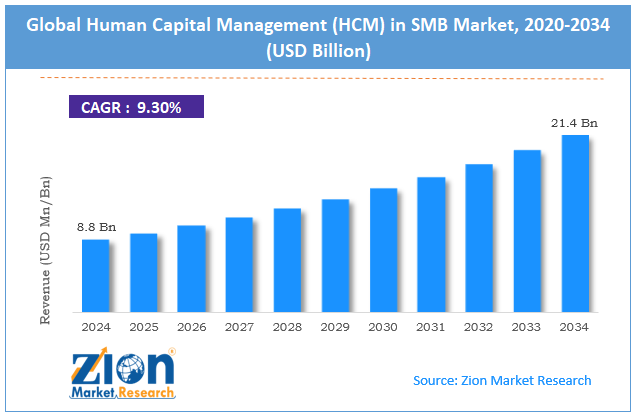
The global Human Capital Management (HCM) in SMB market size was worth around USD 8.8 billion in 2024 and is predicted to grow to around USD 21.4 billion by 2034, with a compound annual growth rate (CAGR) of roughly 9.3% between 2025 and 2034.
Key insights
- As per the analysis shared by our research analyst, the global Human Capital Management (HCM) in SMB market is estimated to grow annually at a CAGR of around 9.3% over the forecast period (2025-2034).
- In terms of revenue, the global Human Capital Management (HCM) in SMB market size was valued at around USD 8.8 billion in 2024 and is projected to reach USD 21.4 billion by 2034.
- Increasing focus on employee experience and retention is expected to dominate the Human Capital Management (HCM) in SMB market over the projected period.
- Based on the product type, the HR core administration segment dominated the market in 2024.
- Based on the deployment mode, the cloud-based deployment mode is projected to grow substantially over the projected period.
- Based on region, North America dominated the market in 2024.
Human Capital Management (HCM) in SMB Market: Overview
Human Capital Management (HCM) for the Small and Medium-Sized Business (SMB) Market addresses the deployment of integrated application platforms and associated HR services and offerings targeted at smaller enterprises that require HR programs, systems, and services for the management of the workforce throughout all of the lifecycle stages – from pre-hire to pre-retirement. SMB HCMs often include modules for recruiting and onboarding, payroll administration, time and attendance, performance management, training and development, and benefits, as well as regulatory reporting and compliance. Smaller business HCMs are often cloud-delivered, scalable, and affordable application platforms that allow small HR organizations to run their most basic HR programs and processes more efficiently, while improving workforce planning, engagement, and productivity.
Human Capital Management (HCM) in SMB Market: Dynamics
Growth Drivers
Why does the expansion of mining activities drive the expansion of the Human Capital Management (HCM) in SMB market?
One of the largest factors contributing to the growth of the Human Capital Management (HCM) in the SMB market is the rise in the use of cloud-based HR solutions. SMBs are increasingly shifting away from traditional manual HR management and on-premises systems towards cloud-based HCM platforms, as these offer greater flexibility, scalability, and cost savings. Cloud-based HR solutions offer SMBs access to features such as payroll processing, hiring, employee databases, performance management, and time tracking over the internet and through software, without requiring IT infrastructure or a large initial investment. Cloud platforms also benefit SMBs by providing real-time data, remote workforce management, and easier integration with other enterprise applications. With the growing emphasis on workforce digitalization and efficiency improvements, demand for cloud-based HCM software is expected to grow, thereby fueling market expansion.
Restraints
How do the high implementation and subscription costs hamper the Human Capital Management (HCM) in SMB industry?
The high cost of implementation and subscription services is a significant barrier to HCM adoption in the SMB market. Most HCM application vendors offer their applications on a subscription basis through the cloud. Nonetheless, adopting these cloud models remains costly for SMBs, which tend to have limited financial resources. The costs of application licensing, training, customization, and data migration, not to mention ongoing subscription costs, can have a financial impact on SMBs, inhibiting the adoption of HCM systems.
Moreover, some high-end systems require integration with other large systems, such as accounting or enterprise resource planning systems, which can further increase implementation costs. This has led many SMBs to delay or opt out of adopting full-fledged HCM solutions, instead relying on traditional HR software or manual processes.
Opportunities
Will rising collaboration offer a potential opportunity for the Human Capital Management (HCM) in SMB market?
More partnerships between HCM software providers and payroll companies, accounting software firms and cloud technology providers are also opening opportunities for the development of more integrated, easier to use applications for SMBs. in this way, HCM platforms are able to work with other types of applications such as accounting systems, project management tools, communications applications, enterprise resource planning (ERP) systems and so on, thus enabling SMBs to operate several business functions in one single digital environment. This not only improves workflows but also eliminates data silos and strengthens the workforce analytics capacity of the platform.
Besides, partnerships between HCM players and local HR consulting and benefits administration companies, as well as recruitment companies, allow SMBs to access a broad spectrum of HR services without establishing bloated internal HR departments, aiming to create a one-stop shop for these services.
For instance, in December 2023, Salesforce, a global leader in cloud computing solutions for human capital management (HCM), announced the expansion of its work with ADP to reinvent ADP's client experience for its more than 1 million clients. ADP and Salesforce will combine ADP‘s data and insights, decades of HCM expertise and unparalleled service with Salesforce‘s Customer 360 platform in order to enable ADP‘s service teams to work together more efficiently and empower them with the information they need to respond quickly and in real time to ADP‘s clients using generative AI to search through thousands of ADP FAQ and knowledge articles and generate instant responses to client questions.
Challenges
Limited IT expertise and technical resources pose a significant challenge to the Human Capital Management (HCM) in SMB market
A lack of IT skills and technical resources presents a significant barrier to the growth of HCM implementation in SMBs. In many SMBs, the IT department is nonexistent or non-independent. Instead, the business operates with a single or minimal support staff, which inhibits the ability to successfully implement and support any complex platform. Hardware or software deployments cannot occur without technical input to configure the appropriate system, then implement seamless integration. Data conversion and system use training require technical input.
Lastly, ongoing support for the platform is time-intensive, and nothing has slowed further implementation of HCM platforms faster than the lack of technical capacity in the SMB sector.
Human Capital Management (HCM) in SMB Market: Report Scope
| Report Attributes | Report Details |
|---|---|
| Report Name | Human Capital Management (HCM) in SMB Market |
| Market Size in 2024 | USD 8.8 Billion |
| Market Forecast in 2034 | USD 21.4 Bllion |
| Growth Rate | CAGR of 9.3% |
| Number of Pages | 225 |
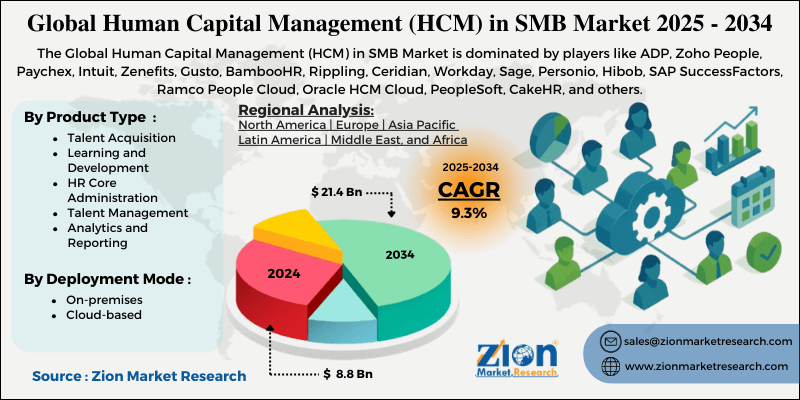
| Key Companies Covered | ADP, Zoho People, Paychex, Intuit, Zenefits, Gusto, BambooHR, Rippling, Ceridian, Workday, Sage, Personio, Hibob, SAP SuccessFactors, Ramco People Cloud, Oracle HCM Cloud, PeopleSoft, CakeHR, and others. |
| Segments Covered | By Product Type, By Deployment Mode, and By Region |
| Regions Covered | North America, Europe, Asia Pacific (APAC), Latin America, Middle East, and Africa (MEA) |
| Base Year | 2024 |
| Historical Year | 2019 to 2023 |
| Forecast Year | 2025 - 2034 |
| Customization Scope | Avail customized purchase options to meet your exact research needs. Request For Customization |
Human Capital Management (HCM) in SMB Market: Segmentation
Product Type insights
Why is HR core administration expected to hold a dominant position in the Human Capital Management (HCM) in SMB market?
The HR core administration segment dominated the market in 2024. This segment's growth is fueled by the rising demand for centralized, streamlined administration of employee records and other HR processes. HR core administration solutions are used by SMBs to automate their fundamental HR activities, including employee records, payroll administration, benefits management, time and attendance tracking, and compliance documentation, on a single platform. The revenue growth of this segment is driven mainly by increased adoption of cloud-based HR solutions by SMBs, which reduces their reliance on manual paperwork and improves the accuracy of employee data.
Deployment Mode insights
Why is the cloud-based segment growing at a significant rate in the Human Capital Management (HCM) in SMB market?
The cloud-based deployment mode is projected to grow substantially over the projected period. HCM systems enable small- to midsize businesses to automate all core HR activities, including payroll, recruiting, employee databases, performance management, and time and attendance reporting, through web-based platforms that can be accessed from anywhere. The revenue growth of this segment is therefore predominantly due to lower initial capital expenditure (“Capex”) than with on-premises solutions, as cloud platforms generally operate on subscription-based pricing that is more affordable for SMBs.
Regional insights
Why does North America lead the Human Capital Management (HCM) in SMB market?
North America dominated the market in 2024. Regional growth is attributed to robust advanced digital infrastructure and high adoption of cloud-based HR technologies. SMBs in the region are moving toward HCM solutions to manage their workforce more efficiently (recruitment and payroll, employee performance, and compliance). Revenue growth is primarily attributable to accelerated digital transformation among SMBs, increased demand for automation in HR processes, and the need to manage remote and hybrid workforces effectively. The presence of large HCM solution vendors and the need for labor and payroll compliance among SMBs are other factors fueling the adoption of HCM solutions. As organizations in the region focus on enhancing productivity and employee experience, SMBs' investment in HCM solutions is expected to continue on a positive trajectory.
Human Capital Management (HCM) in SMB Market: Competitive Analysis
The global Human Capital Management (HCM) in SMB market is dominated by players like:
- ADP
- Zoho People
- Paychex
- Intuit
- Zenefits
- Gusto
- BambooHR
- Rippling
- Ceridian
- Workday
- Sage
- Personio
- Hibob
- SAP SuccessFactors
- Ramco People Cloud
- Oracle HCM Cloud
- PeopleSoft
- CakeHR
The global Human Capital Management (HCM) in SMB market is segmented as follows:
By Product Type
- Talent Acquisition
- Learning and Development
- HR Core Administration
- Talent Management
- Analytics and Reporting
By Deployment Mode
- On-premises
- Cloud-based
By Region
- North America
- The U.S.
- Canada
- Mexico
- Europe
- France
- The UK
- Spain
- Germany
- Italy
- Rest of Europe
- Asia Pacific
- China
- Japan
- India
- Australia
- South Korea
- Rest of Asia Pacific
- The Middle East & Africa
- Saudi Arabia
- UAE
- Egypt
- Kuwait
- South Africa
- Rest of the Middle East & Africa
- Latin America
- Brazil
- Argentina
- Rest of Latin America
Table Of Content
Methodology
FrequentlyAsked Questions
Which region will contribute notably towards the Human Capital Management (HCM) in SMB market value?

HappyClients

