
Cloud Enterprise Resource Planning Market Size, Share Report 2034

Cloud Enterprise Resource Planning Market By Offering (Professional Services and Software), By Deployment Type (Hybrid Cloud, Public Cloud, and Private Cloud), By Application (Project Management, Financial Management, Human Resource Management, Sales & Order Management, Inventory Management, Supply Chain Management, Business Intelligence & Analytics, and Others), By Organization Size (Small & Medium Size Enterprises and Large Enterprises), By Vertical (Telecommunications, IT& ITeS, BFSI, Healthcare & Life Sciences, Government & Public Sector, Retail & E-commerce, Education, and Others), and By Region - Global and Regional Industry Overview, Market Intelligence, Comprehensive Analysis, Historical Data, and Forecasts 2025 - 2034
| Market Size in 2024 | Market Forecast in 2034 | CAGR (in %) | Base Year |
|---|---|---|---|
| USD 80.14 Billion | USD 281.38 Billion | 14.92% | 2024 |
Cloud Enterprise Resource Planning Industry Perspective:
What will be the global cloud enterprise resource planning market size during the forecast period?
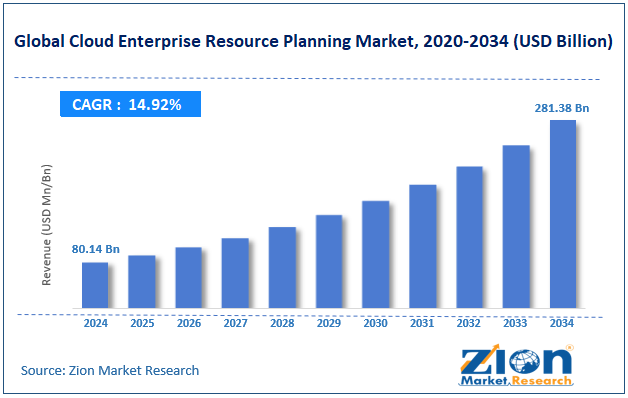
The global cloud enterprise resource planning market size was worth around USD 80.14 billion in 2024 and is predicted to grow to around USD 281.38 billion by 2034, with a compound annual growth rate (CAGR) of roughly 14.92% between 2025 and 2034.
Cloud Enterprise Resource Planning Market: Overview
Cloud enterprise resource planning (ERP) is a type of ERP delivered over the internet. Cloud-based ERP solutions can be accessed from anywhere and offer advantages such as low initial investment and scalability. Cloud enterprise resource planning allows companies to effectively conduct several aspects of business operations through the internet using a provider’s cloud computing platform. It is typically considered part of the growing Software-as-a-Service (SaaS) industry, in which customers do not own the software but can lease its use through a different form of payment. Cloud ERPs are considered a more promising counter to on-premise ERP solutions, as the latter are most expensive to deploy. Global demand for cloud enterprise resource planning is projected to continue to grow as cloud technology penetrates across industries. Additionally, advantages offered by cloud ERP will further help the industry thrive. A major drawback for industry players may emerge in the form of data security concerns and challenges in integrating systems with legacy infrastructure.
Key Insights:
- As per the analysis shared by our research analyst, the global cloud enterprise resource planning market is estimated to grow annually at a CAGR of around 14.92% over the forecast period (2025-2034)
- In terms of revenue, the global cloud enterprise resource planning market size was valued at around USD 80.14 billion in 2024 and is projected to reach USD 281.38 billion by 2034.
- The cloud enterprise resource planning market is projected to grow at a significant rate due to the rising demand for cloud-based solutions across the globe.
- Based on the offering, the software segment is growing at a high rate and will continue to dominate the global market, as per industry projections
- Based on the application, the financial management segment is anticipated to command the largest market share
- Based on region, North America is projected to dominate the global market during the forecast period
Cloud Enterprise Resource Planning Market: Dynamics
Growth Drivers
How will increasing demand for cloud-based solutions influence cloud enterprise resource planning market growth?
The global cloud enterprise resource planning market is expected to continue growing due to rising demand for cloud-based solutions across the globe. The technology allows companies to store and access information over the internet. They do not have to rely on personal computers or local servers for accessing store information. According to industry research, more than 94.01% of global companies, including large and small enterprises, use some form of cloud technology in their business operations. Enterprise resource planning solutions are becoming integral to operational procedures, as ERP systems allow improved streamlining and structuring of complicated aspects of any business. Cloud-based ERP offers several advantages compared to on-premise ERP. The former ERP systems are not only cost-effective but scalable to an unprecedented level. Companies can ensure optimal performance even when business operations escalate to new levels.
Rising remote work culture to generate new growth avenues for the industry players
Demand for cloud enterprise resource planning is projected to have accelerated due to the rapid growth of the remote work culture. This novel format of employment allows employees to work from their preferred location, such as their homes. Since the onset of COVID-19, a major portion of the world’s employed population has begun working remotely. The trend has continued since then.
According to official data, more than 50% of the global workforce continues to work in hybrid or fully remote formats. The solutions available in the global cloud enterprise resource planning market facilitate remote working. Employees can obtain and store information using a third party’s server. According to projections, remote work will remain a prominent work arrangement, as it offers advantages for employees and employers, thereby driving revenue for cloud ERP.
Restraints
What will be the impact of data security concerns on the cloud enterprise resource planning market?
The global cloud enterprise resource planning industry is projected to be restricted due to the growing concerns over data security. Cloud-based technologies are often subject to digital attacks, including malware, data breaches, and ransomware. Studies suggest that more than 79% of companies worldwide reported at least one incident of cloud breach in 2025. Data security and privacy concerns may affect business revenue, as customers may have doubts about the security of information stored in systems.
Opportunities
Sustained technological growth is reported in the market to offer growth opportunities to the industry players
The global cloud enterprise resource planning market is expected to experience growth opportunities due to the rising rate of sustained technological growth reported in the market. Industry players are investing heavily in offering optimal tools and services to the evolving set of consumers. Key innovations reported in cloud ERP solutions include integration of Artificial Intelligence (AI) and Machine Learning (ML), development of conversational interfaces, and generative AI business process agents, among other technologies.
In 2025, Oracle, one of the world’s leading technology companies, announced the launch of new AI agents within Oracle Cloud ERP. The technology is prebuilt and offers advanced safety features. The recent additions to Oracle Cloud ERP include new finance agents that automate multi‑channel invoice processing, thus reducing manual work.
In December 2025, Dynamics Motion, a leading provider of ERP solutions and digital transformation services, announced the launch of its new MotionERP. The recently released technology is integrated with Google Gemini as its reasoning engine. The company has thus positioned itself as the first Thai company to integrate generative AI directly into essential workflows. The integration will reduce costs for customers by 3.5 times.
Challenges
Why will integration with legacy systems challenge cloud enterprise resource planning market growth?
The global cloud enterprise resource planning industry is expected to be challenged by the complexities in integrating the technology with legacy systems. The existing digital infrastructure of a company may not be compatible with modern cloud ERP solutions, as most legacy systems are outdated. Moreover, accurate and timely data migration may pose additional challenges for industry players, thereby limiting the industry growth rate.
Cloud Enterprise Resource Planning Market: Report Scope
| Report Attributes | Report Details |
|---|---|
| Report Name | Cloud Enterprise Resource Planning Market |
| Market Size in 2024 | USD 80.14 Billion |
| Market Forecast in 2034 | USD 281.38 Bllion |
| Growth Rate | CAGR of 14.92% |
| Number of Pages | 219 |
| Key Companies Covered | NetSuite, SAP, Sage Intacct, Microsoft Dynamics 365, Workday, Plex Systems, Oracle, Deltek, Syspro, Epicor, Acumatica, Infor, Unit4, IFS, Odoo, and others. |
| Segments Covered | By Offering, By Deployment Type, By Application, By Organization Size, By Vertical, and By Region |
| Regions Covered | North America, Europe, Asia Pacific (APAC), Latin America, Middle East, and Africa (MEA) |
| Base Year | 2024 |
| Historical Year | 2019 to 2023 |
| Forecast Year | 2025 - 2034 |
| Customization Scope | Avail customized purchase options to meet your exact research needs. Request For Customization |
Cloud Enterprise Resource Planning Market: Segmentation
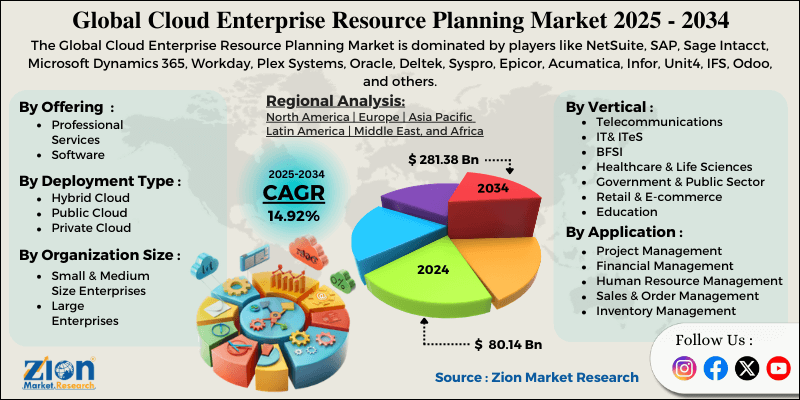
The global cloud enterprise resource planning market is segmented based on offering, deployment type, application, organization size, vertical, and region
Why is the software segment leading the cloud enterprise resource planning market?
Based on offering, the global market segments are professional services and software. In 2024, the highest growth was listed in the software segment, as it deals with the core offering of the market. Cloud ERP software is gaining traction as business operations continue to become more complicated and heavily regulated. Cloud EPR systems allow businesses to perform their operations with ease using automated technologies.
Based on deployment type, the global cloud enterprise resource planning industry is divided into hybrid cloud, public cloud, and private cloud.
Why did the financial management segment dominate the cloud enterprise resource planning industry in 2024?
Based on application, the global market is fragmented into project management, financial management, human resource management, sales & order management, inventory management, supply chain management, business intelligence & analytics, and others. In 2024, the financial management segment emerged as the highest revenue generator. Cloud ERP systems for finance and accounting include budgeting, tax management, and compliance. The finance management segment will continue to dominate the market during the projection period.
Based on organization size, the global market divisions are small & medium-sized enterprises and large enterprises.
Why will the IT& ITeS segment emerge as the leading in the cloud enterprise resource planning industry?
Based on verticals, the global market is divided into telecommunications, IT& ITeS, BFSI, healthcare & life sciences, government & public sector, retail & e-commerce, education, and others. The IT& ITeS segment emerged as the leading revenue generator in 2024 and will continue to lead the market during the forecast period. The rapid adoption of cloud ERP systems across technology companies will help with segmental proliferation during the forecast period.
Cloud Enterprise Resource Planning Market: Regional Analysis
Which factors will contribute to North America’s prominence in the cloud enterprise resource planning market?
The global cloud enterprise resource planning market is expected to be led by North America during the forecast period, with a CAGR of 15%. Regional dominance will be driven by the presence of a mature, highly advanced IT infrastructure across the US. Furthermore, regional players are among the first companies to integrate cloud technologies into their business operations to optimize performance.
In addition, the presence of the most dominant cloud technology service providers in the regional market, with presence across the globe, will further add to the region’s growing CAGR.
At what CAGR is Asia Pacific projected to grow in the cloud enterprise resource planning industry?
Asia-Pacific is anticipated to emerge as the fastest-growing region in the market with a CAGR of 18.01% during the projection period. The rapid technological growth reported across prominent Asian countries such as India, China, and South Korea will help fuel regional revenue. In addition, government support for the expansion of the IT sector will play a crucial role in shaping the regional market.
In November 2025, LG CNS, a South Korean technology company, announced a partnership with Indonesia’s Korindo Group. The technology company will support the migration of Korindo’s core enterprise resource planning (ERP) system from on-premises to the cloud as part of the company’s global expansion strategy.
Cloud Enterprise Resource Planning Market: Competitive Analysis
The global cloud enterprise resource planning market is led by players like;
- NetSuite
- SAP
- Sage Intacct
- Microsoft Dynamics 365
- Workday
- Plex Systems
- Oracle
- Deltek
- Syspro
- Epicor
- Acumatica
- Infor
- Unit4
- IFS
- Odoo
What are the key trends in the Cloud Enterprise Resource Planning Market?
Real-time data and analysis
A promising trend in the cloud enterprise resource planning market is the growing demand for access to real-time data and analysis. Cloud-based ERP systems are designed to provide real-time information, enabling businesses to make timely, accurate decisions that support growth.
Demand among SMEs
In recent years, small & medium-sized enterprises (SMEs) have shown greater adoption of cloud ERP solutions due to the introduction of affordable and effective platforms. It allows SMEs to make essential business decisions without worrying about the financial burdens.
The global cloud enterprise resource planning market is segmented as follows:
By Offering
- Professional Services
- Software
By Deployment Type
- Hybrid Cloud
- Public Cloud
- Private Cloud
By Application
- Project Management
- Financial Management
- Human Resource Management
- Sales & Order Management
- Inventory Management
- Supply Chain Management
- Business Intelligence & Analytics
- Others
By Organization Size
- Small & Medium Size Enterprises
- Large Enterprises
By Vertical
- Telecommunications
- IT& ITeS
- BFSI
- Healthcare & Life Sciences
- Government & Public Sector
- Retail & E-commerce
- Education
- Others
By Region
- North America
- The U.S.
- Canada
- Mexico
- Europe
- France
- The UK
- Spain
- Germany
- Italy
- Rest of Europe
- Asia Pacific
- China
- Japan
- India
- Australia
- South Korea
- Rest of Asia Pacific
- The Middle East & Africa
- Saudi Arabia
- UAE
- Egypt
- Kuwait
- South Africa
- Rest of the Middle East & Africa
- Latin America
- Brazil
- Argentina
- Rest of Latin America
Table Of Content
Methodology
FrequentlyAsked Questions

HappyClients

