
Graphite Crucible Market Size, Share, Trends, Growth and Forecast 2034

Graphite Crucible Market By Product Type (Clay Graphite Crucibles, Pure Graphite Crucibles, and Silicon Carbide Graphite Crucibles), By Application (Metal Melting and Casting, Chemical Processing, Laboratory Use, and Semiconductor Manufacturing), By End-User (Foundries and Metal Casting Units, Chemical and Petrochemical Industries, Research Laboratories, and Electronics Manufacturers), By Distribution Channel (Direct Sales, Industrial Distributors, Specialty Material Suppliers, and Online Industrial Platforms), and By Region - Global and Regional Industry Overview, Market Intelligence, Comprehensive Analysis, Historical Data, and Forecasts 2025 - 2034
| Market Size in 2024 | Market Forecast in 2034 | CAGR (in %) | Base Year |
|---|---|---|---|
| USD 1170.27 Million | USD 1600.37 Million | 3.56% | 2024 |
Graphite Crucible Industry Perspective:
What will be the size of the graphite crucible market during the forecast period?
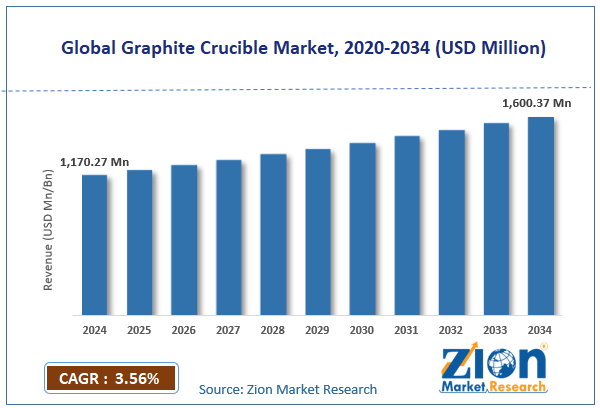
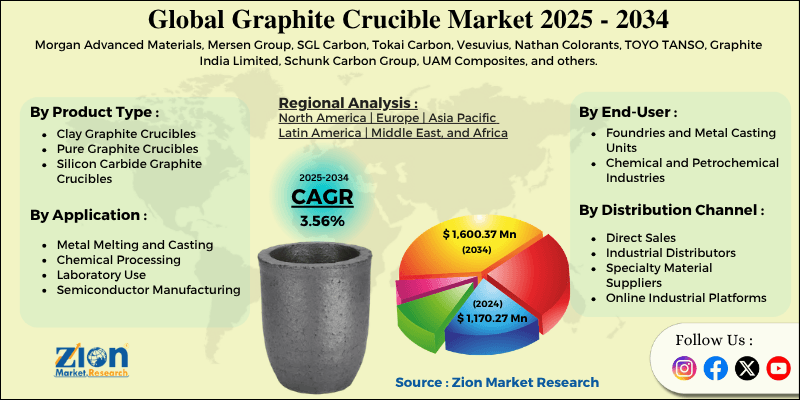
The global graphite crucible market size was worth approximately USD 1,170.27 million in 2024 and is projected to grow to around USD 1,600.37 million by 2034, with a compound annual growth rate of roughly 3.56% between 2025 and 2034.
Graphite Crucible Market: Overview
A graphite crucible is a heat-resistant container made from graphite material, used for melting, casting, and processing metals, alloys, and chemicals at very high temperatures. Graphite crucibles are widely used because they offer excellent thermal conductivity, high melting point, and strong resistance to thermal shock, allowing them to handle rapid temperature changes without damage. Different types of graphite crucibles include clay graphite crucibles, pure graphite crucibles, and silicon carbide-graphite crucibles, each designed for specific industrial applications based on temperature and material requirements. Clay graphite crucibles are commonly used in metal foundries, while pure graphite crucibles are preferred in laboratories and semiconductor manufacturing due to their high purity.
Silicon carbide graphite crucibles provide added strength and durability for heavy-duty industrial use. Industries such as metal casting, chemical processing, research laboratories, and semiconductor manufacturing rely heavily on graphite crucibles. The growing demand for electric vehicles, renewable energy, and advanced electronics continues to drive the global graphite crucible market.
The graphite crucible market is driven by rising demand for high-temperature processing, improved performance, and stricter quality standards, while expanding metal production and advanced manufacturing continue to strengthen its role in the global industrial supply chain.
Key Insights
- As per the analysis shared by our research analyst, the global graphite crucible market is estimated to grow annually at a compound annual growth rate of around 3.56% over the forecast period from 2025 to 2034.
- In terms of revenue, the global graphite crucible market size was valued at approximately USD 1,170.27 million in 2024 and is projected to reach USD 1,600.37 million by 2034.
- The graphite crucible market is expected to grow steadily, driven by rising demand from metal foundries, expanding semiconductor manufacturing, growing chemical processing industries, and increasing adoption of advanced materials in electric vehicle and renewable energy production.
- Based on product type, the silicon carbide-graphite crucible segment is expected to lead the overall market, while the pure graphite crucible segment is anticipated to grow at a notably faster pace as semiconductor and laboratory applications expand globally.
- Based on application, the metal melting and casting segment is expected to lead the graphite crucible market, while the semiconductor manufacturing segment is anticipated to grow rapidly, driven by increasing global production of electronic components and chips.
- Based on end-user, the foundries and metal casting unit segment is the largest current end-user group, while the electronics manufacturers segment is anticipated to grow most rapidly during the forecast period as demand for high-purity processing containers rises.
- Based on distribution channel, the industrial distributors segment is expected to lead the graphite crucible market, while online industrial platforms are anticipated to grow steadily as procurement shifts toward digital channels.
- Based on region, Asia Pacific is projected to dominate the global graphite crucible market during the estimated period, followed by North America and Europe.
Impact of the USA-Israel War on Iran on the Graphite Crucible Market
The ongoing tensions among the United States, Israel, and Iran are expected to influence the graphite crucible market, encouraging stronger supply chain resilience and strategic sourcing. Iran’s role in supplying industrial raw materials and the impact of regional instability on energy prices may create short-term cost fluctuations, while also opening opportunities for alternative suppliers to strengthen global supply. Potential disruptions in the Strait of Hormuz may affect logistics and delivery timelines, though manufacturers are likely to respond with diversified sourcing, better inventory planning, and long-term strategies to maintain stable growth.
Graphite Crucible Market: Technology Roadmap 2025–2034
What is the projected development roadmap of the graphite crucible market over the forecast period?
The graphite crucible market is advancing through improved material purity, composite materials, and more precise manufacturing, which enhance accuracy and product lifespan. The market is expected to grow at a compound annual growth rate of around 3.56% over the forecast period, driven by consistent demand from foundries and expanding high-technology industries.
The following roadmap outlines key development phases expected through 2034.
2025–2027: Material Innovation and Quality Enhancement Phase
- Manufacturers will invest in higher-purity graphite to reduce contamination during sensitive metal-melting processes.
- Improved sintering and pressing techniques will make crucibles stronger, denser, and less likely to crack under extreme heat.
- New protective coatings will help crucibles resist oxidation and chemical attack, significantly increasing service life and reducing replacement frequency.
2028–2031: Smart Manufacturing and Sustainability Integration Phase
- Smart monitoring tools will track crucible wear in real time, helping industries plan timely replacements and avoid unexpected failures.
- Recycling programs for used graphite crucibles will expand steadily as companies aim to cut costs and reduce reliance on raw materials.
- Manufacturing capacity will grow across emerging regions, creating stronger local supply chains and reducing dependence on imports from limited countries.
2032–2034: Advanced Applications and Circular Materials Phase
- Demand for specialized crucibles used in electric vehicle battery production will rise as lithium and cobalt processing increases globally.
- New recyclable composite crucibles will offer better heat performance while also supporting long-term environmental and cost efficiency goals.
- AI-based inspection systems will be adopted to identify defects early and ensure consistent product quality across large-scale production batches.
Graphite Crucible Market: Dynamics
Growth Drivers
What is driving graphite crucible market growth amid rising industrial and advanced technology production?
The graphite crucible market is growing steadily due to strong demand from key industries that depend on high-temperature metal processing. Metal foundries are among the biggest drivers, as rising construction, infrastructure development, and manufacturing activities increase demand for melting and casting metals such as aluminum, copper, gold, and other alloys. Graphite crucibles play a critical role in these processes by efficiently and safely handling extreme heat. Another important growth factor comes from the expanding semiconductor and electronics industry, where high-purity graphite crucibles are used to process materials in clean, controlled environments required for the production of chips, smartphones, and other electronic devices.
Rapid growth in electric vehicle production is also boosting demand, as battery materials like lithium and other specialty metals require high-temperature processing, which in turn requires reliable crucibles. Increasing industrialization across regions such as Asia, Europe, and North America further supports market expansion, as manufacturers invest in durable and efficient equipment to improve productivity and meet rising global demand.
Industrial diversification and the expansion of chemical processing are driving additional demand for graphite crucibles.
The graphite crucible industry is experiencing steady growth driven by rising demand in chemical processing and worldwide research. Chemical manufacturers use graphite crucibles for high-temperature reactions and handling reactive materials because graphite is stable, durable, and does not readily react with most chemicals. Industries producing specialty chemicals, fertilizers, and industrial compounds depend on reliable containers that withstand extreme heat without breaking down. The growth of chemical manufacturing in regions such as Asia and the Middle East is increasing demand for robust, long-lasting graphite crucibles.
Research institutions and universities also contribute to market demand, as laboratories use graphite crucibles for testing metals, studying new materials, and developing advanced compounds. Increased government funding and private investment in research and development are supporting consistent use of laboratory-grade crucibles. Expanding industrial research, along with continuous innovation in materials science, is expected to keep demand for graphite crucibles stable and growing across multiple industries globally.
Restraints
Raw material availability and competition from alternative crucible materials are key challenges in the graphite crucible market.
The graphite crucible market faces several restraints that may slow its growth over time. One major challenge is the limited supply and rising cost of high-quality graphite, as production is concentrated in a few countries, especially China, making the market sensitive to supply disruptions and price changes. Strict mining rules, export limits, and logistics issues can further increase costs and reduce the availability of raw materials. Another restraint comes from alternative materials such as ceramic and silicon carbide crucibles, which can sometimes offer lower costs or better performance for specific applications, attracting some users away from graphite.
Environmental concerns related to graphite mining and processing also affect the market, as stricter regulations increase production costs and limit output. These factors can lead to higher prices for end-users and create supply uncertainty, making it challenging for manufacturers to maintain stable production and long-term growth in the global graphite crucible market.
Opportunities
How are electric vehicles, semiconductor growth, and sustainability creating opportunities in the graphite crucible market?
The graphite crucible market has strong growth opportunities driven by expanding industries and new technologies worldwide. One of the biggest opportunities lies in the rapid growth of electric vehicles and clean energy systems, where battery materials such as lithium, cobalt, and nickel require high-temperature processing in graphite crucibles. Increasing production of electric vehicles across major regions is expected to increase demand for reliable, high-performance crucibles. The growing semiconductor industry also offers significant potential, as countries invest heavily in building new chip manufacturing facilities that require high-purity graphite crucibles for precise, clean processing.
The rising focus on local manufacturing in regions such as the United States, Europe, and India further supports long-term demand. Another key opportunity lies in developing longer-lasting, eco-friendly crucibles that reduce waste and energy consumption. Manufacturers offering durable, recyclable, and efficient products can gain a strong advantage as industries focus more on sustainability, cost savings, and improved operational efficiency across global manufacturing sectors.
Challenges
What challenges does the graphite crucible market face in managing quality consistency and navigating supply chain concentration risks?
The graphite crucible market faces several ongoing challenges that affect both manufacturers and end users. Maintaining consistent quality is difficult because graphite is a natural material, and variations can impact strength, heat resistance, and performance, leading to unexpected breakage during high-temperature operations. Supply risk is another major issue, as a large share of global graphite comes from China, making the market sensitive to trade policies, regulations, and geopolitical changes. Limited alternative supply sources make quick diversification challenging for many regions.
Price fluctuations also create uncertainty, as energy prices, industrial demand, and export conditions can influence graphite prices. Such volatility makes long-term planning and budgeting difficult for companies that depend on crucibles for daily operations. These challenges highlight the need for better sourcing strategies, improved quality control, and stable supply chains to support steady growth in the global graphite crucible market.
Graphite Crucible Market: Report Scope
| Report Attributes | Report Details |
|---|---|
| Report Name | Graphite Crucible Market |
| Market Size in 2024 | USD 1,170.27 Million |
| Market Forecast in 2034 | USD 1,600.37 Million |
| Growth Rate | CAGR of 3.56% |
| Number of Pages | 226 |
| Key Companies Covered | Morgan Advanced Materials, Mersen Group, SGL Carbon, Tokai Carbon, Vesuvius, Nathan Colorants, TOYO TANSO, Graphite India Limited, Schunk Carbon Group, UAM Composites, and others. |
| Segments Covered | By Product Type, By Application, By End-User, By Distribution Channel, and By Region |
| Regions Covered | North America, Europe, Asia Pacific (APAC), Latin America, Middle East, and Africa (MEA) |
| Base Year | 2024 |
| Historical Year | 2019 - 2023 |
| Forecast Year | 2025 - 2034 |
| Customization Scope | Avail customized purchase options to meet your exact research needs. Request For Customization |
Graphite Crucible Market: Segmentation
What makes the silicon carbide graphite crucible segment the expected leader in the broader graphite crucible market?
Based on product type, the global market is divided into clay-graphite crucibles, pure graphite crucibles, and silicon carbide-graphite crucibles. The silicon carbide graphite crucible segment accounts for approximately 50% of the global graphite crucible market and remains dominant due to its high strength, strong thermal shock resistance, and wide industrial use. The pure graphite crucible segment holds around 25% share. It is the fastest-growing, driven by rising demand from semiconductor manufacturers and research laboratories that require extremely low contamination levels during high-temperature processing.
How does the metal melting and casting application segment maintain its leading position in the graphite crucible market?
Based on application, the graphite crucible industry is categorized into metal melting and casting, chemical processing, laboratory use, and semiconductor manufacturing. The metal melting and casting segment accounts for approximately 58% of the global graphite crucible market share, reflecting its key role in processing metals and alloys across foundry applications. The semiconductor manufacturing segment holds around 14% share. It is growing rapidly, supported by massive global investment in new chip production facilities and the expansion of advanced electronics manufacturing.
What makes the foundries and metal casting unit segment lead the graphite crucible end-user market?
Based on end-user, the market is classified into foundries and metal casting units, chemical and petrochemical industries, research laboratories, and electronics manufacturers. The foundries and metal casting unit segment leads the market with approximately 55% share, reflecting its key role in daily metal processing across major industries. The electronics manufacturers segment holds around 18% of the market share. It is growing quickly as demand for high-purity processing containers expands alongside semiconductor and battery production capacity.
How do industrial distributors dominate the distribution landscape of the graphite crucible market?
Based on distribution channel, the graphite crucible market is segregated into direct sales, industrial distributors, specialty material suppliers, and online industrial platforms. The industrial distributors segment accounts for around 42% of the global market and is expected to remain dominant, as buyers rely on distributors for easy availability and support. The online industrial platforms segment holds around 10% share. It is growing steadily as procurement managers at larger manufacturing companies increasingly use digital purchasing channels for standard industrial supplies.
Graphite Crucible Market: Regional Analysis
How is Asia Pacific shaping global demand for graphite crucibles?
The graphite crucible market is led by Asia Pacific and is expected to grow steadily at a CAGR of around 6.5% during the forecast period. Growth in the region is supported by large-scale metal processing, strong manufacturing output, and rising demand for high-temperature industrial applications. Asia Pacific has some of the world’s largest metal foundries, where graphite crucibles are used daily to melt and shape metals such as gold, aluminum, copper, and steel. The region is also a global hub for electronics and semiconductor production, where high-purity graphite crucibles are essential for clean, precise processing. China plays a central role as both a major producer and consumer, supplying a large share of global graphite crucibles while also using them extensively in its own industries. India is emerging as a fast-growing market driven by rising demand in jewelry manufacturing, automotive parts production, and new semiconductor investments.
Southeast Asian countries such as Indonesia, Vietnam, Thailand, and Malaysia are also expanding their industrial bases, boosting demand for reliable, durable crucibles. Strong government support, rising industrialization, and continuous infrastructure development are further strengthening the Asia Pacific’s position as the leading region in the global graphite crucible market. Increasing foreign investments and rising exports of manufactured goods are further supporting regional demand. Growing focus on advanced materials and high-performance manufacturing is also expected to sustain long-term market growth.
How does North America maintain its strong position in the graphite crucible market?
The graphite crucible market sees North America as the second-largest region, expected to grow at a CAGR of around 5.8% during the forecast period. A well-established metal foundry industry and strong demand for high-temperature processing across multiple sectors support growth in North America. Foundries in the United States and Canada regularly use graphite crucibles for melting and casting metals used in automotive parts, aerospace components, and industrial machinery. The region is also witnessing major investments in semiconductor manufacturing, as the United States focuses on building domestic chip production capacity. These facilities require high-purity graphite crucibles for precise and contamination-free processing. The rising production of electric vehicles and battery materials is further increasing the need for reliable crucibles that can withstand extreme temperatures.
Canada contributes to regional demand through its active mining, refining, and metallurgical industries, where crucibles are essential for processing metals such as gold, nickel, and other specialty materials. Strong technological capabilities, stable supply chains, and continuous industrial upgrades make North America a key growth region. The increased focus on advanced manufacturing, the energy transition, and domestic production is expected to keep demand for graphite crucibles steady across the region.
Recent Market Developments
- In May 2025, Toyo Tanso Co., Ltd. signed a large-scale on-site power purchase agreement with TESS Engineering to supply renewable energy to its production facilities, aiming to reduce carbon emissions in graphite and carbon material manufacturing processes.
Graphite Crucible Market: Competitive Analysis
The leading players in the global graphite crucible market are:
- Morgan Advanced Materials
- Mersen Group
- SGL Carbon
- Tokai Carbon
- Vesuvius
- Nathan Colorants
- TOYO TANSO
- Graphite India Limited
- Schunk Carbon Group
- UAM Composites
The global graphite crucible market is segmented as follows:
By Product Type
- Clay Graphite Crucibles
- Pure Graphite Crucibles
- Silicon Carbide Graphite Crucibles
By Application
- Metal Melting and Casting
- Chemical Processing
- Laboratory Use
- Semiconductor Manufacturing
By End-User
- Foundries and Metal Casting Units
- Chemical and Petrochemical Industries
- Research Laboratories
- Electronics Manufacturers
By Distribution Channel
- Direct Sales
- Industrial Distributors
- Specialty Material Suppliers
- Online Industrial Platforms
By Region
- North America
- The U.S.
- Canada
- Mexico
- Europe
- France
- The UK
- Spain
- Germany
- Italy
- Rest of Europe
- Asia Pacific
- China
- Japan
- India
- Australia
- South Korea
- Rest of Asia Pacific
- The Middle East & Africa
- Saudi Arabia
- UAE
- Egypt
- Kuwait
- South Africa
- Rest of the Middle East & Africa
- Latin America
- Brazil
- Argentina
- Rest of Latin America
Table Of Content
Methodology
FrequentlyAsked Questions
A graphite crucible is a heat-resistant container made from graphite material, used for melting, casting, and processing metals, alloys, and chemicals at very high temperatures. Graphite crucibles are widely used because they offer excellent thermal conductivity, high melting point, and strong resistance to thermal shock, allowing them to handle rapid temperature changes without damage.
The global graphite crucible market is expected to grow, driven by rising metal foundry activity, expanding semiconductor manufacturing investment, growing electric vehicle production, increasing demand from chemical processing industries, and the ongoing development of higher-purity, longer-lasting crucible materials.
According to a study, the global graphite crucible market size was worth around USD 1,170.27 million in 2024 and is predicted to grow to around USD 1,600.37 million by 2034.
What will be the compound annual growth rate value of the graphite crucible market during 2025–2034?
The compound annual growth rate value of the graphite crucible market is expected to be around 3.56% during 2025–2034.
Asia Pacific is expected to lead the global graphite crucible market during the forecast period, driven by massive foundry and manufacturing activity in China, rapid industrial growth in India, and expanding electronics and battery production across Southeast Asia.
The major players in the global graphite crucible market include Morgan Advanced Materials, Mersen Group, SGL Carbon, Tokai Carbon, Vesuvius, TOYO TANSO, Graphite India Limited, Schunk Carbon Group, and Nathan Colorants.
The report examines growth drivers, market restraints, emerging opportunities, competitive landscape analysis, regional breakdowns, and a detailed forecast across all major product types, applications, end-users, and geographic regions through 2034.
The industrial distributors segment holds the largest share, as most industrial buyers prefer to source graphite crucibles through established distributor networks that offer reliable supply, technical expertise, and flexible purchasing terms suited to operational needs.
The graphite crucible market is affected by environmental regulations on graphite mining, dust, and emissions standards at manufacturing facilities, restrictions on the use of certain binders and coatings, and growing pressure on industrial buyers to demonstrate sustainable sourcing practices throughout their supply chains.
The graphite crucible market will be influenced by global steel and metals production volumes, energy price trends, semiconductor investment cycles, electric vehicle adoption rates, and trade policies affecting graphite exports from major producing countries, particularly China.

HappyClients

