
Edible Fungus Market Size, Growth, Global Trends, Forecast 2034

Edible Fungus Market By Fungus Type (Shiitake, Button Mushrooms, Oyster Mushrooms, Enoki Mushrooms, Truffles, and Other Edible Fungi), By Form (Fresh, Dry, Frozen, Canned/Preserved), By Distribution Channel (Supermarkets and Hypermarkets, Specialty Food Stores, Online Retailers, Farmers Markets and Direct Sales), and By Region - Global and Regional Industry Overview, Market Intelligence, Comprehensive Analysis, Historical Data, and Forecasts 2025 - 2034
| Market Size in 2024 | Market Forecast in 2034 | CAGR (in %) | Base Year |
|---|---|---|---|
| USD 68.10 Billion | USD 104.19 Billion | 5.46% | 2024 |
Edible Fungus Industry Perspective:
What will be the size of the global edible fungus market during the forecast period?
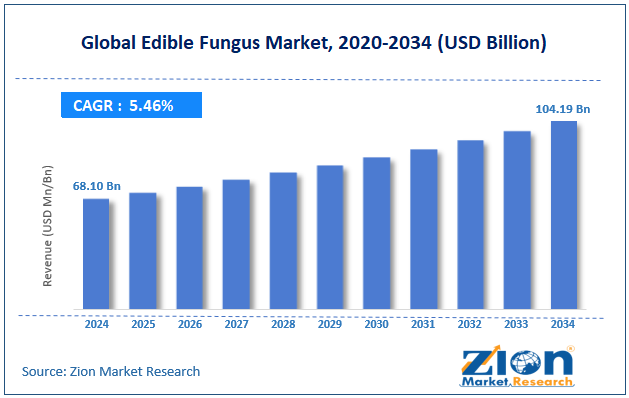
The global edible fungus market size was around USD 68.10 billion in 2024 and is projected to reach USD 104.19 billion by 2034, with a compound annual growth rate (CAGR) of roughly 5.46% between 2025 and 2034.
Key Insights:
- As per the analysis shared by our research analyst, the global edible fungus market is estimated to grow annually at a CAGR of around 5.46% over the forecast period (2025-2034)
- In terms of revenue, the global edible fungus market size was valued at around USD 68.10 billion in 2024 and is projected to reach USD 104.19 billion by 2034.
- The edible fungus market is projected to grow significantly owing to increasing vegan and plant-based diet trends, expansion of the food processing and convenience foods sector, and rising disposable incomes in emerging economies.
- Based on fungus type, the button mushrooms segment is expected to lead the market, while the shiitake segment is expected to grow considerably.
- Based on form, the frozen segment is the largest, while the dry segment is projected to record sizeable revenue over the forecast period.
- Based on the distribution channel, the supermarkets and hypermarkets segment is expected to lead the market compared to the ‘online retailers’ segment.
- By region, the Asia Pacific is projected to dominate the global market during the forecast period, followed by Europe.
Edible Fungus Market: Overview
Edible fungi are mushrooms and other related species that are nutritious and safe for human consumption. They are widely used worldwide for cooking and valued for their rich flavors, health benefits, and textures. Common fungi like shiitake, morels, and oyster mushrooms are good sources of vitamins (mainly B vitamins), protein, dietary fiber, and minerals, while being low in fat. The global edible fungus market is projected to witness substantial growth driven by health and nutrition awareness, growth of plant-based diets, and culinary diversification and gourmet demand. Edible fungi are widely consumed for their higher nutritional value, which includes minerals, vitamins, dietary fiber, and antioxidants. Growing health consciousness and preventive healthcare trends are fueling regular consumption. Consumers prefer mushrooms since these functional foods support immunity and overall wellness.
Moreover, the inclination toward vegan, vegetarian, and flexitarian diets has elevated demand for mushrooms as meat alternatives. Their umami texture and flavor make them ideal for plant-based recipes. This trend is majorly impacting food restaurants and manufacturers. Furthermore, worldwide exposure to different cuisines has elevated interest in specialty and exotic mushrooms. Foodservice providers and chefs are steadily using edible fungi in premium diets. This has increased mushrooms from staples to gourmet ingredients.
Although drivers exist, the global market is challenged by factors like the short shelf life of fresh mushrooms, supply variability, and climate sensitivity. Edible fungi are highly sensitive to storage conditions and perishable. Bad handling results in wastage and spoilage. This restricts long-distance transportation and increases distribution costs. Fungal growth is sensitive to humidity, temperature, and contamination. Environmental variations may hamper production cycles. This results in inconsistent supply and price fluctuations.
Even so, the global edible fungus industry is well-positioned due to the development of value-added products and innovation in controlled-environment farming. Processed mushroom products, such as ready meals, snacks, and powders, are gaining prominence. These products offer better convenience and longer shelf life. Value addition increases market reach and profitability. Advanced technologies like AI monitoring and vertical farming enhance efficiency. They allow consistent higher yields and quality. Innovation reduces dependency on external climate conditions.
Edible Fungus Market: Dynamics
Growth Drivers
How is the edible fungus market driven by plant‑based & sustainability trends?
The move toward plant-based eating, encompassing vegan, vegetarian, and flexitarian diets, has significantly driven the global edible fungus market, as consumers value mushrooms as sustainable protein alternatives. Mushrooms require less land and water and emit less greenhouse gas than livestock protein, supporting environmental concerns and carbon-reduction objectives. This trend has amplified product innovations such as plant-rich food launches and mushroom-based meat analogs, which have grown in recent years. Hence, the said industry is steadily integrated into mainstream plant-centric food menus and portfolios worldwide.
How are product innovation & functional offerings fueling the global edible fungus market?
Innovation in edible fungus products is accelerating, with new formats such as extracts, dried products, and mushroom-infused beverages entering mainstream markets. Functional products targeting immune health, wellness niches, and cognitive support have elevated market scope, especially among health-oriented consumers. Mushrooms are now used not only in the fresh produce aisles but also on plant-based snack and nutraceutical shelves. This diversification has offered additional revenue channels and attracted investment in research and development in the sector.
Restraints
Input cost volatility negatively impacts the market progress
Growing costs for major inputs like substrate materials, energy for climate control, packaging, and labor squeeze producer margins. Volatile energy costs and commodity prices may significantly increase production costs, especially in controlled-environment cultivation. Smaller farmers are disproportionately impacted and may find it challenging to compete with larger players. This cost volatility may hamper reinvestment in innovation and expansion.
Opportunities
How does sustainable & eco-friendly branding offer advantageous conditions for the development of the edible fungus market?
Mushrooms are inherently sustainable, needing notably less land, water, and energy than livestock or other plant proteins. Brands can capitalize on this by marketing regenerative, organic, or carbon-neutral mushroom products. Sustainable branding resonates strongly with environmentally conscious consumers, especially in North America, urban Asian markets, and Europe. Underscoring low environmental impact and ethical production may differentiate products in a crowded market. Sustainability-focused innovation also offers opportunities in the edible fungus industry for associations with eco-conscious foodservice providers and retailers.
Challenges
Consumer perception & culinary adoption restrict the market growth
In several markets, mushrooms are still considered niche or exotic, hampering their routine consumption. Flavor and textural preferences may vary across cultures, and unfamiliarity may demotivate trial purchases. Overcoming these perceptions requires targeted marketing, sampling, and recipe education, all of which are resource-intensive. Consumer hesitation slows adoption in the emerging markets and prevents mushrooms from achieving the same staple-food status as vegetables like carrots and tomatoes.

Edible Fungus Market: Report Scope
| Report Attributes | Report Details |
|---|---|
| Report Name | Edible Fungus Market |
| Market Size in 2024 | USD 68.10 Billion |
| Market Forecast in 2034 | USD 104.19 Billion |
| Growth Rate | CAGR of 5.46% |
| Number of Pages | 215 |
| Key Companies Covered | Xuerong Biotechnology, Ruyiqing, JUNESUN FUNGI, China Greenfresh Group, Shanghai Bright Esunyes, Starway Bio-technology, Shanghai Finc Bio Tech, HuBei SenYuan, Shandong Youhe, Zhuhai Sunny Evergreen Food, The Mushroom Company, Monaghan Mushrooms, Monterey Mushrooms, Costa Group, Bonduelle Group, and others. |
| Segments Covered | By Fungus Type, By Form, By Distribution Channel, and By Region |
| Regions Covered | North America, Europe, Asia Pacific (APAC), Latin America, Middle East, and Africa (MEA) |
| Base Year | 2024 |
| Historical Year | 2019 to 2023 |
| Forecast Year | 2025 - 2034 |
| Customization Scope | Avail customized purchase options to meet your exact research needs. Request For Customization |
Edible Fungus Market: Segmentation
The global edible fungus market is segmented based on fungus type, form, distribution channel, and region.
Based on the type of fungus, the global edible fungus industry is divided into shiitake, button mushrooms, oyster mushrooms, enoki mushrooms, truffles, and other edible fungi. The button mushroom segment accounts for 50% of the total market share. They are largely consumed edible fungi because of their affordability and simple cultivation. They are versatile in cooking and used in processed, fresh, and canned forms. Their worldwide prominence makes them the industry leader.
On the other hand, the shiitake segment ranks second, with 25% market share. They are largely valued for their medicinal properties and rich flavor. They are broadly consumed in Asia and largely in Western markets.
Based on form, the global edible fungus market is segmented into fresh, dry, frozen, and canned/preserved. The fresh mushrooms segment leads with 60% of the overall market share due to their texture, flavor, and high nutritional value. They are broadly used in restaurants, cooking, and ready-to-eat items. Despite a short shelf life, their versatility and convenience keep demand elevated.
Conversely, the dried mushrooms segment captures 25% of the market because of their preserved nutrients and long shelf-life. They are extensively used in sauces, soups, nutraceuticals, and packaged foods. This form makes export easy and appeals to both health-focused and culinary markets.
Based on distribution channel, the global market is segmented into supermarkets and hypermarkets, specialty food stores, online retailers, farmers' markets, and direct sales. The supermarkets and hypermarkets segment dominates the market with 55% share. This growth is attributed to their convenience and wide reach. They offer frozen, fresh, and packaged mushrooms to urban consumers. Large chains drive sales through promotions, visibility, and consistent supply.
However, the online retailers segment ranks second with 24% market share, backed by growing home delivery trends and e-commerce. They offer access to dried, fresh, and specialty mushrooms directly to consumers. Variety and convenience drive the segmental dominance.
Edible Fungus Market: Regional Analysis
What gives Asia Pacific a competitive edge in the global Edible Fungus Market?
Asia Pacific is likely to sustain its leadership in the edible fungus market, with a 8.9% CAGR, driven by high production and market share, deep culinary and cultural integration, and rapid growth and consumer demand. Asia Pacific holds a leading share of the market, with nearly 50%, fueled by commercial infrastructure and massive cultivation output. China alone produces millions of metric tons every year, accounting for a major share of worldwide exports and production. This large production base highlights the region’s dominance.
Moreover, mushrooms are deeply embedded in daily diets in nations like Japan, China, and South Korea, where more than 60% individuals regularly consumer edible fungi. Health practices and traditional cuisines use multiple varieties of mushrooms, sustaining strong domestic demand. This cultural norm augments consumption in more Western markets. Moreover, the regional market continues to grow substantially due to urbanization, rising middle-class incomes, and health-driven food preferences. The demand for both specialty and fresh mushrooms increases each year, particularly in large populations such as India and China. This sustained growth trend strengthens APAC’s dominance.
Europe continues to hold the second-highest share, with a 6% CAGR in the edible fungus industry, owing to strong consumer demand for specialty and fresh mushrooms, growing health trends and plant-based diet preferences, and supportive policies and sustainable practices. European consumers show a strong demand for fresh mushrooms, with nearly 60 percent consumed in their fresh form, along with a strong interest in gourmet and organic varieties. This signifies broader culinary use and greater health awareness across foodservice sectors and households. Diverse tastes help sustain strong industry growth. Increasing health consciousness and the rise of plant-based diets are driving mushroom consumption in Europe. Demand for organic, value-added, and functional fungi products is growing, particularly among urban populations. These trends support consistent adoption and elevated market value.
Additionally, European regulatory architecture and sustainability initiatives motivate high production standards and organic farming. This boosts consumer confidence in traceability and quality of edible fungi. These policies strengthen the region’s competitiveness in value-driven segments.
Edible Fungus Market: Competitive Analysis
The leading players in the global edible fungus market are:
- Xuerong Biotechnology
- Ruyiqing
- JUNESUN FUNGI
- China Greenfresh Group
- Shanghai Bright Esunyes
- Starway Bio-technology
- Shanghai Finc Bio Tech
- HuBei SenYuan
- Shandong Youhe
- Zhuhai Sunny Evergreen Food
- The Mushroom Company
- Monaghan Mushrooms
- Monterey Mushrooms
- Costa Group
- Bonduelle Group
Edible Fungus Market: Key Market Trends
Rising demand for health‑focused & functional products:
Consumers increasingly seek foods with health benefits, fueling interest in mushrooms for their antioxidant, functional nutrition, and immune-supporting properties. Edible fungi are now promoted not only as food, but also as wellness ingredients. This trend augments sales of value-added products such as powders and extracts, as well as fresh mushrooms.
Emphasis on sustainable & eco‑friendly production:
Producers are adopting controlled environment agriculture, recyclable substrates, and vertical farming to reduce environmental impact. Mushrooms already have lower land and water requirements than livestock, supporting sustainability-oriented consumer values. This trend enhances industry appeal and investment in green practices.
The global edible fungus market is segmented as follows:
By Fungus Type
- Supermarkets and Hypermarkets
- Specialty Food Stores
- Online Retailers
- Farmers Markets and Direct Sales
By Form
- Fresh
- Dry
- Frozen
- Canned/Preserved
By Distribution Channel
- Supermarkets and Hypermarkets
- Specialty Food Stores
- Online Retailers
- Farmers Markets and Direct Sales
By Region
- North America
- The U.S.
- Canada
- Europe
- France
- The UK
- Spain
- Germany
- Italy
- Rest of Europe
- Asia Pacific
- China
- Japan
- India
- South Korea
- Southeast Asia
- Rest of Asia Pacific
- Latin America
- Brazil
- Mexico
- Rest of Latin America
- Middle East & Africa
- GCC
- South Africa
- Rest of Middle East & Africa
Table Of Content
Methodology
FrequentlyAsked Questions

HappyClients

