
Biologics and Biosimilars Market Size, Share, Value and Forecast 2034

Biologics and Biosimilars Market By Drug Class (Vaccines, Monoclonal Antibodies, Recombinant Insulin, Fusion Protein, Growth Factors, Interferons, Erythropoietin, Immune Modulators, Oligonucleotides, Colony Stimulation Factors, and Others), By Source (Animal Cells, Plant Cells, Bacterial Cells, Yeast Cells, and Others), By Application (Autoimmune Diseases, Oncology, Rare Diseases, Infectious Diseases, Hematological Disorders, Cardiovascular Diseases, and Others), By Manufacturing Type (Contract Manufacturing, In-House Manufacturing, and Hybrid Manufacturing), By Distribution Channel (Retail Pharmacies, Hospital Pharmacies, Online Pharmacies, and Specialty Pharmacies), and By Region - Global and Regional Industry Overview, Market Intelligence, Comprehensive Analysis, Historical Data, and Forecasts 2026 - 2034
| Market Size in 2025 | Market Forecast in 2034 | CAGR (in %) | Base Year |
|---|---|---|---|
| USD 527.36 Billion | USD 1320.19 Billion | 10.77% | 2025 |
Biologics and Biosimilars Industry Perspective:
What is the anticipated size of the biologics and biosimilars market during the projection period?
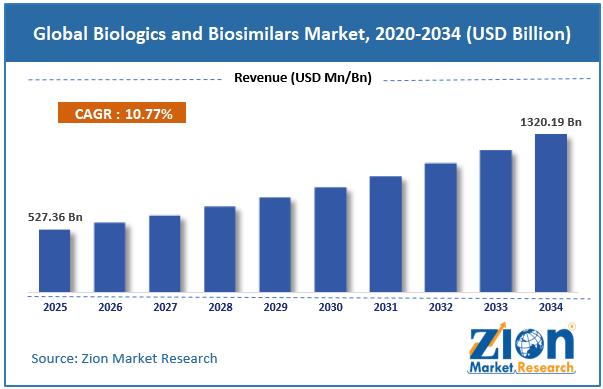
The global biologics and biosimilars market size was worth around USD 527.36 billion in 2025 and is predicted to grow to around USD 1320.19 billion by 2034, with a compound annual growth rate (CAGR) of roughly 10.77% between 2026 and 2034.
Key Insights:
- As per the analysis shared by our research analyst, the global biologics and biosimilars market is estimated to grow annually at a CAGR of around 10.77% over the forecast period (2026-2034)
- In terms of revenue, the global biologics and biosimilars market size was valued at around USD 527.36 billion in 2025 and is projected to reach USD 1320.19 billion, by 2034.
- The biologics and biosimilars market is projected to grow at a significant rate due to the rising prevalence of cancer, autoimmune disorders, increasing healthcare expenditure, and advancements in biotechnology.
- Based on the drug class, the monoclonal antibodies segment is growing at a high rate and will continue to dominate the global market as per industry projections.
- Based on the source, the bacterial cells segment is anticipated to command the largest market share.
- Based on the application, the oncology segment is expected to lead the market growth trends.
- Based on the manufacturing type, the in-house manufacturing segment is projected to influence revenue in the market.
- Based on the distribution channel, the hospital pharmacies will emerge as the fastest-growing segment.
- Based on region, North America is projected to dominate the global market during the forecast period.
Biologics and Biosimilars Market: Overview
Biologics are advanced medicines produced from living organisms or cells. Common biologic medicines used across the healthcare sector are transplant tissue, gene therapies, stem cell therapies, and recombinant proteins. They are used for the treatment of rare and life-threatening conditions such as cancer and rare diseases. Biologics are expensive since they use specialized material classes as raw materials. In addition, they are structurally complex and undergo rigorous regulatory assessment before commercial launch. Biosimilars, on the other hand, were created to offer affordable biological treatments to patients worldwide. Biosimilars are highly similar to biologics in terms of structure and performance. However, they are more affordable and hence ensure equal healthcare access to the general population. The global biologics and biosimilars market is projected to grow, driven by the rising prevalence of cancer and autoimmune disorders, increasing healthcare expenditure, and advancements in biotechnology. The market may face growth limitations due to high production cost, complex manufacturing, and patent issues.
Impact of the USA-Israel and Iran war on the Biologics and Biosimilars Market:
The USA-Israel and Iran war has affected supply chain, logistics costs, and raw material transportation concerning the biologics and biosimilars market. Global healthcare expenditure may be affected by escalating geopolitical tensions worldwide. In the long run, the war is expected to drive higher demand as companies build stronger inventories. Additionally, supply chain diversification will remain a prominent strategy among leading players.
Biologics and Biosimilars Market: Dynamics
Growth Drivers
Why will the rising prevalence of cancer influence growth in the biologics and biosimilars market?
The global biologics and biosimilars market is expected to be influenced by the rising prevalence of cancer. Researchers are aggressively investigating advanced medicines derived from living cells for their role in cancer treatment. According to Mayo Clinic, biological cancer therapies strengthen the body’s immune system to attack cancer cells with extreme precision, which is difficult to achieve through traditional treatments. In August 2026, the US Food & Drug Administration (FDA) approved a novel genetically modified oncolytic viral therapy, Tudriqev (vusolimogene oderparepvec-wtpg), for treating advanced melanoma. Tudriqev can be prescribed along with nivolumab for patients suffering from unresectable advanced cutaneous melanoma. In addition, growing efforts toward improving access to affordable cancer treatment will create demand for biosimilars in the coming years.
Surge in patients with autoimmune diseases to drive market revenue in the long run
Biologics and biosimilars are used extensively to treat autoimmune conditions such as psoriasis, rheumatoid arthritis, Crohn’s disease, and psoriatic arthritis. Ongoing advances in autoimmune treatments will favor market leaders. The US FDA has recently approved new biologics targeting specific inflammatory pathways such as Rinvoq (upadacitinib) and Skyrizi (risankizumab) for treating Crohn’s disease. The global biologics and biosimilars market will benefit from the expansion of diagnostic centers, especially targeting prominent autoimmune conditions.
Restraints
Why is cost the leading growth barrier in the biologics and biosimilars industry?
The global biologics and biosimilars industry is projected to be restricted due to the high cost of manufacturing and associated treatment. Biological medicines and therapies are produced in specialized facilities under expert guidance, using advanced technologies. Biologic-based treatments can be expensive, limiting their overall adoption rate in the global healthcare setup. Cost barriers will remain a prominent industry limitation as global economic uncertainty intensifies.
Opportunities
How will ongoing advancements support expansion of the biologics and biosimilars market?
The global biologics and biosimilars market is expected to grow as next-generation biological medicines and therapies emerge. Recent advancements in biotechnology, such as monoclonal antibodies, gene editing, and protein engineering, are expected to create novel expansion possibilities. In June 2026, Bionyra Pharma, a leading clinical-stage biopharmaceutical company working on next-generation biologics for autoimmune diseases, announced its $165 million oversubscribed Series A financing. The company is expected to launch a broad pipeline of clinical and near-clinical, next-generation anti-inflammatory therapies. They are developed using multi-pronged biology with optimized pharmacokinetics, thus maximizing efficacy and patient benefit. Biosimilar manufacturers are expected to benefit as patents for leading biologics expire in the coming years. According to recent reports, pharmaceutical companies are developing more effective, affordable, and safer Glucagon-Like Peptide-1 (GLP-1) drugs as patents begin to expire.
Challenges
Intellectual property-related barriers and lack of infrastructure to challenge industry growth
The global biologics and biosimilars industry will be challenged by concerns over Intellectual Property (IP) disputes, which can be complex and time-consuming. These complexities may delay biosimilar launches. In addition, a lack of infrastructure to support industry research & development (R&D) and the absence of skilled professionals may add to existing growth barriers.
Biologics and Biosimilars Market: Report Scope
| Report Attributes | Report Details |
|---|---|
| Report Name | Biologics and Biosimilars Market |
| Market Size in 2025 | USD 527.36 Billion |
| Market Forecast in 2034 | USD 1320.19 Billion |
| Growth Rate | CAGR of 10.77% |
| Number of Pages | 228 |
| Key Companies Covered | Roche, Fresenius Kabi, Biocon Biologics, Johnson & Johnson, Amgen, Merck & Co., Samsung Bioepis, Pfizer, Teva Pharmaceuticals, AbbVie, Celltrion, Eli Lilly, Sanofi, Sandoz, Biogen, and others. |
| Segments Covered | By Drug Class, By Source, By Application, By Manufacturing Type, By Distribution Channel, and By Region |
| Regions Covered | North America, Europe, Asia Pacific (APAC), Latin America, Middle East, and Africa (MEA) |
| Base Year | 2025 |
| Historical Year | 2020 - 2024 |
| Forecast Year | 2026 - 2034 |
| Customization Scope | Avail customized purchase options to meet your exact research needs. Request For Customization |
Biologics and Biosimilars Market: Segmentation
The global biologics and biosimilars market is segmented based on drug class, source, application, manufacturing type, distribution channel, and region.
Why will the monoclonal antibodies segment lead the biologics and biosimilars industry revenue during the forecast period?
Based on drug class, the global market segments are vaccines, monoclonal antibodies, recombinant insulin, fusion protein, growth factors, interferons, erythropoietin, immune modulators, oligonucleotides, colony stimulation factors, and others. In 2025, the monoclonal antibodies segment showed the highest growth. It accounted for 32.5% of global revenue in 2025 and will continue leading the market with significant CAGR during the forecast period. Monoclonal antibodies have wider applications and an established manufacturing sector, due to continued innovation.
Which will be the fastest-growing source during the forecast period in the biologics and biosimilars market?
Based on source, the global market is fragmented into animal cells, plant cells, bacterial cells, yeast cells, and others. In 2025, bacterial cells accounted for 45.67% of global revenue, and similar trends are expected to continue. Higher use in the production of growth factors, insulin, and recombinant proteins will drive segmental expansion in the coming years.
Which factors drive demand in the oncology segment in the biologics and biosimilars industry?
By application, the global biologics and biosimilars industry is fragmented into autoimmune diseases, oncology, rare diseases, infectious diseases, hematological disorders, cardiovascular diseases, and others. Oncology emerged as the leading revenue generator in 2025, accounting for 24.9% of the total market share. Rising cancer cases, increasing investments in cancer research, and demand for affordable care will drive segmental revenue to new heights.
What will be the influence of the in-house manufacturing segment on the biologics and biosimilars market?
Based on manufacturing type, the global market is fragmented into contract manufacturing, in-house manufacturing, and hybrid manufacturing. In 2025, the in-house manufacturing segment generated the most revenue. It will continue to dominate the market since in-house production allows greater control over the production process and reduces the risk of IP theft.
How will the hospital pharmacies segment lead the biologics and biosimilars market?
Based on distribution channel, the global divisions are retail pharmacies, hospital pharmacies, online pharmacies, and specialty pharmacies. In 2025, hospital pharmacies were the leading revenue generator and will continue to achieve similar revenue in the coming years. Hospital pharmacies are equipped to handle complex medicines such as biologics and biosimilars, resulting in higher segmental growth.
Biologics and Biosimilars Market: Regional Analysis
Why will North America lead the biologics and biosimilars market in the coming years?
The global biologics and biosimilars market is currently led by North America. In 2025, it accounted for 45% of the global revenue and will grow at a CAGR of 9.78% during the forecast period. Major pharmaceutical and biotechnology companies in the US will drive regional growth. In addition, higher demand for biosimilars, increasing FDA approvals, and favorable policies will allow greater regional revenue in the coming years.
Why will Asia-Pacific generate the fastest CAGR in the biologics and biosimilars market during the forecast period?
Asia-Pacific is expected to emerge as the fastest-growing region in the biologics and biosimilars market with a CAGR of 11.011% during the forecast period. In 2025, it accounted for a considerable share of the global revenue. China is anticipated to lead the regional market with a CAGR of 8.89%. The region is investing heavily in local biologics and biosimilar production. India and China are home to some of the leading drug manufacturing facilities, helping the regional market thrive. Growing disease prevalence and increased government support will drive growth across Asia-Pacific.
Biologics and Biosimilars Market: Competitive Analysis
The global biologics and biosimilars market is led by players like:
- Roche
- Fresenius Kabi
- Biocon Biologics
- Johnson & Johnson
- Amgen
- Merck & Co.
- Samsung Bioepis
- Pfizer
- Teva Pharmaceuticals
- AbbVie
- Celltrion
- Eli Lilly
- Sanofi
- Sandoz
What are the latest key trends in the biologics and biosimilars market?
Use of interchangeable biosimilars
Federal authorities are encouraging development of interchangeable biosimilars. This will allow hospitals and pharmacies to substitute biosimilars for reference biologics, helping ensure access to affordable medical care.
Simplification of development process
Ongoing work toward simplifying biologic and biosimilar development processes is a major market trend. It will not only reduce development timelines and costs, but also increase approval rates.
The global biologics and biosimilars market is segmented as follows:
By Drug Class
- Vaccines
- Monoclonal Antibodies
- Recombinant Insulin
- Fusion Protein
- Growth Factors
- Interferons
- Erythropoietin
- Immune Modulators
- Oligonucleotides
- Colony Stimulation Factors
- Others
By Source
- Animal Cells
- Plant Cells
- Bacterial Cells
- Yeast Cells
- Others
By Application
- Autoimmune Diseases
- Oncology
- Rare Diseases
- Infectious Diseases
- Hematological Disorders
- Cardiovascular Diseases
- Others
By Manufacturing Type
- Contract Manufacturing
- In-House Manufacturing
- Hybrid Manufacturing
By Distribution Channel
- Retail Pharmacies
- Hospital Pharmacies
- Online Pharmacies
- Specialty Pharmacies
By Region
- North America
- The U.S.
- Canada
- Mexico
- Europe
- France
- The UK
- Spain
- Germany
- Italy
- Rest of Europe
- Asia Pacific
- China
- Japan
- India
- Australia
- South Korea
- Rest of Asia Pacific
- The Middle East & Africa
- Saudi Arabia
- UAE
- Egypt
- Kuwait
- South Africa
- Rest of the Middle East & Africa
- Latin America
- Brazil
- Argentina
- Rest of Latin America
Table Of Content
Methodology
FrequentlyAsked Questions
Biologics are an advanced set of medicinal drugs produced from living organisms or cells.
The global biologics and biosimilars market is expected to be influenced by the rising prevalence of cancer.
According to study, the global biologics and biosimilars market size was worth around USD 527.36 billion in 2025 and is predicted to grow to around USD 1320.19 billion by 2034.
The CAGR value of the biologics and biosimilars market is expected to be around 10.77% during 2026-2034.
The global biologics and biosimilars industry will be challenged by concerns over Intellectual Property (IP) disputes, which can be complex and time-consuming.
Use of interchangeable biosimilars and simplification of development processes are the emerging trends and innovations impacting the biologics and biosimilars market.
The global biologics and biosimilars market has performed well so far and will offer similar trends in the coming years.
North America will contribute notably towards the biologics and biosimilars market value.
The global biologics and biosimilars market is led by players like Roche, Fresenius Kabi, Biocon Biologics, Johnson & Johnson, Amgen, Merck & Co., Samsung Bioepis, Pfizer, Teva Pharmaceuticals, AbbVie, Celltrion, Eli Lilly, Sanofi, Sandoz, and Biogen.
The report explores crucial aspects of the biologics and biosimilars market, including a detailed discussion of existing growth factors and restraints, while also browsing future growth opportunities and challenges that impact the market.

HappyClients

