
Global Artificial Womb Facility Market Size, Share, Trends, Growth 2034

Artificial Womb Facility Market By Technology (Artificial Placenta Systems, Extrauterine Support Devices, Bioreactors, Amniotic-Fluid Systems, and Closed-Loop Monitoring/Control), By Component (Oxygenation System, Artificial Womb Chamber/Biobag, Temperature Control, Circulatory Support, Monitoring & Sensors, and Sterilization/Safety), By Application (Extreme Prematurity Support, Neonatal Care, Reproductive/Fertility Research, Fetal Organ Development Research, and Prenatal/Fetal Care), By End-User (NICUs/Neonatal Care Centers, Super-specialty Hospitals, IVF/Reproductive Centers, and Biomedical Laboratories), By Facility Type (NICU-Integrated Facilities, Dedicated Artificial-Womb Units, Hybrid Clinical-Research Facilities, and Others), and By Region - Global and Regional Industry Overview, Market Intelligence, Comprehensive Analysis, Historical Data, and Forecasts 2026 - 2034
| Market Size in 2025 | Market Forecast in 2034 | CAGR (in %) | Base Year |
|---|---|---|---|
| USD 348.98 Million | USD 992.36 Million | 12.31% | 2025 |
Artificial Womb Facility Industry Perspective:
What is the anticipated size of the artificial womb facility market during the projection period?
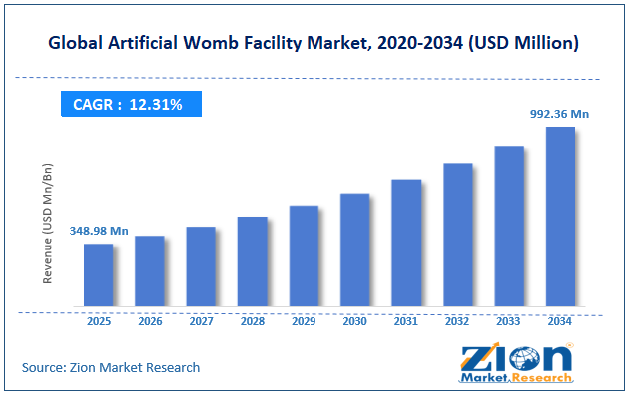
The global artificial womb facility market size was worth around USD 348.98 million in 2025 and is predicted to grow to around USD 992.36 million by 2034, with a compound annual growth rate (CAGR) of roughly 12.31% between 2026 and 2034.
Key Insights:
- As per the analysis shared by our research analyst, the global artificial womb facility market is estimated to grow annually at a CAGR of around 12.31% over the forecast period (2026-2034)
- In terms of revenue, the global artificial womb facility market size was valued at around USD 348.98 million in 2025 and is projected to reach USD 992.36 million, by 2034.
- The artificial womb facility market is projected to grow at a significant rate due to the growing rate of premature birth and neonatal mortality and surging investments in fertility treatments.
- Based on the technology, the artificial placenta systems segment is growing at a high rate and will continue to dominate the global market as per industry projections.
- Based on the component, the artificial womb chamber/biobag segment is anticipated to command the largest market share.
- Based on the application, the extreme prematurity support segment is expected to lead the market growth trends.
- Based on the end-user, super-specialty hospitals are projected to influence revenue in the market.
- Based on the facility type, the NICU-integrated facilities segment will emerge as the fastest-growing segment.
- Based on region, North America is projected to dominate the global market during the forecast period.
Artificial Womb Facility Market: Overview
An artificial womb facility is an emerging class of next-generation neonatal technology. It aims to reduce neonatal mortality by offering an artificial amnion and placenta environment, also known as an artificial womb. The market currently stands between institutional healthcare deployment and experimental biomedical development. Artificial womb facilities are designed to address respiratory struggles faced by the premature lungs of a fetus. The growing rate of premature birth and neonatal mortality will drive demand for artificial womb facilities during the forecast period. Additionally, surging investments in fertility treatments will benefit market players. However, high initial development costs, ethical concerns, and regulatory pressures will affect market revenue in the long run.
Impact of the USA-Israel and Iran war on the Artificial Womb Facility Market:
The USA-Israel and Iran war is expected to marginally impact the artificial womb facility market. The war's effects will be seen in healthcare funding, raw material supply chains, and disruptions to international research collaboration. Artificial womb technologies are still under development. In the long run, the market may witness steady growth as geopolitical stress subsides.
Artificial Womb Facility Market: Dynamics
Growth Drivers
Why will growing cases of preterm birth influence demand in the artificial womb facility market?
The global artificial womb facility market is expected to be driven by the growing cases of extreme preterm birth. According to the World Health Organization (WHO), more than 13.4 million cases of preterm births were reported in 2020. In addition, over 900,000 children died in 2019 due to complications arising from preterm birth. These data reflect only the documented cases. Preterm birth raises medical complications for mothers as well. It can lead to traumatic stress, emotional distress, and postpartum depression. Existing technologies for treating children born before full term do not offer complete solutions. Artificial womb facilities can fill this gap by offering a replica of reproductive conditions. Medical experts can shift from reactive neonatal care to a proactive approach toward high-risk pregnancies and childbirth.
Rising number of fertility treatments to deliver improved market revenue during the forecast period
Research suggests an increase in the number of failed implantations and miscarriages. As per the National Institutes of Health, over 23 million miscarriages occur annually worldwide. In addition, infertility is a common problem among many people around the globe. Hormonal disorders, aging, structural issues in reproductive organs, undergoing treatments, and overall lifestyle are some of the leading reasons for infertility. The global artificial womb facility market offers an effective alternative solution to traditional gestation. It greatly reduces the pressure and dependency on women for carrying pregnancies, especially in cases that may put the mother and the child at risk.
Restraints
Which ethical concerns will limit expansion of the artificial womb facility industry?
The global artificial womb facility industry is expected to be restricted due to ethical concerns. Societal acceptance toward non-traditional methods of pregnancy has not yet fully developed, especially in remote parts of the world. In addition, as the industry is still evolving, it raises several questions over the moral status of the unborn fetus. For instance, concerns regarding authority over the fetus during gestation and changes in perception over natural birth. Other ethical considerations may arise around access disparity and donor exploitation.
Opportunities
How will ongoing research shape the artificial womb facility market during the projection period?
The global artificial womb facility market is projected to grow due to ongoing research & development (R&D) worldwide. Market players are actively working to bridge existing gaps. The introduction of new artificial womb technologies is expected to encourage government authorities to draft and establish a comprehensive legal framework surrounding the market, elevating its acceptance in society. In August 2025, reports emerged suggesting that China is soon expected to introduce a humanoid robot that can carry a pregnancy by hosting the fetus. The technology is being developed by researchers at Kaiwa Technology. The robot will be available for EUR 11,000. In April 2024, scientists at Toronto’s Hospital for Sick Children were working on developing an effective artificial womb facility for extremely premature babies.
Challenges
How will regulatory challenges affect the artificial womb facility market in the coming years?
The global artificial womb facility industry is expected to face challenges due to a lack of standard policies and regulatory frameworks. The industry is still in its early stages of development. Government officials have not signaled comprehensive regulatory plans in action to commercialize artificial womb facilities due to several ethical, medical, and socio-cultural factors. The absence of a legal framework will continue to hinder industry expansion aspirations for the leaders.
Artificial Womb Facility Market: Report Scope
| Report Attributes | Report Details |
|---|---|
| Report Name | Artificial Womb Facility Market |
| Market Size in 2025 | USD 348.98 Million |
| Market Forecast in 2034 | USD 992.36 Million |
| Growth Rate | CAGR of 12.31% |
| Number of Pages | 229 |
| Key Companies Covered | California Preterm Birth Initiative, Zhejiang University, Emmaus Life Sciences, Shanghai First Maternity and Infant Hospital, SomaGenics Inc., The Children’s Hospital of Philadelphia, Virtus Health, Womb Institute, American University of Beirut, Vitara Biomedical, TissUse GmbH, Juno Perinatal Healthcare, Tokyo Women’s Medical University, Sera Prognostics Inc., Biotex Inc., and others. |
| Segments Covered | By Technology, By Component, By Application, By End-User, By Facility Type, and By Region |
| Regions Covered | North America, Europe, Asia Pacific (APAC), Latin America, Middle East, and Africa (MEA) |
| Base Year | 2025 |
| Historical Year | 2020 - 2024 |
| Forecast Year | 2026 - 2034 |
| Customization Scope | Avail customized purchase options to meet your exact research needs. Request For Customization |
Artificial Womb Facility Market: Segmentation
The global artificial womb facility market is segmented based on technology, component, application, end-user, facility type, and region.
Why will the artificial placenta systems segment lead the artificial womb facility industry revenue during the forecast period?
Based on technology, the global market segments are artificial placenta systems, extrauterine support devices, bioreactors, amniotic-fluid systems, and closed-loop monitoring/control. In 2025, the artificial placenta systems segment showed the highest growth. It accounted for 30.01% of the global revenue and will grow at a CAGR of 28.02% during the forecast period. Increasing investments in clinical research and technological advancements will drive segmental growth in the coming years.
Which will be the fastest-growing component during the forecast period in the artificial womb facility market?
Based on component, the global artificial womb facility industry is fragmented into oxygenation system, artificial womb chamber/biobag, temperature control, circulatory support, monitoring & sensors, and sterilization/safety. In 2025, the artificial womb chamber/biobag segment dominated the market and will continue to lead it with strong CAGR. Advancements in ancillary technologies such as real-time monitoring, oxygenation, and circulation will aid segmental growth in the future.
Which factors drive demand in the extreme prematurity support segment in the artificial womb facility industry?
Based on application, the global market is fragmented into extreme prematurity support, neonatal care, reproductive/fertility research, fetal organ development research, and prenatal/fetal care. In 2025, the extreme prematurity support segment contributed 48.07% of the total revenue and is expected to deliver high CAGR in the coming years. Increasing cases of extreme premature birth and demand for next-generation medical technologies will prove beneficial for the industry leaders.
What will be the influence of the super-specialty hospitals segment on the artificial womb facility market?
Based on end-user, the global market segments are NICUs/neonatal care centers, super-specialty hospitals, IVF/reproductive centers, and biomedical laboratories. Super-specialty hospitals were the leading revenue generators in 2025. They accounted for 60.06% of the total market share and are anticipated to deliver similar results during the forecast period. Growing construction of technologically equipped, well-funded super specialty hospitals with superior NICU infrastructure will aid accelerated segmental growth.
How will the NICU-integrated facilities segment lead the artificial womb facility market?
Based on facility type, the global market is divided into NICU-integrated facilities, dedicated artificial-womb units, hybrid clinical-research facilities, and others. According to market projections, NICU-integrated facilities accounted for over 33.1% of the global revenue in 2025. NICU-integrated facilities offer an existing, practical, and cost-effective infrastructure for artificial womb facilities, thus influencing segmental growth.
Artificial Womb Facility Market: Regional Analysis
Why will North America lead the artificial womb facility market in the coming years?
The global artificial womb facility market is currently led by North America. In 2025, it accounted for 34% of the global revenue and will grow at a CAGR of 25.1% during the forecast period. The USA and Canada are projected to emerge as regional leaders. The US was the first country where researchers in Philadelphia launched the world’s first artificial womb. As of 2023, the US regulatory authorities were studying the subject to green-light clinical trials. The presence of major technology companies and medical innovations will promote regional growth.
Why will Asia-Pacific generate the fastest CAGR in the artificial womb facility market during the forecast period?
Asia-Pacific is expected to emerge as the fastest-growing region in the artificial womb facility market with a CAGR of 27.15% during the forecast period. In 2025, it accounted for 22% of the global revenue. China will emerge as the leading revenue generator, as per recent regional trends. It is investing heavily in next-generation technologies, including artificial womb solutions. Favorable regulatory policies and access to supportive infrastructure may aid regional expansion in the coming years.
Artificial Womb Facility Market: Competitive Analysis
The global artificial womb facility market is led by players like:
- California Preterm Birth Initiative
- Zhejiang University
- Emmaus Life Sciences
- Shanghai First Maternity and Infant Hospital
- SomaGenics Inc.
- The Children’s Hospital of Philadelphia
- Virtus Health
- Womb Institute
- American University of Beirut
- Vitara Biomedical
- TissUse GmbH
- Juno Perinatal Healthcare
- Tokyo Women’s Medical University
- Sera Prognostics Inc.
- Biotex Inc.
What are the latest key trends in the artificial womb facility market?
Integration of Artificial Intelligence (AI)
Market players are increasingly integrating AI and automated monitoring systems to improve the technology's overall performance. AI-integrated artificial womb facilities are still in the development stages but are expected to emerge as promising trends in the coming years.
Expansion beyond neonatal care
Artificial wombs are being explored for their applications beyond neonatal care. This includes exploring their use in implantation research and organ mutation, creating growth opportunities for the market players.
The global artificial womb facility market is segmented as follows:
By Technology
- Artificial Placenta Systems
- Extrauterine Support Devices
- Bioreactors
- Amniotic-Fluid Systems
- Closed-Loop Monitoring/Control
By Component
- Oxygenation System
- Artificial Womb Chamber/Biobag
- Temperature Control
- Circulatory Support
- Monitoring & Sensors
- Sterilization/Safety
By Application
- Extreme Prematurity Support
- Neonatal Care
- Reproductive/Fertility Research
- Fetal Organ Development Research
- Prenatal/Fetal Care
By End-User
- NICUs/Neonatal Care Centers
- Super-specialty Hospitals
- IVF/Reproductive Centers
- Biomedical Laboratories
By Facility Type
- NICU-Integrated Facilities
- Dedicated Artificial-Womb Units
- Hybrid Clinical-Research Facilities
- Others
By Region
- North America
- The U.S.
- Canada
- Mexico
- Europe
- France
- The UK
- Spain
- Germany
- Italy
- Rest of Europe
- Asia Pacific
- China
- Japan
- India
- Australia
- South Korea
- Rest of Asia Pacific
- The Middle East & Africa
- Saudi Arabia
- UAE
- Egypt
- Kuwait
- South Africa
- Rest of the Middle East & Africa
- Latin America
- Brazil
- Argentina
- Rest of Latin America
Table Of Content
Methodology
FrequentlyAsked Questions
An artificial womb facility is an emerging class of next-generation neonatal technology. It aims to reduce neonatal mortality by offering an artificial amnion and placenta environment, also known as an artificial womb.
The global artificial womb facility market is expected to be driven by the growing cases of extreme preterm birth.
According to study, the global artificial womb facility market size was worth around USD 348.98 million in 2025 and is predicted to grow to around USD 992.36 million by 2034.
The CAGR value of the artificial womb facility market is expected to be around 12.31% during 2026-2034.
The global artificial womb facility industry is anticipated to be challenged by lack of standard policies and regulatory frameworks.
Integration of Artificial Intelligence (AI) and expansion beyond neonatal care are the emerging trends and innovations impacting the artificial womb facility market.
The global artificial womb facility market has performed well so far and will offer similar trends in the coming years.
North America will contribute notably towards the artificial womb facility market value.
The global artificial womb facility market is led by players like California Preterm Birth Initiative, Zhejiang University, Emmaus Life Sciences, Shanghai First Maternity and Infant Hospital, SomaGenics Inc., The Children’s Hospital of Philadelphia, Virtus Health, Womb Institute, American University of Beirut, Vitara Biomedical, TissUse GmbH, Juno Perinatal Healthcare, Tokyo Women’s Medical University, Sera Prognostics Inc., and Biotex Inc.
The report explores crucial aspects of the artificial womb facility market, including a detailed discussion of existing growth factors and restraints, while also browsing future growth opportunities and challenges that impact the market.

HappyClients

