
Women’s Health Rehabilitation Products Market Size, Share, Value and Forecast 2034

Womens Health Rehabilitation Products Market By Product Type (Pelvic Floor Rehabilitation Devices, Postpartum Recovery Products, Menopause Support Products, Physical Therapy Equipment), By Application (Postnatal Care, Pelvic Health Disorders, Menopause Management, Post-Surgical Recovery), By End-User (Hospitals and Clinics, Rehabilitation Centers, Home Care Settings, Wellness and Fitness Centers), By Distribution Channel (Hospital Pharmacies, Retail Pharmacies, Online Procurement Platforms, Government and Institutional Tender Procurement), and By Region - Global and Regional Industry Overview, Market Intelligence, Comprehensive Analysis, Historical Data, and Forecasts 2026 - 2034
| Market Size in 2025 | Market Forecast in 2034 | CAGR (in %) | Base Year |
|---|---|---|---|
| USD 5.6 Billion | USD 10.2 Billion | 6.89% | 2025 |
Women's Health Rehabilitation Products Industry Perspective:
What will be the size of the women's health rehabilitation products market during the forecast period?
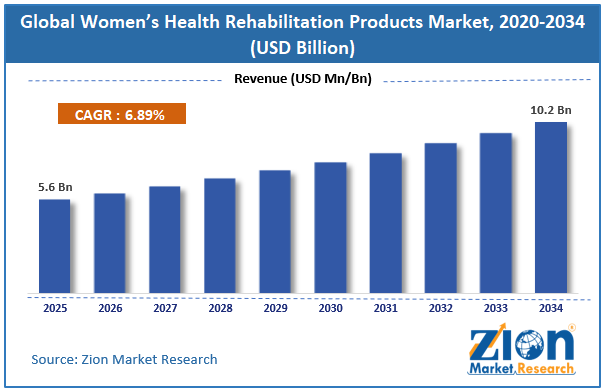
The global women's health rehabilitation products market size was approximately USD 5.6 billion in 2025 and is projected to reach USD 10.2 billion by 2034, growing at a compound annual growth rate of approximately 6.89% between 2026 and 2034.
Key Insights
- According to our research team's analysis, the global women’s health rehabilitation products market is expected to grow at a compound annual growth rate of approximately 6.89% over the forecast period from 2026 to 2034.
- In terms of revenue, the global women’s health rehabilitation products market was valued at approximately USD 5.6 billion in 2025 and is projected to reach USD 10.2 billion by 2034.
- The women’s health rehabilitation products market is expected to grow steadily due to rising awareness of pelvic health, increasing focus on postpartum recovery, and ongoing advancements in rehabilitation product design.
- Based on product type, pelvic floor rehabilitation devices hold the largest market share, as more women seek non-surgical solutions for bladder control and core strength, while menopause support products are growing the fastest due to rising awareness of healthy aging.
- Based on application, postnatal care leads the market as more new mothers seek proper recovery support after childbirth, while menopause management applications are growing steadily as more women seek comfort and support during this life stage.
- Based on end-user, hospitals and clinics hold the largest market share due to trusted medical supervision during recovery, while home care settings are growing rapidly as more women prefer convenient recovery options in their own homes.
- Based on distribution channel, retail pharmacies lead the market because women prefer purchasing rehabilitation products from trusted, easily accessible local pharmacies, while online procurement platforms are expanding steadily to serve women seeking privacy and convenience.
- Based on region, North America leads the global women’s health rehabilitation products market due to strong healthcare infrastructure and growing awareness about women’s wellness, followed by Europe, where rising focus on maternal health and supportive government policies are driving further growth.
Women's Health Rehabilitation Products Market: Overview
A woman’s health rehabilitation product is a specially designed device or support tool that helps women recover, regain strength, and improve their health after childbirth, surgery, or during life stages such as menopause. These products are created to meet the unique needs of the female body and support issues like pelvic floor weakness, bladder control, postpartum recovery, and physical rehabilitation. They help women heal more comfortably, reduce pain, and return to everyday activities with greater confidence. Women’s health rehabilitation products are used in hospitals, rehabilitation centers, and clinics, and increasingly at home under the guidance of healthcare professionals. They can improve recovery, lower the risk of long-term health problems, and enhance overall quality of life by addressing health concerns early. Many products are designed to be safe, comfortable, and easy to use, making them suitable for regular use during recovery. Growing awareness about women’s health, increasing focus on postpartum care, pelvic health, and healthy aging, along with better access to healthcare services, is boosting demand for these solutions. Continuous product innovation and the introduction of more effective rehabilitation devices are further driving growth in the women’s health rehabilitation products market worldwide.
The women's health rehabilitation products industry is expanding steadily as hospitals, wellness centers, and individual women seek reliable and effective rehabilitation solutions to support recovery and long-term health.
Impact of the USA-Israel War on Iran on the Women’s Health Rehabilitation Products Market
Rising tensions between the United States, Israel, and Iran may temporarily disrupt the supply of raw materials and medical-grade components used in manufacturing rehabilitation devices. They could also affect shipping routes for healthcare products. However, the demand for women’s health rehabilitation products remains strong because postpartum care, pelvic health support, and recovery needs continue regardless of global events. As more women seek proper healthcare support and awareness continues to spread, the women’s health rehabilitation products market is expected to grow despite short-term disruptions.
Women’s Health Rehabilitation Products Market: Technology Roadmap 2026–2034
What is the projected development roadmap of the women’s health rehabilitation products market over the forecast period?
The women’s health rehabilitation products market is advancing through more comfortable device designs, improved tracking features, lower-cost solutions, and the growing use of digital technology to guide recovery in real time. The market is expected to grow at a compound annual growth rate of approximately 6.89% during the forecast period, driven by rising awareness, growing healthcare access, and continuous innovation in product design.
The following roadmap outlines key development phases expected through 2034.
2026–2028: Comfort and Accessibility Phase
- More comfortable and easy-to-use rehabilitation devices are expected to see wider adoption as manufacturers seek practical solutions for everyday recovery needs.
- Improved product guidance features are expected to make it easier for women to use devices correctly without needing constant clinical supervision.
- Expanding pharmacy and retail networks are expected to make it easier for women in smaller towns to access rehabilitation products conveniently.
2029–2032: Smart Tracking and Personalization Phase
- Application-connected rehabilitation devices are expected to help women automatically track progress and adjust recovery routines for better results.
- Personalized recovery programs are expected to enable healthcare providers to guide treatment remotely without requiring frequent in-person visits.
- Hybrid rehabilitation solutions that combine multiple therapy types are expected to offer more flexible and reliable recovery support across different needs.
2033–2034: Advanced Integration and Sustainability Phase
- Advanced sensor integration technology is expected further to improve the accuracy and comfort of rehabilitation devices.
- Next-generation products with longer usability and gentler materials are expected to improve the overall value of women’s healthcare.
- Stronger recycling and sustainable manufacturing practices are expected to reduce the environmental impact of medical product production.
Women’s Health Rehabilitation Products Market: Dynamics
Growth Drivers
How is rising awareness of postpartum recovery driving the women’s health rehabilitation products market?
The women’s health rehabilitation products market is growing as hospitals, clinics, wellness centers, and women seek reliable products that make recovery easier and more comfortable. These products help women heal after childbirth, surgery, or other health conditions by reducing pain, improving recovery, and lowering the risk of long-term problems through early care. Growing awareness about pelvic floor health, postpartum recovery, postpartum depression, and menopause-related changes is increasing the demand for simple and effective rehabilitation solutions.
Manufacturers are introducing products that are more comfortable, easier to use, and made from soft, skin-friendly materials to meet women’s needs better. These rehabilitation products are widely used for maternity care, pelvic health, menopause support, and recovery after surgery, helping women regain strength, confidence, and overall wellbeing. Better healthcare services, increased awareness, and continuous product improvements are encouraging more women to choose these solutions. As a result, these factors are supporting the steady growth of the market across countries and healthcare settings worldwide.
The growing demand for non-surgical recovery and wellness solutions drives the women’s health rehabilitation products market.
The women’s health rehabilitation products market is growing as hospitals, clinics, and wellness centers seek reliable recovery products that support women at different stages of life. These products help women recover after childbirth or surgery, regain strength, reduce discomfort, and feel more confident during the healing process. Growing awareness about maternal health, women’s wellness, and pelvic health is increasing the demand for safe and effective rehabilitation products. Many of these products can be used at home or under the guidance of healthcare professionals, making recovery easier while helping to reduce overall healthcare costs. They are widely used in maternity centers, gynecology clinics, physical therapy centers, and wellness facilities. Manufacturers are introducing products made from softer, more comfortable materials with user-friendly designs that are easier to wear and use. Improved manufacturing methods are also making these rehabilitation products more affordable and accessible to more women. As awareness of women’s health continues to grow and social stigma around pelvic and postpartum care declines, demand for reliable rehabilitation solutions is increasing.
Restraints
How are cost concerns and lack of awareness affecting the women’s health rehabilitation products market?
The women’s health rehabilitation products market faces several challenges that may limit its growth. One of the biggest challenges is the high cost of specialized rehabilitation products, which makes them less affordable than regular fitness or wellness products. Many women also need guidance from healthcare professionals to use these products correctly, which can make the recovery process more time-consuming. In some regions, low awareness and social stigma around pelvic health, postpartum recovery, and women’s intimate health prevent many women from seeking the right treatment. Supply chain disruptions and rising raw material costs can also affect product availability and increase manufacturing expenses.
In addition, limited access to trained healthcare professionals and rehabilitation services makes it difficult for some women to receive proper support. Manufacturers must continue investing in research and product development to improve comfort, effectiveness, and affordability, which increases overall costs. Despite these challenges, growing awareness about women’s health, improving healthcare services, and ongoing product innovations are expected to encourage wider adoption and support the long-term growth of the market.
Opportunities
How are emerging technologies, growing awareness, and expanding healthcare access creating opportunities in the women’s health rehabilitation products market?
The women’s health rehabilitation products market offers strong growth opportunities as more countries improve healthcare services and invest in women’s health. Growing awareness about maternal health, postpartum recovery, pelvic health, and menopause is increasing the demand for rehabilitation products across the world. Countries in the Asia Pacific, Latin America, and the Middle East are expanding healthcare access, creating new opportunities for manufacturers. These products are also becoming more popular in home healthcare, wellness centers, fitness facilities, and workplace wellness programs as women focus more on their long-term health. Governments are supporting women’s healthcare through better healthcare policies, funding, and maternal care programs, helping more women access rehabilitation services.
At the same time, manufacturers are developing products that are more comfortable, easier to use, and more effective for daily recovery. New medical technologies and improved product designs are making rehabilitation products suitable for both home and clinical use. As awareness continues to increase and healthcare services improve, more women are expected to use these products. The growing availability of online healthcare platforms and e-commerce channels is also making these products easier to access. Rising partnerships between healthcare providers and product manufacturers are further expanding the reach of rehabilitation solutions.
Challenges
What challenges does the women’s health rehabilitation products market face in achieving broad adoption and delivering long-term value?
The women’s health rehabilitation industry market faces several challenges that may slow its growth. One of the biggest challenges is the lack of awareness and open discussion about pelvic health, postpartum recovery, and menopause, which prevents many women from seeking the right treatment. Many rehabilitation products also require guidance from healthcare professionals to ensure they are used safely and effectively. Manufacturers depend on specialized materials, and supply chain disruptions can increase production costs and delay product availability.
In addition, companies must meet strict medical regulations and quality standards before launching new products, making product development more expensive and time-consuming. Strong competition in the healthcare industry also puts pressure on manufacturers to offer better-quality products at affordable prices. Continuous investment in research and innovation is needed to improve product comfort, safety, and effectiveness. Despite these challenges, growing awareness about women’s health, better healthcare services, and ongoing product improvements are expected to increase adoption and support the long-term growth of the market across hospitals, clinics, wellness centers, and home care settings.
Women’s Health Rehabilitation Products Market: Report Scope
| Report Attributes | Report Details |
|---|---|
| Report Name | Women’s Health Rehabilitation Products Market |
| Market Size in 2025 | USD 5.6 Billion |
| Market Forecast in 2034 | USD 10.2 Billion |
| Growth Rate | CAGR of 6.89% |
| Number of Pages | 226 |
| Key Companies Covered | Elvie, Kegel8, Pelvital, InControl Medical, Perifit, Femicushion, Renovia, Materna Medical, DJO Global, Cardinal Health, and others. |
| Segments Covered | By Product Type, By Application, By End-User,By Distribution Channel, and By Region |
| Regions Covered | North America, Europe, Asia Pacific (APAC), Latin America, Middle East, and Africa (MEA) |
| Base Year | 2025 |
| Historical Year | 2020 to 2024 |
| Forecast Year | 2026 - 2034 |
| Customization Scope | Avail customized purchase options to meet your exact research needs. Request For Customization |
Women’s Health Rehabilitation Products Market: Segmentation
The global women’s health rehabilitation products market is segmented by product type, application, end user, distribution channel, and region.
How do pelvic floor rehabilitation devices maintain their leading position in the women’s health rehabilitation products market?
Based on product type, the global women’s health rehabilitation products market is segregated into pelvic floor rehabilitation devices, postpartum recovery products, menopause support products, and physical therapy equipment. Pelvic floor rehabilitation devices lead with about a 38% share because they offer women a non-surgical way to effectively manage bladder control and core strength issues. The menopause support products segment holds around 25% of the market share. It is growing rapidly due to increasing awareness about healthy aging and comfort during hormonal changes.
What is driving the dominance of postnatal care in the women’s health rehabilitation products market?
Based on application, the market is classified into postnatal care, pelvic health disorders, menopause management, and post-surgical recovery. Postnatal care accounts for about 35% of market share, as more new mothers seek proper support and guidance to recover fully after childbirth. The menopause management segment holds around 24% of the market share. It is growing steadily as more women seek comfort and long-term wellness support during this transitional life stage.
Why do hospitals and clinics account for the largest share of the women’s health rehabilitation products market?
Based on end-user, the women’s health rehabilitation products market is segmented into hospitals and clinics, rehabilitation centers, home care settings, and wellness and fitness centers. Hospitals and clinics hold around a 40% share because women trust medical supervision during sensitive recovery periods. The home care settings segment accounts for about 26% of the market share. It is growing rapidly due to the rising preference for private and convenient recovery options at home.
Which factors are driving the growth of retail pharmacies in the women’s health rehabilitation products market?
Based on distribution channel, the women’s health rehabilitation products industry is divided into hospital pharmacies, retail pharmacies, online procurement platforms, and government and institutional tender procurement. Retail pharmacies account for about 39% of the market share because women prefer to purchase rehabilitation products from trusted, easily accessible local pharmacies. The online procurement platforms segment holds around 29% of the market share. It continues to expand by offering women privacy and convenience when shopping for sensitive health products.
Women’s Health Rehabilitation Products Market: Regional Analysis
How is strong healthcare infrastructure strengthening the North America women’s health rehabilitation products market?
The North American women's health rehabilitation products market is expected to grow at a CAGR of 7.1% during the forecast period, driven by a strong healthcare infrastructure, growing awareness of women's health, and increasing use of rehabilitation products. The United States holds the largest market share because of its advanced healthcare system, high healthcare spending, and strong focus on maternal care, postpartum recovery, and pelvic health. Hospitals, clinics, and healthcare professionals are increasingly recommending rehabilitation products to help women recover faster, reduce discomfort, and improve their overall quality of life. Canada is also supporting market growth through investments in women's healthcare research, better rehabilitation services, and partnerships between healthcare providers and product manufacturers.
Mexico is becoming an important market as healthcare access improves and awareness about postpartum care and pelvic health continues to grow. The region benefits from modern hospitals, skilled healthcare professionals, and awareness programs that encourage women to seek timely treatment. The growing use of home healthcare, online health consultations, and digital health monitoring is making rehabilitation products easier to access. Continuous product innovation and rising demand for comfortable and effective recovery solutions are expected to help North America maintain its leading position in the women's health rehabilitation products market during the forecast period.
Why is the rising focus on maternal health accelerating the European women’s health rehabilitation products market?
The European women's health rehabilitation products market is expected to grow at a CAGR of 6.5% during the forecast period, supported by rising awareness of women's health, improved maternal care, and supportive government healthcare programs. Germany leads the market because of its advanced healthcare system, high awareness of postpartum recovery, and strong government support for maternal wellness. The UK and France are also major markets, driven by modern healthcare services, growing use of rehabilitation products, and increasing demand for pelvic health support. The Nordic countries and the Benelux Union are investing more in women's healthcare, wellness programs, and better healthcare facilities to improve maternal and pelvic health services.
Hospitals, clinics, and rehabilitation centers across Europe are increasingly using these products to help women recover faster, reduce discomfort, and improve their overall quality of life. Government funding, healthcare investments, and research activities are encouraging the development of better rehabilitation products. The growing use of home healthcare, digital health monitoring, and personalized recovery programs is also increasing demand across the region. Continuous product innovation, improved healthcare access, and rising awareness about women's wellbeing are expected to support the long-term growth of the European women's health rehabilitation products market and strengthen its position in the global healthcare industry.
Recent Market Developments
- In March 2026, Willow Innovations was named to Fast Company's World's Most Innovative Companies 2026 list after expanding its maternal health platform by integrating Elvie and introducing new postpartum care solutions, strengthening its portfolio across breastfeeding, pelvic health, and women's rehabilitation products.
- In April 2026, Joylux announced the launch of ReliefHER™, a next-generation intimate skincare product designed for women experiencing perimenopause and menopause. The launch expanded the company's women's wellness portfolio and strengthened its presence in pelvic health and home-based rehabilitation solutions.
Women’s Health Rehabilitation Products Market: Competitive Analysis
The leading players in the global women’s health rehabilitation products market are:
- Elvie
- Kegel8
- Pelvital
- InControl Medical
- Perifit
- Femicushion
- Renovia
- Materna Medical
- DJO Global
- Cardinal Health
The global women’s health rehabilitation products market is segmented as follows:
By Product Type
- Pelvic Floor Rehabilitation Devices
- Postpartum Recovery Products
- Menopause Support Products
- Physical Therapy Equipment
By Application
- Postnatal Care
- Pelvic Health Disorders
- Menopause Management
- Post-Surgical Recovery
By End-User
- Hospitals and Clinics
- Rehabilitation Centers
- Home Care Settings
- Wellness and Fitness Centers
By Distribution Channel
- Hospital Pharmacies
- Retail Pharmacies
- Online Procurement Platforms
- Government and Institutional Tender Procurement
By Region
- North America
- The U.S.
- Canada
- Mexico
- Europe
- France
- The UK
- Spain
- Germany
- Italy
- Rest of Europe
- Asia Pacific
- China
- Japan
- India
- Australia
- South Korea
- Rest of Asia Pacific
- The Middle East & Africa
- Saudi Arabia
- UAE
- Egypt
- Kuwait
- South Africa
- Rest of the Middle East & Africa
- Latin America
- Brazil
- Argentina
- Rest of Latin America
Table Of Content
Methodology
FrequentlyAsked Questions
Women’s health rehabilitation products are specially designed devices or support tools that help women recover, regain strength, and improve their health after childbirth, surgery, or during life stages such as menopause.
The global women's health rehabilitation products market is expected to grow, driven by rising awareness of pelvic and postpartum health worldwide, increasing focus on menopause support, growing acceptance of women's wellness conversations, and continuous improvements in product design.
According to research, the global women’s health rehabilitation products market was valued at approximately USD 5.6 billion in 2025 and is projected to reach approximately USD 10.2 billion by 2034.
The compound annual growth rate of the women’s health rehabilitation products market is expected to be approximately 6.89% from 2026 to 2034.
North America is expected to lead the global women’s health rehabilitation products market throughout the forecast period, driven by a strong healthcare infrastructure, growing awareness of women's wellness, and rising demand for postpartum support.
Which are the major players driving the growth of the women’s health rehabilitation products market?
The major players in the global women’s health rehabilitation products market include Elvie, Kegel8, Pelvital, InControl Medical, Perifit, Femicushion, Renovia, Materna Medical, DJO Global, and Cardinal Health.
The report examines key aspects of the women’s health rehabilitation products market, including growth drivers, adoption barriers, emerging opportunities, competitive dynamics, detailed regional performance, and a forward-looking outlook across all major product types, applications, end-user segments, and geographic regions through 2034.
The women’s health rehabilitation products market faces challenges such as higher product costs, social hesitation around discussing women’s health issues, complex usage requirements, evolving medical device standards, and the need for continuous research and development to meet growing demands for comfort and effectiveness.
The women’s health rehabilitation products market is highly competitive, with global healthcare companies focusing on product innovation, strategic partnerships, mergers and acquisitions, market expansion, and advanced rehabilitation technologies. Companies compete through comfort, effectiveness, customization, discretion, and strong global distribution networks.
The women’s health rehabilitation products market is seeing prices gradually decline due to manufacturing advancements and economies of scale. In contrast, premium rehabilitation products with advanced tracking, better comfort, and personalized features continue to command higher prices in specialized applications.

HappyClients

