
Water Sensor Market Size, Share, Growth, Opportunities 2034

Water Sensor Market By Sensor Type (pH Sensor, Chlorine Residual Sensor, Conductivity Sensor, Oxidation-Reduction Potential (ORC) Sensor, Total Organic Carbon (TOC) Sensor, and Others), By Size (More than 38 mm and Less than 38 mm), By Weight (Less than 60 grams and More than 60 grams), By Device Range (Less than 250 ft and More than 250 ft), By Voltage Range (Less than 15 VDC, 15 VDC to 25 VDC), and More than 25 VDC), By Connectivity (Wireless and Wired), By End-User Vertical (Wastewater, Aquaculture, Ground Water, Drinking Water, Industrial, and Others), and By Region - Global and Regional Industry Overview, Market Intelligence, Comprehensive Analysis, Historical Data, and Forecasts 2025 - 2034
| Market Size in 2024 | Market Forecast in 2034 | CAGR (in %) | Base Year |
|---|---|---|---|
| USD 5.31 Billion | USD 12.54 Billion | 8.14% | 2024 |
Water Sensor Industry Perspective:
What will be the size of the global water sensor market during the projected period?
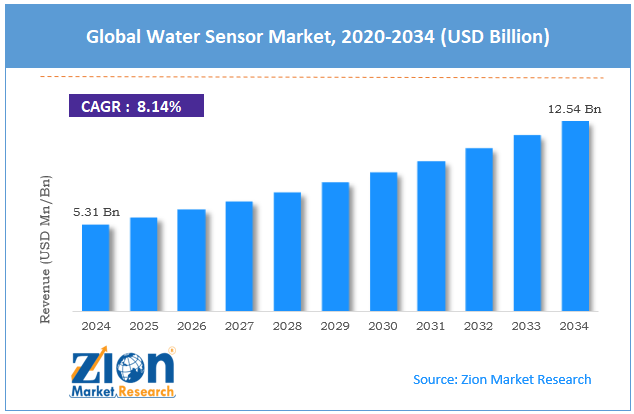
The global water sensor market size was worth around USD 5.31 billion in 2024 and is predicted to grow to around USD 12.54 billion by 2034, with a compound annual growth rate (CAGR) of roughly 8.14% between 2025 and 2034.
Key Insights:
- As per the analysis shared by our research analyst, the global water sensor market is estimated to grow annually at a CAGR of around 8.14% over the forecast period (2025-2034)
- In terms of revenue, the global water sensor market size was valued at around USD 5.31 billion in 2024 and is projected to reach USD 12.54 billion by 2034.
- The water sensor market is projected to grow at a significant rate due to the rising investments in the expansion of wastewater treatment infrastructure across the globe.
- Based on the sensor type, the total organic carbon (TOC) sensor segment is growing at a high rate and will continue to dominate the global market, as per industry projections
- Based on the weight, the less than 60-gram segment is anticipated to command the largest market share
- Based on region, North America is projected to dominate the global market during the forecast period
Water Sensor Market: Overview
Water sensors are crucial tools in modern infrastructure that help measure various chemical, biological, and physical properties of water. They have emerged as indispensable tools that ensure the purity, quality, and safety of water across industries. According to industry research, water sensors are used to measure the mineral content of water and detect the presence of contaminants, among other end applications. Some of the prominent industries leveraging the benefits of water sensors are municipal water treatment and industrial processing facilities. The industry is divided into different types of water sensors, including pH sensors, turbidity sensors, ammonium (NH4+) sensors, conductivity/salinity sensors, and nitrate sensors, to name a few.
The global demand for water sensors is expected to continue growing, driven by several factors including expansion of wastewater treatment facilities, stringent environmental regulations, and rising concerns over public health. During the projection period, the industry may face growth limitations due to a lack of standardization and complexities in managing and analyzing sensor data.
Water Sensor Market: Dynamics
Growth Drivers
How will increased investments in wastewater treatment infrastructure influence water sensor market growth?
The global water sensor market is expected to be driven by rising investments in the expansion of wastewater treatment infrastructure across the globe. According to official reports, more than 379 trillion liters of wastewater are generated worldwide every year. Wastewater treatment is an essential aspect of protecting health. Additionally, treatment procedures for wastewater are also designed to ensure the ecological system remains undisturbed by preventing wastewater from entering the environment. Another major benefit of wastewater treatment is water conservation, as treated water can be further used for extended applications such as industrial cooling and irrigation.
The growing disturbance between global demand and supply of clean water will further facilitate the expansion of wastewater treatment facilities, driving revenue for water sensors. These devices are used for real-time monitoring of various parameters in wastewater treatment facilities, including the presence of toxic elements, overall water quality, and pH levels. The global wastewater treatment market is expected to reach more than USD 600 billion by 2033 and will subsequently work in favor of water sensor providers.
Stringent environmental regulations will push water sensor applications in the coming years
The growing concerns over environmental damage caused by rapid industrialization and commercialization have led to the implementation of several strict environmental regulations worldwide. These legal frameworks are recorded in the form of a lowered permissible limit for toxic contaminants in water bodies.
Additionally, various statutory regulations require companies to send automated reports on the real-time, continuous monitoring of water quality parameters, such as pH and biological oxygen demand (BOD). Companies are required to adhere to the legal guidelines or risk facing severe penalties and fines. The growing strictness of environmental regulations and the introduction of new implementation policies will work in favor of the global water sensor market in the coming years.
Restraints
Why will the high cost of initial setup limit growth in the water sensor market?
The global water sensor industry is expected to be limited due to the high cost of initial setup and regular maintenance. While traditionally used water sensors are relatively affordable, modern sensors with next-generation technologies, such as real-time monitoring and data analysis, are expensive to procure and install. The average cost of an industrial-scale water sensor can range from USD 500 to USD 4,000 per device. Installing a greater number of modern water sensors is a cost-intensive process, limiting end-user adoption.
Opportunities
Ongoing technological advancements reported in the industry offer growth opportunities to industry players
The global water sensor market is expected to experience new growth opportunities due to the rising technological advancements reported in the market. In November 2025, researchers at Nanjing University and Nanjing Normal University announced they had developed a low-cost sensor to detect toxic perchlorate in water. The new introduction has emerged as a crucial device for providing communities with safer water and for better environmental monitoring. According to official reports, the sensor is expected to cost less than USD 2 and is heavily inspired by porphyrin molecules.
In November 2025, Shelly Group, a leading provider of smart home products, announced the launch of Shelly Flood Gen4. It is a next-generation smart water leak detector designed especially for property owners and homeowners to effectively identify water leaks at early stages and prevent costly repairs. The novel introduction is a 2-meter scale compact detector that can extend up to 150 meters. Some of the prominent areas of innovation in water sensors include wireless connectivity, battery-powered systems, and self-powered designs.
Challenges
Why will the lack of standardization challenge water sensor market growth trends in the future?
The global water sensor industry is expected to be challenged by a lack of standardization in the industry. According to industry analysis, the significant presence of non-uniform standards governing sensor performance, data collection & analysis, and reporting makes it difficult for industry players to expand into new markets. Additionally, high competition within the industry and rising demand for alternative solutions may further impede market expansion in the long run.
Water Sensor Market: Report Scope
| Report Attributes | Report Details |
|---|---|
| Report Name | Water Sensor Market |
| Market Size in 2024 | USD 5.31 Billion |
| Market Forecast in 2034 | USD 12.54 Billion |
| Growth Rate | CAGR of 8.14% |
| Number of Pages | 213 |
| Key Companies Covered | Bosch, Honeywell, ABB, Panasonic, Danfoss, Omega Engineering, Siemens, Sensata Technologies, Schneider Electric, Endress+Hauser, Emerson Electric, TE Connectivity, Pentair, Xylem, Yokogawa, and others. |
| Segments Covered | By Sensor Type, By Size, By Weight, By Device Range, By Voltage Range, By Connectivity, By End-User Vertical, and By Region |
| Regions Covered | North America, Europe, Asia Pacific (APAC), Latin America, Middle East, and Africa (MEA) |
| Base Year | 2024 |
| Historical Year | 2019 to 2023 |
| Forecast Year | 2025 - 2034 |
| Customization Scope | Avail customized purchase options to meet your exact research needs. Request For Customization |
Water Sensor Market: Segmentation
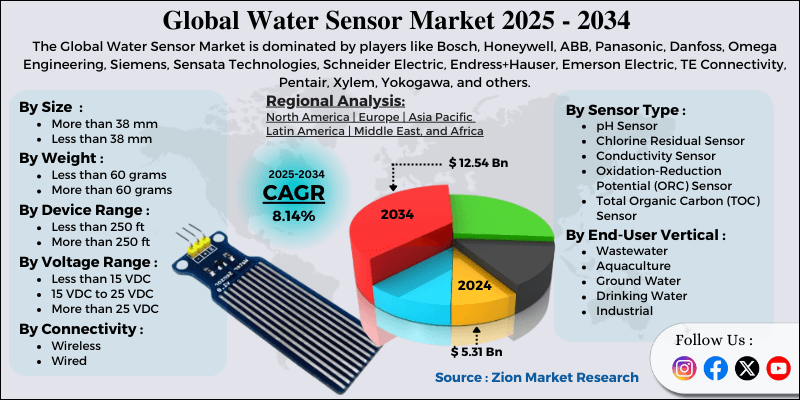
The global water sensor market is segmented based on sensor type, size, weight, device range, voltage range, connectivity, end-user vertical, and region.
Based on sensor type, the global market segments are pH sensor, chlorine residual sensor, conductivity sensor, oxidation-reduction potential (ORP) sensor, total organic carbon (TOC) sensor, and others. In 2024, the highest growth was listed in the total organic carbon (TOC) sensor segment due to its widespread adoption in environmental monitoring. The intensifying rate of ecological damage and increased demand for real-time monitoring systems will help fuel segmental revenue in the future.
Based on size, the global industry is fragmented into more than 38 mm and less than 38 mm.
Based on weight, the global water sensor industry is divided into those weighing less than 60 grams and those weighing more than 60 grams. In 2024, the highest growth rate was registered in the less than 60 grams segment, led by rising demand for compact and portable systems. The growing miniaturization trend reported in the industry may help the segment generate improved revenue.
Based on device range, the global market divisions are less than 250 ft and more than 250 ft.
Based on the voltage range, the global market is fragmented into less than 15 VDC, 15 VDC to 25 VDC, and more than 25 VDC. The less than 15 VDC segment was the leading revenue generator in 2024, and it will continue to lead the market. The rising demand for energy-efficient devices with applications across industries will help fuel segmental demand in the future.
Based on connectivity, the global industry is divided into wireless and wired.
Based on end-user vertical, the global market segments are wastewater, aquaculture, groundwater, drinking water, industrial, and others. In 2024, the highest growth rate was listed in the industrial segment and is expected to follow similar trends in the future. The presence of strict regulatory protocols governing industrial water waste and its treatment will help accelerate segmental revenue in the coming years.
Water Sensor Market: Regional Analysis
Which factors will contribute to North America’s growth rate in the water sensor market?
The global water sensor market is expected to be led by North America during the projection period. In 2024, it accounted for around 35.01% of the global revenue and is expected to grow at a CAGR of 6.1% in the coming years. The regional growth will be driven by the presence of strict environmental regulatory guidelines governing the industrial and commercial landscape. The region is dominated by some of the most comprehensive and strict environmental regulations, as well as advanced infrastructure supporting the use of water sensors. The rising integration of intelligent technologies in smart homes may further facilitate regional revenue in the coming years.
Asia-Pacific is set to emerge as the fastest-growing market with a CAGR of 10.21%, led by countries such as China, India, and Japan. The growing rate of technological advancements and research on innovative water sensors will help accelerate regional growth trends. Additionally, growing government focus on wastewater treatment infrastructure, along with rising regulatory pressure, may facilitate improved CAGR in the Asia-Pacific. Moreover, an increasing number of players operating in the region, as well as the development of low-cost water sensors, may further drive higher regional revenue growth.
Water Sensor Market: Competitive Analysis
The global water sensor market is led by players like:
- Bosch
- Honeywell
- ABB
- Panasonic
- Danfoss
- Omega Engineering
- Siemens
- Sensata Technologies
- Schneider Electric
- Endress+Hauser
- Emerson Electric
- TE Connectivity
- Pentair
- Xylem
- Yokogawa
Water Sensor Market: Key Market Trends
Multi-parameter sensors
A promising trend in the water sensor industry has emerged in the form of growing development of multi-parameter sensors. These devices are designed to track and monitor essential water parameters, such as dissolved oxygen and pH, in a single solution.
Miniaturization
The rising demand for compact, lightweight water sensors is another significant trend in the industry. The compact design will enable easy device deployment in dynamic conditions, including remote areas.
The global water sensor market is segmented as follows:
By Sensor Type
- pH Sensor
- Chlorine Residual Sensor
- Conductivity Sensor
- Oxidation-Reduction Potential (ORC) Sensor
- Total Organic Carbon (TOC) Sensor
- Others
By Size
- More than 38 mm
- Less than 38 mm
By Weight
- Less than 60 grams
- More than 60 grams
By Device Range
- Less than 250 ft
- More than 250 ft
By Voltage Range
- Less than 15 VDC
- 15 VDC to 25 VDC
- More than 25 VDC
By Connectivity
- Wireless
- Wired
By End-User Vertical
- Wastewater
- Aquaculture
- Ground Water
- Drinking Water
- Industrial
- Others
By Region
- North America
- The U.S.
- Canada
- Europe
- France
- The UK
- Spain
- Germany
- Italy
- Rest of Europe
- Asia Pacific
- China
- Japan
- India
- South Korea
- Southeast Asia
- Rest of Asia Pacific
- Latin America
- Brazil
- Mexico
- Rest of Latin America
- Middle East & Africa
- GCC
- South Africa
- Rest of Middle East & Africa
Table Of Content
Methodology
FrequentlyAsked Questions
How has the global water sensor market performed so far and how will it perform in the coming years?

HappyClients

