
Virtual Clinical Trials Market Size, Growth, Global Trends, Forecast 2034

Virtual Clinical Trials Market By Trial Type (Interventional Trials, Observational Trials, Expanded Access Trials, Hybrid Trials), By Component (Software Platforms, Wearable Devices, Telehealth Services, Data Management Tools), By Therapeutic Area (Oncology, Cardiology, Neurology, Chronic Disease Management), By End-User (Pharmaceutical Companies, Biotechnology Firms, Contract Research Organizations, Academic Research Institutes), and By Region - Global and Regional Industry Overview, Market Intelligence, Comprehensive Analysis, Historical Data, and Forecasts 2026 - 2034
| Market Size in 2025 | Market Forecast in 2034 | CAGR (in %) | Base Year |
|---|---|---|---|
| USD 9.76 Billion | USD 15.68 Billion | 5.41% | 2025 |
Virtual Clinical Trials Industry Perspective:
What will be the size of the virtual clinical trials market during the forecast period?
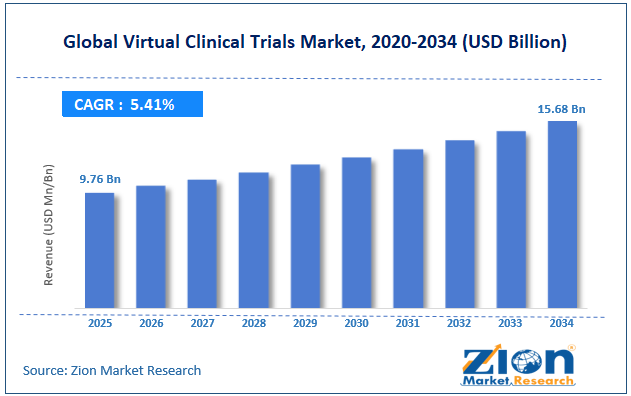
The global virtual clinical trials market size was approximately USD 9.76 billion in 2025 and is projected to reach around USD 15.68 billion by 2034, with a compound annual growth rate of roughly 5.41% between 2026 and 2034.
Key Insights
- As per the analysis shared by our research analyst, the global virtual clinical trials market is estimated to grow annually at a compound annual growth rate of around 5.41% over the forecast period from 2026 to 2034.
- In terms of revenue, the global virtual clinical trials market size was valued at approximately USD 9.76 billion in 2025 and is projected to reach USD 15.68 billion by 2034.
- The virtual clinical trials market is expected to grow steadily, driven by rising drug development activity, growing preference for decentralized research models, expanding chronic disease populations, and continuous improvements in remote monitoring accuracy.
- Based on trial type, interventional trials are expected to lead the market. In contrast, hybrid trials are anticipated to grow rapidly as sponsors seek to combine remote convenience with limited in-person supervision.
- Based on component, software platforms are expected to lead the virtual clinical trials market. At the same time, wearable devices are anticipated to grow quickly, supported by rising demand for continuous and accurate patient monitoring.
- Based on therapeutic area, oncology is the largest current segment. At the same time, chronic disease management is expected to grow rapidly during the forecast period as remote monitoring becomes more widely accepted for long-term conditions.
- Based on end-user, pharmaceutical companies are expected to lead the market, while contract research organizations are anticipated to grow steadily as more sponsors outsource decentralized trial operations.
- Based on region, North America is projected to dominate the global virtual clinical trials market during the estimated period, followed by Europe.
Virtual Clinical Trials Market: Overview
Virtual clinical trials are clinical research studies that use digital technologies to test new medicines, therapies, and medical devices without requiring participants to visit hospitals or research centers frequently. These trials use telehealth consultations, wearable devices, mobile apps, and remote monitoring systems to collect health data from participants in their own homes. This approach makes it easier and more convenient for patients to participate while helping researchers receive accurate, real-time data throughout the study. Virtual clinical trials reduce travel time, improve patient comfort, speed up participant recruitment, and increase study completion rates.
Pharmaceutical companies, biotechnology firms, and contract research organizations are increasingly adopting this model because it lowers operational costs and improves data quality. Wearable sensors continuously monitor vital signs, physical activity, and other health indicators, while digital platforms manage patient consent, scheduling, communication, and secure data collection. The growing use of digital healthcare technologies, rising cases of chronic diseases, increasing demand for patient-centered research, and continuous advancements in remote monitoring solutions are driving the adoption of virtual clinical trials.
The virtual clinical trials industry is growing due to rising demand for patient-centric research models, expanding use of wearable health monitoring devices, and increasing adoption of telehealth platforms by research organizations.
Impact of the USA-Israel War on Iran on the Virtual Clinical Trials Market
Ongoing tensions among the United States, Israel, and Iran may cause short-term disruptions in the global supply of electronic components used to manufacture wearable sensors and remote monitoring devices, since several semiconductor and hardware supply routes pass through affected regions. Research organizations relying on imported devices could face temporary delays in device availability and price increases. However, steady demand from pharmaceutical companies and contract research organizations is expected to keep the virtual clinical trials market on a stable growth path despite short-term regional disruptions.
Virtual Clinical Trials Market: Technology Roadmap 2026–2034
What is the projected development roadmap for the virtual clinical trials market over the forecast period?
The virtual clinical trials market is progressing through improved remote monitoring accuracy, smarter data integration, and fully connected research ecosystems. The market is expected to grow at a compound annual growth rate of around 5.41% over the forecast period, supported by rising global demand for patient-friendly research methods and digital healthcare adoption.
The following roadmap outlines key development phases expected through 2034.
2026–2028: Digital Foundation and Patient Access Phase
- Research organizations are expected to expand telehealth consultation options, reducing the need for patients to visit physical trial sites for routine check-ins.
- Wearable device adoption is expected to grow, allowing continuous collection of vital signs and activity data without disrupting a patient's daily life.
- Improved consent management software is expected to simplify enrollment procedures, making it easier for patients to join studies from remote locations.
2029–2032: Smart Data Integration and Analytics Phase
- Companies are expected to combine wearable data streams with artificial intelligence-based analytics to detect early signs of adverse events during ongoing trials.
- Integration between virtual trial platforms and electronic health record systems is expected to grow, helping researchers access more complete and accurate patient histories.
- Predictive enrollment tools are expected to gain wider acceptance, helping sponsors identify suitable patients faster and reduce overall trial timelines.
2033–2034: Fully Connected and Autonomous Trial Phase
- Virtual trial platforms are expected to become part of larger connected healthcare ecosystems that combine patient recruitment, monitoring, and reporting into a single system.
- Self-adjusting monitoring algorithms are expected to reduce the need for manual data review, making large-scale trials more efficient and less dependent on manual oversight.
- Fully interoperable data-sharing systems are expected to enable seamless collaboration between sponsors, regulators, and research sites, supporting faster approval of new treatments.
Virtual Clinical Trials Market: Dynamics
Growth Drivers
How is rising patient preference for remote participation driving the virtual clinical trials market?
The virtual clinical trials industry is growing as healthcare companies, researchers, and patients seek more convenient and flexible ways to conduct medical research. Traditional clinical trials often require participants to make frequent visits to hospitals or research centers, which can be time-consuming and difficult, especially for people living in remote areas or managing chronic illnesses. Virtual clinical trials allow patients to participate from home through telehealth consultations, wearable devices, mobile apps, and remote monitoring systems. This improves patient convenience, increases participation, and reduces dropout rates during studies. The rising number of chronic diseases, including diabetes, heart disease, and neurological disorders, is also increasing the need for long-term, patient-friendly research methods.
Pharmaceutical and biotechnology companies benefit from faster patient recruitment, lower operational costs, and quicker data collection. Continuous improvements in wearable technology, digital health platforms, and secure data management are making remote clinical research more accurate and reliable. These advantages are driving the adoption of virtual clinical trials and supporting the steady growth of the virtual clinical trials market across the global healthcare industry.
Growing demand for faster drug development and expanding chronic disease management needs is accelerating the virtual clinical trials market.
The virtual clinical trials market is expanding as pharmaceutical companies, biotechnology firms, and research organizations search for faster, more efficient, and cost-effective ways to develop new medicines and therapies. Traditional clinical trials often face delays due to slow patient recruitment, frequent hospital visits, and complex logistics. Virtual clinical trials overcome these challenges by enabling remote patient monitoring, digital consultations, and real-time data collection from participants at home. This helps reduce study timelines, improve patient participation, and accelerate drug development. The growing focus on managing chronic diseases is also increasing the demand for long-term studies that are more convenient for patients. Technology companies are developing advanced digital platforms that combine patient enrollment, informed consent, appointment scheduling, communication, and secure data management into one easy-to-use system. Research organizations are adopting hybrid and fully virtual trial models to improve flexibility, lower operational costs, and collect higher-quality data from larger and more diverse patient populations.
Restraints
Data privacy concerns and inconsistent regulatory frameworks are key challenges in the virtual clinical trials market.
The virtual clinical trials market faces several challenges that could slow its growth. One of the biggest concerns is protecting patient data, as virtual trials depend on digital platforms that collect, store, and share sensitive health information. Any security breach can reduce patient trust and create regulatory issues. Another challenge is the lack of uniform regulations across countries, making it difficult for research organizations to conduct global virtual clinical trials. Maintaining accurate and reliable data is also challenging because wearable devices, internet connectivity problems, or technical issues can affect the quality of information collected. Some patients, especially older adults or those with limited digital skills, may find it difficult to use mobile apps and remote monitoring devices.
In addition, not all regions have reliable internet access or digital healthcare infrastructure, limiting participation in virtual studies. Research organizations must also invest in secure technology and technical support, increasing operational costs. Despite these challenges, growing demand for convenient, patient-centered, and cost-effective research continues to drive the market.
Opportunities
How are decentralized research models and expanding chronic disease populations driving the virtual clinical trials market?
The virtual clinical trials industry offers significant growth opportunities as healthcare organizations increasingly adopt decentralized and patient-centered research models. The rising number of people living with chronic diseases across North America, Europe, and Asia Pacific is creating greater demand for long-term clinical studies that can be conducted remotely. Patients prefer virtual participation because it reduces travel, saves time, and allows them to continue their daily routines while contributing to medical research. Pharmaceutical companies, biotechnology firms, and contract research organizations are expanding hybrid and fully virtual trial models to improve patient recruitment and meet evolving regulatory requirements. The rapid adoption of telehealth services is also increasing demand for digital platforms that combine virtual consultations, remote monitoring, and secure data collection.
Advances in artificial intelligence are improving patient matching, while wearable devices and mobile health technologies provide accurate, real-time health data throughout clinical studies. Cloud-based platforms and digital health solutions are making virtual trials easier to manage across multiple locations and larger patient populations. These innovations are improving research efficiency, reducing operational costs, and enhancing patient engagement, creating strong long-term growth opportunities for the virtual clinical trials market across the global healthcare industry.
Challenges
What challenges does the virtual clinical trials market face in data accuracy and patient engagement amid rising competition?
The virtual clinical trials market faces several challenges that may limit its growth. One of the biggest concerns is maintaining accurate and consistent data throughout a clinical study. Problems with wearable devices, internet connectivity, software performance, or patient compliance can reduce the quality of collected health data and delay research outcomes. Research organizations must also design virtual trial protocols that work effectively for patients of different ages, locations, and levels of digital literacy. Keeping participants engaged during long-term studies is another challenge, as remote participation may lead to lower motivation and missed assessments. Companies also need skilled professionals with both clinical and technical expertise to manage digital trial platforms, remote monitoring systems, and secure data collection.
In addition, increasing competition among technology providers and contract research organizations is creating pricing pressure and driving continuous innovation. Meeting changing regulatory requirements across different countries further adds to operational complexity.
Virtual Clinical Trials Market: Report Scope
| Report Attributes | Report Details |
|---|---|
| Report Name | Virtual Clinical Trials Market |
| Market Size in 2025 | USD 9.76 Billion |
| Market Forecast in 2034 | USD 15.68 Billion |
| Growth Rate | CAGR of 5.41% |
| Number of Pages | 231 |
| Key Companies Covered | Medable Inc., IQVIA Holdings Inc., Science 37 Inc., Parexel International Corporation, ICON plc, Signant Health, Veeva Systems Inc., Oracle Corporation, Huma Therapeutics Limited, Thermo Fisher Scientific Inc., and others. |
| Segments Covered | By Trial Type, By Component, By Therapeutic Area, By End-User, and By Region |
| Regions Covered | North America, Europe, Asia Pacific (APAC), Latin America, Middle East, and Africa (MEA) |
| Base Year | 2025 |
| Historical Year | 2020 to 2024 |
| Forecast Year | 2026 - 2034 |
| Customization Scope | Avail customized purchase options to meet your exact research needs. Request For Customization |
Virtual Clinical Trials Market: Segmentation
The global virtual clinical trials market is segmented by trial type, component, therapeutic area, end-user, and region.
Why are interventional trials the preferred trial type in the virtual clinical trials market?
Based on trial type, the global virtual clinical trials market is divided into interventional trials, observational trials, expanded access trials, and hybrid trials. Interventional trials hold about 42% of the market share, leading due to their widespread use in testing new drugs and therapies that require close monitoring of patient response. Hybrid trials hold around 22% of the market share. It is one of the fastest-growing segments, driven by increasing demand for study designs that combine remote convenience with occasional in-person evaluation.
How does the software platforms component segment maintain its leading position in the virtual clinical trials market?
Based on component, the virtual clinical trials industry is classified into software platforms, wearable devices, telehealth services, and data management tools. The software platforms segment accounts for about 35% of the global virtual clinical trials market, driven by rising demand for centralized systems that manage scheduling, consent, and communication. The wearable devices segment holds around 27% of the market share. It is one of the fastest-growing segments, driven by rising demand for continuous, real-time patient health monitoring.
Which therapeutic area segment dominates the virtual clinical trials market?
Based on therapeutic area, the market is segregated into oncology, cardiology, neurology, and chronic disease management. Oncology leads with about a 33% share, driven by continuous demand for new cancer treatment studies requiring long-term patient monitoring. Chronic disease management holds around 25% of the market share. It is growing rapidly as more patients seek remote monitoring options for long-term conditions such as diabetes and hypertension.
How do pharmaceutical companies dominate the end-user landscape in the virtual clinical trials market?
Based on end-user, the virtual clinical trials industry is categorized into pharmaceutical companies, biotechnology firms, contract research organizations, and academic research institutes. Pharmaceutical companies account for about 38% of the market, due to their large research budgets and continuous need for faster drug development timelines. Contract research organizations hold around a 23% share. They are growing steadily as more sponsors outsource decentralized trial management to specialized service providers.
Virtual Clinical Trials Market: Regional Analysis
What is driving North America's leadership in the virtual clinical trials market?
The North America virtual clinical trials market accounts for around 39% of the global market, making it the largest regional market. A strong pharmaceutical industry, advanced digital healthcare infrastructure, and widespread adoption of telehealth services drive growth. The United States holds the largest market share due to its high number of clinical trials, well-established biotechnology sector, and continuous investment in digital health technologies and remote patient monitoring solutions. Pharmaceutical companies and research organizations are increasingly adopting virtual clinical trials to speed up patient recruitment, improve participant retention, and reduce study costs. The growing focus on chronic diseases, rare diseases, and personalized medicine is further increasing the demand for decentralized clinical research across the country.
Canada is also contributing to market growth through expanding biotechnology research, government support for digital healthcare, and increasing adoption of virtual care platforms. Academic institutions and contract research organizations are using virtual trial technologies to conduct large-scale studies more efficiently. Strong collaboration between pharmaceutical companies, technology providers, healthcare organizations, and regulatory agencies continues to improve trial quality and patient engagement. Continuous investments in artificial intelligence, wearable devices, cloud-based platforms, and remote monitoring technologies are expected to support the long-term growth of the North America virtual clinical trials market.
What factors are supporting the expansion of the virtual clinical trials market across Europe?
The Europe virtual clinical trials market accounts for around 28% of the global market, making it the second-largest regional market. A strong pharmaceutical research ecosystem, supportive regulatory frameworks, and increasing demand for patient-centered clinical studies drive growth. Germany holds the largest market share because of its advanced healthcare infrastructure, well-established pharmaceutical industry, and continuous investment in digital health technologies. Research organizations across the country are widely adopting virtual clinical trials for oncology, cardiology, rare diseases, and chronic disease research. The United Kingdom is also a major contributor, with growing use of remote monitoring tools, telehealth platforms, and digital technologies for vaccine development and long-term clinical studies. France is emerging as an important market due to expanding biotechnology research, government support for healthcare innovation, and rising demand for cost-effective clinical trial methods.
Across Europe, governments are encouraging digital healthcare through regulations that support remote patient monitoring and decentralized research models. Technology companies, pharmaceutical firms, and research institutions are collaborating to develop secure, user-friendly, and efficient virtual trial platforms. These factors are helping expand the adoption of decentralized research models and are expected to drive the steady growth of the European virtual clinical trials market during the forecast period.
Recent Market Developments
- In March 2026, IQVIA Holdings Inc. launched IQVIA.ai, a unified agentic AI platform designed to improve clinical research, advanced analytics, and decision-making across life sciences while supporting more efficient decentralized and hybrid clinical trial workflows.
- In June 2026, Medable Inc. introduced new Agentic AI capabilities for its clinical trial platform, including the Digital Data Flow Agent and AI-powered tools that streamline study startup, support electronic clinical outcome assessment (eCOA) oversight, and accelerate decentralized clinical trial operations.
Virtual Clinical Trials Market: Competitive Analysis
The leading players in the global virtual clinical trials market are:
- Medable Inc.
- IQVIA Holdings Inc.
- Science 37 Inc.
- Parexel International Corporation
- ICON plc
- Signant Health
- Veeva Systems Inc.
- Oracle Corporation
- Huma Therapeutics Limited
- Thermo Fisher Scientific Inc.
The global virtual clinical trials market is segmented as follows:
By Trial Type
- Interventional Trials
- Observational Trials
- Expanded Access Trials
- Hybrid Trials
By Component
- Software Platforms
- Wearable Devices
- Telehealth Services
- Data Management Tools
By Therapeutic Area
- Oncology
- Cardiology
- Neurology
- Chronic Disease Management
By End-User
- Pharmaceutical Companies
- Biotechnology Firms
- Contract Research Organizations
- Academic Research Institutes
By Region
- North America
- The U.S.
- Canada
- Mexico
- Europe
- France
- The UK
- Spain
- Germany
- Italy
- Rest of Europe
- Asia Pacific
- China
- Japan
- India
- Australia
- South Korea
- Rest of Asia Pacific
- The Middle East & Africa
- Saudi Arabia
- UAE
- Egypt
- Kuwait
- South Africa
- Rest of the Middle East & Africa
- Latin America
- Brazil
- Argentina
- Rest of Latin America
Table Of Content
Methodology
FrequentlyAsked Questions
Virtual clinical trials are clinical research studies that use digital technologies to test new medicines, therapies, and medical devices without requiring participants to visit hospitals or research centers frequently. These trials use telehealth consultations, wearable devices, mobile apps, and remote monitoring systems to collect health data from participants in their own homes.
The global virtual clinical trials market is expected to grow, driven by rising patient preference for remote participation, expanding chronic disease research, growing telehealth adoption, and continuous improvements in wearable monitoring accuracy.
According to research, the global virtual clinical trials market size was approximately USD 9.76 billion in 2025 and is projected to reach approximately USD 15.68 billion by 2034.
The compound annual growth rate value of the virtual clinical trials market is expected to be around 5.41% from 2026 to 2034.
North America is expected to lead the global virtual clinical trials market during the forecast period, driven by strong pharmaceutical research activity, advanced digital healthcare infrastructure, and high telehealth adoption.
The major players in the global virtual clinical trials market include Medable Inc., IQVIA Holdings Inc., Science 37 Inc., Parexel International Corporation, ICON plc, Signant Health, Veeva Systems Inc., Oracle Corporation, Huma Therapeutics Limited, and Thermo Fisher Scientific Inc.
The report examines key aspects of the virtual clinical trials market, including growth drivers, restraints, emerging opportunities, challenges, a competitive landscape analysis, regional breakdowns, and a detailed future outlook across all major trial types, components, therapeutic areas, end users, and geographies.
The virtual clinical trials market is witnessing rapid growth through the adoption of artificial intelligence, wearable health devices, telehealth platforms, and decentralized trial models. Cloud-based data management, digital patient engagement tools, and real-time remote monitoring are improving study efficiency, patient participation, and data quality.
What strategies should stakeholders adopt to stay competitive in the virtual clinical trials market?
Companies in the virtual clinical trials market should invest in secure data management systems, improve platform usability, develop more accurate wearable monitoring tools, strengthen partnerships with healthcare providers, and expand global research capabilities, all while focusing on innovation, patient engagement, and regulatory compliance.
Technological advancements are accelerating the virtual clinical trials market by enabling secure remote patient monitoring, faster data collection, and improved communication between researchers and participants. Artificial intelligence, cloud computing, mobile health applications, and advanced wearable sensors are making clinical trials more accurate, efficient, and patient-friendly.

HappyClients

