
Vegan Leather Market Size, Share, Growth, Opportunities 2034

Vegan Leather Market By Material Type (Polyurethane (PU) Leather, Plant-Based Leather, Synthetic/Bio-Based Leather, and Polyvinyl Chloride (PVC) Leather), By Application (Bags, Wallets, & Accessories, Automotive Interiors, Footwear, Furniture & Upholstery, and Fashion & Apparel), By End-User (Automotive, Consumer Goods, Furniture & Interior, Fashion & Luxury, and Others), and By Region - Global and Regional Industry Overview, Market Intelligence, Comprehensive Analysis, Historical Data, and Forecasts 2026 - 2034
| Market Size in 2025 | Market Forecast in 2034 | CAGR (in %) | Base Year |
|---|---|---|---|
| USD 11.07 Billion | USD 27.8 Billion | 10.77% | 2025 |
Vegan Leather Industry Perspective:
What is the anticipated size of the vegan leather market during the projection period?
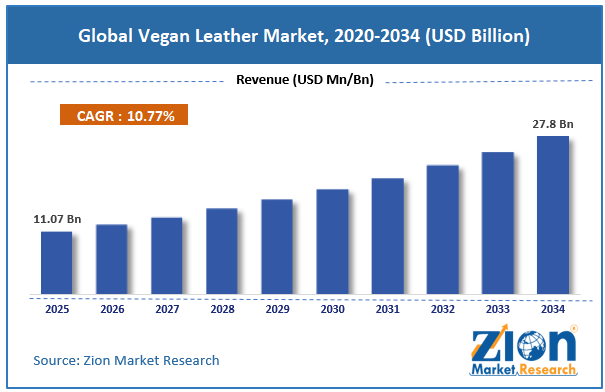
The global vegan leather market size was worth around USD 11.07 billion in 2025 and is predicted to grow to around USD 27.8 billion by 2034, with a compound annual growth rate (CAGR) of roughly 10.77% between 2026 and 2034.
Key Insights:
- As per the analysis shared by our research analyst, the global vegan leather market is estimated to grow annually at a CAGR of around 10.77% over the forecast period (2026-2034)
- In terms of revenue, the global vegan leather market size was valued at around USD 11.07 billion in 2025 and is projected to reach USD 27.8 billion, by 2034.
- The vegan leather market is projected to grow at a significant rate due to the growing concerns over animal cruelty, rising applications in the fast-fashion industry, and rapid expansion of the automotive sector.
- Based on the material type, the polyvinyl chloride (PVC) leather segment will generate the highest CAGR of 13.01% due to the emergence of bio-based PVC material during the forecast period.
- Based on the application, in 2025, footwear emerged as the highest market share holder, contributing 40% of the total revenue. It will continue leading the market in the coming years.
- Based on region, Europe is projected to dominate the global market during the forecast period.
Vegan Leather Market: Overview
Vegan leather, also known as faux leather, is a material that mimics the look and feel of real leather but is not derived from animals. Real leather is typically made from animal skin, such as cow, pig, horse, snake, and crocodile. Vegan leather, on the other hand, imitates the qualities of real versions but is produced from synthetic or biological materials such as pineapple leaves, mushrooms, and cactus. Most vegan leathers are made of polyurethane (PU) or polyvinyl chloride (PVC), petroleum-based plastics. Over the years, vegan leather has found major applications in the fashion industry, including bags, shoes, and clothing. In addition, faux leather is used in the modern automotive industry. During the forecast period, demand for vegan leather is expected to grow due to growing concerns over animal cruelty, rising applications in the fast-fashion industry, and rapid expansion in the automotive sector. However, high cost of bio-based vegan leather, dependency on plastic and plant-based raw materials, and performance limitations will affect overall market revenue in the long run.
Impact of the USA-Israel and Iran war on the Vegan Leather Market:
The USA-Israel and Iran war is expected to affect the supply chain of essential raw materials across geographical markets, especially for transactions that occur through the Strait of Hormuz. These effects will include delayed shipments, higher logistics costs, and restricted raw material availability. In the long run, the war is anticipated to encourage more reliance on domestic supply and production and the development of more resilient supply networks.
Vegan Leather Market: Dynamics
Growth Drivers
How will strict environmental regulations shape the vegan leather market during the forecast period?
The global vegan leather market is expected to be driven by strict environmental regulations and frameworks about animal safety. Traditional real leather is produced using animal skin. The raw material undergoes resource-intensive processes to produce real leather. Countries worldwide are pushing for environmentally sustainable industrial manufacturing processes, discouraging more investments in real leather production. Vegan alternatives, by contrast, require fewer resources and do not significantly harm ecological systems. In June 2025, the US government reintroduced the Kangaroo Protection Act. The legislation aims to ban the production and sale of products made from kangaroo skin. Additionally, animal rights groups have aggressively lobbied for protection of animals from cruelty, encouraging more investments in vegan leather.
Applications in the automotive sector to promote market growth during the forecast period
Vegan leather products have found widespread adoption in the automotive sector. Popular vehicle brands such as Tesla, BMW, Mercedes-Benz, and others have started using vegan leather for most interior parts of a vehicle. According to official claims, BMW has reported an 85% reduction in carbon dioxide (CO2) emissions since it began using new synthetic materials. Tesla uses vegan leather to produce its seats, dashboard trim, and other panels. Strict emission regulations, especially for the automotive sector, will encourage higher growth in the global vegan leather market during the forecast period.
Restraints
High production cost and performance limitations will affect industry revenue in the coming years
The global vegan leather industry is expected to be restricted due to the high cost of bio-based materials. Plant-derived vegan leather relies heavily on agricultural products. It also relies on advanced, specialized technologies. However, seasonal feedstock availability and high production costs will affect industry revenue in the long run. In addition, vegan leather faces several performance limitations such as short-term durability and quick aging. It also lacks resistance to peeling and cracking, further affecting overall industry adoption rate.
Opportunities
How will expansion of production facilities and consistent innovation shape the vegan leather market?
The global vegan leather market is anticipated to generate growth opportunities due to rapid expansion of manufacturing facilities. The ongoing use of next-generation technologies such as mycelium cultivation, advanced bio-based material processing, nanotechnology, and 3D printing is expected to improve the overall performance of vegan leather. For instance, in April 2025, Eori™ Vegan Leather announced the launch of its state-of-the-art vegan leather manufacturing plant. The facility is Asia’s largest of its kind. Moreover, market players are experimenting with new materials instead of relying on plastic-based feedstock, creating significant momentum in the commercial space. A Mexican company, Desserto, produces a cactus-based material called Milan. It is an excellent alternative to petroleum-based materials. In October 2025, Foremost Group, under its NUPELLE® vegan-leather business/brand, launched PANEX® Nanotech pineapple leather. It is produced from recycled pineapple agricultural by-products and proprietary microfiber technology.
Challenges
What are the leading challenges in the vegan leather industry?
The global vegan leather industry is projected to be challenged by concerns over greenwashing, as vegan leather is mainly produced from petroleum-based raw materials. In addition, end-of-life challenges, evolving consumer preferences, and competition from traditional leather will create barriers to industry growth.
Vegan Leather Market: Report Scope
| Report Attributes | Report Details |
|---|---|
| Report Name | Vegan Leather Market |
| Market Size in 2025 | USD 11.07 Billion |
| Market Forecast in 2034 | USD 27.8 Billion |
| Growth Rate | CAGR of 10.77% |
| Number of Pages | 227 |
| Key Companies Covered | Modern Meadow, Desserto, Banofi Leather, Natural Fiber Welding, Fruitleather Rotterdam, VEGEA, Teijin, MycoWorks, Malai Eco, Bolt Threads, Ecovative Design, Winner Nippon Leatherette, Kuraray, Ultrafabrics, Ananas Anam (Piñatex), and others. |
| Segments Covered | By Material Type, By Application, By End-User, and By Region |
| Regions Covered | North America, Europe, Asia Pacific (APAC), Latin America, Middle East, and Africa (MEA) |
| Base Year | 2025 |
| Historical Year | 2020 - 2024 |
| Forecast Year | 2026 - 2034 |
| Customization Scope | Avail customized purchase options to meet your exact research needs. Request For Customization |
Vegan Leather Market: Segmentation
The global vegan leather market is segmented based on material, application, end-user, and region.
Why will the PVC leather segment lead the vegan leather industry revenue during the forecast period?
Based on material type, the global market segments are polyurethane (PU) leather, plant-based leather, synthetic/bio-based leather, and polyvinyl chloride (PVC) leather. In 2025, the highest growth was listed in the polyurethane (PU) leather segment. It accounted for 61% of the total revenue. During the forecast period, the polyvinyl chloride (PVC) leather segment will generate the highest CAGR of 13.01% due to the emergence of bio-based PVC material, which not only meets regulatory pressure but also ensures the production of high-performance leather.
Which will be the fastest-growing application during the forecast period in the vegan leather market?
Based on application, the global vegan leather industry is fragmented into bags, wallets, & accessories, automotive interiors, footwear, furniture & upholstery, and fashion & apparel. In 2025, footwear emerged as the highest market share holder, contributing 40% of the total revenue. It will continue to lead the market, driven by the expansion of fashion e-commerce channels, changes in consumer lifestyles, and higher demand among end-buyers.
Which factors drive demand in the fashion & luxury segment in the vegan leather industry?
Based on end-user, the global market segments are automotive, consumer goods, furniture & interior, fashion & luxury, and others. According to market analysis, fashion & luxury was the leading revenue generator in 2025 and will continue to lead the market. High demand for affordable, leather-based clothes and accessories, along with product innovation, will drive segmental growth in the coming years.
Vegan Leather Market: Regional Analysis
Why will Europe lead the vegan leather market in the coming years?
The global vegan leather market is currently led by Europe. In 2025, it accounted for the largest share of the global revenue and will grow at a CAGR of 13.42% during the forecast period. The European Union has strict environmental regulatory laws concerning animal cruelty, pollution, and deforestation. In addition, consumer preference toward sustainable products, including clothing items and footwear, will drive regional growth. Additionally, the presence of the world’s leading fashion houses across Europe will prove beneficial in the long run.
Why will Asia-Pacific generate the fastest CAGR in the vegan leather market during the forecast period?
Asia-Pacific is expected to emerge as the fastest-growing region in the vegan leather industry with a CAGR of 13.69% during the forecast period. Growing consumer base, e-commerce expansion, high demand for fast fashion, and extensive use of vegan leather in the automotive sector will propel regional growth. Moreover, proliferation of large-scale manufacturing facilities and changes in consumer buying patterns will drive regional revenue during the forecast period.
Vegan Leather Market: Competitive Analysis
The global vegan leather market is led by players like:
- Modern Meadow
- Desserto
- Banofi Leather
- Natural Fiber Welding
- Fruitleather Rotterdam
- VEGEA
- Teijin
- MycoWorks
- Malai Eco
- Bolt Threads
- Ecovative Design
- Winner Nippon Leatherette
- Kuraray
- Ultrafabrics
- Ananas Anam (Piñatex)
What are the latest key trends in the vegan leather market?
Expansion across other industries
Market players are experimenting with extending vegan leather application to other industries such as healthcare and furniture. These emerging markets are expected to open new growth opportunities for the players.
Performance improvement
Ongoing research toward improving vegan leather performance to compete with other alternatives is a promising trend with growth potential. It will allow easy integration of vegan leather across other industries.
The global vegan leather market is segmented as follows:
By Material Type
- Polyurethane (PU) Leather
- Plant-Based Leather
- Synthetic/Bio-Based Leather
- Polyvinyl Chloride (PVC) Leather
By Application
- Bags
- Wallets, & Accessories
- Automotive Interiors
- Footwear
- Furniture & Upholstery
- Fashion & Apparel
By End-User
- Automotive
- Consumer Goods
- Furniture & Interior
- Fashion & Luxury
- Others
By Region
- North America
- The U.S.
- Canada
- Mexico
- Europe
- France
- The UK
- Spain
- Germany
- Italy
- Rest of Europe
- Asia Pacific
- China
- Japan
- India
- Australia
- South Korea
- Rest of Asia Pacific
- The Middle East & Africa
- Saudi Arabia
- UAE
- Egypt
- Kuwait
- South Africa
- Rest of the Middle East & Africa
- Latin America
- Brazil
- Argentina
- Rest of Latin America
Table Of Content
Methodology
FrequentlyAsked Questions
Vegan leather, also known as faux leather, is a type of material that gives the look and feel of real leather but is not derived from animals.
The global vegan leather market is expected to be driven by strict environment regulations and frameworks about animal safety.
According to study, the global vegan leather market size was worth around USD 11.07 billion in 2025 and is predicted to grow to around USD 27.8 billion by 2034.
The CAGR value of the vegan leather market is expected to be around 10.77% during 2026-2034.
The global vegan leather industry is projected to be challenged by concerns over greenwashing, as vegan leather is mainly produced using petroleum-based raw materials.
Expansion across other industries and performance improvement are the emerging trends and innovations impacting the vegan leather market.
The global vegan leather market has performed well so far and will offer similar trends in the coming years.
Europe will contribute notably towards the vegan leather market value.
The global vegan leather market is led by players like Modern Meadow, Desserto, Banofi Leather, Natural Fiber Welding, Fruitleather Rotterdam, VEGEA, Teijin, MycoWorks, Malai Eco, Bolt Threads, Ecovative Design, Winner Nippon Leatherette, Kuraray, Ultrafabrics, and Ananas Anam (Piñatex).
The report explores crucial aspects of the vegan leather market, including a detailed discussion of existing growth factors and restraints, while also browsing future growth opportunities and challenges that impact the market.

HappyClients

