
Global Telerehabilitation Systems Market Size, Share, Analysis, Trends, Growth, 2032

Telerehabilitation Systems Market By Type (Cardiac Telerehabilitation, Neurological Telerehabilitation, Physiotherapy Applied to Telerehabilitation, and Others), By End User (Hospital & Clinics, Home Care Settings, and Rehabilitation Centers), and By Region - Global and Regional Industry Overview, Market Intelligence, Comprehensive Analysis, Historical Data, and Forecasts 2024 - 2032
| Market Size in 2023 | Market Forecast in 2032 | CAGR (in %) | Base Year |
|---|---|---|---|
| USD 801.79 Million | USD 1425.2 Million | 6.6% | 2023 |
What is the Telerehabilitation Systems Market Size?
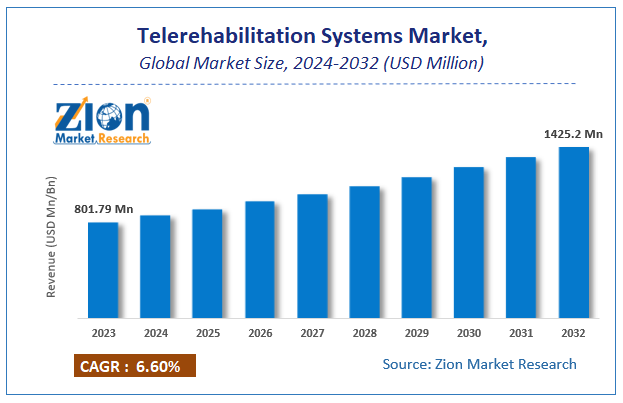
The global telerehabilitation systems market size was worth around USD 801.79 million in 2023 and is predicted to reach around USD 1425.2 million by 2032, with a compound annual growth rate (CAGR) of roughly 6.60% between 2024 and 2032. This report provides a comprehensive analysis of the growth drivers, restraints, and challenges shaping demand across the global telerehabilitation systems market throughout the forecast period, while highlighting high-potential emerging opportunities within the industry.
Key Insights
- As per the analysis shared by our research analyst, the global telerehabilitation systems market is estimated to grow annually at a CAGR of around 6.60% over the forecast period (2024-2032).
- In terms of revenue, the global telerehabilitation systems market size was valued at around USD 801.79 million in 2023 and is projected to reach USD 1425.2 million by 2032.
- The telerehabilitation systems market is projected to grow at a significant rate due to growth in elderly care, rising demand for post-surgical rehabilitation, increasing adoption of remote care models, and the need for accessible rehabilitation services beyond traditional clinical settings.
- Based on the type, the physiotherapy-applied telerehabilitation segment addresses distinct clinical needs, with physiotherapy and neurological applications supporting a large share of remote therapy delivery.
- Based on the end-user, the hospital & clinics segment is growing at a high rate and is projected to dominate the global market.
- Based on region, North America is expected to lead the market during the forecast period due to the presence of major players, favorable healthcare facilities, availability of financial compensation, and strong technical capabilities.
Telerehabilitation Systems Market: Overview
Telerehabilitation can be known as a telemedicine branch. Although this sector is substantially new, its use in developed countries has expanded rapidly. Telerehabilitation typically lowers the cost to both health care services and patients compared to conventional inpatient and person-to-person treatment.
In addition, patients living in remote areas where conventional recovery facilities may not be readily available will benefit from this technology. However, some drawbacks of telerehabilitation, including skepticism on the part of patients due to remote interactions with their doctors or rehabilitators, should not be overlooked.
Telerehabilitation Systems Market: Growth Factors
What factors are propelling the expansion of the telerehabilitation systems market
Patient visits and hospital stays are increasing due to the high incidence of chronic diseases. In addition, fluctuations in patient inflows, personnel deficiency, and resource constraints are factors that contribute to poor patient conditions and overcrowding of the intensive care unit. This obliges healthcare providers to introduce telehealth services such as telerehabilitation in the healthcare sector. Telerehabilitation technologies reduce human effort, boost overall service efficiency, and help to achieve operational efficiencies in the healthcare sector. The disparity between high patient inflows and understaffing in health centers is therefore one of the main factors that will drive the growth of the market in telerehabilitation systems.
The rise of Industry 4.0 healthcare firms is currently contributing to the introduction of advanced technologies. Increasing the integration of IoTs and sensors to efficiently track patients and offer real-time care would accelerate the deployment of telehealth solutions such as telerehabilitation. The incorporation of virtual reality into healthcare processes provides an opportunity to collect data and gain knowledge through IIoT. This will boost the market growth during the forecast era.
Telerehabilitation Systems Market: Restraints
What factors are limiting the growth of the telerehabilitation systems market?
Limited reimbursement coverage in certain regions can reduce the economic attractiveness of telerehabilitation programs for providers and patients. Patient technology adoption barriers, including limited digital literacy or access to suitable devices, may restrict participation among some populations.
Connectivity issues, particularly in rural or underserved areas, can affect the reliability of real-time video and data transmission required for effective remote rehabilitation sessions. These constraints slow uniform market expansion across all geographies and patient groups.
Telerehabilitation Systems Market: Report Scope
| Report Attributes | Report Details |
|---|---|
| Report Name | Telerehabilitation Systems Market |
| Market Size in 2023 | USD 801.79 Million |
| Market Forecast in 2032 | USD 1425.2 Million |
| Growth Rate | CAGR of 6.6% |
| Number of Pages | 220 |
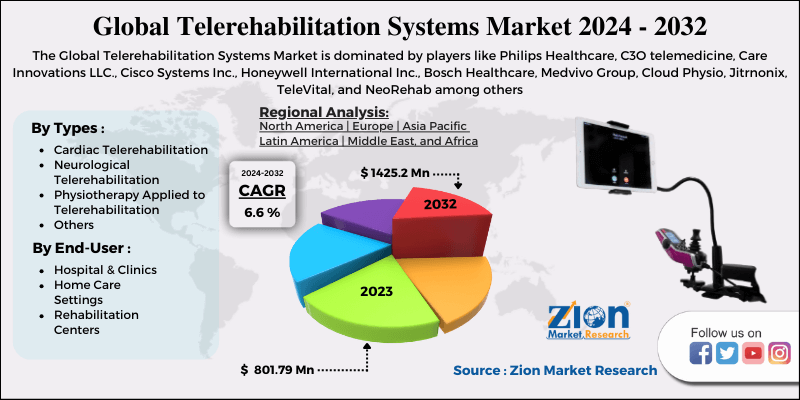
| Key Companies Covered | Philips Healthcare, C3O telemedicine, Care Innovations LLC, Cisco Systems Inc., Honeywell International Inc., Bosch Healthcare, Medvivo Group, Cloud Physio, Jitrnonix, TeleVital, and NeoRehab, among others. |
| Segments Covered | By Type, By End User, and By Region |
| Regions Covered | North America, Europe, Asia Pacific (APAC), Latin America, Middle East, and Africa (MEA) |
| Base Year | 2023 |
| Historical Year | 2018 - 2022 |
| Forecast Year | 2024 - 2032 |
| Customization Scope | Avail customized purchase options to meet your exact research needs. Request For Customization |
Telerehabilitation Systems Market: Segmentation
The telerehabilitation systems market is segmented by type, end user, and region. All the segments of the telerehabilitation systems market have been analyzed based on present and future trends and the market is estimated from 2024 to 2032.
Based on Type Segment, the telerehabilitation systems market is divided into cardiac telerehabilitation, neurological telerehabilitation, physiotherapy applied to telerehabilitation, and others. Physiotherapy applied to telerehabilitation and neurological telerehabilitation represent core application areas because they address high volumes of patients requiring ongoing motor, functional, and recovery support. Cardiac telerehabilitation supports structured remote programs for patients recovering from cardiac events or managing chronic heart conditions. These segments collectively drive market growth by enabling clinicians to extend specialized rehabilitation beyond the clinic, improve continuity of care, and serve patients who face barriers to frequent in-person attendance. Continued refinement of protocols and technology for each clinical domain further strengthens adoption.
Based on End User Segment, the telerehabilitation systems market is divided into hospitals & clinics, home care settings, and rehabilitation centers. Hospitals & clinics remain central because they initiate many rehabilitation pathways, manage complex cases, and integrate remote monitoring into broader care plans. Home care settings are increasingly important as patients and providers seek convenient, ongoing therapy in the home environment, supporting adherence and reducing travel burden. Rehabilitation centers also utilize telerehabilitation tools to extend reach and optimize therapist capacity. The combination of facility-based and home-based delivery models helps expand overall market volume and supports sustainable growth across care settings.
Telerehabilitation Systems Market: Regional Analysis
Why will North America continue to dominate the global market during the projection period?
North America is expected to lead the telerehabilitation systems market during the forecast period. The region benefits from the presence of a large number of major players and well-established healthcare facilities. Availability of financial compensation for remote care services, together with growth in technical skills and knowledge among providers, further supports adoption. Advanced digital infrastructure and strong emphasis on accessible, high-quality rehabilitation care reinforce regional leadership. These factors drive overall market growth by concentrating clinical innovation, supporting early technology deployment, and setting standards that influence adoption in other regions.
Europe has a significant stake due to the presence of a large number of main players in these regions. In addition, favorable healthcare facilities and the availability of financial compensation in these facilities, along with the growth in diverse technical skills and knowledge, are fuelling the North American market. Middle East & Africa is experiencing a substantial demand for telerehabilitation services due to a large patient pool and a scarcity of healthcare services in the region.
In Asia Pacific, the growth in the geriatric population in Japan is accelerating the use of telerehabilitation facilities in the country. Increasing healthcare facilities and a reduced physician-to-patient ratio in emerging countries such as India and China give substantial opportunities for investment in telerehabilitation services.
Telerehabilitation Systems Market: Competitive Players
The major players in the global telerehabilitation systems market include
- Philips Healthcare
- C3O telemedicine
- Care Innovations LLC.
- Cisco Systems Inc.
- Honeywell International Inc.
- Bosch Healthcare
- Medvivo Group
- Cloud Physio
- Jitrnonix
- TeleVital
- NeoRehab
Telerehabilitation Systems Market: Key Trends
What are the key trends in the telerehabilitation systems market?
Expansion of hybrid and home-based rehabilitation models
Providers are increasingly combining clinic-based care with remote sessions to improve access, continuity, and patient convenience while optimizing clinical resources.
Integration of digital tools for assessment and monitoring
Platforms that support video-based therapy, progress tracking, and remote clinician guidance are enhancing the effectiveness and scalability of cardiac, neurological, and physiotherapy telerehabilitation programs.
The global telerehabilitation systems market is segmented as follows:
By Type
- Cardiac Telerehabilitation
- Neurological Telerehabilitation
- Physiotherapy Applied to Telerehabilitation
- Others
By End User
- Hospital & Clinics
- Home Care Settings
- Rehabilitation Centers
By Region
- North America
- The U.S.
- Canada
- Mexico
- Europe
- France
- The UK
- Spain
- Germany
- Italy
- Rest of Europe
- Asia Pacific
- China
- Japan
- India
- Australia
- South Korea
- Rest of Asia Pacific
- The Middle East & Africa
- Saudi Arabia
- UAE
- Egypt
- Kuwait
- South Africa
- Rest of the Middle East & Africa
- Latin America
- Brazil
- Argentina
- Rest of Latin America
Table Of Content
Methodology
FrequentlyAsked Questions
Telerehabilitation systems enable the remote delivery of rehabilitation services through digital platforms, allowing clinicians to assess, monitor, and guide patients in cardiac, neurological, physiotherapy, and related programs outside traditional in-person settings.
Key growth drivers include growth in elderly care, rising demand for post-surgical rehabilitation, expanding remote and hybrid care models, favorable healthcare infrastructure and compensation in leading markets, and advances in digital health technologies.
According to the study, the global telerehabilitation systems market size was worth around USD 801.79 million in 2023 and is predicted to grow to around USD 1425.2 million by 2032.
The global telerehabilitation systems market is expected to grow at a Compound Annual Growth Rate (CAGR) of around 6.60% during the forecast period from 2024 to 2032.
The global telerehabilitation systems industry is projected to be challenged by Challenges include limited reimbursement coverage, patient technology adoption barriers, and connectivity issues.
The Opportunities include post-acute care demand, aging population, home-based rehabilitation, and telehealth policy support will offer significant growth opportunities in the Telerehabilitation Systems market.
AI-guided therapy programs; motion tracking via wearables/computer vision; hybrid in-clinic and home rehab models are the emerging trends and innovations impacting the telerehabilitation systems market.
The global telerehabilitation systems market is expected to be led by North America during the forecast period.
Some of the prominent players operating in the global telerehabilitation systems market are: Philips Healthcare, C3O telemedicine, Care Innovations LLC, Cisco Systems Inc., Honeywell International Inc., Bosch Healthcare, Medvivo Group, Cloud Physio, Jitrnonix, TeleVital, and NeoRehab, among others. and others.
The report explores crucial aspects of the telerehabilitation systems market, including growth drivers and restraints, opportunities and challenges, segmentation by type and end user, regional analysis, competitive landscape, and historical and forecast data.

HappyClients

