
Targeted Sequencing And Resequencing Market Size Report 2034

Targeted Sequencing And Resequencing Market By Technology (Sequencing and Resequencing), By Application (Drug Development, Plant & Animal Sciences, Clinical Application, and Others), By Type (DNA-based Target Sequencing and RNA-based Targeted Sequencing), and By Region - Global and Regional Industry Overview, Market Intelligence, Comprehensive Analysis, Historical Data, and Forecasts 2025 - 2034
| Market Size in 2024 | Market Forecast in 2034 | CAGR (in %) | Base Year |
|---|---|---|---|
| USD 8.69 Billion | USD 69.23 Billion | 23.06% | 2024 |
Targeted Sequencing And Resequencing Industry Perspective:
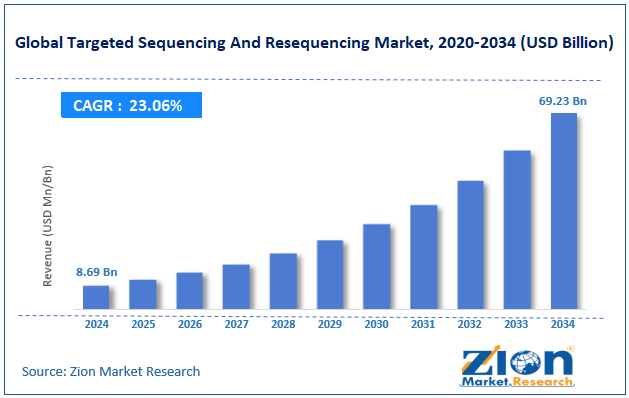
The global targeted sequencing and resequencing market size was worth around USD 8.69 billion in 2024 and is predicted to grow to around USD 69.23 billion by 2034, with a compound annual growth rate (CAGR) of roughly 23.06% between 2025 and 2034.
Key Insights:
- As per the analysis shared by our research analyst, the global targeted sequencing and resequencing market is estimated to grow annually at a CAGR of around 23.06% over the forecast period (2025-2034)
- In terms of revenue, the global targeted sequencing and resequencing market size was valued at around USD 8.69 billion in 2024 and is projected to reach USD 69.23 billion by 2034.
- The targeted sequencing and resequencing market is projected to grow at a significant rate due to the increasing cancer research worldwide
- Based on the technology, the sequencing segment is growing at a high rate and will continue to dominate the global market, as per industry projections
- Based on the type, the DNA-based targeted sequencing segment is anticipated to command the largest market share
- Based on region, North America is projected to dominate the global market during the forecast period
Targeted Sequencing And Resequencing Market: Overview
Targeted sequencing is a method employed in healthcare and research that sequences only specific genomic regions of interest. It does not include sequencing the entire genome. Targeted sequencing and resequencing help focus on specific regions or genes. It is considered a more effective alternative to traditional methods of broader sequencing, such as Whole Genome Sequencing (WGS). According to market analysis, targeted sequencing is specifically beneficial for studying complex genomic regions. It can also follow WGS procedures to examine the results in detail. During the forecast period, demand for targeted sequencing and resequencing is expected to continue growing due to rising end-user applications. For instance, industry research suggests greater integration of targeted sequencing in cancer research and drug development.
Furthermore, the growing demand for precision medicine is expected to open new avenues for extended revenue in the market. The target sequencing and resequencing industry may be affected by the high investment costs associated with the market, as well as regulatory concerns.
Targeted Sequencing And Resequencing Market Dynamics
Growth Drivers
What will be the impact of growing cancer research on the targeted sequencing and resequencing market growth?
The global targeted sequencing and resequencing market is expected to deliver favorable responses to increasing cancer research worldwide. According to industry analysis, targeted sequencing is a widely adopted method in cancer-related studies. It is used for targeting cancer-specific genes. The method is employed to identify and research mutations that lead to different types of cancer. In addition, targeted sequencing and resequencing are used to study tumor biology. The growing number of patients worldwide suffering from cancer has resulted in increased investments toward developing effective treatment plans.
For instance, the Reimagining Cancer Research in Europe is a novel joint initiative between the Union for International Cancer Control (UICC) and its member societies. The collaboration has already funded 1.2 million Euros across six European countries for implementing cancer research projects with a special focus on early detection and prevention of the disease.
Rising cases of serious infectious diseases globally are expected to propel industry revenue during the forecast period
A market study indicates growing use of targeted sequencing methods to study and monitor viral genomes and infectious disease outbreaks. The demand for targeted sequencing and resequencing accelerated during COVID-19 and has continued at a similar pace in the last few years. According to the Cleveland Clinic, the world is currently plagued by hundreds of viral diseases. While some of them can be treated easily, others are more dangerous and fatal in certain circumstances.
Some of the viral infectious diseases include chickenpox, chikungunya, dengue, diphtheria, and Ebola. As per official reports, approximately 35,000 Ebola cases had been reported worldwide between 1976 and 2022. As the number of patients suffering from infectious diseases continues to grow, investments in the global targeted sequencing and resequencing market are expected to rise steadily.
Restraints
Why will cost barriers limit targeted sequencing and resequencing market growth?
The global industry for targeted sequencing and resequencing will be affected by the high cost of investment associated with technology and equipment procurement. Automation systems and sequencers used for the gene sequencing method are highly expensive, limiting the number of investors worldwide. The average cost of a Deoxyribonucleic acid (DNA) sequencer ranges from USD 20,000 to USD 1.1 million.
Opportunities
Surging demand for precision and customized medicines creates growth opportunities
The global targeted sequencing and resequencing market can expect novel growth opportunities in the form of rising demand for precision and customized medicines. Industry experts are leveraging targeted sequencing to develop personalized treatment plans for patients suffering from rare and fatal medical conditions. The global personalized medicine market is expected to cross over USD 1.15 trillion by 2035, with a special focus on oncology and genetic disorders. Precision medicine has proven highly effective in treating several serious medical cases. Additionally, targeted therapy can also assist in reducing the risk of disease progression and recurrence.
How will integration with Artificial Intelligence (AI) influence targeted sequencing and resequencing market growth trends?
Artificial Intelligence is witnessing rapid integration with targeted sequencing and resequencing solutions worldwide. AI integration can help accelerate sequencing results with higher accuracy than the currently used methods. In June 2025, Google DeepMind, a research laboratory, launched AlphaGenome. It is an AI-powered technology that accurately predicts how single mutations in DNA will impact a wide range of biological processes regulating genes. Such innovations are expected to advance the adoption of modern targeted sequencing methods worldwide and in all forms of health-based research.
Challenges
Regulatory and ethical concerns will challenge the market growth trajectory in the coming years
The global industry for targeted sequencing and resequencing is expected to face regulatory hurdles, challenging market players. Legal frameworks governing testing, clinical trials, and data privacy are highly dynamic and complex, creating growth barriers for industry players. Additionally, targeted sequencing is often subject to ethical concerns, especially when dealing with informed consent. This can further affect market growth trends in the future.

Targeted Sequencing And Resequencing Market: Report Scope
| Report Attributes | Report Details |
|---|---|
| Report Name | Targeted Sequencing And Resequencing Market |
| Market Size in 2024 | USD 8.69 Billion |
| Market Forecast in 2034 | USD 69.23 Billion |
| Growth Rate | CAGR of 23.06% |
| Number of Pages | 213 |
| Key Companies Covered | DNASTAR, Illumina, Thermo Fisher Scientific, Pacific Biosciences (PacBio), RainDance Technologies, PierianDx, GATC Biotech AG, Agilent Technologies, Macrogen, F. Hoffmann-La Roche (Roche), PerkinElmer, Bio-Rad Laboratories, Genomatix GmbH, Integrated DNA Technologies (IDT), BGI Group, and others. |
| Segments Covered | By Technology, By Application, By Type, and By Region |
| Regions Covered | North America, Europe, Asia Pacific (APAC), Latin America, Middle East, and Africa (MEA) |
| Base Year | 2024 |
| Historical Year | 2019 to 2023 |
| Forecast Year | 2025 - 2034 |
| Customization Scope | Avail customized purchase options to meet your exact research needs. Request For Customization |
Targeted Sequencing And Resequencing Market: Segmentation
The global targeted sequencing and resequencing market is segmented based on technology, application, type, and region.
Based on technology, the global market segments are sequencing and resequencing. In 2024, around 71% of the total revenue was led by the sequencing segment. Market players are working on lowering costs related to sequencing technologies, which may enable higher segmental revenue during the forecast period. Additionally, growing end-user applications of sequencing methods across cancer research and the development of precision medicine will further help the segment thrive.
Based on application, the global targeted sequencing and resequencing market is divided into drug development, plant & animal sciences, clinical application, and others.
Based on type, the global market divisions are DNA-based target sequencing and RNA-based target sequencing. The industry witnessed the highest revenue generated by the DNA-based targeted sequencing in 2024, and similar trends can be expected in the future. Targeted sequencing considerably reduced the cost and time spent on data analysis since it only focuses on specific areas of interest. The rising use of targeted gene panels will fuel segmental revenue in the future.
Targeted Sequencing And Resequencing Market: Regional Analysis
Which factors will mark growth in the targeted sequencing and resequencing market in Asia-Pacific during the forecast period?
The global targeted sequencing and resequencing market is projected to be led by North America during the forecast period. The region accounted for nearly 52% of the global revenue in 2024. Growth in North America is heavily influenced by the presence of crucial market leaders shaping the regional and global industry.
In November 2025, the University of Texas MD Anderson Cancer Center announced the launch of a USD 2.5 billion philanthropic campaign called the Only Possible Here, The Campaign to End Cancer. Asia-Pacific is set to emerge as a critical player in the industry, with China and India leading the regional market. The rising number of infectious diseases across Asian countries, along with the growing demand for precision medicine, will promote higher revenue across the Asia-Pacific.
In October 2025, Taiwan-based Genomics BioSci & Tech, a gene sequencing company, announced a strategic partnership with Illumina. The companies will jointly work on promoting gene sequencing and multi-omics technologies across Asia-Pacific. Furthermore, rising investments in cancer research across the region and growing technological advancements in sequencing technology will benefit the regional market during the forecast period.
Targeted Sequencing And Resequencing Market: Competitive Analysis
The global targeted sequencing and resequencing market is led by players like:
- DNASTAR
- Illumina
- Thermo Fisher Scientific
- Pacific Biosciences (PacBio)
- RainDance Technologies
- PierianDx
- GATC Biotech AG
- Agilent Technologies
- Macrogen
- F. Hoffmann-La Roche (Roche)
- PerkinElmer
- Bio-Rad Laboratories
- Genomatix GmbH
- Integrated DNA Technologies (IDT)
- BGI Group
Targeted Sequencing And Resequencing Market: Key Market Trends
Study of biomarkers
Targeted sequencing and resequencing are used extensively to study genetic variants and biomarkers. The method is highly effective at understanding the underlying causes and mechanisms of complex diseases that currently have limited or moderately effective treatment options.
Global strategic partnerships
The world of targeted sequencing and resequencing is witnessing rising strategic transcontinental and cross-border partnerships. The collaborations are either aimed at improving the overall efficiency of the sequencing technology or knowledge sharing. It also helps companies enter new and emerging markets without 100% compliance.
The global targeted sequencing and resequencing market is segmented as follows:
By Technology
- Sequencing
- Resequencing
By Application
- Drug Development
- Plant & Animal Sciences
- Clinical Application
- Others
By Type
- DNA-based Target Sequencing
- RNA-based Targeted Sequencing
By Region
- North America
- The U.S.
- Canada
- Mexico
- Europe
- France
- The UK
- Spain
- Germany
- Italy
- Rest of Europe
- Asia Pacific
- China
- Japan
- India
- Australia
- South Korea
- Rest of Asia Pacific
- The Middle East & Africa
- Saudi Arabia
- UAE
- Egypt
- Kuwait
- South Africa
- Rest of the Middle East & Africa
- Latin America
- Brazil
- Argentina
- Rest of Latin America
Table Of Content
Methodology
FrequentlyAsked Questions

HappyClients

