
Targeted Drug Delivery Market Size, Share, Trends, Growth 2034

Targeted Drug Delivery Market By Disease Type (Infectious Diseases, Cardiovascular Diseases, Endocrine Diseases, Pulmonary Diseases, and Oncological Diseases), By Application (First-Order Targeting, Second-Order Targeting, and Third-Order Targeting), By End-User (Clinics, Hospitals, and Others), and By Region - Global and Regional Industry Overview, Market Intelligence, Comprehensive Analysis, Historical Data, and Forecasts 2026 - 2034
| Market Size in 2025 | Market Forecast in 2034 | CAGR (in %) | Base Year |
|---|---|---|---|
| USD 11.4 Billion | USD 39.6 Billion | 14.76% | 2025 |
Targeted Drug Delivery Industry Perspective:
What is the anticipated size of the targeted drug delivery market during the projection period?
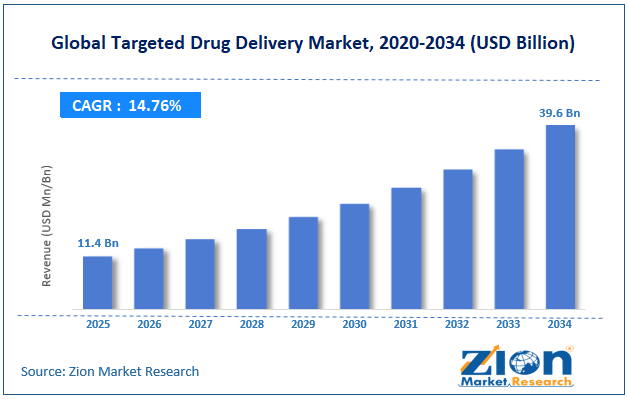
The global targeted drug delivery market size was worth around USD 11.4 billion in 2025 and is predicted to grow to around USD 39.6 billion by 2034, with a compound annual growth rate (CAGR) of roughly 14.76% between 2026 and 2034.
Key Insights:
- As per the analysis shared by our research analyst, the global targeted drug delivery market is estimated to grow annually at a CAGR of around 14.76% over the forecast period (2026-2034)
- In terms of revenue, the global targeted drug delivery market size was valued at around USD 11.4 billion in 2025 and is projected to reach USD 39.6 billion, by 2034.
- The targeted drug delivery market is projected to grow at a significant rate due to the rising prevalence of cancer and chronic diseases, higher demand for precision medicine, and growing healthcare expenditure.
- Based on the disease type, the cardiovascular diseases segment is growing at a high rate and will continue to dominate the global market as per industry projections.
- Based on the application, the first-order targeting segment was the highest revenue generator, and it will continue leading the market.
- Based on the end-user, the hospitals segment is expected to lead the market growth trends.
- Based on region, North America is projected to dominate the global market during the forecast period.
Targeted Drug Delivery Market: Overview
Targeted drug delivery (TDD) is a breakthrough approach to deliver drugs to targeted sites in the body. TDD is a novel drug delivery mechanism that aims to minimize drug release in other parts of the body. This mechanism enhances overall drug pharmacological activities and reduces unwanted reactions. Recent technological developments, such as new nanocarriers and drug-delivering medical devices, will encourage market growth during the forecast period. Conventional drug delivery systems often fail to deliver the expected level of effectiveness, especially for certain conditions. Targeted drug delivery technologies can help fill the existing gap and ensure optimal patient care in the long run. The global targeted drug delivery market is expected to be driven by rising prevalence of cancer and chronic diseases, higher demand for precision medicine, and growing healthcare expenditure. Ongoing market innovation will continue to fuel higher revenue in the coming years. However, high cost of TDD, lack of effective infrastructure, and absence of skilled professionals may affect overall market revenue in the long run.
Impact of the USA-Israel and Iran war on the Targeted Drug Delivery Market:
The USA-Israel and Iran war has affected the supply chain of raw materials and final goods concerning the targeted drug delivery market. This includes export and import of pharmaceutical polymers, lipids, specialty chemicals, and nanoparticles. Delayed delivery and high logistics cost has raised uncertainty among market leaders. In the long run, the war is anticipated to encourage more strategic and resilient supply chain networks among international partners.
Targeted Drug Delivery Market: Dynamics
Growth Drivers
Why will rising prevalence of cancer and chronic medical conditions drive demand in the targeted drug delivery market?
The global targeted drug delivery market is projected to be driven by the growing prevalence of cancer and chronic medical conditions, such as respiratory disorders, neurological disorders, and cardiovascular diseases. According to the American Association for Cancer, more than 20 million new cancer cases were reported globally in 2025. The pressure on existing healthcare infrastructure is mounting to unprecedented levels due to a rapid surge in patients and a significant lack of effective medical care in most parts of the world. Targeted drug delivery systems improve drug effectiveness and limit the risk of side effects. As per official records, targeted therapies for cancer treatment can be as effective as 80%, whereas traditional non-targeted therapies offer around a 31% chance of success.
Growing investments in precision medicine to create higher revenue for the market players
Precision medicine is a new healthcare approach that offers tailored treatment programs depending on the patient’s environment, lifestyle, and genetic makeup. Regional regulatory bodies such as the US Food & Drug Administration (FDA) and others are offering favorable, supportive initiatives to encourage greater investment in improving the accessibility and effectiveness of personalized medical care. The solutions in the global targeted drug delivery market are expected to play a crucial role in shaping the adoption of precision medicine in healthcare infrastructure during the forecast period.
Restraints
Which factors contribute to cost limitations in the targeted drug delivery industry?
The global targeted drug delivery industry is projected to be limited due to the high cost of treatment. The use of next-generation technologies to deliver targeted therapies and complex manufacturing processes contribute to high treatment costs. Targeted drug delivery systems use special and advanced raw materials such as liposomes and nanoparticles. In addition, they can only be produced in high-tech facilities, which further increases overall development expense. The availability of relatively affordable alternatives will affect industry revenue in the long run.
Opportunities
How are technological advancements expected to contribute to targeted drug delivery market growth?
The global targeted drug delivery market is expected to see new growth opportunities due to ongoing technological advancements. Targeted drug delivery-based developments in robotics and nanotechnology have gained significant attention from market investors and researchers. In August 2026, the US Department of Energy Office of Science published an article highlighting the role of nanoplatelets in effective targeted cancer therapy. Researchers are investigating nanoplatelets made from alkali metal-substituted alpha-zirconium phosphate for targeted radionuclide therapy (TRT). The process will include transportation of radioactive isotopes directly to cancer tumors, either destroying or imaging them. Scientists at Lehigh University's P.C. Rossin College of Engineering and Applied Science are studying how tiny robots move through the body to deliver drugs to the exact target location, opening new growth avenues for market leaders.
Challenges
Toxicity concerns, performance & technical limitations, and regulatory restrictions challenge industry growth
The global targeted drug delivery industry is expected to face challenges from concerns about delivery-system biocompatibility and toxicity risk. Drug delivery systems, such as nanoparticles, may cause the immune system to react unexpectedly, putting patients' lives at risk. Additional performance and technical limitations, including chances of nanocarrier accumulation in other body organs, may further impact industry revenue. Regulatory restrictions will continue to limit industry expansion in the coming years.
Targeted Drug Delivery Market: Report Scope
| Report Attributes | Report Details |
|---|---|
| Report Name | Targeted Drug Delivery Market |
| Market Size in 2025 | USD 11.4 Billion |
| Market Forecast in 2034 | USD 39.6 Billion |
| Growth Rate | CAGR of 14.76% |
| Number of Pages | 227 |
| Key Companies Covered | Johnson & Johnson, AbbVie Inc., Eli Lilly and Company, F. Hoffmann-La Roche Ltd., Daiichi Sankyo Co. Ltd, AstraZeneca PLC, Becton Dickinson and Company, Merck & Co. Inc., Baxter International Inc., Boston Scientific Corporation, Amgen Inc., Novartis AG, Arrowhead Pharmaceuticals Inc., Pfizer Inc., Sanofi S.A., and others. |
| Segments Covered | By Disease Type, By Application, By End-User, and By Region |
| Regions Covered | North America, Europe, Asia Pacific (APAC), Latin America, Middle East, and Africa (MEA) |
| Base Year | 2025 |
| Historical Year | 2020 - 2024 |
| Forecast Year | 2026 - 2034 |
| Customization Scope | Avail customized purchase options to meet your exact research needs. Request For Customization |
Targeted Drug Delivery Market: Segmentation
The global targeted drug delivery market is segmented based on disease type, application, end-user, and region.
Why will the cardiovascular diseases segment lead the targeted drug delivery industry revenue during the forecast period?
Based on disease type, the global market segments are infectious diseases, cardiovascular diseases, endocrine diseases, pulmonary diseases, and oncological diseases. In 2025, the cardiovascular diseases segment showed the highest growth. It accounted for 21.1% of the global revenue and will continue to lead the market due to the growing number of patients. The pulmonary diseases segment is anticipated to generate the highest CAGR of 17%. Increasing research on developing targeted therapies that deliver drugs directly to the lungs will drive segmental growth.
Which will be the fastest-growing application during the forecast period in the targeted drug delivery market?
Based on application, the global targeted drug delivery industry is fragmented into first-order targeting, second-order targeting, and third-order targeting. In 2025, the first-order targeting segment generated the highest revenue and will continue to lead the market. First-order targeting is simple to apply and has broader applications. In addition, the ongoing development of novel nanocarriers will encourage segmental expansion in the coming years.
Which factors drive demand in the hospitals segment in the targeted drug delivery industry?
Based on the end-user, the global market fragments are clinics, hospitals, and others. In 2025, hospitals were the leading revenue generator, accounting for 55% of the total market share. They will continue to grow at a strong CAGR due to rapid expansion of the healthcare infrastructure, technology integration across major hospitals, and availability of targeted drug therapies across hospital facilities.
Targeted Drug Delivery Market: Regional Analysis
Why will North America lead the targeted drug delivery market in the coming years?
The global targeted drug delivery market is currently led by North America. In 2025, it accounted for 38% of the global revenue and will grow at a strong CAGR during the forecast period. North America is home to the world’s leading pharmaceutical companies that are investing heavily in developing new targeted drug therapies. Additionally, regulatory support will play a crucial role in novel developments, clinical trials, and fast-track approvals. Higher regional demand for precision medicine will further boost regional revenue.
Why will Asia-Pacific generate the fastest CAGR in the targeted drug delivery market during the forecast period?
Asia-Pacific is expected to emerge as the fastest-growing region in the targeted drug delivery industry during the forecast period. The mounting burden on existing regional healthcare infrastructure, an aging population, the rising prevalence of cardiovascular and respiratory disorders, and the expansion of local drug manufacturing facilities will favor regional players. Moreover, growing research & development work and government incentives will shape growth across Asia-Pacific.
Targeted Drug Delivery Market: Competitive Analysis
The global targeted drug delivery market is led by players like:
- Johnson & Johnson
- AbbVie Inc.
- Eli Lilly and Company
- F. Hoffmann-La Roche Ltd.
- Daiichi Sankyo Co. Ltd
- AstraZeneca PLC
- Becton Dickinson and Company
- Merck & Co. Inc.
- Baxter International Inc.
- Boston Scientific Corporation
- Amgen Inc.
- Novartis AG
- Arrowhead Pharmaceuticals Inc.
- Pfizer Inc.
- Sanofi S.A.
What are the latest key trends in the targeted drug delivery market?
Antibody drug conjugates (ADCs) for cancer treatment
The growing use of ADCs as target platforms for cancer treatment is an emerging market trend. Antibody drug conjugates allow more selective drug delivery to cancer cells, ensuring optimal outputs in most cases.
Artificial Intelligence (AI) integrations
AI integration during the R&D stage can help optimize budgets instead of relying on trial-and-error development methods. AI can be leveraged to predict drug-release behavior and further interactions with the cells before the drug advances to clinical trials.
The global targeted drug delivery market is segmented as follows:
By Disease Type
- Infectious Diseases
- Cardiovascular Diseases
- Endocrine Diseases
- Pulmonary Diseases
- Oncological Diseases
By Application
- First-Order Targeting
- Second-Order Targeting
- Third-Order Targeting
By End-User
- Clinics
- Hospitals
- Others
By Region
- North America
- The U.S.
- Canada
- Mexico
- Europe
- France
- The UK
- Spain
- Germany
- Italy
- Rest of Europe
- Asia Pacific
- China
- Japan
- India
- Australia
- South Korea
- Rest of Asia Pacific
- The Middle East & Africa
- Saudi Arabia
- UAE
- Egypt
- Kuwait
- South Africa
- Rest of the Middle East & Africa
- Latin America
- Brazil
- Argentina
- Rest of Latin America
Table Of Content
Methodology
FrequentlyAsked Questions
Targeted drug delivery (TDD) is a breakthrough approach to deliver drugs to targeted sites in the body.
The global targeted drug delivery market is projected to be driven by the growing prevalence of cancer and chronic medical conditions, such as respiratory disorders, neurological disorders, and cardiovascular diseases.
According to study, the global targeted drug delivery market size was worth around USD 11.4 billion in 2025 and is predicted to grow to around USD 39.6 billion by 2034.
The CAGR value of the targeted drug delivery market is expected to be around 14.76% during 2026-2034.
The global targeted drug delivery industry is anticipated to be challenged by concerns over biocompatibility of delivery systems and toxicity risk.
Antibody drug conjugates (ADCs) for cancer treatment and Artificial Intelligence (AI) integrations are the emerging trends and innovations impacting the targeted drug delivery market.
The global targeted drug delivery market has performed well so far and will offer similar trends in the coming years.
North America will contribute notably towards the targeted drug delivery market value.
The global targeted drug delivery market is led by players like Johnson & Johnson, AbbVie Inc., Eli Lilly and Company, F. Hoffmann-La Roche Ltd., Daiichi Sankyo Co., Ltd, AstraZeneca PLC, Becton Dickinson and Company, Merck & Co., Inc., Baxter International Inc., Boston Scientific Corporation, Amgen Inc., Novartis AG, Arrowhead Pharmaceuticals, Inc., Pfizer Inc., Sanofi S.A., and others.
The report explores crucial aspects of the targeted drug delivery market, including a detailed discussion of existing growth factors and restraints, while also browsing future growth opportunities and challenges that impact the market.

HappyClients

