
Global Stainless Steel Scrap Market Size, Share, Growth Trends, and Forecast 2034

Stainless Steel Scrap Market By Stainless Steel Grade (300 Series/Austenitic, 200 Series, 400 Series, and Duplex & Specialty), By Scrap Source (Industrial/Manufacturing Scrap, Construction & Demolition Scrap, Automotive Scrap, Consumer & Appliance Scrap, and Industrial Equipment/End-of-Life Machinery), By Scrap Form (Solids, Turnings/Swarf, Stampings/Punchings, Mixed Stainless Scrap, Clippings/Light Scrap, and Bundles/Baled Scrap), By Processing (Collection, Sorting, Processing, Trading, and Remelting), and Region - Global and Regional Industry Overview, Market Intelligence, Comprehensive Analysis, Historical Data, and Forecasts 2026 - 2034
| Market Size in 2025 | Market Forecast in 2034 | CAGR (in %) | Base Year |
|---|---|---|---|
| USD 37.9 Billion | USD 69.1 Billion | 6.9% | 2025 |
Stainless Steel Scrap Industry Perspective:
What will be the size of the global stainless steel scrap market during the forecast period?
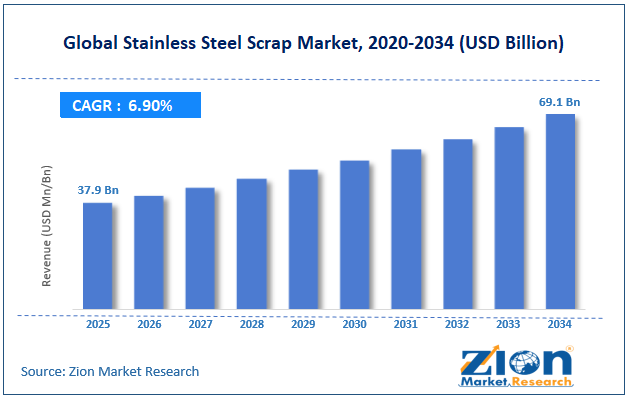
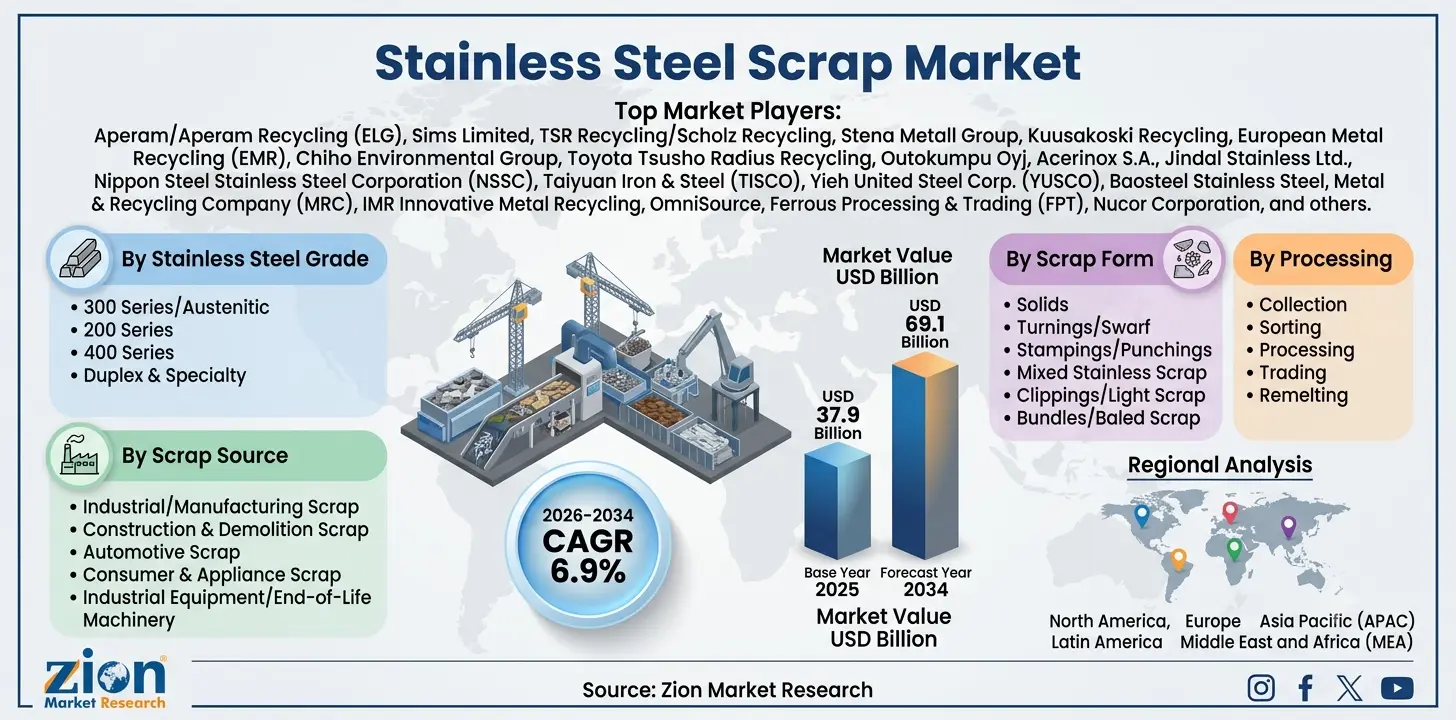
The global stainless steel scrap market size was worth around USD 37.9 billion in 2025 and is predicted to grow to around USD 69.1 billion by 2034, with a compound annual growth rate (CAGR) of roughly 6.9% between 2026 and 2034.
Key Insights
- As per the analysis shared by our research analyst, the global stainless steel scrap market is estimated to grow annually at a CAGR of around 6.9% over the forecast period (2026-2034).
- In terms of revenue, the global stainless steel scrap market size was valued at around USD 37.9 billion in 2025 and is projected to reach USD 69.1 billion by 2034.
- Expansion of circular economy practices is expected to propel the stainless steel scrap market over the projected period.
- Based on the stainless steel grade, the 300 series/austenitic segment dominates the market.
- Based on the scrap source, the industrial/manufacturing scrap segment holds a majority of market share in 2025.
- Based on the scrap form, the solids segment holds a majority of market share in 2025.
- Based on processing, the collection segment is forecast to see a steady increase in stainless steel scrap sales.
- Based on region, the Asia Pacific holds the largest market share in 2025.
Stainless Steel Scrap Market: Overview
The stainless steel scrap market includes all collection, processing, trading, and recycling activities for stainless steel materials discharged as waste during manufacturing, construction and demolition, automotive, industrial, electrical and consumer goods, and other equipment and structures. These materials include stainless steel alloys in the 200, 300, and 400 series, including duplex and other grades. As stainless steel contains chromium, nickel, and molybdenum, it can be recycled. Processing firms sort and classify this metal scrap into specific categories and shapes, then prepare it for melting in electric arc furnaces to produce new stainless steel materials and other metal products.
Thus, the market aggregates potential scrap collectors, processors, buyers, recyclers, steel mills, and stainless steel producers. Moreover, stainless steel scrap market growth is driven by the push to recycle metals and the resulting demand for post-consumer stainless steel scrap, resource conservation, reduced use of virgin ore, and decarbonization of steel production.
Impact of the USA-Israel War on Iran on the Stainless Steel Scrap Market
The U.S.-Israel war with Iran will have a short-term impact on the stainless steel scrap market, mainly through higher energy, freight, insurance, and logistics costs. Disputes and significantly reduced traffic through the Strait of Hormuz create additional risks for maritime transport and hinder the flow of metals and raw materials. Higher transportation and steel production costs can raise stainless steel and scrap prices.
Moreover, a temporary reduction in steelmaking activity and construction in the Middle East will decrease demand for metal scrap in the region. At the same time, risk management by steel mills and recyclers may drive demand for local stainless steel scraps and their inventories, increasing supply in Europe, Asia, and other regions.
Stainless Steel Scrap Market: Dynamics
Growth Drivers
How does the rising demand for low-carbon steel production drive the stainless steel scrap market?
The growing need to reduce the carbon footprint of steel production is a main driver of demand for stainless steel scrap. This is because steel production using scrap as a resource typically produces lower carbon emissions than traditional ore-based methods. According to World Steel Association data, carbon emissions for steel production using scrap-EAF amounted to 0.69 tonnes of CO2 per tonne of crude steel in 2024, while for BF-BOF production, they were equal to 2.34 tonnes of CO2 per tonne of crude steel, which is around 71% higher. This trend is especially evident in stainless steel production, as higher scrap incorporation typically significantly reduces carbon emissions. World Stainless data show that stainless steel production using 85% scrap generated 1.95 tonnes of emissions per tonne of steel, compared with 3.70 tonnes of CO2 per tonne for production with 50% scrap and 6.80 tonnes for production with 30% scrap.
As a result, many steel producers are interested in using higher amounts of stainless steel scrap to reduce carbon emissions and meet stricter decarbonization regulations, creating additional supply-chain dynamics for recycling and processing stainless scrap.
Restraints
Volatility in scrap and nickel prices acts as a major restraint on the growth of the stainless steel scrap industry
Fluctuations in scrap and nickel prices are among the main challenges facing the stainless steel scrap market, hindering growth. Because nickel is the main constituent of 300 series stainless steel, changes in nickel prices affect stainless steel scrap prices. A significant drop in nickel prices lowers the value of nickel-containing stainless steel scrap, which may result in losses for recyclers who bought the scrap at a higher price.
Moreover, a sudden increase in nickel prices may motivate suppliers to hold stainless steel scrap and may also prevent steel mills from buying stainless steel scrap. Past price dynamics show that sudden increases or decreases in stainless steel scrap prices affect steel mills' buying behavior. For instance, mills reduce stainless steel scrap purchases when prices rise, and they buy more when prices fall. As a result, unpredictable price changes may reduce inventory, contract sales, and profits, which will also slow growth in the stainless steel scrap market.
Opportunities
How does the growing partnership among the key market players for the supply of low-emission steel offer a lucrative opportunity for the stainless steel scrap market?
Growing collaboration among steelmakers, recyclers, suppliers, mining companies, and downstream buyers creates attractive opportunities in the stainless steel scrap market by enabling long-term supply contracts for low-emission stainless steel. These relationships benefit producers, as modern stainless steel manufacturing that uses higher amounts of recycled materials requires high-quality resources. According to World Stainless, producing 1 tonne of stainless steel with an 85% scrap content emits nearly 1.95 tonnes of CO2, compared with 3.70 tonnes of CO2 at 50%.
For instance, in June 2025, Alstom, a world leader in smart and sustainable mobility, and Outokumpu, a global leader in sustainable stainless steel, announced a partnership to supply stainless steel with up to a 93% lower carbon footprint than the industry average. The first delivery of the Outokumpu Circle Green® stainless steel is expected in 2026 and will be integrated into the newest generation of Alstom Metropolis metro trains. The agreement supports Alstom’s eco-design policy and sustainable sourcing strategy, with a target to reduce carbon emissions from purchased goods and services by 30% by 2030.
Challenges
Why do the high investment requirements for advanced sorting pose a significant challenge to the growth of the stainless steel scrap industry?
High investment costs for sophisticated sorting technologies can impede growth in the stainless steel scrap market because advanced facilities using X-ray fluorescence (XRF), X-ray transmission (XRT), LIBS, induction, or artificial intelligence (AI) sorters are required to identify and separate diverse stainless steel grades. Indeed, modern high-tech sorters can recognize valuable stainless steel grades (e.g., 304, 316, 201) to ensure the production of higher-grade, homogeneous scrap metals. At the same time, the cost of advanced recycling facilities is associated with significant capital expenditures (on sorters), conveyor belts, sensors, software, installation works, maintenance, and professional operators.
Therefore, integrating cutting-edge technologies into private recycling operations may be particularly challenging for small and medium-sized companies with limited access to financial resources. Moreover, these capital-intensive projects may struggle to remain profitable amid stainless steel price volatility or reduced scrap processing volumes. As a result, many recyclers opt to process stainless steel using conventional methods instead of investing in high-tech equipment.
Stainless Steel Scrap Market: Report Scope
| Report Attributes | Report Details |
|---|---|
| Report Name | Stainless Steel Scrap Market |
| Market Size in 2025 | USD 37.9 Billion |
| Market Forecast in 2034 | USD 69.1 Billion |
| Growth Rate | CAGR of 6.9% |
| Number of Pages | 227 |
| Key Companies Covered | Aperam/Aperam Recycling (ELG), Sims Limited, TSR Recycling/Scholz Recycling, Stena Metall Group, Kuusakoski Recycling, European Metal Recycling (EMR), Chiho Environmental Group, Toyota Tsusho Radius Recycling, Outokumpu Oyj, Acerinox S.A., Jindal Stainless Ltd., Nippon Steel Stainless Steel Corporation (NSSC), Taiyuan Iron & Steel (TISCO), Yieh United Steel Corp. (YUSCO), Baosteel Stainless Steel, Metal & Recycling Company (MRC), IMR Innovative Metal Recycling, OmniSource, Ferrous Processing & Trading (FPT), Nucor Corporation, and others. |
| Segments Covered | By Stainless Steel Grade, By Scrap Source, By Scrap Form, By Processing, and By Region |
| Regions Covered | North America, Europe, Asia Pacific (APAC), Latin America, Middle East, and Africa (MEA) |
| Base Year | 2025 |
| Historical Year | 2020 - 2024 |
| Forecast Year | 2026 - 2034 |
| Customization Scope | Avail customized purchase options to meet your exact research needs. Request For Customization |
Stainless Steel Scrap Market: Segmentation
Stainless Steel Grade Insights
Why does the 300 series/austenitic segment hold a prominent position in the stainless steel scrap market?
The 300 series/austenitic segment dominates the market. Market growth (based on the share of grades 304 and 316) is driven by extensive use and the grade's relatively high value. The segment has high nickel and chromium content, making it extremely desirable for remelting and recycling into new stainless steel.
Scrap Source Insights
How does the industrial/manufacturing scrap segment capture the largest share in the stainless steel scrap market?
The industrial/manufacturing scrap segment holds a majority of market share in 2025. Revenue growth in this market segment is driven by rising scrap use in electric-arc-furnace steelmaking and circular manufacturing, as manufacturers aim to cut raw material costs, conserve nickel and chromium, and reduce carbon emissions. Industrial scrap usually offers better value than post-consumer scrap because it comes from specific mills and can therefore be segregated by grade, making it more consistent in composition and higher in value.
Scrap Form Insights
Why does the solids segment capture the largest share in the stainless steel scrap market?
The solids segment holds a majority of market share in 2025. Growth is favored by the availability of good scrap, such as stainless steel sheets, plates, bars, pipes, tubes, structural shapes, and fabrication scraps, which are generally simpler to collect, classify, analyze, and remelt than fragmented or contaminated stainless steel scrap. In addition, compared with mixed household or industrial waste, relatively pure solid stainless steel scraps have a predictable chemical composition, especially at the grade level (e.g., 304 or 316), allowing recyclers and steel producers to produce higher-value alloys.
Processing Insights
How does the collection segment capture the largest share in the Stainless Steel Scrap market?
The collection segment is forecast to see a steady increase in stainless steel scrap sales, driven by rising stainless steel consumption, which increases production and, in turn, stainless steel waste and end-of-life products. Stainless steel is highly collectible because it contains significant amounts of elements such as chromium, nickel, and molybdenum. As a result, scrap collectors find it lucrative to collect discarded stainless steel products instead of letting them go to waste. Approximately 95% of stainless steel is reprocessed at the end of its life, according to World Stainless.
Regional Insights
What factors drive the Asia Pacific region in the stainless steel scrap market?
The Asia Pacific stainless steel scrap market is anticipated to register significant revenue growth in the coming years. This is mainly due to higher stainless steel production in the region, more manufacturers, and rising demand for secondary raw materials. According to WorldStainless, in 2025, Asia produced 55.3 million tonnes of stainless steel, accounting for around 86% of the total 64.2 million tonnes. In the region, Asia’s stainless steel production increased by 2.7% year-over-year (YoY) to 55.3 million tonnes. Of that, China produced 40.9 million tonnes of stainless steel, up 3.6% YoY. Demand for stainless steel scrap is rising significantly, as it serves as an essential source of secondary raw material.
Additionally, according to the South East Asia Iron and Steel Institute (SEAISI), stainless steel production in India rose 22% year-over-year (YoY) to 1.71 million tonnes in Jan-May 2025. In addition, stainless steel scrap imports from India climbed 41% YoY to 602,000 tonnes in Jan-May 2025. On the other hand, 300 series stainless steel scrap imports increased 56% YoY to 431,000 tonnes, with 304 stainless steel scrap rising 72% year-over-year and 316 stainless steel scrap rising 75% YoY.
Stainless Steel Scrap Market: Competitive Analysis
The global stainless steel scrap market is dominated by players like:
- Aperam/Aperam Recycling (ELG)
- Sims Limited
- TSR Recycling/Scholz Recycling
- Stena Metall Group
- Kuusakoski Recycling
- European Metal Recycling (EMR)
- Chiho Environmental Group
- Toyota Tsusho Radius Recycling
- Outokumpu Oyj
- Acerinox S.A.
- Jindal Stainless Ltd.
- Nippon Steel Stainless Steel Corporation (NSSC)
- Taiyuan Iron & Steel (TISCO)
- Yieh United Steel Corp. (YUSCO)
- Baosteel Stainless Steel
- Metal & Recycling Company (MRC)
- IMR Innovative Metal Recycling
- OmniSource
- Ferrous Processing & Trading (FPT)
- Nucor Corporation
The global stainless steel scrap market is segmented as follows:
By Stainless Steel Grade
- 300 Series/Austenitic
- 200 Series
- 400 Series
- Duplex & Specialty
By Scrap Source
- Industrial/Manufacturing Scrap
- Construction & Demolition Scrap
- Automotive Scrap
- Consumer & Appliance Scrap
- Industrial Equipment/End-of-Life Machinery
By Scrap Form
- Solids
- Turnings/Swarf
- Stampings/Punchings
- Mixed Stainless Scrap
- Clippings/Light Scrap
- Bundles/Baled Scrap
By Processing
- Collection
- Sorting
- Processing
- Trading
- Remelting
By Region
- North America
- The U.S.
- Canada
- Mexico
- Europe
- France
- The UK
- Spain
- Germany
- Italy
- Rest of Europe
- Asia Pacific
- China
- Japan
- India
- Australia
- South Korea
- Rest of Asia Pacific
- The Middle East & Africa
- Saudi Arabia
- UAE
- Egypt
- Kuwait
- South Africa
- Rest of the Middle East & Africa
- Latin America
- Brazil
- Argentina
- Rest of Latin America
Table Of Content
Methodology
FrequentlyAsked Questions
The stainless steel scrap market includes all collection, processing, trading, and recycling activities for stainless steel materials discharged as waste during manufacturing, construction and demolition, automotive, industrial, electrical and consumer goods, and other equipment and structures.
The key growth drivers for the stainless steel scrap market include rising demand for low-carbon steel production, increasing adoption of circular-economy and recycling practices, growth in stainless steel production across construction, automotive, manufacturing, and infrastructure sectors, and the high economic value of nickel, chromium, and molybdenum contained in stainless steel scrap.
The major challenges restraining the growth of the stainless steel scrap market include volatility in scrap and nickel prices, inconsistent scrap quality, contamination and mixing of different stainless steel grades, high investment requirements for advanced sorting and processing technologies, and limited availability of high-quality scrap in some regions.
Based on the stainless steel grade, the 300 series/austenitic segment is expected to dominate the stainless steel scrap market growth during the projected period.
Emerging trends in the stainless steel scrap market include the adoption of AI-powered sorting, sensor-based alloy identification, automation, digital traceability, and low-carbon recycling practices. Advanced technologies such as XRF, LIBS, induction sensors, computer vision, and machine learning are improving the identification and separation of grades such as 304 and 316, increasing scrap purity and recovery rates. AI and deep-learning systems are also being integrated into automated sorting lines to identify contaminants and different metal fractions in real time, reducing dependence on manual labor.
According to the report, the global stainless steel scrap market size was worth around USD 37.9 billion in 2025 and is predicted to grow to around USD 69.1 billion by 2034.
The global stainless steel scrap market is expected to grow at a CAGR of 6.9% during the forecast period.
The global stainless steel scrap industry growth is expected to be led by the Asia Pacific over the forecast period.
The global stainless steel scrap market is dominated by players like Aperam/Aperam Recycling (ELG), Sims Limited, TSR Recycling/Scholz Recycling, Stena Metall Group, Kuusakoski Recycling, European Metal Recycling (EMR), Chiho Environmental Group, Toyota Tsusho Radius Recycling, Outokumpu Oyj, Acerinox S.A., Jindal Stainless Ltd., Nippon Steel Stainless Steel Corporation (NSSC), Taiyuan Iron & Steel (TISCO), Yieh United Steel Corp. (YUSCO), Baosteel Stainless Steel, Metal & Recycling Company (MRC), IMR Innovative Metal Recycling, OmniSource, Ferrous Processing & Trading (FPT), and Nucor Corporation, among others.
The stainless steel scrap market report covers the geographical market along with a comprehensive competitive landscape analysis. It also includes cash flow analysis, profit ratio analysis, market basket analysis, market attractiveness analysis, sentiment analysis, PESTLE analysis, trend analysis, SWOT analysis, trade area analysis, demand & supply analysis, Porter’s five forces analysis, and value chain analysis.

HappyClients

