
Smart Mat Market Size, Trend, Growth, Industry Analysis 2034

Smart Mat Market By Type (Smart Yoga Mat, Smart Foot Mat and Others), By Distribution Channel (Online and Offline) and By Region - Global and Regional Industry Overview, Market Intelligence, Comprehensive Analysis, Historical Data, and Forecasts 2025 - 2034
| Market Size in 2024 | Market Forecast in 2034 | CAGR (in %) | Base Year |
|---|---|---|---|
| USD 154 Million | USD 339 Million | 8.2% | 2024 |
Smart Mat Industry Perspective:
What will be the size of the global Smart Mat market during the forecast period?
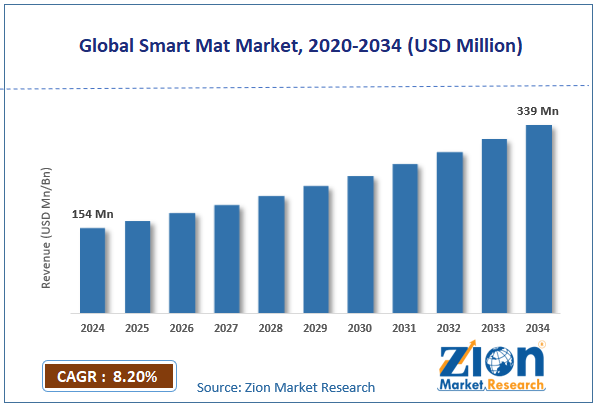
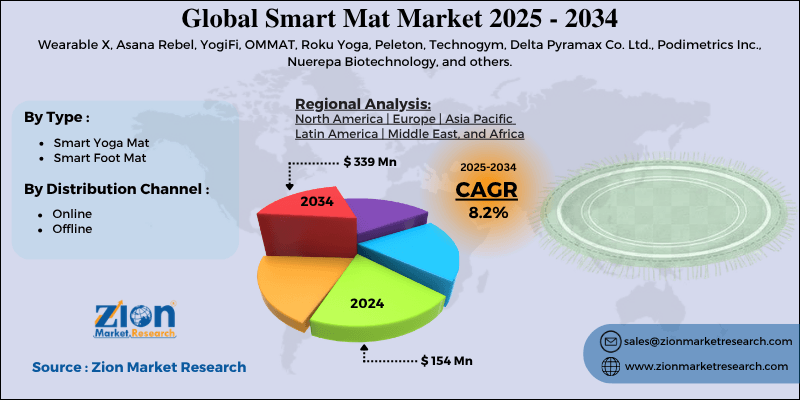
The global smart mat market size was worth around USD 154 million in 2024 and is predicted to grow to around USD 339 million by 2034 with a compound annual growth rate (CAGR) of roughly 8.2% between 2025 and 2034.
Smart Mat Market: Overview
A smart mat is a high-tech mat equipped with pressure sensors, motion sensors, electronic chips, wireless communication capabilities, and artificial intelligence to collect, evaluate, and relay information about users' activities in real time. Smart mats usually detect movement, position, balance, body posture, foot pressure, and other physical activities in areas such as exercise, yoga, rehabilitation, health monitoring, smart living, video gaming, and workplace health and safety. These mats may connect to smartphones, wearables, cloud computing platforms, or smart home technology via Bluetooth, Wi-Fi, or Internet of Things (IoT). In healthcare and geriatric care facilities, smart mats can be used to monitor falls, gait, and patients in general, and in fitness centers to perform posture correction, guide workouts, and measure physical activity, among other uses.
Key Insights
- As per the analysis shared by our research analyst, the global smart mat market is estimated to grow annually at a CAGR of around 8.2% over the forecast period (2025-2034).
- In terms of revenue, the global smart mat market size was valued at around USD 154 million in 2024 and is projected to reach USD 339 million by 2034.
- Expansion of smart home and IoT ecosystems is expected to propel the smart mat market over the projected period.
- Based on the type, the smart yoga mat segment captures the largest market share in 2024 of over 52%.
- Based on the distribution channel, the offline segment dominated the market with a highest revenue share in 2024.
- Based on region, North America captures the largest market share in 2024 of 35%.
Impact of the USA-Israel War on Iran on the Smart Mat Market
The ongoing conflict between the USA-Israeli alliance and Iran has had an indirect impact on the market for smart mats by disrupting the supply chains of electronics and semiconductors in the international market, resulting in higher prices for raw materials and delivery. As mentioned above, smart mats require sensors, electronics, communication chips, batteries, and semiconductors, all of which are sensitive to rising energy prices and disrupted deliveries due to tensions in the Strait of Hormuz. Higher delivery and electronics costs may increase manufacturers' smart mat costs, leading to a possible price rise for their goods. Additionally, higher inflation and lower consumer spending in certain parts of the world may prompt consumers to postpone purchases of luxury gadgets, such as smart fitness and wellness devices.
Smart Mat Market: Dynamics
Growth Drivers
Why does the growing smart fitness and wellness trend drive the smart mat market?
The adoption of intelligent fitness and wellness services is fueling demand for intelligent mats, as more individuals adopt these services for their personalized health and fitness benefits. Intelligent mats with pressure, motion, and posture sensors, and AI-based coaching services are becoming popular among individuals practicing yoga, exercising at home, meditating, and undergoing rehabilitation. The growing importance of physical fitness and preventive health and wellness platforms encourages people to exercise using technology-driven equipment that can be used alongside smartphones and fitness application.
Restraints
High product and technology cost hinder the growth of the smart mat industry
The high costs associated with product development and technologies constitute one of the primary barriers to the expansion of the smart mat industry, as these technologies involve complex sensors and electronic equipment such as pressure sensors, processors, wireless modules, battery-powered systems, and AI software. The incorporation of advanced technology components drives up production costs, thus making the final costs much higher than those of regular mats, which is a key challenge, especially in developing countries, where price becomes an issue. Besides, maintenance and repair costs for electronic parts are another concern for device owners.
Opportunities
Why does the rising number of product launches offer a lucrative opportunity for the smart mat market?
The rising number of product launch is expected to offer a lucrative opportunity to the smart mat market. For instance, in October 2025, Podimetrics, an innovation-driven healthcare organization specializing in difficult diabetes cases, has developed SmartMat+, the latest innovation designed to prevent falls, track heart failure symptoms, and help prevent diabetic foot ulcers. With virtual clinical guidance, the SmartMat+ system helps detect risks and implement measures to prevent diabetes-related complications. The company first released its SmartMat system in 2016, relying on scientific knowledge of remote temperature measurement to detect the early stages of an inflammation process, which research has proven to be the harbinger of diabetic ulcers. By detecting inflammation early in patients at risk, health professionals and insurance companies can take action to prevent the development of ulcers.
Challenges
Why does the data privacy and security concerns pose a significant challenge to the smart mat market?
One of the threats the smart mat faces concerns data privacy and cybersecurity, as such devices are in continuous use, gathering sensitive personal information from consumers about their movements, behavior, and physiological parameters via connected applications and cloud services. In consideration of the fact that the typical smart mat uses the following technologies: Wi-Fi, Bluetooth, Internet of Things, and mobile application services, it becomes evident that there are certain security challenges for a consumer, such as the threat of cyber-attack, abuse of personal information, data leakage, and theft. Potential buyers, as well as medical organizations, may be concerned about the security of their personal data when purchasing smart mats due to the threat of data breaches and the lack of security for patients' health and physical activity.
Smart Mat Market: Report Scope
| Report Attributes | Report Details |
|---|---|
| Report Name | Smart Mat Market |
| Market Size in 2024 | USD 154 Million |
| Market Forecast in 2034 | USD 339 Million |
| Growth Rate | CAGR of 8.2% |
| Number of Pages | 227 |
| Key Companies Covered | Wearable X, Asana Rebel, YogiFi, OMMAT, Roku Yoga, Peleton, Technogym, Delta Pyramax Co. Ltd., Podimetrics Inc., Nuerepa Biotechnology, and others. |
| Segments Covered | By Type, By Distribution Channel, and By Region |
| Regions Covered | North America, Europe, Asia Pacific (APAC), Latin America, Middle East, and Africa (MEA) |
| Base Year | 2024 |
| Historical Year | 2019 - 2023 |
| Forecast Year | 2025 - 2034 |
| Customization Scope | Avail customized purchase options to meet your exact research needs. Request For Customization |
Smart Mat Market: Segmentation
Type Insights
Why does the smart yoga mat dominate the smart mat market?
The smart yoga mat segment captures the largest market share in 2024 of over 52%. This increase can be attributed to the increasing worldwide trend of practicing yoga, home workouts, and online wellness apps. More consumers have been embracing technologically innovative yoga mats equipped with pressure sensors, automatic posture correction technology, body-motion tracking, artificial intelligence-based coaching, and app integration. The growing trend of home exercise, online classes, and other fitness ecosystems has significantly increased the adoption of technologically innovative yoga mats.
Distribution Channel Insights
How does the offline segment capture the largest market share in the smart mat market?
The offline segment holds the largest market share over the projected period. This growth is attributed to consumers' preference for hands-on evaluation of high-tech fitness and health products. Consumers will have access to various retail outlets, such as sports shops, electronics retailers, specialty fitness shops, grocery stores, and health centers, where they can evaluate product quality through sensory reactions and connective capabilities.
Regional Insights
Why does North America lead the smart mat market?
North America captures the largest market share in 2024 of 35%. This expansion is fueled by the widespread adoption of innovative fitness solutions, rising health and wellness trends, and extensive digital infrastructure in the area. US and Canadian consumers have been making more investments in smart fitness equipment, home products, and wellness solutions that are based on artificial intelligence. This has led to increased demand for items like smart yoga mats, rehabilitation mats, and physical activity trackers.
Moreover, home fitness training and wearable-based health applications are gaining popularity in the area, further contributing to market expansion. Besides, the high purchasing power of consumers, the rapid adoption of innovative IoT and artificial intelligence solutions, and the prevalence of innovative fitness technology and healthcare companies in the area have played an important role in this regard. The use of smart mats in elderly patients, physiotherapy, sports training, and healthcare monitoring has contributed to market revenue growth.
Smart Mat Market: Competitive Analysis
The global smart mat market is dominated by players like:
- Wearable X
- Asana Rebel
- YogiFi
- OMMAT
- Roku Yoga
- Peleton
- Technogym
- Delta Pyramax Co. Ltd.
- Podimetrics Inc.
- Nuerepa Biotechnology
The global smart mat market is segmented as follows:
By Type
- Smart Yoga Mat
- Smart Foot Mat
- Others
By Distribution Channel
- Online
- Offline
By Region
- North America
- The U.S.
- Canada
- Mexico
- Europe
- France
- The UK
- Spain
- Germany
- Italy
- Rest of Europe
- Asia Pacific
- China
- Japan
- India
- Australia
- South Korea
- Rest of Asia Pacific
- The Middle East & Africa
- Saudi Arabia
- UAE
- Egypt
- Kuwait
- South Africa
- Rest of the Middle East & Africa
- Latin America
- Brazil
- Argentina
- Rest of Latin America
Table Of Content
Methodology
FrequentlyAsked Questions
A smart mat is a high-tech mat equipped with pressure sensors, motion sensors, electronic chips, wireless communication capabilities, and artificial intelligence to collect, evaluate, and relay information about users' activities in real time.
Key growth drivers for the smart mat market include rising adoption of smart fitness and wellness technologies, growing demand for healthcare monitoring solutions, increasing integration of IoT and AI-based sensors, and expanding use of connected devices in smart homes and rehabilitation applications.
Major challenges restraining the growth of the smart mat market include high product costs, data privacy and cybersecurity concerns, limited consumer awareness, and durability and connectivity issues associated with advanced sensor technologies.
Based on the type, the smart yoga mat segment is expected to dominate the smart mat market growth during the projected period.
Emerging trends and innovations impacting the smart mat market include AI-powered posture analysis, IoT-enabled connectivity, integration with wearable and smart home ecosystems, flexible sensor technology, and growing adoption of app-based personalized fitness and healthcare monitoring solutions.
According to the report, the global smart mat market size was worth around USD 154 million in 2024 and is predicted to grow to around USD 339 million by 2034.
The global smart mat market is expected to grow at a CAGR of 8.2% during the forecast period.
The global smart mat industry growth is expected to be led by North America over the forecast period.
The global smart mat market is dominated by players like Wearable X, Asana Rebel, YogiFi, OMMAT, Roku Yoga, Peleton, Technogym, Delta Pyramax Co., Ltd., Podimetrics Inc. and Nuerepa Biotechnology among others.
The market report covers the geographical market along with a comprehensive competitive landscape analysis. It also includes cash flow analysis, profit ratio analysis, market basket analysis, market attractiveness analysis, sentiment analysis, PESTLE analysis, trend analysis, SWOT analysis, trade area analysis, demand & supply analysis, Porter’s five forces analysis, and value chain analysis.

HappyClients

