
Propylene Oxide Market Size, Share, Trends, Growth and Forecast 2034

Propylene Oxide Market By Production Process (Hydrogen Peroxide Process, Chlorohydrin Process (CHPO), Cumene-Based Process, Styrene Monomer Process, and TBA Co-Product Process), By Application (Polyalkylene Glycols, Polyether Polyols, Propylene Glycol Ethers (PGE), Propylene Glycols, and Others), By End-User Industry (Chemicals and Pharmaceuticals, Construction, Automotive, Textile & Furnishing, Packaging, and Others), and By Region - Global and Regional Industry Overview, Market Intelligence, Comprehensive Analysis, Historical Data, and Forecasts 2026 - 2034
| Market Size in 2025 | Market Forecast in 2034 | CAGR (in %) | Base Year |
|---|---|---|---|
| USD 20.25 Billion | USD 32.06 Billion | 5.24% | 2025 |
Propylene Oxide Industry Perspective:
What is the anticipated size of the propylene oxide market during the projection period?
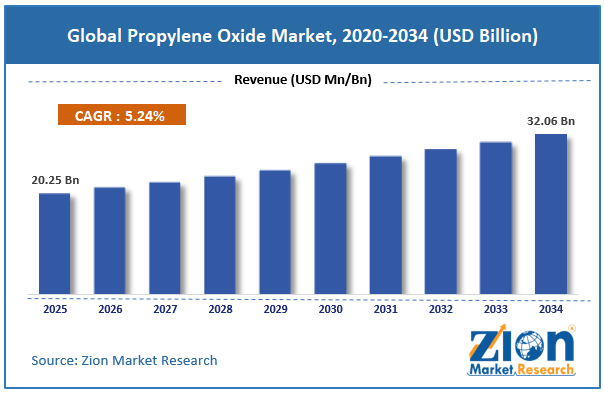
The global propylene oxide market size was worth around USD 20.25 billion in 2025 and is predicted to grow to around USD 32.06 billion by 2034, with a compound annual growth rate (CAGR) of roughly 5.24% between 2026 and 2034.
Key Insights:
- As per the analysis shared by our research analyst, the global propylene oxide market is estimated to grow annually at a CAGR of around 5.24% over the forecast period (2026-2034)
- In terms of revenue, the global propylene oxide market size was valued at around USD 20.25 billion in 2025 and is projected to reach USD 32.06 billion, by 2034.
- The propylene oxide market is projected to grow at a significant rate due to the growing use in the cosmetic industry, increasing applications in automotives, and sustainability trends.
- Based on the production process, the hydrogen peroxide process segment is growing at a high rate and will dominate the global market as per industry projections.
- Based on the application, the polyether polyols segment is anticipated to command the largest market share.
- Based on the end-user industry, the automotive industry segment is expected to lead the market growth trends.
- Based on region, Asia-Pacific is projected to dominate the global market during the forecast period.
Propylene Oxide Market: Overview
Propylene oxide is an inflammable, colorless, volatile liquid. Its odor is similar to ether, and it is known as a universal reagent. Due to its high reactiveness, propylene oxide is used as an essential feedstock for several commercial products. Items produced using these chemicals are known as propylene oxide derivatives. For instance, polyether polyols are a key component of flexible and rigid foams. On the other hand, propylene glycols are used as food additives and in de-icing systems. During the forecast period, demand for propylene oxide is expected to grow due to growing use in the cosmetic industry, increasing applications in automotives, and sustainability trends. However, high raw material price volatility, strict government regulations, and health & safety concerns will impact market revenue during the projection period.
Impact of the USA-Israel and Iran war on the Propylene Oxide Market:
The USA-Israel and Iran war has significantly affected the propylene oxide market in the form of delayed shipments, increased cost of raw materials, and a surge in insurance premiums. Petrochemical suppliers from the Middle Eastern countries are facing significant operational risks, especially for shipments passing through the Strait of Hormuz. In the coming years, the war is expected to influence the development of new shipping routes and novel strategic partnerships.
Propylene Oxide Market: Dynamics
Growth Drivers
How will the cosmetic sector influence growth in the propylene oxide market?
The global propylene oxide market is expected to be driven by the growing demand for emulsifiers and surfactants in cosmetic & personal care products. Propylene oxide is an important feedstock for producing ingredients for modern cosmetic items. For instance, polyether-based ingredients can improve skin texture and also promote moisture retention. The cosmetic and personal care sector has witnessed steady growth in the last few years. Factors such as rising disposable income, emerging beauty trends, demand for high-performance skin care products, and proliferation of beauty-based e-commerce channels are expected to contribute to demand for propylene oxide.
Growth in automotive production volume to promote market revenue in the coming years
Propylene oxide-based derivatives have extensive applications in producing interior and exterior components of modern vehicles. The compound is used in the production of vehicle headrests, seats, armrests, and insulation panels, among other polyurethane applications. Furthermore, propylene oxide-based materials facilitate lightweight vehicle strategies. The growing volume of automotives, including luxury and affordable, will propel demand in the global propylene oxide market during the forecast period. Moreover, rapid expansion of electric vehicles (EVs) and self-driving cars may further help the market thrive.
Restraints
Raw material price volatility and safety concerns limit expansion of the propylene oxide industry during the projection period
The global propylene oxide industry is expected to be restricted due to growing raw material price volatility. Propylene, the key feedstock for propylene oxide production, is sensitive to external market changes such as fluctuations in crude oil and natural gas availability. Intensifying geopolitical conflicts across major crude-oil-supplying regions have further destabilized propylene supply. Moreover, safety concerns associated with the compound's production, storage, transportation, and distribution affect overall industry revenue. Propylene oxide is a highly flammable and reactive compound. The US Environmental Protection Agency (EPA) has classified it as a Group B2 probable human carcinogen, resulting in limited adoption.
Opportunities
Which growth opportunities will the propylene oxide market players come across during the forecast period?
The global propylene oxide market players will come across new growth opportunities by investing in sustainable business practices. This includes efforts toward reducing emissions, optimizing production procedures, and use of green technologies. The increasing shift toward Hydrogen Peroxide to Propylene Oxide (HPPO) processes can reduce energy consumption and wastewater. A recent report by the US EPA estimates that HPPO procedures can reduce wastewater by 70 to 80%. Additionally, low-carbon propylene oxide production and sustainable feedstocks may open new growth avenues for market leaders. In September 2023, Qixiang Tengda, a leading market leader, announced the commencement of operations at its propylene oxide complex in China. With this move, the company began a new era of sustainable propylene oxide production using technology developed by Evonik and thyssenkrupp Uhde. The state-of-the-art complex has two plants. One is an HPPO facility, and the other is a hydrogen peroxide megaplant to produce raw material on-site.
Challenges
Which factors will challenge expansion of the propylene oxide industry during the forecast period?
The global propylene oxide industry will be challenged by regulatory pressure, high upfront investment, and demand from downstream applications. Production and distribution of propylene oxide is heavily regulated due to the sensitive nature of the compound. Moreover, it requires large-scale production facilities to produce a high volume of propylene oxide. Fluctuating downstream demand may impact business revenue in the long run.
Propylene Oxide Market: Report Scope
| Report Attributes | Report Details |
|---|---|
| Report Name | Propylene Oxide Market |
| Market Size in 2025 | USD 20.25 Billion |
| Market Forecast in 2034 | USD 32.06 Billion |
| Growth Rate | CAGR of 5.24% |
| Number of Pages | 228 |
| Key Companies Covered | BASF, Dow Chemical, China Petroleum & Chemical Corporation (Sinopec), Sumitomo Chemical, Mitsubishi Chemical, LyondellBasell Industries, AGC Chemicals, Indorama Ventures,Tokuyama Corporation, INEOS, NAGASE & CO., Shell, SKC, Repsol, SABIC, and others. |
| Segments Covered | By Production Process, By Application, By End-User Industry, and By Region |
| Regions Covered | North America, Europe, Asia Pacific (APAC), Latin America, Middle East, and Africa (MEA) |
| Base Year | 2025 |
| Historical Year | 2020 - 2024 |
| Forecast Year | 2026 - 2034 |
| Customization Scope | Avail customized purchase options to meet your exact research needs. Request For Customization |
Propylene Oxide Market: Segmentation
The global propylene oxide market is segmented based on production process, application, end-user industry, and region.
Why will the hydrogen peroxide process segment lead the propylene oxide industry revenue during the forecast period?
Based on production process, the global market segments are hydrogen peroxide process, chlorohydrin process (CHP), cumene-based process, styrene monomer process, and TBA co-product process. In 2025, the highest growth was listed in the styrene monomer process segment. It accounted for 29.25% of the global revenue. During the forecast period, the hydrogen peroxide process segment will grow at a faster CAGR of 10.01%. HPPO is an eco-friendly novel process that reduces wastewater and limits the volume of by-products. Growing large-scale HPPO investments will fuel segmental growth in the future.
Which will be the fastest-growing application during the forecast period in the propylene oxide market?
Based on application, the global propylene oxide industry is divided into polyalkylene glycols, polyether polyols, propylene glycol ethers (PGE), propylene glycols, and others. In 2025, polyether polyols were the leading revenue generators, contributing up to 69.5% of the total market share. They will continue leading the market with a CAGR of 5.16%. Polyether polyols are used for producing polyurethane foams, which are ultimately used in several end-user industries such as appliances, refrigeration, building insulation, and adhesives & sealants.
Which factors drive demand in the automotive segment in the propylene oxide industry?
Based on the end-user industry, the global market divisions are chemicals & pharmaceuticals, construction, automotive, textile & furnishing, packaging, and others. In 2025, the automotive industry emerged as the highest revenue generator, accounting for 35.7% of the total revenue. It is expected to dominate the global market in the coming years. Growing demand for propylene oxide derivatives in the thriving automotive sector will promote regional growth. The construction industry will emerge as the second-leading revenue generator in the coming years.
Propylene Oxide Market: Regional Analysis
Why will Asia-Pacific lead the propylene oxide market during the forecast period?
The global propylene oxide market is expected to be dominated by Asia-Pacific during the forecast period. In 2025, it accounted for 58.9% of the global revenue and is projected to grow at a CAGR of 6.41% during the forecast period. Regional dominance is driven by the presence of leading propylene oxide producers in the region, with China emerging as the leading contributor. Rising commercialization, urbanization, and industrialization will aid regional growth. Furthermore, expansion of the automotive sector may contribute to higher regional demand.
How is North America expected to perform in the propylene oxide market during the projection period?
North America is anticipated to deliver a strong CAGR of 4.21% in the global propylene oxide market during the forecast period. It accounts for a significant share of the total market. Rising industrial and automotive applications of propylene oxide will generate higher regional market revenue. Furthermore, North America is expected to register greater demand for eco-friendly production methods with significant advancements in HPPO-based investments.
Propylene Oxide Market: Competitive Analysis
The global propylene oxide market is led by players like:
- BASF
- Dow Chemical
- China Petroleum & Chemical Corporation (Sinopec)
- Sumitomo Chemical
- Mitsubishi Chemical
- LyondellBasell Industries
- AGC Chemicals
- Indorama Ventures,Tokuyama Corporation
- INEOS
- NAGASE & CO.
- Shell
- SKC
- Repsol
- SABIC
What are the latest key trends in the propylene oxide market?
Digitalization of production facilities
Rapid digitalization of propylene oxide-manufacturing facilities using predictive maintenance, real-time process monitoring systems, and other next-generation optimization techniques is a prominent market trend. These technologies will improve the cost and energy efficiency of the sites.
Shift away from chlorohydrin technology
Market players are increasingly shifting away from chlorohydrin technology due to environmental pressure. This is creating scope for growth in sustainable alternatives such as bio-based feedstocks and HPPO systems.
The global propylene oxide market is segmented as follows:
By Production Process
- Hydrogen Peroxide Process
- Chlorohydrin Process (CHPO)
- Cumene-Based Process
- Styrene Monomer Process
- TBA Co-Product Process
By Application
- Polyalkylene Glycols
- Polyether Polyols
- Propylene Glycol Ethers (PGE)
- Propylene Glycols
- Others
By End-User Industry
- Chemicals and Pharmaceuticals
- Construction
- Automotive
- Textile & Furnishing
- Packaging
- Others
By Region
- North America
- The U.S.
- Canada
- Mexico
- Europe
- France
- The UK
- Spain
- Germany
- Italy
- Rest of Europe
- Asia Pacific
- China
- Japan
- India
- Australia
- South Korea
- Rest of Asia Pacific
- The Middle East & Africa
- Saudi Arabia
- UAE
- Egypt
- Kuwait
- South Africa
- Rest of the Middle East & Africa
- Latin America
- Brazil
- Argentina
- Rest of Latin America
Table Of Content
Methodology
FrequentlyAsked Questions
Propylene oxide is an inflammable, colorless, volatile liquid. It has an ether-like odor and is known as a universal reagent.
The global propylene oxide market is expected to be driven by the growing demand for emulsifiers and surfactants in cosmetic & personal care products.
According to study, the global propylene oxide market size was worth around USD 20.25 billion in 2025 and is predicted to grow to around USD 32.06 billion by 2034.
The CAGR value of the propylene oxide market is expected to be around 5.24% during 2026-2034.
The global propylene oxide industry will be challenged by regulatory pressure, high upfront investment, and demand from downstream applications.
Digitalization of production facilities and shift away from chlorohydrin technology are the emerging trends and innovations impacting the propylene oxide market.
The global propylene oxide market has performed well so far and will offer similar trends in the coming years.
Asia-Pacific will contribute notably towards the propylene oxide market value.
The global propylene oxide market is led by players like BASF, Dow Chemical, China Petroleum & Chemical Corporation (Sinopec), Sumitomo Chemical, Mitsubishi Chemical, LyondellBasell Industries, AGC Chemicals, Indorama Ventures, Tokuyama Corporation, INEOS, NAGASE & CO., Shell, SKC, Repsol, and SABIC.
The report explores crucial aspects of the propylene oxide market, including a detailed discussion of existing growth factors and restraints, while also browsing future growth opportunities and challenges that impact the market.

HappyClients

