
Global Polymeric Biomaterials Market Size, Share, Trends, Growth and Forecast 2034

Polymeric Biomaterials Market By Product (Polydixanone, Polyaryletheretherketone, Polytetrafluoroethylene, Polyurethanes, Polyglycolic Acid, Polylactic Acid, and Others), By Application (Wound Care, Orthopedics, Plastic Surgery, Neurology, Dental, Cardiology, Ophthalmology, and Others), and By Region - Global and Regional Industry Overview, Market Intelligence, Comprehensive Analysis, Historical Data, and Forecasts 2025 - 2034
| Market Size in 2024 | Market Forecast in 2034 | CAGR (in %) | Base Year |
|---|---|---|---|
| USD 69.55 Billion | USD 267.25 Billion | 15.86% | 2024 |
Polymeric Biomaterials Market: Industry Perspective
What is the anticipated size of the polymeric biomaterials market during the projection period?
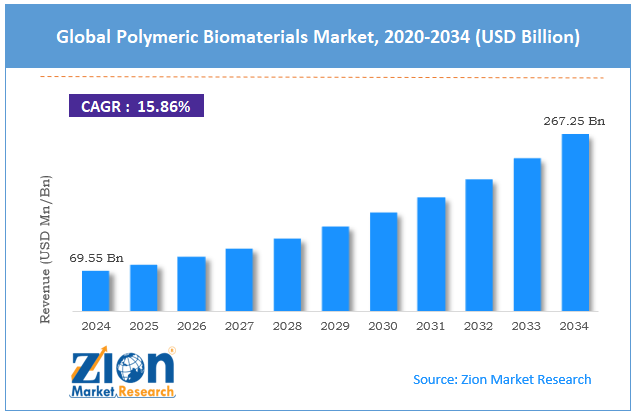
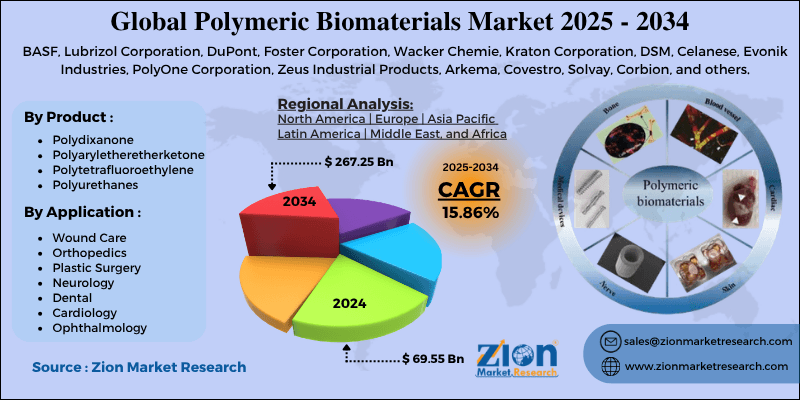
The global polymeric biomaterials market size was worth around USD 69.55 billion in 2024 and is predicted to grow to around USD 267.25 billion by 2034 with a compound annual growth rate (CAGR) of roughly 15.86% between 2025 and 2034.
Key Insights:
- As per the analysis shared by our research analyst, the global polymeric biomaterials market is estimated to grow annually at a CAGR of around 15.86% over the forecast period (2025-2034)
- In terms of revenue, the global polymeric biomaterials market size was valued at around USD 69.55 billion in 2024 and is projected to reach USD 267.25 billion by 2034.
- The market is projected to grow at a significant rate due to the growing focus on regenerative medicine.
- Based on the product, the polytetrafluoroethylene segment is projected to influence revenue in the market.
- Based on the application, the wound care segment is anticipated to command the largest market share.
- Based on region, the Asia-Pacific is projected to dominate the global market during the forecast period.
Polymeric Biomaterials Market: Overview
Polymeric biomaterials are transformative elements of modern healthcare. They are used in regenerative medicine, drug delivery, medical implants, and diagnostics. Polymeric biomaterials are synthetic or natural macromolecules designed to interact with biological elements. Key properties of polymeric biomaterials include biocompatibility and adjustable mechanical characteristics. Furthermore, polymeric biomaterials are environmentally safe as they degrade into harmless products. Some of the most popular polymeric biomaterials include chitosan, collagen, and polylactic-co-glycolic acid (PLGA). During the forecast period, demand for polymeric biomaterials is expected to be driven by growing demand for regenerative medicine. Advancements in drug delivery technology and the expansion of the healthcare sector will work in favor of the industry players. However, limited mechanical strength and a regulatory framework will challenge market growth during the forecast period.
Impact of the USA-Israel and Iran War on the Polymeric Biomaterials Market:
The USA-Israel and Iran war is projected to affect the raw material supply chain due to high volatility in the petrochemical feedstocks sector. In addition, a surge in transportation expenses will further impact profit margins in the polymeric biomaterials industry. In the long run, the war is projected to influence higher demand for bio-based materials and risk diversification by partnering with multiple stakeholders.
Polymeric Biomaterials Market: Dynamics
Growth Drivers
How will growing focus on regenerative medicine influence demand in the polymeric biomaterials market?
The global polymeric biomaterials market is expected to be led by the growing focus on regenerative medicine. This multidisciplinary field focuses on replacing, regenerating, and repairing human tissues, cells, and organs. Regenerative medicine has applications across the medical segment, including chronic disease management, cardiovascular diseases, and wound care. Polymeric biomaterials are the 3-dimensional framework required for cells to grow and form new tissues. Since they are biocompatible, the risk of infection or implantation failure is considerably reduced. Medical research suggests that the use of polymeric biomaterials can speed up the recovery process, further influencing market adoption trends. During the forecast period, the global regenerative medicine market is expected to grow at a CAGR of over 20%, driving polymeric biomaterials applications.
Higher prevalence of chronic medical conditions to support market growth in the coming years
According to market research, there is a significant increase in the number of patients suffering from chronic diseases and cardiovascular conditions. The most prominent forms of chronic diseases requiring polymeric biomaterials include orthopedic conditions, diabetes, and heart-related issues. More than 830 million worldwide suffer from diabetes, as per the latest projects by the World Health Organization (WHO). The global polymeric biomaterials market will witness higher growth with the higher prevalence of such conditions due to several lifestyle and environmental factors.
Restraints
Which factors will limit the expansion of the polymeric biomaterials industry in the coming years?
The global polymeric biomaterials industry is expected to be restricted due to limited mechanical strength. Compared to metals and other alternative solutions, polymeric biomaterials do not have excellent strength and durability. This limits their load-bearing capacity, thus restricting end applications. In addition, the presence of a strict regulatory environment governing the production and application of polymeric biomaterials will further limit market growth trends in the coming years.
Opportunities
Advancements reported in the industry are creating growth opportunities in the long run
The global polymeric biomaterials market is anticipated to experience growth opportunities due to technological and performance-based advancements. For instance, sustainable biomaterials are emerging as a prominent class of next-generation polymeric solutions. In March 2025, Evonik, a leading market player, announced the launch of high-performance medical-grade Polyether Ether Ketone (PEEK) polymer. It is designed for long-term implants as it offers superior mechanical strength and biocompatibility. The novel PEEK polymer is expected to have applications in spinal and orthopedic surgeries.
How will the expansion of the healthcare sector shape the polymeric biomaterials market during the forecast period?
Ongoing efforts by regional governments and healthcare agencies to expand medical care infrastructure will accelerate revenue in the polymeric biomaterials industry. The growing world population and mounting pressure on the existing healthcare infrastructure will encourage new investments to promote access to affordable and quality care. These expansion strategies will fuel significant demand for polymeric biomaterials as more patients undergo treatment for chronic and other conditions.
Challenges
Unpredictable degrading and high cost to challenge the industry growth trajectory during the forecast period
The global polymeric biomaterials industry will be challenged by the unpredictable degrading process, as there is significant uncertainty in terms of by-products formed in the body. It can create risks to patient safety, especially among people with a lack of effective care. Moreover, the high cost of research & development may further create barriers against market growth.
Polymeric Biomaterials Market: Report Scope
| Report Attributes | Report Details |
|---|---|
| Report Name | Polymeric Biomaterials Market |
| Market Size in 2024 | USD 69.55 Billion |
| Market Forecast in 2034 | USD 267.25 Billion |
| Growth Rate | CAGR of 15.86% |
| Number of Pages | 228 |
| Key Companies Covered | BASF, Lubrizol Corporation, DuPont, Foster Corporation, Wacker Chemie, Kraton Corporation, DSM, Celanese, Evonik Industries, PolyOne Corporation, Zeus Industrial Products, Arkema, Covestro, Solvay, Corbion, and others. |
| Segments Covered | By Product, By Application, and By Region |
| Regions Covered | North America, Europe, Asia Pacific (APAC), Latin America, Middle East, and Africa (MEA) |
| Base Year | 2024 |
| Historical Year | 2019 to 2023 |
| Forecast Year | 2025 - 2034 |
| Customization Scope | Avail customized purchase options to meet your exact research needs. Request For Customization |
Polymeric Biomaterials Market: Segmentation
The global polymeric biomaterials market is segmented based on product, application, and region.
Why will the polylactic acid segment lead the polymeric biomaterials revenue during the forecast period?
Based on product, the global market segments are polydixanone, polyaryletheretherketone, polytetrafluoroethylene, polyurethanes, polyglycolic acid, polylactic acid, and others. In 2024, polylactic acid emerged as the leading revenue generator, accounting for 28% of the global revenue. The polytetrafluoroethylene segment is expected to deliver a notable CAGR of 22% during the forecast period, driven by growing demand for high-performance materials and unique properties of polytetrafluoroethylene (PTFE).
Which will be the fastest-growing application during the forecast period in the polymeric biomaterials market?
Based on application, the global market divisions are wound care, orthopedics, plastic surgery, neurology, dental, cardiology, ophthalmology, and others. In 2024, the highest growth rate was listed in the orthopedics segment, accounting for 29% of the total market share. During the forecast period, the wound care segment is projected to grow at the fastest CAGR of 21% due to the higher prevalence of chronic conditions and increasing innovations in wound care solutions.
Polymeric Biomaterials Market: Regional Analysis
Why is North America the current leader in the polymeric biomaterials market?
The global polymeric biomaterials market is currently led by North America. In 2024, it contributed 39% of the global revenue and is anticipated to grow at 14.35% CAGR during the forecast period. The presence of a robust and highly advanced medical care infrastructure, along with biotechnology companies, will help fuel regional growth. In addition, rising regulatory approvals, growing medical tourism, and advancements in regenerative medicine will further propel market growth trends across North America.
How will the Asia-Pacific shape the polymeric biomaterials market during the projection period?
Asia-Pacific is set to emerge as the fastest-growing region in the polymeric biomaterials market during the forecast period with a CAGR of 21.01%. In 2024, it accounted for 25% of the industry revenue. The rising prevalence of heart conditions, growing geriatric population, and expansion of the regional healthcare sector will improve regional market revenue. In addition, ongoing advancements in the development of safer and biocompatible materials will boost the growth of polymeric biomaterials in the Asia-Pacific.
Polymeric Biomaterials Market: Competitive Analysis
The global polymeric biomaterials market is led by players like:
- BASF
- Lubrizol Corporation
- DuPont
- Foster Corporation
- Wacker Chemie
- Kraton Corporation
- DSM
- Celanese
- Evonik Industries
- PolyOne Corporation
- Zeus Industrial Products
- Arkema
- Covestro
- Solvay
- Corbion
What are the latest key trends in the polymeric biomaterials market?
Use of 3D printing technology
The growing integration of 3D printing technology in medical care has propelled the use of polymeric biomaterials. It allows the development of customized and complex tissue structures with ease.
Advancement in drug delivery systems
Polymeric biomaterials are used extensively in novel drug delivery systems such as long-acting injectables. It promotes better treatment of chronic conditions, thus helping the market thrive.
The global polymeric biomaterials market is segmented as follows:
By Product
- Polydixanone
- Polyaryletheretherketone
- Polytetrafluoroethylene
- Polyurethanes
- Polyglycolic Acid
- Polylactic Acid
- Others
By Application
- Wound Care
- Orthopedics
- Plastic Surgery
- Neurology
- Dental
- Cardiology
- Ophthalmology
- Others
By Region
- North America
- The U.S.
- Canada
- Mexico
- Europe
- France
- The UK
- Spain
- Germany
- Italy
- Rest of Europe
- Asia Pacific
- China
- Japan
- India
- Australia
- South Korea
- Rest of Asia Pacific
- The Middle East & Africa
- Saudi Arabia
- UAE
- Egypt
- Kuwait
- South Africa
- Rest of the Middle East & Africa
- Latin America
- Brazil
- Argentina
- Rest of Latin America
Table Of Content
Methodology
FrequentlyAsked Questions
Polymeric biomaterials are transformative elements of modern healthcare. They are used in regenerative medicine, drug delivery, medical implants, and diagnostics.
The global polymeric biomaterials market is expected to be led by the growing focus on regenerative medicine.
According to study, the global polymeric biomaterials market size was worth around USD 69.55 billion in 2024 and is predicted to grow to around USD 267.25 billion by 2034.
The CAGR value of polymeric biomaterials market is expected to be around 15.86% during 2025-2034.
The global polymeric biomaterials industry will be challenged by the unpredictable degrading process as there is significant uncertainty in terms of by-products formed in the body.
The competitive landscape in the polymeric biomaterials market is moderately fragmented with larger companies dominating and influencing the growth trends.
Market trends and consumer preferences are shifting toward sustainable and eco-friendly solutions.
Asia-Pacific will contribute notably towards the polymeric biomaterials market value.
The global polymeric biomaterials market is led by players like BASF, Lubrizol Corporation, DuPont, Foster Corporation, Wacker Chemie, Kraton Corporation, DSM, Celanese, Evonik Industries, PolyOne Corporation, Zeus Industrial Products, Arkema, Covestro, Solvay, and Corbion.
The report explores crucial aspects of the polymeric biomaterials market including detailed discussion of existing growth factors and restraints while also browsing future growth opportunities and challenges that impact the market.

HappyClients