
Polyclonal Antibody Market Size, Growth, Global Trends, Forecast 2034

Polyclonal Antibody Market By Product (Primary Antibodies and Secondary Antibodies), By Application (Biomedical Research and Diagnostics), By Source (Mouse, Sheep, Goats, Rabbits, and Others), By End-Use (Hospitals & Diagnostic Centers, Pharmaceutical & Biotechnology Companies, and Academic & Research Centers), and By Region - Global and Regional Industry Overview, Market Intelligence, Comprehensive Analysis, Historical Data, and Forecasts 2025 - 2034
| Market Size in 2024 | Market Forecast in 2034 | CAGR (in %) | Base Year |
|---|---|---|---|
| USD 1,560 Million | USD 2,440 Million | 5.01% | 2024 |
Polyclonal Antibody Industry Perspective
What is the anticipated size of the polyclonal antibody market during the projection period?
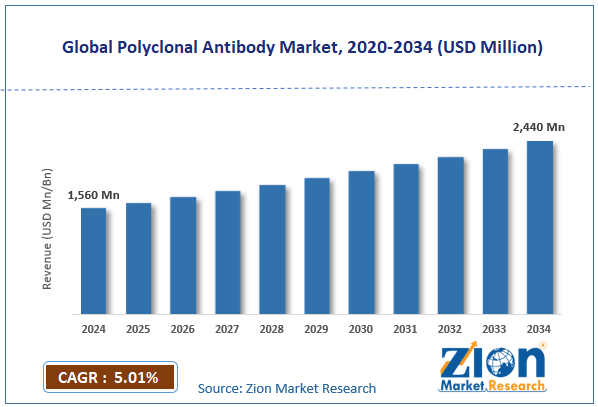
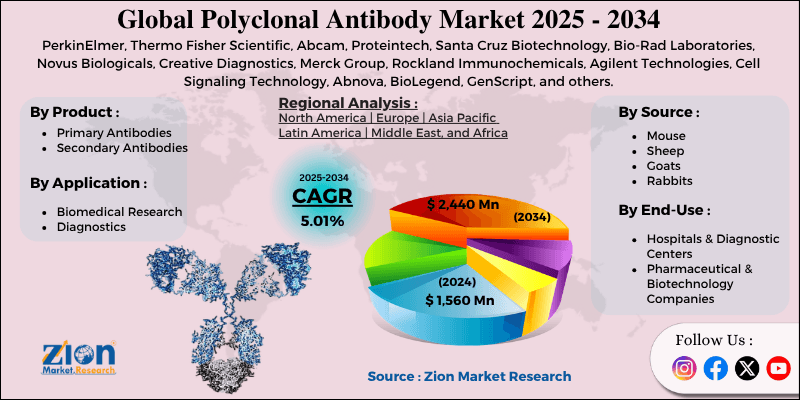
The global polyclonal antibody market size was worth around USD 1,560 million in 2024 and is predicted to grow to around USD 2,440 million by 2034 with a compound annual growth rate (CAGR) of roughly 5.01% between 2025 and 2034.
Key Insights:
- As per the analysis shared by our research analyst, the global polyclonal antibody market is estimated to grow annually at a CAGR of around 5.01% over the forecast period (2025-2034)
- In terms of revenue, the global polyclonal antibody market size was valued at around USD 1,560 million in 2024 and is projected to reach USD 2,440 million by 2034.
- The market is projected to grow at a significant rate due to the growing prevalence of blood disorders.
- Based on the product, the primary antibodies will dominate the global market as per industry projections,
- Based on the application, the diagnostics segment is anticipated to command the largest market share.
- Based on the source, the rabbits segment is expected to lead the market growth trends.
- Based on the end-use, the pharmaceutical & biotechnology segment is projected to influence revenue in the market.
- Based on region, the Asia-Pacific is projected to dominate the global market during the forecast period.
Polyclonal Antibody Market: Overview
Polyclonal antibodies come from different lineages of plasma B cells. Each polyclonal antibody attaches itself to or recognizes different parts or epitopes of the same antigen. According to market research, polyclonal antibodies are used extensively in laboratory tests and research. In addition, they have applications in treating certain types of blood disorders, digoxin overdose, and infectious disease outbreaks. Some of the prominent advantages driving investments in polyclonal antibodies are their inexpensive development and excellent detection capabilities.
However, concerns over quality inconsistency, risk of allergic reactions, and higher chances of cross-reactivity are expected to limit market expansion in the long run. The polyclonal antibody industry may benefit from the expansion of the healthcare infrastructure, the rising prevalence of infectious conditions, and increasing investments in medical research.
Impact of the USA-Israel and Iran War on the Polyclonal Antibody Market:
The ongoing war between the USA, Israel, and Iran is projected to disrupt global operations, thus creating volatility in the global polyclonal antibody market. The Strait of Hormuz is responsible for over 10% of global pharma trade, thus delaying international shipments containing raw materials. In the long run, the war is projected to influence the integration of new trade routes and the emergence of several strategic partnerships.
Polyclonal Antibody Market: Dynamics
Growth Drivers
How will the growing prevalence of blood disorders influence the expansion of the polyclonal antibody market?
The global polyclonal antibody market is expected to be driven by the growing prevalence of blood disorders. Some of the common blood-related diseases treated using polyclonal antibodies include aplastic anemia, graft-versus-host disease (GVHD), and immune thrombocytopenia (ITP). A large number of these blood disorders include autoimmune conditions such as hemolytic anemias. The growing world population, along with environmental and lifestyle factors, has contributed to an increase in patients suffering from these conditions, driving demand for more effective polyclonal antibodies. For instance, according to the National Institutes of Health (NIH), more than 60% to 70% of patients who undergo hematopoietic stem cell transplantation (HSCT) suffer from GVHD.
Expansion in diagnostic procedures to support market revenue in the long run
Polyclonal antibodies are actively preferred in diagnostic procedures, especially against infectious conditions. They are an integral element of rapid diagnostic kits and Enzyme-Linked Immunosorbent Assay (ELISA) procedures. The growing volume of timely and efficient diagnostic procedures and the expansion of medical laboratories will work in favor of the global polyclonal antibody market players.
Restraints
How will ethical concerns and batch-to-batch variability limit the expansion of the polyclonal antibody market?
The global polyclonal antibody industry is projected to be restricted due to concerns over batch-to-batch variability. Polyclonal antibodies are produced in living animals, which leads to inconsistency in batch quality. The inconsistency leads to limited applications of polyclonal antibodies in high-precision requirements. In addition, the production of polyclonal antibodies depends heavily on living animals such as rabbits. These issues raise concern over animal cruelty, leading to higher demand for animal-free solutions.
Opportunities
Personalized medicine to open new avenues for market growth during the forecast period
The global polyclonal antibodies market is anticipated to generate growth opportunities due to the rising demand for personalized medicine. This has resulted in a shift toward patient-centric therapies designed according to individual healthcare needs and immune response. The success of personalized medicine depends heavily on the efficiency of specific biomarkers, thus leading to increased demand for custom polyclonal antibodies.
How will digital technology integration influence the polyclonal antibody industry's growth?
The integration of advanced technologies such as Machine Learning (AI) and generative Artificial Intelligence (AI) during the development and production of polyclonal antibodies will further influence market growth trends during the forecast period. In April 2026, Amazon launched a new drug discovery platform called Amazon Bio Discovery (ABD). The tool is powered by AI and equipped with 40 AI biological foundation models to enhance the drug discovery process. Similar other advancements will help market players deliver improved revenue in the long run.
Challenges
Competition from monoclonal antibodies and high cost to challenge industry expansion
The global polyclonal antibodies industry is expected to be challenged by the competition it faces from monoclonal antibodies. The latter have higher specificity as compared to polyclonal antibodies, thus leading to reduced risk of false results and cross-reactivity. Additionally, high production and purification costs may further limit market adoption among end-users with limited budgets.
Polyclonal Antibody Market: Report Scope
| Report Attributes | Report Details |
|---|---|
| Report Name | Polyclonal Antibody Market |
| Market Size in 2024 | USD 1,560 Million |
| Market Forecast in 2034 | USD 2,440 Million |
| Growth Rate | CAGR of 5.01% |
| Number of Pages | 225 |
| Key Companies Covered | PerkinElmer, Thermo Fisher Scientific, Abcam, Proteintech, Santa Cruz Biotechnology, Bio-Rad Laboratories, Novus Biologicals, Creative Diagnostics, Merck Group, Rockland Immunochemicals, Agilent Technologies, Cell Signaling Technology, Abnova, BioLegend, GenScript, and others. |
| Segments Covered | By Product, By Application, By Source, By End-Use, and By Region |
| Regions Covered | North America, Europe, Asia Pacific (APAC), Latin America, Middle East, and Africa (MEA) |
| Base Year | 2024 |
| Historical Year | 2019 to 2023 |
| Forecast Year | 2025 - 2034 |
| Customization Scope | Avail customized purchase options to meet your exact research needs. Request For Customization |
Polyclonal Antibody Market: Segmentation
The global polyclonal antibody market is segmented based on product, application, source, end-use, and region.
Why will the primary antibodies segment lead the polyclonal antibody industry revenue during the forecast period?
Based on the product, the global market segments are primary antibodies and secondary antibodies. In 2024, the highest growth was reported in the secondary antibodies market, accounting for 56% of the total revenue. However, during the forecast period, primary antibodies are expected to grow at a faster CAGR of 6.56% due to their wider adoption in personalized medicine.
Which will be the fastest-growing application during the forecast period in the polyclonal antibody market?
Based on application, the global polyclonal antibody industry is divided into biomedical research and diagnostics. During the forecast period, diagnostics is projected to emerge as the fastest-growing segment at a CAGR of 7.15%. In 2024, the segment accounted for 41% of the global revenue. However, during the forecast period, it is projected to hold the majority of the final revenue driven by the expansion of diagnostic facilities worldwide.
Which factors drive demand in the rabbits segment in the polyclonal antibody industry?
Based on the source, the global market divisions are mice, sheep, goats, rabbits, and others. In 2024, rabbits dominated the source type, accounting for up to 46% of the total revenue. During the forecast period, rabbits will continue to remain a prominent segment, growing at a CAGR of 7.15%, since rabbits have a stronger immune response and better specificity as compared to other counterparts.
Which end-user industry will contribute notably to the polyclonal antibody market?
Based on end-use, the global market is fragmented into hospitals & diagnostic centers, pharmaceutical & biotechnology companies, and academic & research centers. In 2024, pharmaceutical & biotechnology companies emerged as the leading revenue generators, contributing up to 45.6% of the total revenue. During the forecast period, it is projected to deliver a CAGR of 7.12% as demand for novel therapies and drugs continues to grow exponentially.
Polyclonal Antibody Market: Regional Analysis
Why does North America contribute notably to the polyclonal antibody market?
The global polyclonal antibody market is currently led by North America. In 2024, the region contributed to 44.9% of the global revenue and will grow at a CAGR of 5.6% during the forecast period. North America is heavily dominated by the presence of leading biotechnology and pharmaceutical companies working extensively on drug discovery and new therapies. Moreover, ongoing public and private investments in healthcare will further help the region thrive.
What is the projected CAGR for Asia-Pacific in the polyclonal antibody market?
Asia-Pacific is expected to emerge as the fastest-growing region with a CAGR of 9.8%. In 2024, it accounted for 25% of the global revenue. Higher prevalence of chronic conditions, an aging population, and expansion of diagnostic centers will work in favor of the regional players. Moreover, rising government initiatives and policies supporting investments in the biotech industry and pharmaceutical sector will promote regional expansion in the coming years.
Polyclonal Antibody Market: Competitive Analysis
The global polyclonal antibody market is led by players like:
- PerkinElmer
- Thermo Fisher Scientific
- Abcam
- Proteintech
- Santa Cruz Biotechnology
- Bio-Rad Laboratories
- Novus Biologicals
- Creative Diagnostics
- Merck Group
- Rockland Immunochemicals
- Agilent Technologies
- Cell Signaling Technology
- Abnova
- BioLegend
- GenScript
What are the latest key trends in the polyclonal antibody market?
Growth in Contract Development and Manufacturing Organization (CDMO) industry
Expansion of the Contract Development and Manufacturing Organization (CDMO) industry is a promising market trend. It will allow companies to outsource drug discovery procedures and leverage the offerings of industry experts.
Production of animal-free polyclonal antibodies
Production of animal-free polyclonal antibodies will help companies manage concerns over animal cruelty. Effective synthetic alternatives will also promote sustainability and regulatory compliance.
The global polyclonal antibody market is segmented as follows:
By Product
- Primary Antibodies
- Secondary Antibodies
By Application
- Biomedical Research
- Diagnostics
By Source
- Mouse
- Sheep
- Goats
- Rabbits
- Others
By End-Use
- Hospitals & Diagnostic Centers
- Pharmaceutical & Biotechnology Companies
- Academic & Research Centers
By Region
- North America
- The U.S.
- Canada
- Mexico
- Europe
- France
- The UK
- Spain
- Germany
- Italy
- Rest of Europe
- Asia Pacific
- China
- Japan
- India
- Australia
- South Korea
- Rest of Asia Pacific
- The Middle East & Africa
- Saudi Arabia
- UAE
- Egypt
- Kuwait
- South Africa
- Rest of the Middle East & Africa
- Latin America
- Brazil
- Argentina
- Rest of Latin America
Table Of Content
Methodology
FrequentlyAsked Questions
Polyclonal antibodies come from different lineages of plasma B cells. Each polyclonal antibody attaches itself to or recognizes different parts or epitopes of the same antigen.
The global polyclonal antibody market is expected to be driven by the growing prevalence of blood disorders.
According to study, the global polyclonal antibody market size was worth around USD 1,560 million in 2024 and is predicted to grow to around USD 2,440 million by 2034.
The CAGR value of polyclonal antibody market is expected to be around 5.01% during 2025-2034.
The global polyclonal antibodies industry is expected to be challenged by the competition the industry faces from monoclonal antibodies.
Growth in the Contract Development and Manufacturing Organization (CDMO) industry and production of animal-free polyclonal antibodies are the emerging trends and innovations impacting the polyclonal antibody market.
The global polyclonal antibody market has performed well so far and will offer similar trends in the coming years.
Asia-Pacific will contribute notably towards the polyclonal antibody market value.
The global polyclonal antibody market is led by players like PerkinElmer, Thermo Fisher Scientific, Abcam, Proteintech, Santa Cruz Biotechnology, Bio-Rad Laboratories, Novus Biologicals, Creative Diagnostics, Merck Group, Rockland Immunochemicals, Agilent Technologies, Cell Signaling Technology, Abnova, BioLegend, and GenScript.
The report explores crucial aspects of the polyclonal antibody market including detailed discussion of existing growth factors and restraints while also browsing future growth opportunities and challenges that impact the market.

HappyClients

